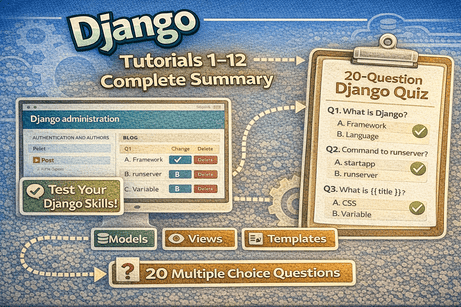
This series introduced you to Django step by step, starting from the basics and ending with building a functional data-driven application.
🔹 1. Introduction to Django
You learned what Django is and why it is powerful:
- high-level Python web framework
- follows MVT (Model–View–Template) architecture
- used to build scalable web apps (blogs, e-commerce, dashboards)
🔹 2. Development Environment Setup
You prepared your workspace:
- installed Python & Django
- created a virtual environment
- created your first Django project
- ran the development server
🔹 3. Project Structure
You understood Django’s architecture:
manage.py→ command toolsettings.py→ configurationurls.py→ routing- project vs app
🔹 4. Creating a Django App
You learned modular development:
- created an app with
startapp - registered it in
INSTALLED_APPS - understood app structure
🔹 5. URLs and Routing
You connected URLs to views:
- used
path()andinclude() - created dynamic URLs (
<int:id>) - used named URLs
🔹 6. Views Basics
You built application logic:
- created views (functions)
- returned responses (
HttpResponse,render) - handled requests
🔹 7. Templates Basics
You created dynamic HTML:
- used
{{ }}for variables {% %}for logic- loops, conditions
- template inheritance
🔹 8. Passing Data to Templates
You made pages dynamic:
- used context dictionary
- passed lists, dictionaries, objects
- displayed data with loops
🔹 9. Static Files
You improved UI:
- added CSS, JS, images
- used
{% load static %} - organized static folders
🔹 10. Models Introduction
You worked with databases:
- defined models (tables)
- used fields (
CharField,TextField, etc.) - used Django ORM instead of SQL
🔹 11. Database Migrations
You managed schema changes:
makemigrations→ create changesmigrate→ apply changes- version control for database
🔹 12. Django Admin Interface
You managed data easily:
- created superuser
- registered models
- customized admin (
list_display,search_fields)
🧠 Global Understanding
After Tutorials 1–12, you now understand:
👉 How Django builds a full web application
👉 How frontend (templates) connects with backend (views & models)
👉 How data flows from database → view → template
👉 How to manage everything via admin

💬 Comments
No comments yet. Be the first to comment!
Login to comment.