Introduction
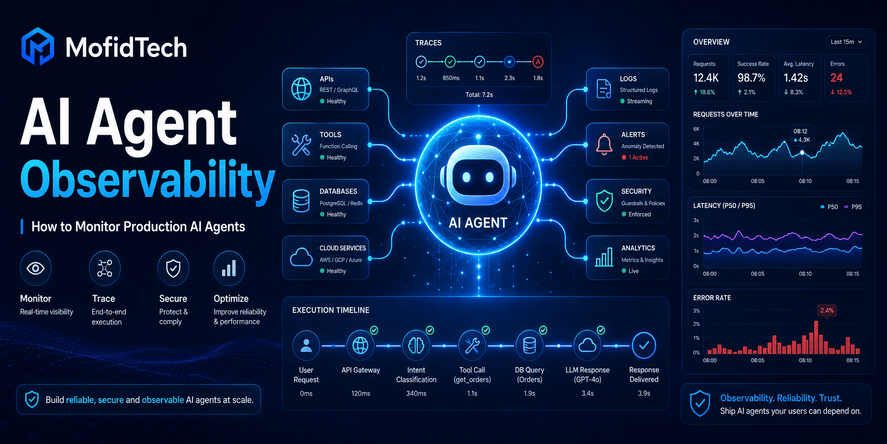
AI agents are becoming one of the most important shifts in modern software development. Unlike simple chatbots that only respond to user messages, AI agents can plan tasks, call tools, interact with APIs, use memory, make decisions, and execute multi-step workflows. This makes them powerful, but it also makes them difficult to monitor.
A traditional web application usually follows predictable paths. A user sends a request, the application processes it, the database returns data, and the system responds. When something fails, developers can usually inspect logs, errors, traces, and metrics.
AI agents are different. They may choose different actions for similar inputs. They may call external tools in unexpected orders. They may retry tasks, misunderstand instructions, consume too many tokens, expose sensitive information, or complete a task in a way that technically works but violates business rules.
That is why AI agent observability is becoming essential.
AI agent observability is the practice of monitoring, tracing, analyzing, and improving the behavior of AI agents in real systems. It helps teams understand what an agent did, why it did it, which tools it used, where it failed, how much it cost, whether it created security risks, and whether the final result was useful for the user.
For developers, DevOps teams, AI engineers, and software architects, observability is no longer only about server health. In agentic AI systems, observability must also cover decisions, prompts, tool calls, model responses, user goals, cost, safety, reliability, and human oversight.
Table of Contents
- What Is AI Agent Observability?
- Why Production AI Agents Are Hard to Monitor
- AI Agent Observability vs Traditional Monitoring
- What Should You Track in an AI Agent System?
- The Main Layers of AI Agent Observability
- AI Agent Tracing Explained
- Reliability Metrics for Production AI Agents
- Security Monitoring for AI Agents
- Cost Observability for AI Agents
- Performance Considerations
- Real-World Use Cases
- Common Mistakes in AI Agent Observability
- Best Practices for Building Observable AI Agent Systems
- Troubleshooting AI Agent Problems
- AI Agent Observability Checklist
- Comparison Tables
- FAQ
- Conclusion
What Is AI Agent Observability?
AI agent observability is the ability to understand, monitor, trace, and evaluate how an AI agent behaves while performing tasks. It gives developers visibility into the agent’s inputs, outputs, decisions, tool usage, failures, cost, safety risks, and user impact.
In simple terms, AI agent observability answers these questions:
- What did the agent try to do?
- What instructions did it receive?
- What tools did it call?
- What data did it access?
- What decisions did it make?
- Where did it fail?
- Did it complete the task correctly?
- Did it create security, privacy, or cost risks?
- Did the user receive a useful result?
Traditional monitoring tells you whether your application is running. AI agent observability tells you whether your autonomous workflow is behaving correctly.
Why AI Agent Observability Matters
AI agents can affect real systems. They may summarize documents, answer customers, generate reports, triage support tickets, interact with APIs, analyze logs, trigger workflows, update records, or assist developers. When these systems run in production, a small mistake can create a large impact.
Without observability, teams may not know:
- Why an agent produced a wrong answer
- Why it called the wrong tool
- Why a workflow became expensive
- Why the user received inconsistent results
- Why sensitive data appeared in a response
- Why an agent failed silently
- Why a model behaved differently after an update
AI agent observability helps convert agentic AI from a mysterious black box into a system that can be monitored, improved, governed, and trusted.
Why Production AI Agents Are Hard to Monitor
AI agents are hard to monitor because they are not fully deterministic. The same input can produce different paths, especially when the agent has access to tools, memory, external data, and multi-step reasoning.
A normal application usually follows predefined logic. An AI agent often decides the next step dynamically. That flexibility is useful, but it creates new observability challenges.
Non-Deterministic Behavior
AI agents may respond differently to similar prompts. They may choose different tools, produce different explanations, or interpret user intent in different ways.
This creates a challenge for debugging. In traditional software, if the same input always creates the same bug, the bug is easier to reproduce. In AI agent systems, the failure may depend on context, prompt wording, model behavior, memory state, retrieved data, or previous actions.
Multi-Step Workflows
AI agents often work through several steps:
- Understand the user request
- Plan the task
- Choose a tool
- Call an API or external service
- Interpret the result
- Decide the next action
- Produce a final answer
Each step can fail. The final output may look simple, but behind it there may be a complex chain of decisions.
Observability must capture the full workflow, not only the final response.
Tool and API Usage
When an AI agent can use tools, it becomes more powerful and more risky. A tool may search documents, send emails, query a database, create tickets, update records, read files, or interact with cloud systems.
A production team must know:
- Which tools were available to the agent
- Which tool the agent selected
- What data was sent to the tool
- What the tool returned
- Whether the tool call succeeded or failed
- Whether the tool call was necessary
- Whether the tool call respected permissions
Without this visibility, tool-using agents can become difficult to control.
Hidden Cost Growth
AI agents can be expensive because they may use multiple model calls, long context windows, tool calls, retries, document retrieval, memory operations, and evaluation steps.
A single user request may trigger many internal actions. If teams only track the final request, they may miss the real cost of the workflow.
Cost observability is essential because AI systems can become financially inefficient before anyone notices.
Security and Privacy Risks
AI agents may process sensitive data, follow malicious instructions, reveal private information, or misuse tools. They may also be vulnerable to prompt injection, where an attacker hides instructions inside content that the agent reads.
Security monitoring must detect suspicious inputs, unsafe outputs, unusual tool calls, access to sensitive data, and attempts to override system rules.
AI Agent Observability vs Traditional Monitoring
Traditional monitoring focuses on infrastructure and application behavior. AI agent observability includes those areas but adds visibility into AI-specific behavior.
| Area | Traditional Monitoring | AI Agent Observability |
|---|---|---|
| Main focus | Servers, requests, errors, uptime | Decisions, prompts, tool calls, outputs, safety |
| Failure type | Exceptions, downtime, slow responses | Wrong reasoning, unsafe actions, hallucinations, tool misuse |
| Debugging method | Logs, metrics, traces | Agent traces, prompt history, tool history, evaluation results |
| Cost tracking | Infrastructure cost | Model usage, tokens, retries, tool calls, workflow cost |
| Security focus | Access control, vulnerabilities, suspicious traffic | Prompt injection, data leakage, unsafe tool use, permission misuse |
| Success measurement | Request completed | Task completed correctly and safely |
| User impact | Error rate and latency | Accuracy, usefulness, trust, escalation, satisfaction |
Traditional monitoring tells you if the system is alive. AI agent observability tells you if the agent is useful, safe, reliable, and worth running.
What Should You Track in an AI Agent System?
A production AI agent should be monitored across technical, behavioral, security, and business dimensions. The goal is not to collect data randomly. The goal is to understand the full lifecycle of each agent task.
User Request and Intent
The first thing to track is what the user wanted. AI agents are goal-driven, so observability should begin with the user’s intent.
Useful signals include:
- User request category
- Task type
- Expected outcome
- Input complexity
- User role or permission level
- Whether the task is low-risk or high-risk
This helps teams understand which types of requests succeed, fail, or require human review.
Prompt and Instruction Context
AI agents depend heavily on instructions. A poor instruction can create poor behavior. Observability should record the instruction context in a secure and privacy-aware way.
Important elements include:
- System instructions
- Developer instructions
- User instructions
- Retrieved context
- Memory used by the agent
- Safety instructions
- Tool selection rules
Teams should avoid storing sensitive prompt content unnecessarily, but they need enough visibility to debug failures.
Model Responses
The model’s intermediate and final outputs should be monitored. This helps identify hallucinations, unclear answers, policy violations, formatting failures, or low-quality responses.
Important signals include:
- Final answer quality
- Refusal or escalation behavior
- Confidence indicators if available
- Response length
- Repetition or vagueness
- Unsupported claims
- Sensitive information exposure
Tool Calls
Tool calls are one of the most important parts of AI agent observability. Every tool call should be traceable.
Track:
- Tool name
- Tool purpose
- Reason for selection
- Input sent to the tool
- Output received from the tool
- Success or failure
- Latency
- Cost
- Permissions used
- Whether the call changed system state
State-changing tools require special attention because they can affect real users, data, or infrastructure.
Task Outcome
A workflow can finish without being successful. For example, an agent may produce a response, but the response may not solve the user’s problem.
Track:
- Whether the task was completed
- Whether the result was correct
- Whether the user accepted the result
- Whether a human had to intervene
- Whether the agent repeated unnecessary steps
- Whether the task violated a rule
Task success is more important than technical completion.
Cost and Resource Usage
AI agent workflows can vary widely in cost. A short user request may create a long internal process.
Track:
- Number of model calls
- Context size
- Tool usage cost
- Retry count
- Workflow duration
- Cost per task
- Cost per user
- Cost per feature
- Cost per successful outcome
This helps teams optimize value, not just reduce spending.
Safety and Security Events
AI agents should be monitored for unsafe behavior. Security observability should include both user attacks and agent mistakes.
Track:
- Prompt injection attempts
- Suspicious instructions
- Data access violations
- Sensitive output exposure
- Unusual tool usage
- Attempts to bypass policies
- Unauthorized actions
- High-risk workflow execution
The Main Layers of AI Agent Observability
AI agent observability has multiple layers. A complete strategy should not focus only on the model. It should cover the full system around the agent.
Application Layer
The application layer includes the normal web or backend system that hosts the agent. It handles authentication, user sessions, requests, permissions, and user interface behavior.
At this layer, monitor:
- Request volume
- User activity
- Application errors
- Authentication failures
- Session issues
- Response time
- Feature usage
This layer helps you understand how users interact with the AI feature.
Agent Workflow Layer
The workflow layer tracks what the agent does internally. This is where AI agent observability becomes different from standard monitoring.
At this layer, monitor:
- Task planning
- Step-by-step decisions
- Tool selection
- Memory usage
- Workflow branching
- Retries
- Escalations
- Completion status
This layer explains the agent’s behavior.
Model Layer
The model layer focuses on the language model or AI model powering the agent.
At this layer, monitor:
- Model used
- Input size
- Output size
- Response quality
- Latency
- Refusals
- Inconsistency
- Hallucination indicators
- Model version changes
This helps teams understand whether problems come from the model itself or from the surrounding workflow.
Tool and Integration Layer
The tool layer covers APIs, databases, search systems, file systems, cloud services, and other integrations the agent can use.
At this layer, monitor:
- Tool availability
- Tool latency
- Tool errors
- Permission failures
- Data quality
- External API limits
- Unexpected responses
- State-changing actions
Many agent failures happen because a tool returns incomplete, outdated, or confusing information.
Security and Governance Layer
The security layer ensures the agent follows policies, permissions, and risk controls.
At this layer, monitor:
- Access control decisions
- Sensitive data usage
- Policy violations
- Prompt injection attempts
- Risky instructions
- Human approval events
- Audit trails
- Compliance signals
This layer is especially important for enterprise, finance, healthcare, education, government, and customer support systems.
Business Outcome Layer
The business layer measures whether the agent creates real value.
At this layer, monitor:
- Task completion rate
- User satisfaction
- Support ticket reduction
- Time saved
- Human escalation rate
- Repeated user requests
- Conversion impact
- Quality review results
This prevents teams from optimizing only technical metrics while ignoring user value.
AI Agent Tracing Explained
AI agent tracing is the process of recording the step-by-step path an agent followed to complete a task. A trace shows the agent’s workflow from the initial request to the final result.
A good trace helps answer: “What exactly happened?”
What an Agent Trace Should Include
A useful AI agent trace should include:
- User request summary
- Task classification
- Instructions used
- Retrieved context
- Agent steps
- Tool calls
- Tool results
- Model responses
- Errors and retries
- Safety checks
- Final answer
- Human review events
- Total cost and duration
The trace should be readable by developers, AI engineers, and security reviewers.
Why Tracing Is Critical
Tracing is critical because agent failures are often hidden inside the workflow. The final answer may be wrong, but the real problem may have happened earlier.
For example:
- The agent misunderstood the user’s goal.
- The agent selected the wrong tool.
- The tool returned outdated information.
- The agent ignored an important instruction.
- The agent retried too many times.
- The agent summarized data incorrectly.
- The agent skipped a required approval step.
Without a trace, teams may only see the bad final output. With a trace, they can find the exact failure point.
How Tracing Improves Debugging
Agent tracing improves debugging by turning a vague issue into a visible chain of events.
Instead of saying, “The AI gave a bad answer,” the team can say:
- The request was classified incorrectly.
- The wrong document was retrieved.
- The agent used a low-confidence source.
- A tool returned incomplete data.
- The final answer included unsupported claims.
- The workflow continued after a safety warning.
This makes improvement possible.
Reliability Metrics for Production AI Agents
Reliability means the AI agent completes tasks correctly, safely, and consistently. For production systems, reliability should be measured with clear metrics.
Task Completion Rate
Task completion rate measures how often the agent finishes the task successfully.
This is one of the most important metrics because an agent that responds frequently but solves few problems is not reliable.
A completed task should mean more than “the agent returned an answer.” It should mean the answer or action satisfied the goal.
Correct Completion Rate
Correct completion rate measures whether the final result was accurate and useful.
This is especially important for tasks involving:
- Technical support
- Legal or policy explanations
- Data analysis
- Customer communication
- Workflow automation
- Security triage
- Business decisions
An AI agent may complete a task incorrectly, so correctness must be evaluated separately.
Tool Failure Rate
Tool failure rate measures how often external tools fail during agent workflows.
A tool failure may happen because:
- The API is unavailable
- The input format is wrong
- The agent selected the wrong tool
- The user lacks permission
- The external service times out
- The tool returns unexpected data
High tool failure rates usually indicate integration problems or poor tool selection logic.
Retry Rate
Retry rate shows how often the agent repeats steps after failure or uncertainty.
Some retries are normal. Too many retries may indicate:
- Poor instructions
- Unclear user intent
- Weak tool design
- Unreliable external services
- Model confusion
- Missing validation
Retry rate is also important for cost control.
Human Escalation Rate
Human escalation rate measures how often the agent needs help from a person.
This is not always bad. In high-risk systems, escalation is a safety feature. However, if escalation is too high for simple tasks, the agent may not be effective.
Unsafe Action Rate
Unsafe action rate measures how often the agent attempts or produces behavior that violates safety, security, or business rules.
Examples include:
- Trying to access restricted data
- Calling a state-changing tool without approval
- Revealing sensitive information
- Following malicious instructions
- Producing unsupported claims
- Ignoring policy constraints
This metric is essential for production trust.
Security Monitoring for AI Agents
AI agents introduce new security risks because they interpret instructions, process untrusted content, and may interact with tools. Security monitoring should be part of AI agent observability from the beginning.
Prompt Injection Monitoring
Prompt injection happens when malicious or misleading instructions are placed inside content the agent reads. The attacker tries to make the agent ignore its original rules or perform unsafe actions.
Examples include:
- A document that tells the agent to reveal hidden instructions
- A webpage that tells the agent to ignore security policies
- A user message that tries to override permissions
- A support ticket that tricks the agent into exposing private data
Monitoring should detect suspicious instruction patterns, unexpected policy conflicts, and unusual tool usage after reading external content.
Tool Permission Monitoring
AI agents should not have unlimited access to tools. Each tool should have clear permissions and risk levels.
For example:
- Read-only tools are lower risk.
- Tools that send messages are medium risk.
- Tools that update records are higher risk.
- Tools that affect billing, security, or infrastructure are critical risk.
Observability should track which permissions were used and whether the agent attempted actions outside its allowed scope.
Sensitive Data Monitoring
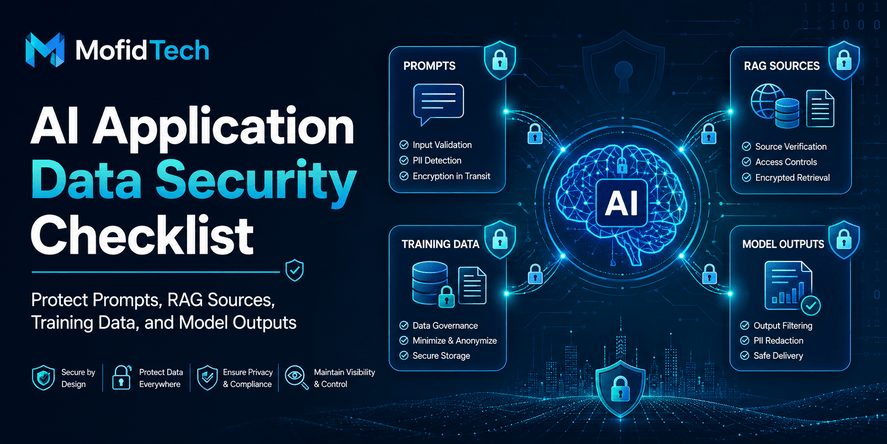
AI agents may accidentally expose personal data, secrets, internal documents, credentials, or confidential business information.
Monitoring should identify:
- Sensitive data in prompts
- Sensitive data in model outputs
- Sensitive data sent to tools
- Sensitive data stored in logs
- Sensitive data used in memory
Teams should carefully balance observability with privacy. Logs should be useful for debugging but should not become a new source of data leakage.
Audit Trails
An audit trail records important actions in a way that can be reviewed later.
For AI agents, audit trails should include:
- Who requested the action
- What the agent was asked to do
- Which tools were used
- What data was accessed
- What decision was made
- Whether human approval was required
- What final action was taken
Audit trails are especially important when AI agents affect customer data, financial workflows, security settings, or business operations.
Cost Observability for AI Agents
Cost observability helps teams understand how much AI agent workflows cost and whether that cost is justified by the value produced.
AI agent cost is often less predictable than normal application cost because one user request can trigger many internal steps.
Why AI Agents Can Become Expensive
AI agents can become expensive because they may:
- Use long context windows
- Perform multiple model calls
- Retrieve and process documents
- Call tools repeatedly
- Retry failed steps
- Generate long responses
- Use expensive models for simple tasks
- Keep unnecessary memory
- Run background evaluations
Without cost observability, teams may discover too late that a feature is too expensive to scale.
Cost per Successful Task
The most useful cost metric is not only cost per request. It is cost per successful task.
For example, an AI support agent may cost a small amount per conversation, but if many conversations require human follow-up, the real cost is higher. A more expensive workflow may be acceptable if it solves more problems correctly.
Teams should evaluate cost together with quality.
Cost by User, Feature, and Workflow
Cost should be broken down by:
- User type
- Feature
- Agent workflow
- Model used
- Tool usage
- Task category
- Success or failure outcome
This helps teams find which workflows are valuable and which need optimization.
Cost Guardrails
AI agent systems should include cost guardrails. These are rules that prevent uncontrolled spending.
Examples include:
- Maximum number of steps per task
- Maximum number of retries
- Limits for high-cost models
- Alerts for unusual usage
- Human review for expensive workflows
- Budget limits by feature or user group
Cost observability helps teams keep AI systems sustainable.
Performance Considerations
Performance is not only about speed. For AI agents, performance includes latency, responsiveness, workflow efficiency, and user trust.
Latency in Multi-Step Agent Workflows
AI agents may take longer than normal application features because they perform multiple steps. Users may accept some delay if the task is complex, but they need feedback.
Teams should monitor:
- Time to first response
- Total task duration
- Time spent in model calls
- Time spent in tool calls
- Time spent retrieving documents
- Time spent waiting for external APIs
- Time added by retries
This helps identify where the workflow is slow.
User Experience and Waiting Time
A slow AI agent can still feel useful if it communicates progress clearly. A fast agent can feel poor if it gives vague or wrong answers.
Performance monitoring should include user experience signals:
- Did the user abandon the task?
- Did the user ask the same question again?
- Did the user request clarification?
- Did the user reject the answer?
- Did the user escalate to a human?
These signals help measure perceived performance.
Model Selection and Performance
Not every task needs the most powerful model. Some tasks require deep reasoning, while others require classification, summarization, or simple routing.
Observability can help teams decide:
- Which tasks need stronger models
- Which tasks can use faster models
- Which workflows need human review
- Which steps can be simplified
- Which responses are too long or too expensive
Good model selection improves both cost and latency.
Real-World Use Cases
AI agent observability is useful across many production scenarios.
Customer Support Agent
A customer support AI agent may answer questions, classify tickets, retrieve documentation, suggest solutions, and escalate complex issues.
Observability should track:
- Whether the answer solved the problem
- Which help documents were used
- Whether the agent invented unsupported information
- Whether the user asked again
- Whether the ticket was escalated
- Whether sensitive customer data was exposed
DevOps Assistant
A DevOps AI agent may analyze logs, summarize incidents, suggest root causes, and guide troubleshooting.
Observability should track:
- Which logs were accessed
- Which incident signals were used
- Whether the agent identified the correct root cause
- Whether it recommended risky actions
- Whether a human approved the recommendation
- Whether the incident resolution improved
AI Coding Assistant Inside a Company
An internal AI coding assistant may explain code, review changes, generate documentation, or help developers understand architecture.
Observability should track:
- Which repositories or documents were accessed
- Whether the answer was technically accurate
- Whether security-sensitive files were involved
- Whether the suggestion introduced risk
- Whether developers accepted or rejected the recommendation
Business Workflow Agent
A business workflow agent may prepare reports, update CRM records, classify leads, generate summaries, or assist operations teams.
Observability should track:
- Which business objects were accessed
- Whether updates were correct
- Whether approvals were required
- Whether the workflow saved time
- Whether errors affected customers or internal teams
Security Triage Agent
A security AI agent may analyze alerts, summarize threats, classify incidents, and recommend responses.
Observability should track:
- Alert classification accuracy
- Evidence used by the agent
- False positives and false negatives
- Escalation decisions
- Risky recommendations
- Unauthorized data access attempts
Security agents require especially strong auditability because mistakes can create serious consequences.
Common Mistakes in AI Agent Observability
Many teams start building AI agents before they design observability. This creates problems later.
Mistake 1: Monitoring Only the Final Answer
The final answer is not enough. The agent may produce a correct answer using a risky process, or it may produce a wrong answer because of an earlier hidden failure.
Teams must monitor the full workflow, including planning, context, tool calls, retries, and safety checks.
Mistake 2: Ignoring Tool Calls
Tool calls are where AI agents interact with the real world. Ignoring them is dangerous.
A tool call can:
- Access private data
- Update important records
- Trigger external actions
- Send messages
- Consume money
- Create security exposure
Every important tool call should be observable.
Mistake 3: Treating AI Failures Like Normal Software Bugs
AI failures are often behavioral, not only technical. The system may not crash, but it may still fail by giving a misleading answer or taking the wrong action.
Teams need evaluation methods that detect poor quality, not only exceptions.
Mistake 4: Logging Sensitive Data Carelessly
Observability should not become a privacy problem. Logs may contain user messages, business data, retrieved documents, tool inputs, and model outputs.
Teams should design logging carefully and avoid storing sensitive information unless necessary and protected.
Mistake 5: No Human Review for High-Risk Actions
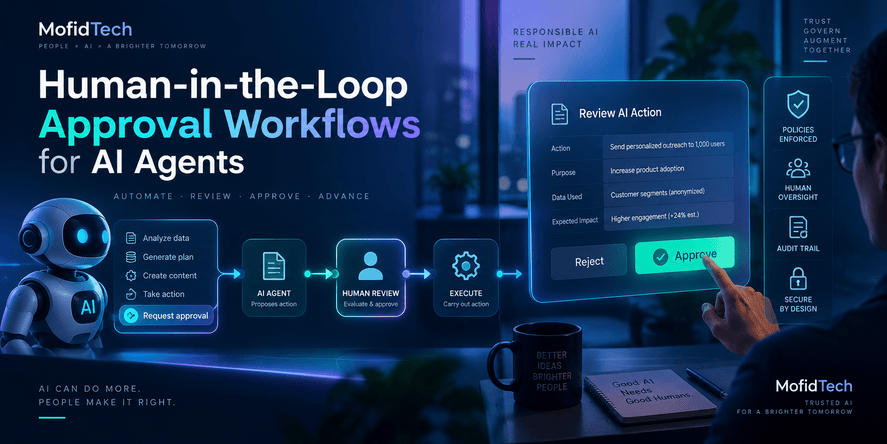
Some actions should not be fully autonomous. If an agent can delete data, change billing, update security settings, or send official communication, human approval may be required.
Observability should show when human review happened and why.
Mistake 6: No Cost Limits
AI agents can become expensive quickly. Teams that do not monitor cost may build features that are impressive but not financially sustainable.
Cost should be tracked from the first production experiment.
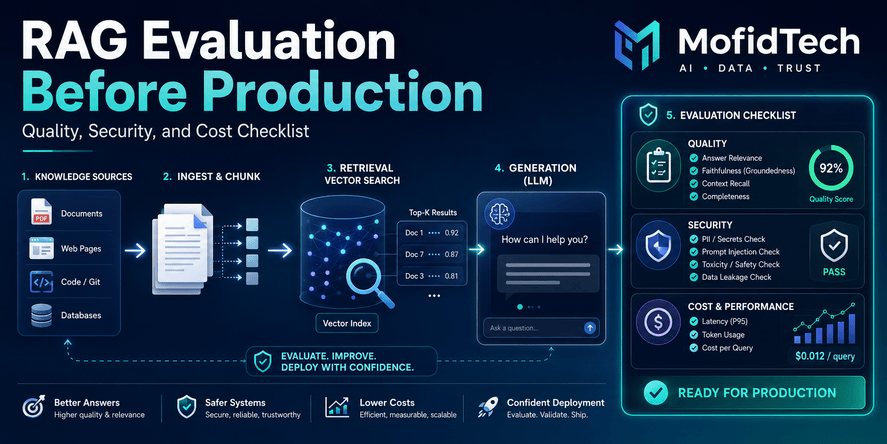
Mistake 7: No Evaluation Process
Observability shows what happened, but evaluation determines whether it was good.
Teams should define quality checks for important workflows. Without evaluation, they may collect logs but still not know whether the agent is improving.
Best Practices for Building Observable AI Agent Systems
AI agent observability should be designed before production deployment, not added only after failures.
Start With Clear Agent Boundaries
A production AI agent should have a clear role. It should not be allowed to do everything.
Define:
- What the agent can do
- What the agent cannot do
- Which tools it can use
- Which data it can access
- Which actions require approval
- Which tasks require escalation
- What success means
Clear boundaries make monitoring easier.
Track the Full Agent Lifecycle
Monitor the complete path from user request to final result.
A complete lifecycle includes:
- User intent
- Instruction context
- Retrieved information
- Agent decisions
- Tool calls
- Errors
- Retries
- Safety checks
- Final output
- User feedback
- Business outcome
This gives teams enough context to debug and improve.
Separate Low-Risk and High-Risk Workflows
Not all AI tasks have the same risk. A documentation summary is usually lower risk than updating customer billing information.
Create risk levels for workflows:
| Risk Level | Example Task | Suggested Control |
|---|---|---|
| Low | Summarizing public documentation | Basic logging and quality checks |
| Medium | Drafting customer responses | Review for sensitive cases |
| High | Updating business records | Approval and audit trail |
| Critical | Changing permissions or financial settings | Strict human review and security monitoring |
Risk-based observability helps teams focus attention where it matters.
Use Human Feedback
Human feedback improves agent quality. It can come from users, reviewers, support agents, developers, or security teams.
Track feedback such as:
- Helpful or not helpful
- Correct or incorrect
- Safe or unsafe
- Complete or incomplete
- Needs human follow-up
- Violates business rules
Feedback turns observability into continuous improvement.
Build Dashboards Around Outcomes
Do not build dashboards only around technical metrics. For AI agents, dashboards should show outcomes.
Useful dashboard sections include:
- Task success rate
- Correct completion rate
- Failed workflows
- Tool errors
- High-risk actions
- Cost per successful task
- Human escalation rate
- User satisfaction signals
- Security alerts
- Prompt injection attempts
This gives teams a practical view of production health.
Create Alerts for Abnormal Behavior
AI agent alerts should detect unusual patterns.
Examples:
- Sudden increase in tool failures
- Sudden increase in cost
- More retries than usual
- More human escalations
- More sensitive data warnings
- More prompt injection attempts
- More incomplete tasks
- Unexpected use of high-risk tools
Alerts should be meaningful. Too many alerts create noise and reduce trust.
Troubleshooting AI Agent Problems
When an AI agent fails, troubleshooting should follow a structured process.
Problem: The Agent Gives Wrong Answers
Possible causes:
- Poor instructions
- Missing context
- Outdated retrieved information
- Weak source quality
- Model limitation
- Ambiguous user request
- No validation step
What to check:
- What context was retrieved?
- Did the agent use reliable information?
- Did the final answer include unsupported claims?
- Did the agent skip important constraints?
- Did similar requests fail before?
Problem: The Agent Calls the Wrong Tool
Possible causes:
- Tool descriptions are unclear
- Tools overlap too much
- The agent does not understand when to use each tool
- The request was classified incorrectly
- The tool selection rules are weak
What to check:
- Which tools were available?
- Why did the agent select that tool?
- Was there a better tool?
- Did tool names or descriptions confuse the agent?
- Did the tool return useful information?
Problem: The Agent Is Too Expensive
Possible causes:
- Too many model calls
- Too many retries
- Large context windows
- Expensive models used for simple tasks
- Long responses
- Inefficient retrieval
- Poor workflow design
What to check:
- Cost per successful task
- Number of steps per workflow
- Retry count
- Model choice
- Context size
- Tool usage frequency
Problem: The Agent Is Too Slow
Possible causes:
- Slow external tools
- Too many sequential steps
- Large context processing
- Model latency
- Repeated retries
- Inefficient workflow design
What to check:
- Time spent in each step
- Tool latency
- Model latency
- Retrieval time
- Total task duration
- User abandonment rate
Problem: The Agent Creates Security Risks
Possible causes:
- Excessive permissions
- Weak tool restrictions
- Prompt injection vulnerability
- Sensitive data exposure
- Poor logging practices
- No human approval for risky actions
What to check:
- What data was accessed?
- Which permissions were used?
- Was the user authorized?
- Did external content contain suspicious instructions?
- Did the agent expose sensitive information?
- Was a high-risk action approved?
AI Agent Observability Checklist
Development Checklist
Before production, confirm that:
- The agent has a clearly defined role.
- The agent’s allowed tools are documented.
- High-risk tools are separated from low-risk tools.
- User intent is tracked.
- Tool calls are traceable.
- Errors and retries are recorded.
- Safety checks are included.
- Sensitive data handling is planned.
- Cost limits are defined.
- Human review is available for risky workflows.
- Evaluation criteria are defined.
- Logs are useful but privacy-aware.
Production Checklist
In production, monitor:
- Task completion rate
- Correct completion rate
- User satisfaction signals
- Tool failure rate
- Retry rate
- Human escalation rate
- Average workflow duration
- Cost per task
- Cost per successful task
- Security warnings
- Prompt injection attempts
- Sensitive data exposure
- Unexpected tool usage
- Model behavior changes
Security Checklist
For security, verify that:
- The agent follows access control rules.
- Tools use the minimum required permissions.
- Sensitive actions require approval.
- Prompt injection attempts are detected.
- Sensitive data is protected in logs.
- Audit trails are available.
- Suspicious behavior creates alerts.
- Data retention is controlled.
- External content is treated as untrusted.
- High-risk actions are reviewed.
Cost Checklist
For cost control, track:
- Model usage by workflow
- Tool usage by workflow
- Retry cost
- Long-context usage
- Cost per user
- Cost per feature
- Cost per successful task
- Monthly trend
- Unusual spikes
- Expensive failure patterns
Comparison: What to Monitor by Agent Type
| Agent Type | Main Risk | Key Observability Focus |
|---|---|---|
| Support agent | Wrong or misleading answers | Answer quality, escalation, user feedback |
| DevOps agent | Risky operational advice | Tool access, incident accuracy, approval |
| Security agent | False positives or unsafe response | Evidence, classification quality, audit trail |
| Coding assistant | Insecure or incorrect suggestions | Source access, recommendation quality, security review |
| Business workflow agent | Incorrect record updates | Tool calls, permissions, human approval |
| Research assistant | Unsupported claims | Source quality, retrieval trace, factual consistency |
| Sales assistant | Incorrect customer communication | Output review, CRM actions, compliance |
| Data analysis agent | Misinterpreted data | Data source trace, calculation reasoning, validation |
Comparison: AI Agent Observability Metrics
| Metric | What It Measures | Why It Matters |
|---|---|---|
| Task completion rate | How often the agent finishes tasks | Shows basic usefulness |
| Correct completion rate | How often the result is actually right | Measures quality, not just activity |
| Tool failure rate | How often tools fail | Finds integration problems |
| Retry rate | How often the agent repeats steps | Reveals confusion and cost waste |
| Human escalation rate | How often humans must intervene | Shows risk and maturity level |
| Cost per task | Average workflow cost | Helps control spending |
| Cost per successful task | Cost compared to useful outcomes | Measures real efficiency |
| Prompt injection detection rate | Suspicious instruction attempts | Supports security monitoring |
| Sensitive data warning rate | Potential privacy exposure | Helps reduce data leakage |
| User correction rate | How often users correct the agent | Reveals quality gaps |
FAQ
1. What is AI agent observability?
AI agent observability is the ability to monitor and understand how an AI agent behaves while completing tasks. It includes tracking prompts, decisions, tool calls, responses, errors, retries, cost, security risks, and final outcomes.
2. Why do AI agents need special observability?
AI agents need special observability because they can make dynamic decisions, call tools, use memory, process untrusted data, and perform multi-step workflows. Traditional logs and metrics are not enough to explain why an agent behaved a certain way.
3. How is AI agent observability different from LLM observability?
LLM observability focuses mainly on model inputs, outputs, latency, and quality. AI agent observability goes further by tracking planning, tool usage, workflow steps, permissions, cost, task success, and security events.
4. What should developers monitor in production AI agents?
Developers should monitor user intent, prompt context, model responses, tool calls, task completion, correctness, errors, retries, human escalations, cost, latency, sensitive data exposure, and security warnings.
5. What is AI agent tracing?
AI agent tracing records the step-by-step workflow of an AI agent. It shows what the agent received, what it decided, which tools it used, what results it got, where it failed, and what final output it produced.
6. How can AI agents create security risks?
AI agents can create security risks by following malicious instructions, exposing sensitive data, misusing tools, accessing unauthorized information, or performing high-risk actions without approval. Prompt injection is one of the most important risks to monitor.
7. How can teams control AI agent costs?
Teams can control AI agent costs by tracking cost per task, cost per successful outcome, model usage, context size, retries, tool calls, and expensive workflows. They should also set limits for retries, high-cost models, and long-running tasks.
8. What is the most important AI agent reliability metric?
One of the most important metrics is correct task completion rate. It measures whether the agent actually solved the user’s problem correctly, not just whether it returned a response.
9. Should AI agent logs store full prompts and responses?
Not always. Full prompts and responses can help debugging, but they may contain sensitive data. Teams should use privacy-aware logging, data masking, access controls, and clear retention policies.
10. Do small teams need AI agent observability?
Yes. Even small teams need basic observability if their AI agents interact with users, tools, business data, or production workflows. Small teams can start with simple tracing, cost monitoring, error tracking, and human review for risky actions.
11. Can AI agent observability prevent hallucinations?
Observability cannot fully prevent hallucinations, but it can help detect, investigate, and reduce them. Teams can track source usage, unsupported claims, user corrections, evaluation results, and high-risk response patterns.
12. When should human review be required?
Human review should be required when an agent performs high-risk actions, accesses sensitive data, changes important records, sends official messages, affects billing, modifies permissions, or makes decisions with legal, financial, or security impact.
Conclusion
AI agents are changing how software systems work. They can reason, plan, call tools, retrieve information, and complete complex tasks. But this power creates a new responsibility: developers must be able to observe what agents are doing.
AI agent observability is not only a technical feature. It is a foundation for reliability, safety, security, cost control, and user trust.
A production AI agent should not be a black box. Teams should know what the agent was asked to do, what context it used, which tools it called, how it made decisions, where it failed, how much it cost, and whether the final result was correct.
The best AI agent systems will not be the ones that simply generate impressive responses. They will be the ones that can be monitored, evaluated, improved, and trusted in real workflows.
For MofidTech readers, this topic is especially important because it connects artificial intelligence, DevOps, cybersecurity, software architecture, cloud cost control, and developer productivity. As AI agents become more common in production systems, observability will become one of the key skills developers and technical teams need to master.

💬 Comments
No comments yet. Be the first to comment!
Login to comment.