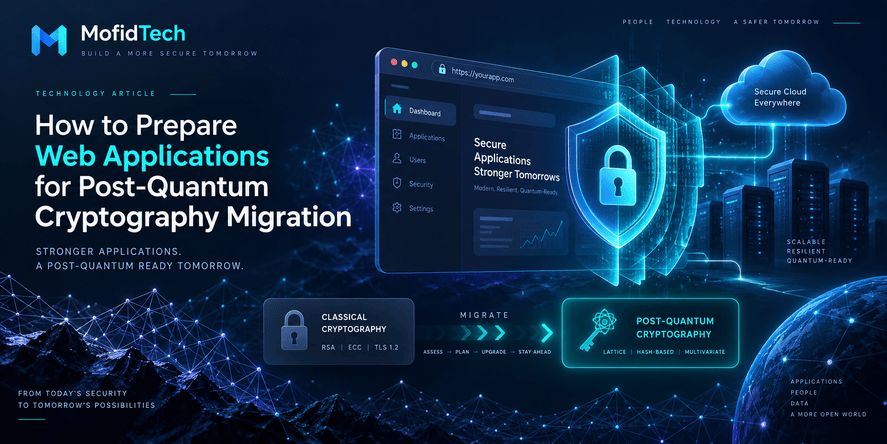
Post-quantum cryptography is no longer only a concern for cryptographers, national-security teams, or quantum-computing researchers. It is becoming a practical architecture and lifecycle issue for web developers, platform teams, security engineers, and organizations that depend on public-key cryptography for secure communication, digital signatures, certificates, software updates, identity, and trusted infrastructure.
The reason is simple: many of the public-key algorithms that protect today’s Internet are designed around mathematical problems that a sufficiently capable quantum computer could solve far more efficiently than a classical computer. No one can state with certainty when a cryptographically relevant quantum computer will arrive, but migration cannot begin on the day that it does. Large systems take years to inventory, modernize, test, coordinate with vendors, and roll out safely.
For web applications, the most useful question is therefore not “When will quantum computers break encryption?” It is “What can we do now to reduce future cryptographic risk without destabilizing systems that already work?” The answer is a staged migration centered on visibility, prioritization, crypto agility, standards-based hybrid deployment, compatibility testing, and vendor coordination.
This guide explains that migration from a developer and web-architecture perspective. It deliberately avoids implementation snippets. The goal is to help teams understand the decisions, dependencies, risks, and workflows that matter before they change cryptographic components in production.
| Short answer: Web teams should not replace cryptography ad hoc. Start by inventorying where public-key cryptography is used, identify data and trust relationships that need long-term protection, modernize toward TLS 1.3 and supported platforms, design for crypto agility, evaluate vendor PQC support, test hybrid post-quantum mechanisms in controlled environments, and roll out in phases with rollback and observability. |
Table of Contents
- 1. What post-quantum cryptography means for web applications
- 2. Why developers should prepare before a cryptographically relevant quantum computer exists
- 3. The standards and ecosystem status in 2026
- 4. Which parts of a web architecture are affected
- 5. Step 1: Build a cryptographic inventory
- 6. Step 2: Prioritize data and systems by quantum risk
- 7. Step 3: Improve crypto agility before changing algorithms
- 8. Step 4: Modernize transport security and understand hybrid TLS
- 9. Step 5: Plan certificates, signatures, and identity migration
- 10. Step 6: Evaluate libraries, platforms, cloud services, and vendors
- 11. Step 7: Test interoperability, performance, and operational behavior
- 12. Step 8: Roll out gradually and prevent regression
- 13. Architecture patterns for a safer migration
- 14. Performance and reliability considerations
- 15. Security risks and common mistakes
- 16. Practical migration roadmap by organization maturity
- 17. Troubleshooting and diagnostic logic
- 18. Migration checklist
- 19. Frequently asked questions
- 20. Conclusion
1. What Post-Quantum Cryptography Means for Web Applications
Post-quantum cryptography, usually abbreviated PQC, refers to cryptographic algorithms designed to remain secure against attacks from both conventional computers and future quantum computers. The important distinction for web teams is that PQC is still ordinary software cryptography. It does not require a quantum computer to deploy, and it can be integrated into existing network protocols, libraries, operating systems, cloud services, and application platforms.
Public-key cryptography is the main migration target
Quantum risk is especially important for widely used public-key techniques such as RSA and elliptic-curve cryptography. These technologies support key establishment, certificates, digital signatures, identity, software signing, and many trust relationships in modern systems. Symmetric encryption and secure hash functions are affected differently and are not generally replaced in the same way. That difference matters because a PQC migration should focus effort where quantum risk is structurally highest rather than treating every cryptographic component as equally urgent.
PQC is not the same as quantum key distribution
Post-quantum cryptography is often confused with quantum networking or quantum key distribution. For most web applications, the migration path being standardized today is software-based PQC that fits into familiar Internet and enterprise protocols. This makes the problem closer to a major cryptographic platform migration than to a complete reinvention of networking.
The two major protection goals
| Goal | What it protects | Why it matters |
| Post-quantum key establishment | Confidentiality of session keys and encrypted traffic | Helps protect recorded encrypted traffic from future decryption if an adversary later gains powerful quantum capability. |
| Post-quantum digital signatures | Authentication, integrity, certificates, signed software, and trust assertions | Helps prevent future quantum-capable attackers from forging signatures or impersonating trusted systems. |
2. Why Developers Should Prepare Before a Quantum Computer Exists
The migration time is part of the risk
A cryptographic transition touches far more than a single encryption setting. It can involve browsers, mobile applications, operating systems, reverse proxies, load balancers, API gateways, service meshes, certificate authorities, hardware security modules, cloud services, identity systems, VPNs, monitoring systems, third-party SDKs, embedded devices, and external partners. Even when the new algorithms are available, the slowest dependency can determine when end-to-end protection becomes practical.
Harvest now, decrypt later changes the timeline
For data that must remain confidential for many years, waiting for a quantum computer may already be too late. An adversary can collect encrypted traffic today and store it for future analysis. If that traffic was protected using quantum-vulnerable key establishment, a future breakthrough could expose information whose confidentiality period has not yet expired. This is commonly called a harvest-now-decrypt-later risk.
Long-lived systems amplify migration difficulty
Some web applications can be updated quickly. Others depend on appliances, old operating systems, pinned libraries, proprietary middleware, regulated certificate infrastructure, branch networks, industrial devices, or customer-controlled clients. Systems with long replacement cycles need earlier planning precisely because they are harder to change.
The right goal is readiness, not panic
Teams should avoid sensational deadlines and speculative “Q-Day” claims. The practical objective is to eliminate avoidable migration blockers, gain visibility into cryptographic dependencies, reduce the lifetime of legacy technology, and deploy standardized PQC where the ecosystem is sufficiently mature. A measured transition is safer than either ignoring the problem or rushing experimental cryptography into production.
3. Standards and Ecosystem Status in 2026
The standards landscape is materially different from only a few years ago. NIST finalized its first three post-quantum standards in 2024: ML-KEM for key establishment, ML-DSA for digital signatures, and SLH-DSA as a stateless hash-based digital signature standard. NIST now explicitly says organizations should begin migration to quantum-resistant cryptography.
A major TLS milestone arrived in August 2026
The IETF published RFC 10024 in August 2026. It defines hybrid post-quantum/traditional key agreement mechanisms for TLS 1.3 that combine ML-KEM with established elliptic-curve key exchange. This is especially relevant to web teams because TLS is the security layer behind HTTPS and many service-to-service connections.
Large providers are moving on different but converging timelines
Google announced a 2029 timeline for its post-quantum migration. Cloudflare is also targeting 2029 for full post-quantum security across its product suite, including authentication. AWS is rolling out ML-KEM and ML-DSA support across services and describes migration as a shared-responsibility process. Microsoft made hybrid TLS using ML-KEM key exchange generally available in supported Windows platforms in 2026. These actions do not mean every application is automatically quantum-safe, but they show that PQC is entering mainstream platform engineering.
NIST migration guidance emphasizes inventory and crypto agility
NIST’s National Cybersecurity Center of Excellence frames migration around cryptographic visibility, risk management, interoperability, and benchmarking. NIST also defines crypto agility as the capability to replace or adapt cryptographic algorithms in protocols, software, hardware, and infrastructure while preserving security and ongoing operations. That concept should be a central architectural requirement for web teams.
4. Which Parts of a Web Architecture Are Affected?
A typical web application uses cryptography in many places that are easy to overlook. The front-end HTTPS connection is only one of them. A complete assessment follows trust and encrypted data across the entire architecture.
| Architecture area | Examples of cryptographic dependency | PQC migration question |
| Browser or mobile client to edge | HTTPS, certificates, key agreement | Do supported clients negotiate a standardized hybrid mechanism, and what happens to older clients? |
| CDN, WAF, reverse proxy, or load balancer | TLS termination, origin TLS, certificates | Is PQC used only on the client-facing leg, only to the origin, or on both? |
| Application to database | TLS, client certificates, managed-service endpoints | Does the database service and client stack support the required transport mechanisms? |
| Application to cloud APIs | TLS and service authentication | Does the SDK or runtime need an update before it can negotiate PQC? |
| Service-to-service traffic | mTLS, service mesh certificates, internal PKI | Can the mesh, sidecars, certificate authority, and workloads migrate together? |
| VPN and private connectivity | IKE/IPsec, TLS tunnels, appliance cryptography | Are branch devices, tunnels, and peers compatible with standardized PQC mechanisms? |
| Authentication and identity | Certificates, signed assertions, device identity | Which signatures and roots of trust depend on quantum-vulnerable public-key algorithms? |
| Software supply chain | Code signing, package signatures, update metadata | How long must signatures remain trustworthy and when will the signing ecosystem support PQ signatures? |
| Backups and archives | Encryption keys, key wrapping, long-term confidentiality | Could data captured or archived today still be sensitive when quantum attacks become practical? |
5. Step 1: Build a Cryptographic Inventory
The first operational task is not choosing an algorithm. It is discovering where cryptography exists. NIST describes a cryptographic inventory as a record of the cryptography used across systems, applications, services, devices, and data flows. Without that inventory, teams cannot prioritize migration or even know whether a “PQC-enabled” change protects the full path.
What the inventory should capture
- Applications, services, devices, network paths, and third-party systems that depend on public-key cryptography.
- Protocols such as TLS, SSH, VPN technologies, secure email, device protocols, and certificate-based authentication.
- Algorithms and cryptographic libraries in use, including whether they are supplied by the operating system, application runtime, reverse proxy, cloud platform, or custom dependency.
- Certificates, certificate chains, certificate authorities, trust stores, and renewal mechanisms.
- Key ownership, key purpose, lifecycle, rotation practices, and hardware-backed storage dependencies without recording secret key material in the inventory itself.
- Data classes and the expected confidentiality lifetime of each class.
- External vendors, customers, partners, or client devices that must interoperate with the system.
- Operational owners and business criticality so migration work can be assigned and prioritized.
Inventory data flows, not only servers
A server-centric inventory can miss the real risk. A browser may connect to a CDN, the CDN may connect to an origin through a different TLS profile, the origin may call a cloud API through another runtime, and the application may send data to a third-party processor. Each segment can use a different cryptographic stack. A useful inventory therefore maps protected data flows end to end.
Make the inventory maintainable
A one-time spreadsheet becomes stale quickly. The stronger approach is to assign ownership, define update triggers, connect the inventory to asset management where practical, and review it when platforms, certificates, libraries, or vendors change. PQC makes the need visible, but the same inventory improves incident response and general cryptographic governance.
6. Step 2: Prioritize Data and Systems by Quantum Risk
Not every system needs the same migration speed. A useful prioritization model combines the sensitivity of the protected information, how long the data must stay confidential, the exposure of the traffic, the criticality of the trust relationship, the difficulty of replacing the system, and the maturity of available PQC support.
A practical risk model
| Risk factor | Questions to ask | Higher-priority signal |
| Confidentiality lifetime | How many years must the data remain secret? | Sensitive data must remain confidential for a decade or more. |
| Capture exposure | Can an attacker realistically record this traffic today? | Internet-facing or broadly routed traffic is easy to capture at scale. |
| Authentication criticality | What happens if a signature or certificate can be forged? | The trust anchor protects software updates, privileged identity, or critical infrastructure. |
| Migration lead time | How long does replacement or certification take? | The system depends on hardware, regulated processes, or customer-controlled clients. |
| Dependency complexity | How many independent components must interoperate? | Many vendors or protocols are involved. |
| PQC readiness | Are standards-based implementations available and supported? | Production support exists across both ends of the connection. |
Protect long-lived secrets first
The strongest confidentiality case for early PQC deployment is data that would still be valuable years from now. Examples include strategic business data, long-term credentials, identity records, sensitive research, intellectual property, regulated personal information, and communications whose disclosure could remain harmful well into the future.
Do not confuse urgency with universality
A low-value public data feed and a privileged administrative control plane do not deserve identical treatment. Risk-based sequencing prevents PQC work from becoming a blanket infrastructure project with no clear business value.
7. Step 3: Improve Crypto Agility Before Changing Algorithms
Crypto agility is the ability to replace cryptographic algorithms, keys, certificates, protocols, or providers without redesigning the entire application. In practice, it means reducing hard-coded assumptions and making cryptography a managed capability with clear boundaries, ownership, configuration, observability, and rollback.
Characteristics of a crypto-agile system
- Cryptographic policy is separated from business logic wherever possible.
- Protocol and algorithm choices can evolve through supported platform or security-layer changes rather than application rewrites.
- Certificates and trust stores have automated lifecycle management and clear ownership.
- Dependencies can be upgraded within predictable maintenance windows.
- Multiple compatible mechanisms can coexist during a transition period.
- Telemetry can show what protocol or cryptographic mode is actually negotiated in production.
- Rollback is possible when a new mechanism breaks compatibility or causes unacceptable performance degradation.
- Legacy algorithms have explicit retirement criteria rather than remaining indefinitely “for compatibility.”
Why hybrid migration is an example of crypto agility
Hybrid key agreement combines a post-quantum method with a traditional method. The intention is to preserve the current security properties of the established mechanism while adding resistance to future quantum attacks. This reduces the risk of betting security entirely on a newly deployed cryptographic family and provides a practical bridge while ecosystems transition.
Avoid application-level cryptography when the platform can own it
For most web teams, the safest long-term approach is to consume standards-based PQC through mature browsers, operating systems, TLS libraries, cloud endpoints, load balancers, service meshes, and managed certificate systems. Implementing or composing cryptographic primitives directly inside business applications increases the risk of subtle security mistakes and makes future migration harder.
8. Step 4: Modernize Transport Security and Understand Hybrid TLS
Transport security is the most visible place where PQC is entering web infrastructure. The 2026 IETF standard for hybrid TLS 1.3 key agreement gives vendors a common mechanism for combining ML-KEM with established elliptic-curve key exchange. For developers, the most important architectural lesson is that PQC support depends on both endpoints and the software path between them.
TLS 1.3 is the practical foundation
Major platform guidance increasingly positions TLS 1.3 as the baseline for standardized post-quantum transport. Teams that still depend on old TLS versions, legacy proxies, deep-packet inspection devices, unsupported operating systems, or obsolete client libraries have a broader modernization problem that should be addressed before PQC can be deployed reliably.
What “hybrid” means operationally
In a hybrid exchange, both a traditional key-establishment mechanism and a post-quantum mechanism contribute to the resulting shared secret. The deployment remains compatible with the TLS 1.3 model, but message sizes, handshake behavior, supported groups, and middlebox assumptions can change. This is why interoperability testing matters even when the cryptography is handled by a platform.
End-to-end protection can be segmented
A website behind a CDN can have one TLS connection from the user to the CDN and another from the CDN to the origin. If only the first leg uses a post-quantum hybrid exchange, the overall path still contains a quantum-vulnerable segment. The same issue appears in API gateways, reverse proxies, service meshes, and private tunnels. Teams must know exactly where cryptographic termination occurs.
Do not assume the certificate must change at the same time
Key establishment and digital signatures are separate migration tracks. A web connection can gain post-quantum confidentiality through hybrid key agreement while still using a traditional certificate signature for authentication. Full post-quantum security eventually requires both confidentiality and authentication to be addressed, but forcing them to change simultaneously can make migration unnecessarily complex.
9. Step 5: Plan Certificates, Signatures, and Identity Migration
Transport confidentiality is only half of the long-term problem. Digital signatures protect certificates, signed software, identity assertions, device trust, documents, firmware, and many security control planes. A future quantum attacker capable of breaking widely used public-key signatures could potentially impersonate systems or forge trust assertions unless post-quantum signature mechanisms have been deployed.
Map every root of trust
- Public website certificates and their certificate authority chain.
- Internal PKI for service-to-service mTLS.
- Device identity certificates and hardware-backed credentials.
- Code-signing keys and software update verification.
- Cloud private certificate authorities and enterprise trust anchors.
- Identity-provider signing keys and certificate-based authentication.
- Long-lived document, archive, or audit signatures where verification must remain valid for many years.
Plan for dual-stack trust during transition
Many organizations will need a period where classical and post-quantum trust mechanisms coexist. That transition should be explicit: define which systems understand the new signatures, how older systems continue to validate trusted identities, when new trust anchors are introduced, and how legacy roots will be retired. NIST’s 2026 PIV work illustrates this broader migration principle by considering dual-stack approaches that preserve backward compatibility while adding PQC credentials.
Signature size and certificate-chain behavior matter
Post-quantum signatures can have different key and signature sizes from traditional algorithms. That can affect certificate chains, constrained protocols, network devices, hardware security modules, smart cards, logging systems, databases that store signatures, and any software that made hidden assumptions about field lengths. These are engineering compatibility issues, not merely cryptographic details.
10. Step 6: Evaluate Libraries, Platforms, Cloud Services, and Vendors
A web application rarely owns its cryptographic stack end to end. The actual implementation may live in the browser, operating system, language runtime, TLS library, reverse proxy, cloud load balancer, CDN, API gateway, database driver, service mesh, or hardware appliance. PQC readiness is therefore a supply-chain and vendor-management question.
Questions to ask every vendor
- Which finalized NIST post-quantum algorithms are supported today?
- Is the product using standardized hybrid mechanisms or an older draft mechanism?
- Which product versions and operating systems are required?
- Is PQC enabled by default, optional, or unavailable?
- Does support cover only key agreement, or also digital signatures?
- Can administrators observe which mechanism was negotiated?
- What are the documented performance and compatibility impacts?
- How are legacy clients handled?
- What is the vendor’s deprecation timeline for quantum-vulnerable algorithms?
- How will the product respond if a standardized PQC algorithm or parameter set needs to be replaced?
Prefer current standardized names and mechanisms
The PQC ecosystem evolved through several drafts and experimental deployments before final standards. Teams should distinguish current standardized mechanisms from obsolete draft names that may still appear in older documentation, logs, or infrastructure. This reduces the risk of mistaking experimental compatibility for a durable migration state.
Managed services can reduce migration burden, but not eliminate responsibility
Cloud and edge providers can enable PQC transparently on parts of the path, which is valuable. However, organizations still need to understand client compatibility, origin connections, certificate strategy, SDK versions, private networking, third-party services, and data-flow coverage. “Our cloud provider supports PQC” is not the same as “our application is end-to-end post-quantum ready.”
11. Step 7: Test Interoperability, Performance, and Operational Behavior
A migration is successful only when the full system remains secure, available, observable, and supportable. PQC can expose assumptions in old networking equipment, certificate-processing code, TLS inspection tools, packet-size limits, monitoring pipelines, and dependency versions. Testing should therefore be broader than a simple handshake success check.
Build a representative compatibility matrix
| Dimension | Test examples | Why it matters |
| Client families | Current browsers, mobile OS versions, desktop platforms, server-to-server clients | Older clients may fall back or fail. |
| Network paths | Direct Internet, corporate proxy, VPN, CDN, WAF, private link | Middleboxes may not tolerate new handshake characteristics. |
| Origins and services | Web servers, API gateways, databases, identity services, cloud endpoints | PQC coverage may differ by service. |
| Authentication | Traditional certificates, internal mTLS, emerging PQ signatures | Confidentiality and authentication can migrate at different times. |
| Load conditions | Typical traffic, peak traffic, cold starts, connection churn | Larger handshakes or CPU cost may affect capacity planning. |
| Failure modes | Unsupported peer, timeout, negotiation failure, rollback scenario | Operational safety requires predictable degradation. |
Measure the user-visible metrics
- Connection establishment latency and tail latency.
- CPU utilization on edge and origin termination points.
- Memory use and connection concurrency.
- Handshake failure rates and fallback behavior.
- Bandwidth impact where many short-lived connections are created.
- Error rates by client version, geography, network provider, and proxy path.
- Certificate-processing failures or trust-store incompatibilities.
- Observability gaps caused by old monitoring tools that do not understand the new negotiation.
Test with production-like traffic before broad enablement
Laboratory success is necessary but insufficient. The most difficult problems often appear in the long tail of enterprise proxies, customer-controlled clients, regional network appliances, older libraries, and rarely used integration paths. A staged canary or percentage rollout exposes these issues while the blast radius is still small.
12. Step 8: Roll Out Gradually and Prevent Regression
PQC migration should behave like a security-sensitive platform rollout, not a one-time flag change. Define scope, success metrics, fallback policy, compatibility thresholds, observability, rollback criteria, and a plan for expanding coverage.
A safe phased rollout
- Phase 1 — Discovery: complete the cryptographic inventory and identify long-lived sensitive data.
- Phase 2 — Foundation: modernize runtimes, clients, proxies, and infrastructure toward TLS 1.3 and supported cryptographic platforms.
- Phase 3 — Controlled validation: enable standards-based hybrid PQC in development and test environments.
- Phase 4 — Limited production: use a small traffic cohort, selected services, or internal paths with strong monitoring.
- Phase 5 — Broader confidentiality coverage: expand hybrid key agreement where both endpoints and network paths are stable.
- Phase 6 — Authentication migration: introduce post-quantum signatures and trust anchors where ecosystem support is mature.
- Phase 7 — Legacy retirement: remove quantum-vulnerable dependencies when policy, compatibility, and external ecosystem readiness allow.
- Phase 8 — Continuous agility: keep inventory, vendor tracking, algorithm policy, and regression monitoring active.
Prevent accidental downgrade
Once a system relies on post-quantum protection for a defined risk, teams need controls that detect configuration drift and regressions. A new load balancer, proxy policy, client downgrade, vendor change, or certificate update should not silently remove PQC from a protected path. Governance and telemetry are therefore part of the cryptographic control, not administrative overhead.
13. Architecture Patterns for a Safer Migration
Pattern 1: Edge-first confidentiality
A common first step is to obtain hybrid post-quantum key agreement between modern clients and a capable CDN, cloud edge, or reverse proxy. This can protect a large share of Internet-facing traffic quickly because the edge provider manages protocol implementation and global rollout. The limitation is that the origin leg must be assessed separately.
Pattern 2: End-to-end segmented modernization
For high-value applications, map each transport segment and modernize them one by one: user to edge, edge to origin, origin to managed services, service-to-service calls, and private network tunnels. This avoids assuming that protection at the first hop automatically extends through the architecture.
Pattern 3: Managed cryptographic boundary
Centralize TLS termination, certificate lifecycle, trust policy, and cryptographic telemetry in a small number of well-managed platform components. This reduces the number of places that application teams must modify during algorithm transitions and improves consistency.
Pattern 4: Dual-stack trust migration
Where signature migration is required, support a deliberate coexistence period for traditional and post-quantum identities. Define validation policy, trust-anchor distribution, certificate lifecycle, and retirement criteria in advance. The key is controlled coexistence, not indefinite duplication.
Pattern 5: Risk-tiered migration
Group applications into tiers based on confidentiality lifetime, criticality, exposure, and migration complexity. High-risk systems move first, ordinary systems follow as platforms mature, and low-risk systems can rely on broader ecosystem defaults. This makes the program economically defensible.
14. Performance and Reliability Considerations
PQC algorithms can change the size and computational profile of key establishment and signatures. The exact effect depends on the algorithm, implementation, platform, connection reuse, network latency, and protocol context. Teams should avoid assuming either “PQC is too expensive” or “PQC has no impact” without measuring their own workloads.
Handshake size
Hybrid key agreement can increase the amount of data exchanged during connection setup. On fast broadband this may be difficult to notice, while on high-latency, lossy, mobile, satellite, or constrained networks it can interact with packetization and retransmission behavior. This makes real-network testing valuable.
CPU and connection churn
The cost of a cryptographic handshake matters most when systems establish large numbers of new connections. Connection reuse, persistent transport, CDN termination, and load-balancer architecture can reduce the amount of repeated work. Capacity planning should focus on peak connection establishment, not only average request throughput.
Certificate and signature size
Post-quantum signatures may increase certificate-chain or signed-object size. This can affect constrained devices, firmware formats, protocol limits, storage fields, logging pipelines, and security appliances. The risk is frequently an engineering assumption about size rather than the mathematical algorithm itself.
Observability overhead is worth paying
During migration, teams should collect enough negotiation and compatibility telemetry to distinguish cryptographic failures from ordinary network failures. Once the deployment is stable, high-volume diagnostic logging can be reduced, but the ability to prove whether PQC is active should remain available.
15. Security Risks and Common Mistakes
Mistake: Waiting for a “Q-Day” announcement — Migration lead time is part of the risk. Inventory, vendor coordination, hardware refresh, and testing can take years.
Mistake: Replacing algorithms without an inventory — Teams may protect the public edge while leaving origin, internal, backup, or third-party paths quantum-vulnerable.
Mistake: Implementing cryptography directly in application logic — Custom composition increases the probability of subtle security failures and creates future migration debt.
Mistake: Assuming PQC means every layer is quantum-safe — Hybrid key exchange can protect confidentiality while authentication still relies on traditional signatures.
Mistake: Treating all applications as equally urgent — Risk-based prioritization is more effective and less disruptive.
Mistake: Ignoring legacy clients and middleboxes — The long tail of networks and devices can turn a standards-compliant change into a reliability incident.
Mistake: Using obsolete draft mechanisms indefinitely — Early experiments were useful, but production migration should converge on finalized standards and current vendor guidance.
Mistake: Disabling fallback without understanding compatibility — A strict policy may be appropriate for high-risk environments, but only after validating all required clients and peers.
Mistake: Keeping fallback forever — Compatibility exceptions need owners and retirement dates or they become permanent downgrade paths.
Mistake: Believing cloud support solves the whole problem — Client versions, origin paths, certificates, private networking, and third-party integrations remain the customer’s responsibility.
Mistake: Ignoring cryptographic agility after the migration — PQC itself will evolve. A system that cannot replace a PQ algorithm easily repeats the same problem in a new form.
16. Practical Migration Roadmap by Organization Maturity
| Maturity level | Primary objective | Recommended actions |
| Level 0 — Unaware | Create visibility | Assign ownership, learn which systems use public-key cryptography, identify sensitive long-lived data. |
| Level 1 — Inventorying | Build an actionable crypto map | Record algorithms, protocols, certificates, vendors, data flows, owners, and replacement constraints. |
| Level 2 — Modernizing | Remove obvious blockers | Adopt current supported platforms, TLS 1.3, modern clients, upgradeable libraries, automated certificate lifecycle, and better telemetry. |
| Level 3 — Piloting PQC | Validate standards-based hybrid mechanisms | Test representative clients and network paths; measure latency, failures, and operational impact. |
| Level 4 — Production confidentiality | Protect priority data flows | Deploy hybrid post-quantum key establishment on high-value paths with monitoring and rollback. |
| Level 5 — Trust migration | Address authentication and signatures | Plan PQ certificate, signing, device identity, and code-signing transitions using controlled coexistence. |
| Level 6 — Crypto-agile operations | Make change continuous | Enforce policy, detect regressions, track vendor roadmaps, retire legacy algorithms, and keep inventory current. |
17. Troubleshooting and Diagnostic Logic
Problem: PQC works in testing but fails for some users
Segment failures by browser or client version, operating system, geography, network provider, corporate proxy use, VPN use, and traffic path. The pattern often reveals whether the issue is an unsupported client, legacy middlebox, or a path that terminates TLS differently from the expected architecture.
Problem: The edge reports PQC, but the application team cannot prove end-to-end coverage
Trace every TLS termination point. Identify whether the CDN or WAF re-establishes a separate connection to the origin and whether the origin then makes additional encrypted calls. Treat each segment as a separate cryptographic relationship.
Problem: Latency increases after enabling hybrid TLS
Measure whether the increase appears in handshake time, only on certain networks, only for new connections, or only under connection churn. Compare connection reuse rates, edge location, packet loss, and any proxies that may react poorly to larger handshakes. Do not attribute every slowdown to the cryptographic algorithm without isolating the transport effect.
Problem: A vendor says it is “quantum-safe,” but details are unclear
Ask for the exact standardized algorithm family, protocol layer, supported versions, whether the mechanism covers key establishment or signatures, whether it is hybrid, and how administrators can verify negotiation. Marketing language is not an interoperability specification.
Problem: Security wants strict PQC, but product teams need older clients
Create risk tiers. High-value internal or administrative systems may justify strict requirements earlier, while public consumer services may need a measured compatibility period. Document exceptions, measure remaining non-PQC traffic, and give legacy support an explicit retirement path.
18. Post-Quantum Migration Checklist for Web Teams
- ☐ Assign an owner for post-quantum readiness and cryptographic policy.
- ☐ Create or update a cryptographic inventory across applications, infrastructure, devices, and data flows.
- ☐ Identify which data must remain confidential for many years.
- ☐ Map all TLS termination points, including CDN, WAF, load balancer, reverse proxy, service mesh, and origin.
- ☐ Identify uses of RSA and ECC in certificates, signatures, key establishment, authentication, VPNs, and code signing.
- ☐ Confirm current NIST-standardized PQC terminology and avoid planning around obsolete draft algorithms.
- ☐ Modernize critical systems to TLS 1.3 and supported operating-system or runtime versions.
- ☐ Reduce dependence on hard-coded cryptographic choices and improve crypto agility.
- ☐ Automate certificate renewal, trust-store management, and ownership where possible.
- ☐ Ask cloud, CDN, database, identity, VPN, appliance, and security vendors for explicit PQC roadmaps.
- ☐ Test hybrid PQC with representative clients, networks, and middleboxes.
- ☐ Measure handshake latency, CPU use, bandwidth, failure rate, and fallback behavior.
- ☐ Pilot on low-risk or controlled traffic before high-risk production systems.
- ☐ Expand first to long-lived sensitive data and critical trust relationships.
- ☐ Plan post-quantum signatures separately from key-establishment migration.
- ☐ Design a coexistence strategy for traditional and post-quantum trust during transition.
- ☐ Add telemetry that can verify which cryptographic mechanism is negotiated.
- ☐ Set rollback criteria before changing production cryptographic policy.
- ☐ Detect configuration drift so future infrastructure changes do not remove PQC silently.
- ☐ Give legacy exceptions an owner, business reason, and retirement date.
- ☐ Review the cryptographic inventory and vendor status regularly as standards and products evolve.
19. Frequently Asked Questions
What is post-quantum cryptography in simple terms?
Post-quantum cryptography is a family of software-based cryptographic methods designed to resist attacks from both classical computers and future quantum computers. For web applications, it is mainly relevant to key establishment, digital signatures, certificates, identity, and other uses of public-key cryptography.
Do web developers need to migrate to PQC now?
Developers should begin preparation now, especially inventory, TLS modernization, crypto agility, vendor assessment, and protection of long-lived sensitive data. Immediate full replacement is not appropriate for every system, but postponing discovery and planning creates unnecessary future risk.
What is ML-KEM?
ML-KEM is NIST’s standardized module-lattice-based key-encapsulation mechanism. It is used for establishing shared secrets and is central to current post-quantum transport-security migration.
What is ML-DSA?
ML-DSA is NIST’s standardized module-lattice-based digital signature algorithm. It addresses authentication and integrity use cases such as signatures and certificate-related trust, which are a different migration track from key establishment.
What is hybrid post-quantum TLS?
Hybrid TLS combines a traditional key-establishment mechanism with a post-quantum mechanism so the connection benefits from both. In 2026 the IETF standardized hybrid TLS 1.3 mechanisms that combine ML-KEM with established elliptic-curve key exchange.
Does enabling PQC on a CDN make my whole website quantum-safe?
Not necessarily. A CDN may protect the browser-to-edge connection while using a separate connection to the origin. Databases, internal services, third-party APIs, private tunnels, and certificate signatures may also remain on different cryptographic paths.
Does PQC require replacing website certificates immediately?
Not always. Post-quantum key establishment for confidentiality and post-quantum signatures for authentication can be migrated separately. A site can adopt hybrid PQ key agreement while still using traditional certificate signatures during a transition period.
What is a cryptographic inventory?
It is a maintained record of where cryptography is used, including algorithms, protocols, keys and certificates, dependent systems, data flows, owners, vendors, and sensitive data. It is the foundation for deciding what must migrate and in what order.
What is crypto agility?
Crypto agility is the ability to replace cryptographic algorithms, keys, certificates, protocols, or providers without disruptive redesign. It requires flexible architecture, supported platforms, clear policy, observability, and controlled migration mechanisms.
What is a harvest-now-decrypt-later attack?
It is a risk in which an adversary records encrypted data today and stores it until future technology can break the original key-establishment mechanism. The risk is most important when the information must remain secret for many years.
Will post-quantum cryptography slow down websites?
It can change handshake size and computational cost, but the user-visible impact depends on implementation, network conditions, connection reuse, edge architecture, and workload. Teams should benchmark their own systems rather than rely on generalized assumptions.
Should developers implement PQC algorithms themselves?
For ordinary web applications, the safer approach is to use mature standards-based implementations delivered through operating systems, TLS libraries, browsers, cloud services, reverse proxies, and managed security platforms. Custom cryptographic implementations create avoidable security and maintenance risk.
How do I know whether my provider really supports PQC?
Ask which standardized algorithms and protocol mechanisms are supported, whether support covers key establishment or signatures, which versions are required, whether the feature is enabled by default, how legacy peers are handled, and how administrators can verify negotiation.
What should a small development team do first?
Start with a lightweight inventory of Internet-facing TLS endpoints, cloud services, certificates, sensitive long-lived data, VPNs, identity systems, and critical third-party dependencies. Then modernize to current supported platforms and TLS 1.3 before testing PQC options offered by existing vendors.
Will PQC migration end once ML-KEM and ML-DSA are deployed?
No. Cryptographic standards and attack research continue to evolve. The long-term goal is crypto agility: the organization should be able to replace algorithms again if risk, standards, or interoperability requirements change.
20. Conclusion
Post-quantum cryptography migration should be treated as a long-term security engineering program, not as a speculative reaction to quantum-computing headlines. The strongest teams will not be the ones that rush first into every new algorithm. They will be the ones that know where cryptography is used, understand which data and trust relationships matter most, keep their platforms modern, design for crypto agility, adopt finalized standards through mature implementations, test compatibility realistically, and retire legacy mechanisms deliberately.
For web applications, the 2026 standards and platform milestones make this a particularly good time to begin. Hybrid TLS 1.3 provides a practical path toward post-quantum confidentiality, while NIST guidance on cryptographic inventory and crypto agility gives organizations a framework for the broader transition. The migration will be gradual, and different parts of the stack will move at different speeds. That is not a weakness if the process is visible, risk-based, and controlled.
The most useful first action is therefore simple: map the cryptography you already depend on. Once the dependencies, data lifetimes, trust boundaries, and vendor constraints are visible, post-quantum migration becomes an engineering roadmap instead of an abstract future threat.
💬 Comments
No comments yet. Be the first to comment!
Login to comment.