Table of Contents
- Introduction
- 1. Open-Source Dependencies Are a Trust Decision, Not Just a Convenience
- 2. What Makes an Open-Source Dependency Risky?
- 3. The 12-Step Dependency Trust Evaluation Framework
- 4. How to Score Dependency Risk Before Adoption
- 5. Dependency Security by Ecosystem
- 6. How to Review Dependency Updates Safely
- 7. How CI/CD Pipelines Can Reduce Dependency Risk
- 8. How AI Coding Assistants Change Dependency Risk
- 9. What to Do If You Installed a Malicious Dependency
- 10. Common Dependency Security Mistakes
- 11. Dependency Security Best Practices for Teams
- 12. Performance and Operational Considerations
- 13. Troubleshooting Dependency Trust Decisions
- 14. Real-World Decision Scenarios
- 15. Pre-Install Open-Source Dependency Security Checklist
- 16. Frequently Asked Questions
- Conclusion
Introduction
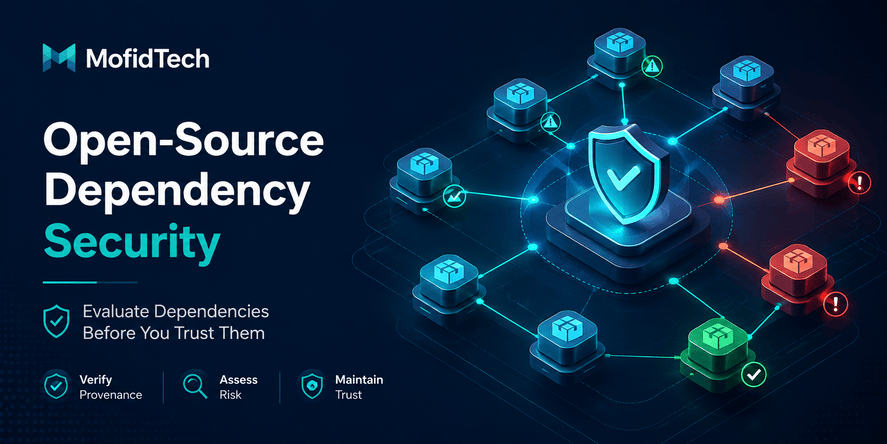
Open-source dependencies make modern software possible. A small development team can add authentication, image processing, data validation, cryptography, logging, database access, user-interface components, and hundreds of other capabilities without rebuilding each function from the ground up. That reuse improves speed and often improves quality because mature components benefit from broader testing and community scrutiny.
The same convenience creates a trust problem. The moment a project imports a third-party package, the project is no longer trusting only its own code. It is also trusting the package name, the registry entry, the maintainers who can publish releases, the source repository, the build system, the package's direct and transitive dependencies, the update process, and sometimes installation behavior that executes before the application ever starts.
That is why open-source dependency security is larger than vulnerability scanning. A package can have no known vulnerabilities and still be malicious. It can be a typo of a legitimate package. A trusted maintainer account can be compromised. A once-safe project can change ownership. A clean source repository can produce an artifact through a build path that is difficult to verify. A new release can be unsafe even though older versions were legitimate.
The issue is especially visible in 2026. GitHub described a pattern of supply-chain attacks in which attackers target package repositories and CI/CD systems to steal credentials and rapidly spread malware across projects. In July 2026, GitHub and npm announced several protections, including publish-time malware scanning, broader malicious-package alerts, workflow approval for certain suspicious GitHub Actions runs, and a default three-day cooldown for routine Dependabot version updates. PyPI also announced a restriction that prevents new files from being added to releases older than 14 days, specifically to reduce the opportunity to poison old, stable releases after a publishing compromise. These platform changes are useful, but they do not remove the developer's responsibility to make careful dependency decisions.
Direct answer Before you trust an open-source dependency, verify that you have the correct package, understand who maintains and publishes it, evaluate project health and security practices, review known vulnerabilities and malware signals, examine its dependency footprint and capabilities, assess release behavior, and treat provenance as evidence of origin—not proof of harmlessness. Then apply a risk level that matches how deeply the package can affect your system. |
|---|
This guide provides a practical evaluation framework for developers and teams. It does not assume that every package must pass an enterprise procurement process. Instead, it helps you spend the most review effort where compromise would matter most: dependencies that run during installation, touch credentials or sensitive data, operate inside CI/CD, handle security-critical functions, or sit deep in production systems.
1. Open-Source Dependencies Are a Trust Decision, Not Just a Convenience
Why third-party code expands your attack surface
Attack surface is often discussed in terms of ports, endpoints, authentication flows, cloud permissions, or user input. Dependencies are part of that attack surface because they introduce code and relationships that your team did not write and may not fully observe. Every dependency adds another path through which a defect, compromised account, malicious release, or abandoned project can affect your application.
The risk is not proportional only to the number of lines of code. A tiny package can be high risk if it executes automatically during installation or has access to build secrets. A large library may be comparatively lower risk if it is mature, widely reviewed, has stable governance, publishes verifiable artifacts, and operates within a narrow application boundary. The important question is not simply “How big is this dependency?” but “What could this dependency do if it became hostile or broken?”
A dependency can influence multiple stages of a software lifecycle. It may run on a developer workstation, in a test environment, during a build, inside a container image, on a production server, in a browser, or in a deployment pipeline. Each location offers different assets to an attacker. A package executing during a build might access source code, package registry credentials, cloud tokens, signing material, or deployment secrets. A front-end package may interact with user sessions and browser data. A server-side package may receive database credentials or sensitive records.
Why package popularity does not equal package safety
Popularity is useful context, but it is not a security guarantee. A widely used package usually has more users who can notice breakage, more integrations that exercise its behavior, and more social evidence that the package identity is legitimate. Yet popularity can also make a package an attractive target. A compromised maintainer account for a high-impact package can create enormous downstream reach.
Download counts also need interpretation. They may include automated builds, mirrors, bots, large organizations, repeated CI jobs, or dependencies that are installed indirectly. Stars and followers can be useful signals of community interest, but they do not prove current maintenance quality, build integrity, or safe release practices. Security decisions should therefore treat popularity as one input among many rather than a pass/fail test.
Dependencies create inherited trust
When you add one package, you may inherit many more. These transitive dependencies are packages required by the dependency you selected. Your team may never choose them directly, yet they can enter the same build and runtime environment. This creates a chain of trust that extends beyond the package name you remember approving.
Inherited trust matters because a small upstream component can become a single point of failure across many projects. It also complicates incident response. If a deeply nested dependency becomes malicious or vulnerable, teams need accurate inventories to discover where it is present and whether it is actually reachable or executed.
2. What Makes an Open-Source Dependency Risky?
Malicious packages versus vulnerable packages
A vulnerable package contains a weakness that may be exploitable. The vulnerability might be accidental, introduced by a design mistake, implementation error, unsafe default, or incomplete validation. A malicious package is different: harmful behavior is intentionally introduced, often to steal credentials, execute unauthorized actions, open backdoors, mine cryptocurrency, redirect transactions, or establish persistence.
This distinction changes the review model. Vulnerability databases are essential, but they mostly answer whether known weaknesses have been reported. They do not guarantee that a package is non-malicious. Malware can be new, short-lived, obfuscated, environment-specific, or discovered only after a release has already been installed by automated systems.
| Question | Vulnerable package | Malicious package |
|---|---|---|
| Primary problem | Unintended security weakness | Intentional harmful behavior |
| Typical detection | Security advisory, CVE, scanner, research report | Malware analysis, registry action, behavioral detection, community report |
| Can a new package have no known advisory? | Yes | Yes |
| Best response | Assess exposure and remediate based on severity and exploitability | Treat as an incident; contain, investigate credentials and systems, remove affected artifacts |
| Key lesson | Known vulnerabilities are only one risk dimension | A clean vulnerability scan does not prove trustworthiness |
Typosquatting and social confusion
Typosquatting relies on human error. An attacker publishes a package whose name is visually or phonetically similar to a legitimate project and waits for developers, automation, or AI assistants to select the wrong one. The malicious package may imitate the description, documentation, branding, or repository links of the real project.
The defense is package identity verification, not popularity alone. Check the exact spelling, namespace or organization, official project documentation, source repository, publisher information, and cross-links between the registry and the project's official site. A package that appears plausible but cannot be traced confidently to the expected source should not be installed in a trusted environment.
Dependency confusion
Dependency confusion occurs when a build process unintentionally resolves a package from an external public registry instead of the intended internal source. The public package may share the same name as an internal dependency and be selected because of versioning or repository-resolution behavior. Although organizations can reduce this risk through repository architecture and naming controls, developers should understand that package identity includes where the package is resolved from, not just what it is called.
Maintainer compromise and account takeover
A legitimate project can become dangerous if a maintainer account is compromised. Attackers may phish credentials, steal tokens from developer machines or CI systems, abuse weak account recovery, or obtain access through a compromised workflow. Once they can publish a release, they inherit the reputation and distribution channel of the legitimate package.
This is why registry protections such as strong multi-factor authentication, short-lived publishing credentials, trusted publishing, staged publishing, account-change delays, and provenance matter. They reduce the opportunity for stolen credentials to become malicious releases. But consumers still need to watch for unusual ownership changes, unexpected maintainers, anomalous release bursts, or releases that do not align with the public development history.
Install-time behavior and hidden execution
Some package ecosystems allow code to run during installation or build preparation. That behavior can be legitimate—for example, generating platform-specific artifacts or preparing native components—but it raises risk because execution may occur before a developer reviews or runs the application. In a compromised package, install-time execution can be used to search for environment variables, credentials, configuration files, SSH keys, cloud tokens, or other valuable material.
When a package requires installation-time execution, treat that as an elevated-risk capability. Ask whether the behavior is necessary, documented, and consistent with the package's purpose. The more privileged the installation environment, the stronger the review should be.
Transitive dependency risk
A direct dependency with strong practices can still pull in weaker components. The security posture of a dependency therefore includes the dependency tree, not only the top-level project. Large trees create more update events, more maintainers, more opportunities for name confusion, and more components that can be abandoned or compromised.
The goal is not to reject all dependencies with large trees. Some ecosystems naturally compose software from many small packages. Instead, use transitive size as a risk multiplier. A package whose value is minor but whose dependency footprint is large may not be worth the inherited trust and operational burden.
Abandoned projects and weak maintenance
Abandonment is not the same as maliciousness, and stable software does not need constant commits. However, an unmaintained package can become risky when its ecosystem changes, vulnerabilities emerge, build infrastructure ages, or no active maintainer is available to respond to security reports. Maintenance should therefore be evaluated in context: recent releases, issue response, compatibility updates, security contacts, and evidence that someone is accountable for the project.
3. The 12-Step Dependency Trust Evaluation Framework
The following framework is designed for pre-adoption review. It can be applied quickly to low-impact packages and more deeply to dependencies that touch sensitive systems. The important point is consistency: teams should be able to explain why a package was accepted, what risks were considered, and what would trigger re-review later.
1. Decide whether the dependency is actually necessary
The safest dependency is the one you do not need. Before adding a package, define the capability you are trying to obtain and compare it with what your platform, framework, or existing dependencies already provide. A dependency that saves a few lines of glue logic but introduces dozens of transitive packages may not be a good trade. Conversely, security-critical functionality such as cryptography is often safer when reused from mature, well-reviewed implementations than reimplemented casually. Necessity is therefore a design judgment, not a rule to avoid open source.
2. Verify the exact package identity and official source
Confirm the package name character by character. Verify the namespace, publisher or organization, project homepage, documentation site, and source repository. Follow links in both directions when possible: the official project should point to the registry package, and the registry page should point back to the expected repository. Watch for recently created lookalikes, copied descriptions, suspicious branding, and package names that differ by a single character or punctuation mark.
3. Compare registry metadata with the source repository
A trustworthy package should have a coherent story across its public surfaces. Compare the package description, version history, release tags, repository location, issue tracker, license, maintainers, and supported environments. Inconsistencies do not automatically mean compromise, but unexplained differences deserve attention. For example, a registry release with no corresponding repository activity, or a repository change that points to a different publisher, may justify delaying adoption until the project clarifies the situation.
4. Review maintainer history and ownership changes
Identify who can publish or administer the project and whether that group has changed recently. Healthy projects may add new maintainers or transfer ownership, but sudden changes create a period of elevated uncertainty. Look for public discussion of transfers, release responsibility, governance, and security contacts. A project with a single inactive maintainer can also create continuity risk because compromise, burnout, or account loss may have outsized consequences.
5. Assess project maintenance and sustainability
Evaluate whether the project is maintained well enough for your intended use. Useful signals include recent compatible releases, issue triage, pull-request review, documented support expectations, active security handling, release notes, and a community that can continue if one maintainer leaves. Avoid reducing this to commit frequency. A mature library may change slowly because it is stable; what matters is evidence that maintainers can respond when change is necessary.
6. Check vulnerability and malicious-package advisories
Search trusted advisory sources for both known vulnerabilities and malware reports. Review whether vulnerabilities were fixed promptly, whether maintainers communicated clearly, and whether the package has a history of repeated severe issues. Distinguish an old fixed vulnerability from a currently exposed flaw. Also remember that absence of an advisory is not proof of safety, especially for very new or obscure packages.
7. Review install-time and runtime capabilities
Ask what the package can access and when it executes. Does it run during installation? Does it perform network communication? Does it read the file system, spawn processes, interact with credentials, load native components, or operate with broad application privileges? Compare those capabilities with the stated purpose. A formatting utility should not need the same level of system access as a deployment tool. Unexpected capability is a strong review signal.
8. Examine the transitive dependency footprint
Determine how many additional packages the dependency introduces and which of them are security-sensitive, rarely maintained, or controlled by different organizations. Pay special attention to dependencies that execute during installation, build native code, handle parsing of untrusted data, or bring large frameworks into a narrow feature. A compact dependency tree is not automatically safer, but it is easier to understand, monitor, and update.
9. Look for suspicious release timing or unusual changes
Risk often rises immediately after a major ownership change, account recovery event, surprise release, or sudden burst of versions. Examine release notes and repository history for context. Be cautious when a routine package suddenly gains new network behavior, installation hooks, obfuscated files, unexpected bundled binaries, or unrelated functionality. When the release looks unusual, delay adoption long enough for community and security signals to develop unless the update fixes a vulnerability that requires urgent action.
10. Evaluate provenance, attestations, and build integrity
Provenance helps answer where, when, and how an artifact was produced. SLSA describes provenance as verifiable information linking an artifact back through the build process to its inputs and builder. That is valuable because consumers can compare the artifact with expectations and detect certain forms of tampering. But provenance is not a malware verdict. A correctly produced artifact can still contain harmful source code if the source itself was compromised or malicious. Treat provenance as strong evidence of origin and process integrity, not as proof of benign intent.
11. Review licensing, governance, and security reporting
Trust includes operational and legal sustainability. Confirm that the license is clear and compatible with your project. Look for a security policy or reporting channel, responsible-disclosure expectations, governance information, and clarity about who owns release decisions. Poor documentation in these areas may not make a small utility unusable, but it raises uncertainty for critical or long-lived systems.
12. Test risky dependencies in an isolated environment
For packages with elevated privileges, installation behavior, uncertain provenance, native components, or limited history, perform evaluation in an environment that does not contain production secrets or trusted developer credentials. Observe what the dependency installs, accesses, changes, and communicates with. Isolation does not replace source and metadata review, but it limits the impact of a bad assumption during investigation.
4. How to Score Dependency Risk Before Adoption
A risk score can make reviews repeatable, but it should not create false precision. The purpose is to help teams compare dependencies and decide how much assurance is necessary. A simple model works best when it separates impact from trust signals.
Start with impact: what happens if this package is compromised?
- Low impact: narrow utility, limited privileges, no secrets, non-production use, easy replacement.
- Medium impact: production runtime dependency, processes user-controlled data, moderate transitive footprint, or affects application reliability.
- High impact: authentication, cryptography, package publishing, CI/CD, cloud deployment, credential handling, sensitive data access, native execution, installation hooks, or broad system permissions.
Then evaluate trust signals
| Signal | Lower-risk evidence | Higher-risk evidence |
|---|---|---|
| Identity | Official cross-links, established namespace, consistent repository and registry metadata | Lookalike name, mismatched links, recently created identity, unclear publisher |
| Maintainers | Known maintainers, documented governance, multiple accountable contributors | Unexpected ownership change, single inactive maintainer, unclear release authority |
| Maintenance | Responsive security handling, compatible releases, active issue triage | Long-unaddressed security issues, broken release process, no clear support path |
| Release behavior | Documented releases aligned with source history | Sudden unexplained release burst, new binaries or capabilities, missing source context |
| Provenance | Verifiable provenance/attestations aligned with expected source and builder | No provenance for high-impact package, changed provenance without explanation |
| Dependencies | Understandable tree with maintained components | Large opaque tree, risky install-time transitive components, abandoned subdependencies |
| Security history | Transparent advisories and timely fixes | Repeated severe incidents with weak communication or unresolved findings |
Stop conditions that should block adoption
Some findings should end the evaluation immediately until they are resolved. These are not merely negative score factors; they are reasons to stop.
- The package identity cannot be confidently linked to the intended project.
- The registry or security community marks the package or release as malicious.
- An unexpected publisher or ownership change has no credible explanation.
- The package requests capabilities that are clearly unrelated to its purpose and cannot be justified.
- A critical known vulnerability is directly relevant to your intended use and no safe remediation is available.
- An artifact expected to have provenance or a signature fails verification or points to an unexpected source or build environment.
- The license or terms are incompatible with the intended project and no approved exception exists.
Why a score should support, not replace, engineering judgment
Automated scores are valuable for triage. OpenSSF Scorecard, for example, evaluates open-source projects across a set of automated security checks and is intended to help consumers make informed risk decisions. But any automated score has blind spots. A project can follow many good practices and still ship a malicious change; another project can be secure in practice while lacking some observable metadata. Use scores to identify questions, not to outsource the final decision.
A practical three-tier review policy
| Tier | When to use | Expected review depth |
|---|---|---|
| Tier 1 — Routine | Low-impact development dependency or well-established utility | Identity check, advisory review, maintenance check, dependency footprint, license |
| Tier 2 — Production | Runtime package, user-data processing, moderate privileges | All Tier 1 checks plus maintainer history, release review, provenance where available, transitive dependency assessment |
| Tier 3 — Critical | CI/CD, publishing, authentication, cryptography, secrets, deployment, sensitive data | Full 12-step review, explicit approval, isolation testing, provenance verification expectations, ongoing monitoring and rapid incident plan |
5. Dependency Security by Ecosystem
The principles are portable, but package ecosystems differ in how they publish software, represent maintainers, handle installation behavior, and expose provenance or security metadata. Teams should therefore combine a common policy with ecosystem-specific checks.
npm and JavaScript packages
JavaScript projects often have deep dependency trees and a culture of composing many small packages. That increases the importance of transitive visibility and release monitoring. Installation scripts have also been a significant supply-chain concern because they can execute before application runtime. GitHub stated that npm v12 is moving toward disabling install scripts by default, with explicit approval for packages that need them, and is blocking additional install-time execution vectors such as certain remote dependency patterns by default.
In July 2026, npm also introduced publish-time malware scanning so newly published packages are scanned before becoming available. This is a meaningful ecosystem safeguard, but consumers should not treat scanning as infallible. Malware detection improves over time, and targeted behavior may evade early signals. Identity, release review, maintainer security, and update policy still matter.
For high-impact npm packages, pay particular attention to maintainer account security and publishing controls. GitHub announced additional protections in 2026, including temporary read-only safeguards for high-impact accounts after sensitive account changes and restrictions on granular tokens that bypass two-factor authentication for sensitive management actions. These changes reflect a central lesson: publishing credentials are part of the software supply chain.
PyPI and Python packages
Python packages range from pure Python utilities to packages that include native extensions, build steps, and platform-specific artifacts. Consumers should verify that the PyPI project maps to the expected source repository, review maintainers and release history, and pay close attention to projects that publish many compiled artifacts or depend on complex build infrastructure.
PyPI has invested in trusted publishing and attestations, and in July 2026 it announced planned interface changes that include a dedicated Security tab intended to centralize provenance and attestation metadata and make missing or changed provenance easier to notice. This is useful for consumers because trust signals become easier to discover at decision time.
PyPI also announced that releases older than 14 days no longer accept new files. The stated security rationale is to reduce the opportunity to poison old, stable releases if publishing tokens or workflows are compromised. This does not eliminate account compromise risk, but it narrows one potentially confusing path by which an old version could change after users had come to trust it.
Maven, NuGet, Cargo, RubyGems, and other ecosystems
Other ecosystems differ in signing practices, centralization, namespaces, lockfile behavior, package immutability, and how much build metadata is available. Rather than memorize one checklist per registry, evaluate four ecosystem questions: How strong is publisher authentication? Can artifacts be replaced or mutated after release? What provenance or signing information is available? How does the tooling help consumers detect vulnerabilities, malware, or unexpected dependency resolution?
OpenSSF's package-repository security principles organize repository maturity around authentication, authorization, general security capabilities, and client tooling. At higher maturity, repositories may support phishing-resistant authentication, short-lived publishing credentials, build provenance, malware reporting, vulnerability warnings, and software bill of materials generation. Consumers benefit when these controls exist, but should still understand which controls are actually present in the ecosystem they use.
6. How to Review Dependency Updates Safely
Why the newest release is not always the safest immediate choice
Automated updating is valuable because stale dependencies accumulate known vulnerabilities and compatibility debt. Yet instantaneous adoption of every new release creates a different risk: a malicious or broken version can move through many downstream projects before maintainers, registries, and researchers have time to detect it.
This tension is why update policy should distinguish security updates from routine version updates. A newly disclosed vulnerability may justify rapid remediation. A routine feature or maintenance release can often tolerate a short observation period, especially for high-impact dependencies.
The role of release cooldown periods
A cooldown delays routine adoption long enough for early warning signals to emerge. GitHub introduced a default three-day cooldown for Dependabot version updates in July 2026, while continuing to open security updates immediately. The design reflects a useful principle: speed should be risk-sensitive, not uniform.
Teams can apply the same principle even when their tooling differs. High-impact packages may deserve longer observation windows for non-urgent releases, while low-impact packages can move faster. A cooldown is not a guarantee that malware will be detected, but it reduces exposure to attacks that depend on rapid automated propagation.
When security updates should bypass normal waiting periods
Do not let a generic cooldown become an excuse to remain exposed to an actively exploitable vulnerability. If a trusted advisory shows that your deployed version is vulnerable and a credible fixed release is available, evaluate that update promptly. The review should focus on authenticity, the scope of the security fix, release integrity, and regression risk rather than waiting simply because the release is new.
Why version-change review matters
A safe dependency decision is not permanent. Re-review when a package changes ownership, introduces new install-time behavior, switches build infrastructure, adds sensitive capabilities, adopts a dramatically larger dependency tree, changes its license, or undergoes an unexplained burst of releases. These changes can alter the trust model even when the package name stays the same.
7. How CI/CD Pipelines Can Reduce Dependency Risk
CI/CD systems are attractive targets because they combine automation with powerful credentials. A malicious dependency that reaches a build environment may be able to access package publishing tokens, cloud credentials, deployment keys, signing material, or repository permissions. Supply-chain security therefore depends on pipeline design as much as package selection.
Separate build credentials from publishing credentials
A build process should not automatically possess every credential needed to publish or deploy. The more credentials a compromised build can access, the easier it is for an attacker to turn one malicious dependency into a broader supply-chain incident. Modern trusted-publishing approaches reduce reliance on long-lived registry secrets by using short-lived identity exchanges tied to approved workflows.
Limit workflow permissions and secret exposure
Treat untrusted pull requests, third-party actions, build plugins, and dependencies as potential execution paths. Sensitive workflows should run with the minimum permissions required, and secrets should not be exposed to jobs that process untrusted contributions unless there is a compelling design reason. This is particularly important for public projects, where attackers can submit code designed to trigger unsafe workflow behavior.
GitHub's 2026 changes include holding certain potentially malicious workflow runs for approval in public repositories and safer defaults around a commonly misused pull-request workflow pattern. Platform protections help, but repository owners still need to understand which workflows can access credentials and which external components those workflows execute.
Use dependency review and malware alerting as gates
Automated dependency analysis is most useful when it is placed at a decision point. New dependencies and major version changes should trigger visibility into what was added, which transitive components appear, whether known vulnerabilities or malware advisories apply, and whether the change introduces a component outside the team's normal policy.
In July 2026, GitHub expanded Dependabot malicious-package alert coverage using data from the OpenSSF malicious-packages project across ecosystems including npm and PyPI. Teams using such alerting should treat malware alerts differently from ordinary vulnerability findings: a confirmed malicious package is an incident signal, not a backlog item.
Maintain an approved-dependency path for critical systems
NIST's Secure Software Development Framework recommends acquiring and maintaining well-secured third-party components, obtaining provenance information, and establishing repositories or lists for sanctioned components. For larger organizations, an internal approved-dependency catalog can reduce repeated reviews and help teams know which versions, sources, and provenance expectations have already been assessed.
The goal should not be bureaucracy for its own sake. A useful approval path is fast for routine, low-risk components and rigorous for dependencies with substantial security impact. If the process is so slow that developers route around it, the control becomes self-defeating.
8. How AI Coding Assistants Change Dependency Risk
The problem with accepting suggested packages blindly
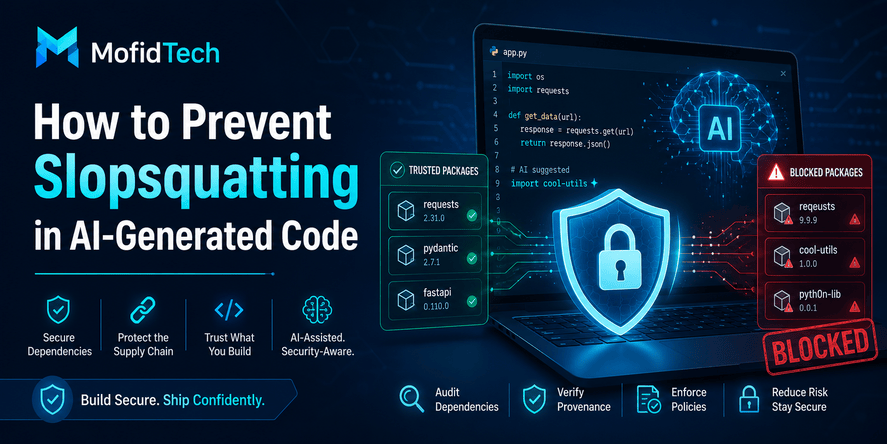
AI coding assistants can accelerate development by recommending libraries that appear to solve a task. The security problem is that a recommendation is not the same as verification. A suggested package may be outdated, incorrectly named, unnecessary, poorly maintained, or less trustworthy than an existing component already present in the project.
This creates a modern form of social proof: developers may assume that a package is legitimate because an AI system mentioned it confidently. That confidence should not be transferred to the package. Treat AI-generated dependency suggestions exactly as you would treat a package name copied from an unfamiliar forum post: as a lead that still requires identity and risk evaluation.
Treat AI-generated dependency choices as untrusted recommendations
A team policy can be simple: AI may propose a dependency, but a human or approved automated review process decides whether the dependency enters the codebase. The same 12-step framework applies. In fact, AI-assisted workflows make consistent review more important because they can increase the speed and volume of dependency changes.
Add dependency evaluation to AI-assisted code review
When reviewing AI-generated changes, ask three dependency questions explicitly: Did the change add a new third-party component? Was the component already approved? Does the new version or transitive tree materially change the application's trust boundary? This keeps supply-chain review visible even when the code itself looks correct.
9. What to Do If You Installed a Malicious Dependency
If a dependency is confirmed or credibly suspected to be malicious, treat the event as a security incident. Removing the package is necessary, but it may not be sufficient because malicious installation or runtime behavior may already have exposed credentials or altered systems.
Contain the environment and identify exposed credentials
First reduce further exposure. Isolate affected developer machines, build runners, containers, or servers as appropriate to the environment. Determine when the malicious version was installed and what privileges were available at that time. Identify environment variables, registry tokens, cloud credentials, SSH keys, source-control tokens, signing keys, database secrets, and service credentials that the process could have accessed.
Rotate secrets and review downstream access
If a credential was accessible to the malicious process, assume exposure unless you have strong evidence otherwise. Prioritize credentials that can publish packages, modify repositories, deploy software, access production, or create new credentials. Revocation and rotation should be coordinated so that replacement credentials do not remain exposed in the same compromised environment.
Trace affected builds, releases, and developer machines
Use build history, dependency inventories, lockfiles, SBOMs, deployment records, and logs to determine where the malicious version appeared. The objective is to answer four questions: Which systems installed it? Which builds included it? Which artifacts were produced while it was present? Which downstream users or environments received those artifacts?
Document the incident and strengthen future controls
After containment, convert the incident into prevention. Identify why the package entered the environment, which signal was missed, whether an update arrived too quickly, whether secrets were overexposed, and whether the team could identify affected systems quickly. Improve review policy, automation, credential boundaries, and dependency inventory based on those findings.
Important Do not assume that deleting the package reverses actions already performed by malicious code. Incident response must consider credential theft, persistence, altered artifacts, and downstream propagation. |
|---|
10. Common Dependency Security Mistakes
Mistake 1: Trusting download counts as a security certification
Popularity can increase visibility, but it can also increase attacker incentives. Use popularity as context, not proof.
Mistake 2: Checking only for CVEs
A package can be intentionally malicious without a traditional vulnerability advisory. Include malware intelligence, identity checks, and behavior review.
Mistake 3: Reviewing only direct dependencies
Transitive dependencies can execute in the same environments and introduce their own maintainers, releases, and vulnerabilities.
Mistake 4: Automatically accepting every update immediately
Fast updates reduce vulnerability exposure but can increase exposure to newly published malicious releases. Use risk-sensitive cooldowns for routine updates.
Mistake 5: Treating provenance as a safety seal
Provenance strengthens origin and build-process assurance. It does not establish that the source code is benign.
Mistake 6: Ignoring ownership changes
A legitimate transfer may be harmless, but it changes who can publish trusted updates. High-impact dependencies deserve re-review after control changes.
Mistake 7: Running evaluation in a credential-rich environment
Suspicious packages should not be tested on a workstation or build runner that contains valuable secrets.
Mistake 8: Keeping no record of why a dependency was approved
Without a lightweight decision record, teams repeat work and cannot tell which change should trigger re-review.
Mistake 9: Letting security policy become unusable
Overly rigid processes encourage bypasses. Scale review depth to dependency impact and provide a fast path for routine components.
Mistake 10: Forgetting removal and replacement
Dependencies accumulate. Periodically ask whether a package is still necessary, supported, and worth its ongoing risk and maintenance cost.
11. Dependency Security Best Practices for Teams
Define a dependency acceptance policy
A team should know what requires review before a dependency appears in production. The policy can specify higher scrutiny for security-critical packages, native components, install-time execution, new or low-history projects, packages outside approved registries, and dependencies that introduce large transitive trees. Keep the policy short enough that developers can actually use it.
Record dependency decisions
For important packages, record the reason for adoption, expected purpose, risk tier, approved source, approved version range or update approach, notable trust assumptions, and reviewer. This does not need to be a long document. The value is traceability when ownership changes, advisories appear, or an incident requires fast scoping.
Maintain a current inventory
You cannot respond quickly to a compromised package if you do not know where it is used. Maintain dependency inventories or SBOMs for production applications and important build systems. CISA describes SBOMs as a transparency mechanism that can improve software asset management, vulnerability management, and supply-chain risk analysis when combined with other information.
Monitor for both vulnerabilities and malicious-package advisories
Security monitoring should cover two different questions: Has a weakness been discovered in a component we use? Has a package or release been identified as intentionally malicious? The response urgency and investigative steps differ, so alerts should be classified accordingly.
Protect maintainer and publishing identities
Teams that publish their own packages should apply the same trust model to themselves. Use strong multi-factor authentication, prefer phishing-resistant methods where supported, reduce long-lived publishing secrets, adopt trusted publishing or equivalent short-lived identity mechanisms, restrict who can change package ownership, and protect account recovery paths.
Reduce secret exposure in builds
Assume that build-time code can become hostile. Give build jobs only the permissions and secrets they require, isolate sensitive release stages, and avoid making high-impact credentials broadly available. This reduces the blast radius if a dependency, build plugin, or workflow component is compromised.
Use automation to find questions, not to declare trust
Automated scanners, scorecards, dependency bots, malware feeds, provenance checks, and SBOM tools are essential at scale. Their best role is to surface evidence and enforce clear policy. The final trust decision should consider context that automation may not understand: business criticality, intended usage, unusual permissions, recent ownership changes, and acceptable alternatives.
12. Performance and Operational Considerations
Dependency security decisions also affect performance, reliability, and long-term maintenance. A package that is secure enough today may still be a poor engineering choice if it creates excessive operational complexity.
Dependency size and application performance
Large dependencies can increase application startup time, browser bundle size, container image size, memory use, installation time, and build duration. These effects vary by ecosystem and deployment model, but they matter because teams may accept substantial supply-chain surface for a feature that could be provided more efficiently by an existing component.
Dependency count and update burden
Every dependency creates future work: monitoring advisories, evaluating updates, handling breaking changes, rebuilding artifacts, and responding when maintainers change direction. A dependency decision should therefore include lifecycle cost, not only the time saved on the day it is introduced.
Reliability and availability risk
A project can be trustworthy but operationally fragile. Consider whether releases are reproducible, whether old versions remain available, whether the registry and source are stable, whether there are multiple maintainers, and whether your team has a replacement path. Critical software should avoid unnecessary single points of external maintenance failure.
Security-performance trade-offs
Security controls can introduce friction: cooldowns delay updates, deeper reviews consume time, and isolated evaluation adds steps. The objective is not maximum friction; it is risk-adjusted friction. A two-line development utility should not require the same process as a package that can publish production artifacts or access customer data.
13. Troubleshooting Dependency Trust Decisions
Sometimes the evidence is mixed. Use the following decision guide when a package looks useful but one or more trust signals are unclear.
| Situation | What it may mean | Recommended action |
|---|---|---|
| Package is popular but has weak security metadata | Mature adoption, but limited visible assurance | Verify identity and maintainers; inspect security policy and release process; do not let popularity close the review |
| Project is new but solves a unique problem | Limited history rather than proven danger | Increase isolation and behavior review; consider whether a simpler or established alternative exists |
| Ownership changed recently | Legitimate succession or increased takeover risk | Look for public transfer context; delay non-urgent adoption; re-review next releases |
| Provenance is missing | Artifact origin is harder to verify | Increase other review depth; for critical dependencies, prefer alternatives with stronger build assurance |
| Provenance changed unexpectedly | Build process or publisher identity changed | Stop and understand the change before adoption |
| New release has no obvious source changes | Could be packaging-only change or suspicious mismatch | Wait for explanation; verify repository tags, maintainers, and artifact origin |
| Dependency adds many transitive packages | Ecosystem norm or unnecessary complexity | Assess what value the package provides relative to inherited risk; inspect critical transitive components |
| Scanner reports no vulnerabilities | Only known vulnerability risk is low | Continue identity, malware, provenance, maintainer, and behavior checks |
| AI assistant suggests an unfamiliar package | Recommendation without trust validation | Treat it as untrusted input and run the same evaluation as any manually discovered package |
A five-question escalation test
When uncertain, ask these five questions. A “yes” to any of them should increase review depth:
- Can this dependency access secrets, sensitive data, deployment systems, or package publishing credentials?
- Does it execute during installation, build, test, or deployment rather than only during normal application runtime?
- Would compromise affect many applications or customers because the package is shared broadly inside the organization?
- Has the project recently changed ownership, release infrastructure, provenance, or major dependencies?
- Would replacing the package after an incident be difficult or disruptive?
14. Real-World Decision Scenarios
Scenario A: A tiny convenience package with 40 transitive dependencies
A developer wants to add a small formatting helper. The package is legitimate and has no known vulnerabilities, but it introduces dozens of transitive dependencies. The feature could also be implemented using capabilities already present in the main framework. The security issue is not that the package is malicious; it is that the trust and maintenance cost is disproportionate to the value. The better decision is likely to avoid the dependency and reduce long-term surface area.
Scenario B: A mature authentication library with a recent ownership transfer
The package is widely used and historically well maintained, but publishing control moved to a new maintainer two weeks ago. Because authentication is high impact, the ownership change triggers re-review. The team verifies the transfer through official project channels, observes the first releases, checks provenance and security policy, and delays a routine upgrade until confidence improves. If a critical security fix is released during that period, the team evaluates it immediately rather than applying a blanket delay.
Scenario C: An AI assistant recommends an obscure package
The package name appears plausible, but the developer has never heard of it. Instead of installing it immediately, the developer confirms whether the project exists, whether the name matches an official source, whether the package is maintained, and whether the application already has equivalent functionality. The suggestion is treated as discovery, not verification.
Scenario D: A package has valid provenance but suspicious new network behavior
The build provenance verifies correctly and matches the expected repository and build platform. However, a new release begins communicating with an external service unrelated to the package's documented purpose. Provenance does not override the behavioral signal. The package is held back while maintainers or reviewers explain the change. This illustrates why provenance is one dimension of trust, not a complete security verdict.
Scenario E: A malicious-package alert arrives after a production build
The team identifies that the affected version was present in a build environment with access to a package registry token and cloud deployment credentials. The response focuses first on credential exposure and artifact traceability, not merely on upgrading the dependency. The team rotates accessible secrets, checks whether any packages or deployments were modified, identifies all builds produced during the exposure window, and updates pipeline boundaries to reduce future blast radius.
15. Pre-Install Open-Source Dependency Security Checklist
Featured-snippet candidate A dependency should not be trusted because of one good signal. Use the checklist below to combine identity, maintenance, vulnerability, malware, capability, dependency, provenance, licensing, and operational evidence. |
|---|
- Need: Is a new dependency necessary, or can an existing trusted component provide the capability?
- Identity: Is the exact package name, namespace, publisher, and official source verified?
- Consistency: Do the registry page, repository, documentation, license, and release history align?
- Maintainers: Are current maintainers known, active enough for the project's needs, and free of unexplained ownership changes?
- Maintenance: Is there evidence the project can respond to compatibility and security issues?
- Advisories: Have you checked both known vulnerabilities and malicious-package reports?
- Capabilities: Does the package request or exercise privileges consistent with its stated purpose?
- Install behavior: Does it execute during installation or build, and if so, is that behavior necessary and documented?
- Transitive dependencies: Is the inherited dependency footprint reasonable and understandable?
- Release behavior: Does the proposed version align with public source history and expected release activity?
- Provenance: Where available, does provenance or attestation match the expected source and builder?
- Licensing: Is the license clear and compatible with the project?
- Security reporting: Is there a credible way to report security issues?
- Isolation: If risk is elevated, was evaluation performed away from valuable credentials and production systems?
- Decision record: Has the team recorded why this dependency is acceptable and what changes would trigger re-review?
16. Frequently Asked Questions
How do I know whether an open-source package is safe before installing it?
You cannot prove safety from a single public signal. Start by verifying the exact package identity and official source, then evaluate maintainers, project health, advisories, malware reports, capabilities, transitive dependencies, release behavior, provenance, licensing, and security practices. For high-impact packages, add isolated testing and explicit approval.
Is a package safe if it has no known vulnerabilities?
No. “No known vulnerabilities” only means that the advisory sources you checked do not currently report a relevant known weakness. A package can still contain undiscovered vulnerabilities or intentional malicious behavior. Vulnerability scanning is necessary, but it is not a complete trust decision.
What is the difference between a malicious package and a vulnerable package?
A vulnerable package contains an exploitable weakness, usually introduced unintentionally. A malicious package contains harmful behavior intentionally. The distinction matters because confirmed malware requires incident response, credential review, and containment rather than only normal patch management.
Does package provenance mean the package is trustworthy?
Provenance strengthens confidence about where, when, and how an artifact was built and can help detect certain forms of tampering. It does not prove that the source code is benign. A malicious source change can still produce valid provenance if it goes through the expected build process.
Should I avoid packages with many dependencies?
Not automatically. Some ecosystems legitimately compose software from many small components. However, a large dependency tree increases inherited trust, monitoring, and update burden. Compare the package's value with the additional surface area and pay special attention to high-impact transitive components.
How long should I wait before adopting a new package release?
There is no universal number. Routine updates for important dependencies can benefit from a short observation period, while security fixes may require immediate evaluation and deployment. GitHub's default three-day cooldown for routine Dependabot version updates illustrates the risk-sensitive principle: delay non-urgent updates without delaying security remediation.
Are npm and PyPI security scans enough to protect me?
Registry scanning and malware alerts are valuable ecosystem defenses, but no detection system is perfect. Keep verifying package identity, maintainers, release context, capabilities, transitive dependencies, and provenance. Platform protections reduce risk; they do not eliminate the need for consumer judgment.
What should trigger a dependency re-review?
Re-review after ownership changes, unexpected publisher changes, major build or provenance changes, new installation behavior, large dependency-tree changes, sensitive new capabilities, major license changes, unusual release bursts, or a security incident involving the project or its maintainers.
How can AI coding assistants create dependency risk?
They can recommend package names quickly, which may lead developers to install unfamiliar or unnecessary dependencies without verification. Treat AI suggestions as untrusted recommendations. Verify identity and run the same security evaluation used for any other new dependency.
What is the most important dependency security practice for small teams?
Use a lightweight, repeatable pre-install checklist and scale review depth to impact. Small teams do not need an enterprise committee for every package, but they should always verify identity, check security signals, understand privileges and transitive dependencies, and record decisions for critical components.
What is an SBOM, and does it make dependencies safe?
A software bill of materials is an inventory of software components. It improves visibility, incident response, and vulnerability management because teams can determine where components are used. It does not make those components safe by itself; it provides information that supports better security decisions.
What should I do first if a dependency is reported as malicious?
Treat the report as an incident. Determine where the affected version ran, what credentials and systems it could access, and which builds or deployments included it. Contain affected environments, rotate exposed credentials, trace downstream artifacts, and only then focus on replacement and recovery.
Is it safer to build every dependency from source?
Not necessarily. Building from source can improve assurance when binary provenance is unclear, but it also moves trust into your own build environment and its dependencies. The correct approach is to understand the source, build process, provenance, and threat model rather than assuming one distribution method is always safer.
Can automated security scores replace manual dependency review?
No. Automated scorecards are excellent for triage and policy enforcement, but they evaluate observable signals and cannot fully understand your application's context or a package's intent. Use automated scores to guide questions and prioritize attention, then apply engineering judgment for important dependencies.
Conclusion
Open-source dependency security begins with a change in mindset: adding a package is not only a development shortcut; it is a trust decision. The package becomes part of your application's attack surface, your update process, your incident-response scope, and often your build and deployment chain.
The best evaluation process does not attempt to prove that software is perfectly safe. That standard is impossible. Instead, it gathers enough evidence to make a risk-informed decision: verify identity, understand maintainers and release history, check vulnerabilities and malicious-package intelligence, examine capabilities and transitive dependencies, assess provenance and build integrity, and match review depth to the impact of compromise.
Recent 2026 changes across npm, GitHub Actions, and PyPI show that package repositories and development platforms are adding stronger supply-chain defenses. Those controls are important, but they work best when developers also slow down at the moment of trust. A short, disciplined dependency review can prevent a convenience package from becoming a credential theft event, a compromised build, or a difficult production incident.
For teams, the long-term objective is simple: know what you depend on, know why you trust it, know what would make you reconsider that trust, and be able to find every affected system quickly when the ecosystem changes.
💬 Comments
No comments yet. Be the first to comment!
Login to comment.