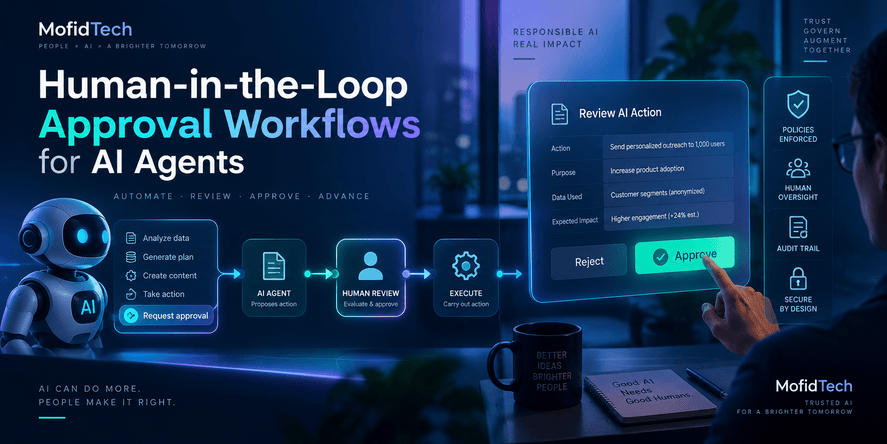
Quick Answer: What Is a Human-in-the-Loop AI Agent Workflow?
A human-in-the-loop (HITL) AI agent workflow is an automated process in which an AI agent can proceed independently for permitted tasks but must pause, ask for information, request approval, or escalate to a person when a decision or action crosses a defined risk boundary. The strongest designs do not require a human for every step. Instead, they classify actions by consequence and reversibility, give the agent bounded authority for routine work, and insert human judgment only where it materially reduces risk or resolves ambiguity.
A production-grade approval workflow should answer six questions before an agent is allowed to act:
- What is the agent trying to do, and what evidence supports the proposed action?
- Is the action reversible, and how large is the potential blast radius if it is wrong?
- Does the action expose sensitive data, money, privileged systems, external communications, or legal commitments?
- Who is authorized to approve it, and does that person have enough context to make an informed decision?
- What happens if the approver rejects, edits, ignores, or cannot evaluate the request?
- What audit trail, rollback path, and post-action monitoring are required?
The central design principle: treat human approval as a risk control at the boundary where an agent can create real-world side effects—not as a decorative confirmation dialog placed after the agent has already made an opaque decision.
Table of Contents
1. Why Human Approval Matters More for AI Agents Than Chatbots
2. The Four Forms of Human Oversight
3. Decide What the Agent Is Allowed to Do
4. Build a Risk-Tier Model for Agent Actions
5. Choose the Right Approval Gate
6. Design an Approval Request a Human Can Actually Judge
7. Define Triggers, Thresholds, and Escalation Rules
8. Make Approval Workflows Durable and Resumable
9. Prevent Duplicate and Stale Actions
10. Connect Approval to Identity, Permissions, and Least Privilege
11. Build Auditability and Observability Around Human Decisions
12. Security Threats Specific to Approval Workflows
13. Performance, Cost, and User-Experience Trade-offs
14. Real-World Use Cases
15. Common Design Mistakes
16. Testing and Evaluation
17. A Practical Rollout Roadmap
18. Troubleshooting Human-in-the-Loop Workflows
19. Production Checklist
20. FAQ
21. Conclusion
Introduction
AI agents change the risk model of software. A conventional assistant may generate a suggestion that a human reads and decides whether to use. An agent can go further: it can select tools, retrieve information, modify records, send messages, schedule work, initiate transactions, change configuration, or coordinate several steps toward a goal. Once software can create side effects on behalf of a user or organization, the design question is no longer only “Is the answer correct?” It becomes “What authority should this system have, under what conditions, and who is accountable when the action matters?”
Human-in-the-loop design is one of the most practical answers, but it is often implemented poorly. A weak design inserts an approval button everywhere, floods people with low-value requests, presents too little evidence, and eventually trains reviewers to click “approve” automatically. Another weak design places a human somewhere in the process but gives that person no realistic ability to understand, stop, or reverse the action. Both approaches create the appearance of control without dependable control.
A strong HITL architecture is selective. It lets agents handle routine, reversible, well-bounded work while routing uncertain, sensitive, expensive, irreversible, or unusual actions to the right human. The result is not “less automation.” It is better delegation: automation where automation is safe, judgment where judgment is valuable, and clear evidence linking the two.
This guide explains how to design that system from first principles. It focuses on workflow architecture, risk classification, approval UX, security boundaries, escalation, durability, auditing, testing, performance, failure handling, and organizational rollout. It deliberately avoids code and copy-paste technical snippets so the ideas can be applied across frameworks, clouds, languages, and industries.
1. Why Human Approval Matters More for AI Agents Than Chatbots
Agents combine reasoning with action
A chatbot primarily transforms information into information. An agent may transform information into an action. That distinction matters because an incorrect answer can often be ignored, while an incorrect action may change the environment before anyone notices. The danger increases when the action is externally visible, difficult to reverse, financially meaningful, security-sensitive, or capable of triggering downstream automation.
Consider a support assistant that drafts a refund recommendation. The human employee can inspect the recommendation, check the account, and decide. Now consider an agent that issues the refund automatically, emails the customer, updates the accounting record, and closes the ticket. The underlying model may be identical, but the operational risk is not. The second system has delegated authority.
Agent errors can compound across steps
Agentic workflows are often multi-step and adaptive. A small error in interpretation can influence tool selection; that tool result can shape the next decision; and the next decision can create a side effect. The system may also retry, branch, delegate to another agent, or continue for a long period. This means a single static validation at the beginning is rarely enough for high-consequence workflows.
Human checkpoints are most useful at moments where the workflow is about to cross a boundary: from reading to writing, from internal to external, from reversible to irreversible, from low privilege to high privilege, or from routine to exceptional.
Autonomy should be treated as a spectrum
Teams often frame the choice as either manual work or full autonomy. In practice, there are many useful levels between those extremes. An agent may gather evidence but not decide; recommend a decision but not execute it; execute only low-risk actions; execute within quantitative limits; or act autonomously while escalating exceptions. Designing these intermediate levels is the heart of a mature HITL system.
2026 relevance. Current agent platforms increasingly expose approval-required tools, workflow pauses, checkpoints, human input, and durable resumption as first-class capabilities. Governance guidance is also shifting toward bounded authority, meaningful oversight, and auditability rather than assuming that a generic human review step is sufficient.
2. The Four Forms of Human Oversight
Human oversight is more precise when teams name the moment at which it occurs. Four patterns are especially useful: pre-execution approval, in-loop intervention, post-execution review, and out-of-loop sampling. They solve different problems and should not be treated as interchangeable.
2.1 Pre-execution approval
The agent prepares a proposed action but cannot execute it until an authorized person approves. This is the strongest preventive pattern for actions with high consequence, low reversibility, or regulatory importance. Examples include changing access permissions, sending sensitive external communications, moving money above a threshold, deleting production data, or committing an organization to a contract term.
Pre-execution approval works best when the reviewer receives a clear evidence pack: what the agent wants to do, why, what information it used, what will change, what could go wrong, and whether the action can be rolled back. Without that context, approval becomes guesswork.
2.2 In-loop intervention
The workflow pauses because the agent needs human judgment, clarification, or missing information. This is different from a simple yes-or-no gate. The person may supply a value, resolve ambiguity, choose between alternatives, or redirect the workflow. This pattern is useful when the system cannot confidently infer intent or when a business rule requires a human decision rather than automated validation.
2.3 Post-execution review
The agent is allowed to act within a bounded area, but selected actions are reviewed after execution. This is appropriate for low-risk, highly reversible operations where preventing every action would create unnecessary friction. Post-action review can catch systematic errors, policy drift, or emerging failure modes and can feed improvements back into thresholds and permissions.
2.4 Out-of-loop sampling and assurance
Not every action needs to interrupt a person. Random or risk-weighted sampling can provide quality assurance across large volumes without blocking the workflow. Samples may be selected by unusual behavior, low confidence, high novelty, specific user segments, model changes, or random selection. This pattern supports governance and monitoring but should not be used as the only control for actions that could cause serious harm before review.
| Pattern | When | Primary purpose | Best fit | Main caution |
|---|---|---|---|---|
| Pre-execution approval | Before action | Prevent a consequential action | High-impact, hard-to-reverse changes | Can become a bottleneck |
| In-loop intervention | During workflow | Resolve ambiguity or request judgment | Missing information, exception handling | Requires durable pause/resume |
| Post-execution review | After action | Detect errors and drift | Low-risk reversible actions | Cannot prevent first harmful action |
| Sampling / assurance | Outside individual flow | Measure quality and control effectiveness | High-volume routine work | Must be risk-weighted |
3. Decide What the Agent Is Allowed to Do
Start with delegated authority, not model capability
The fact that a model can perform an action does not mean the agent should be authorized to perform it. Approval design begins by defining the authority delegated to the agent. The goal is to create a bounded operating envelope that remains safe even when the model makes an imperfect decision.
Document the agent’s allowed resources, permitted actions, prohibited actions, quantitative limits, time limits, environmental scope, and conditions that require escalation. This should be understandable to both technical and business owners. A useful test is whether a reviewer could explain the agent’s authority in one minute without referring to the model prompt.
Separate read authority from write authority
Reading information and changing information should normally be treated as different privileges. An agent may need broad visibility to understand a situation while requiring far narrower authority to create side effects. This separation makes it possible to automate evidence gathering while keeping sensitive changes behind a gate.
Separate recommendation from execution
A valuable migration path is to let an agent recommend actions first. Teams can evaluate the quality of those recommendations, measure disagreement with human decisions, identify failure patterns, and establish thresholds before granting execution authority. This “recommend before act” stage is particularly useful for new workflows, new models, or unfamiliar data.
Define prohibited zones
Some actions should remain outside the agent’s authority regardless of confidence. Examples may include disabling security controls, changing its own permissions, approving its own exception, accessing unneeded sensitive data, altering audit records, or bypassing a required human gate. Prohibited zones reduce the chance that a persuasive model output becomes a substitute for an explicit policy.
4. Build a Risk-Tier Model for Agent Actions
A risk-tier model converts abstract caution into repeatable workflow behavior. Instead of arguing about approval every time a new tool is added, the team classifies the type of side effect and maps it to an autonomy level.
Evaluate consequence and reversibility first
Two questions provide a strong starting point: how bad could a reasonable failure be, and how easily can the action be undone? A low-impact action that can be reversed instantly may be suitable for autonomy. A moderate-impact action with partial reversibility may require approval. A high-impact action that cannot be reliably reversed may need to be prohibited or restricted to a tightly controlled human process.
Add other risk dimensions
Consequence and reversibility are not enough for every system. Mature classifications also consider data sensitivity, privilege level, external visibility, financial value, legal or compliance implications, user vulnerability, novelty, confidence, scope, and whether the action can propagate to other automated systems.
- Impact: What is the worst plausible consequence of a wrong action?
- Reversibility: Can the previous state be restored completely and quickly?
- Data sensitivity: Does the action expose or modify confidential, personal, regulated, or security-sensitive information?
- Privilege: Does the action require elevated access or affect identities, permissions, credentials, or security controls?
- Externality: Does it communicate, publish, transact, or make a commitment outside the organization?
- Financial exposure: Can the action spend, transfer, refund, or materially affect money?
- Scope: Does it affect one item, one user, a group, or an entire environment?
- Novelty: Is the action pattern common and well-tested, or unusual and weakly represented in evaluation data?
- Confidence and evidence quality: Is the proposal supported by reliable information, or is the agent uncertain or working from incomplete data?
- Downstream automation: Can the action trigger other systems that amplify the effect?
A practical four-tier model
| Tier | Typical activity | Risk profile | Default control |
|---|---|---|---|
| Tier 0 — Observe | Read, summarize, classify, gather evidence | No direct side effects | Autonomous with logging |
| Tier 1 — Low-risk action | Routine, reversible, narrow-scope change | Limited impact and easy rollback | Autonomous within policy; sample review |
| Tier 2 — Controlled action | Moderate impact or partial reversibility | Meaningful business or user effect | Human approval before execution |
| Tier 3 — Restricted action | High impact, privileged, irreversible, regulated, or self-modifying | Large blast radius or unacceptable uncertainty | Human-only or explicitly prohibited for the agent |
The exact number of tiers is less important than consistency. The model should be simple enough to use during design reviews and specific enough to drive runtime policy. Every tool or action should have a default tier, and dynamic conditions may raise the tier when risk increases.
5. Choose the Right Approval Gate
Gate the action, not merely the conversation
The most reliable place to enforce approval is close to the boundary that creates the side effect. If the workflow relies only on the agent remembering to ask permission, the control can fail when reasoning changes, a prompt is manipulated, or a new pathway reaches the same capability. The policy should be enforceable independently of the model’s willingness to comply.
Use explicit approval states
An approval request should have a clear lifecycle: pending, approved, rejected, expired, canceled, superseded, or escalated. Ambiguous states cause dangerous retries and make audits difficult. The workflow should also record who made the decision, when, for what exact proposed action, and under which policy version.
Allow edits when “approve or reject” is too rigid
Some workflows benefit from an “approve with changes” option. A reviewer may correct a destination, reduce a quantity, narrow the scope, change wording, or select a safer alternative. The crucial rule is that the final executable action must match the reviewed version. If editing materially changes the action, the system should treat the edited proposal as a new authoritative input rather than silently letting the agent reinterpret it.
Never let the agent approve its own exception
An agent may explain why it believes an exception is justified, but it should not be able to convert that explanation into authorization. Approval authority must belong to an identity and control path outside the agent’s own decision loop.
6. Design an Approval Request a Human Can Actually Judge
Approval quality depends on information design. If reviewers see only a generic message such as “Agent wants to use a tool—approve?”, they cannot assess risk. A good approval request functions like a compact decision brief.
Show the proposed action in human terms
Describe exactly what will happen, not merely which technical capability will run. “Update a customer record” is too vague. The reviewer needs the target, the fields or business state that will change, the intended new state, and the reason for the change. For external communications, show the intended recipient, purpose, and final message summary. For financial operations, show value, destination, and relevant limits.
Show the evidence and uncertainty
The approval screen should surface the facts that led to the proposal and distinguish observed facts from model inference. Where confidence is meaningful, present it alongside evidence quality rather than as a single magic number. A high-confidence model can still be confidently wrong when the underlying data is stale or incomplete.
Show consequences and reversibility
Reviewers should know whether the action can be undone, how, and what downstream effects may occur. This is especially important when an apparently small action triggers notifications, billing events, deployments, access changes, or third-party workflows.
Show the policy reason for the gate
People make better decisions when they understand why they are being asked. The request can state that approval is required because the action exceeds a value threshold, affects a privileged resource, has low reversibility, involves sensitive data, or is outside the agent’s normal pattern. This also helps reviewers spot policy mistakes.
Keep the decision payload stable
The reviewer must approve a specific proposal, not an intention that can change afterward. If relevant inputs change while the request is waiting, the approval should expire or be regenerated. This prevents a stale approval from authorizing a different action than the one the human examined.
Approval UX rule. A reviewer should be able to answer three questions quickly: What exactly will happen? Why does the agent want to do it? What is the consequence if the proposal is wrong? If the interface cannot answer those questions, the human is being asked to rubber-stamp uncertainty.
7. Define Triggers, Thresholds, and Escalation Rules
Risk tiers provide defaults, but real systems need dynamic triggers. The same action can be low risk in one context and high risk in another. A production workflow therefore needs rules that elevate scrutiny when context changes.
Useful approval triggers
- Value thresholds: a payment, refund, purchase, credit, or resource allocation exceeds an authorized limit.
- Privilege thresholds: the action touches identity, permissions, administrative settings, credentials, or security controls.
- Scope thresholds: the operation affects more users, records, systems, or resources than normal.
- Irreversibility: rollback is unavailable, slow, uncertain, or dependent on a third party.
- Low or conflicting evidence: required data is missing, inconsistent, stale, or drawn from an untrusted source.
- Unusual behavior: the proposed action deviates sharply from the agent’s historical pattern or normal workflow sequence.
- External communication: the agent intends to send, publish, commit, purchase, or otherwise act outside a controlled internal environment.
- Policy ambiguity: two rules conflict or no explicit rule covers the situation.
- User sensitivity: the action affects a vulnerable user, regulated process, or high-impact decision context.
- Random assurance sampling: a small percentage of otherwise autonomous actions are routed for review to measure control quality.
Escalate by expertise, not only hierarchy
The right approver is the person who can evaluate the risk. A manager may not be qualified to assess a security exception, and a security engineer may not own a customer refund decision. Route approval based on the type of authority required: business owner, security, privacy, finance, legal, operations, or domain specialist.
Define timeout behavior before launch
Every approval queue eventually encounters delay. Decide whether an expired request should cancel, retry, route to another approver, reduce scope, switch to a safer fallback, or remain pending. The safest default for consequential actions is usually fail closed: no approval means no execution. For time-sensitive but reversible operations, a bounded fallback may be appropriate.
Control alert fatigue
If people receive too many approvals, they stop evaluating them carefully. Track approval volume, time-to-decision, rejection rates, modification rates, and repeated low-value gates. If almost every request is approved without changes, the policy may be too conservative—or the reviewers may be rubber-stamping. Both interpretations require investigation.
8. Make Approval Workflows Durable and Resumable
Human review operates on a different timescale from model inference. An agent step may complete in seconds, but approval can take minutes, hours, or days. A workflow that merely waits in process memory is fragile: infrastructure can restart, credentials can expire, deployments can occur, and upstream data can change.
Persist workflow state at the pause
Before requesting approval, save enough state to resume deterministically. The saved state should identify the workflow instance, proposal, relevant evidence, policy version, pending approver, expiration time, and the next permitted transition. The system should be able to restore the request after a restart without reconstructing a materially different proposal.
Resume from an explicit checkpoint
Resumption should continue from a known checkpoint rather than re-running the entire agent reasoning chain. Re-running can produce a different plan, repeat external calls, or create duplicate effects. A durable checkpoint also makes investigation easier because teams can reconstruct what the agent knew at the moment it requested approval.
Revalidate assumptions after long waits
Durability does not mean blindly executing an old proposal. If an approval has been pending for a meaningful period, the workflow should verify that the target still exists, the relevant state has not changed, the approval is still valid, credentials and permissions are current, and the action remains within policy. If the environment changed materially, create a new proposal and request fresh approval.
9. Prevent Duplicate and Stale Actions
Assume retries will happen
Networks fail, clients retry, users double-click, workers restart, and event delivery can be repeated. Approval architecture must assume that the same “approved” signal may be processed more than once. The goal is to make repeated delivery harmless.
Bind approval to a single action identity
Each proposed side effect should have a stable identity or transaction key. Once that action has been executed, later copies of the same approval should not execute it again. The record should distinguish “approval received” from “action completed” so recovery can determine what remains to be done.
Detect stale approvals
Approvals should include an expiration rule or state version. If the underlying object changes between proposal and execution—such as an account balance, deployment version, access role, ticket status, or destination—the workflow should stop and reassess. A human decision is only meaningful for the state the human actually reviewed.
Protect against partial completion
Multi-step actions may fail after some effects have already occurred. Define whether the workflow can compensate, retry only the failed step, route to manual recovery, or mark the case for investigation. The approval record should identify the intended complete action, while execution telemetry records what actually happened.
10. Connect Approval to Identity, Permissions, and Least Privilege
Human approval should not be confused with authorization. A person clicking “approve” is meaningful only if the system independently verifies that the person is allowed to approve that specific action and the executing agent is allowed to carry it out.
Give agents their own identities
Treat each production agent as a non-human actor with a defined role and auditable identity. Avoid shared, overly broad credentials. Agent identity makes it possible to limit resources, attribute actions, revoke access, and distinguish one workflow from another.
Propagate user context where appropriate
When an agent acts on behalf of a user, the downstream system should not automatically inherit the agent’s broadest permissions. The effective authority should reflect the user, the agent role, the specific task, and policy. This prevents an agent from exposing data or performing operations that the initiating user could not perform directly.
Separate approver authority from execution authority
The approver may be allowed to authorize an action without possessing the technical credential used to execute it. Conversely, the runtime may possess execution capability but should remain blocked until a valid approval is recorded. This separation supports accountability and reduces the risk of one compromised component controlling the entire process.
Use least privilege at the tool boundary
The agent should have only the capabilities required for its current role. A general-purpose tool that can perform many unrelated actions creates a larger blast radius than a narrow capability with constrained parameters and explicit policy. Human approval is strongest when combined with technical limits; it should not be used to justify excessive permissions.
11. Build Auditability and Observability Around Human Decisions
An approval workflow must be explainable after the fact. When an incident, customer dispute, audit, or model evaluation occurs, the organization should be able to reconstruct the chain from user request to agent proposal to human decision to execution outcome.
What to record
- Workflow and agent identity.
- Initiating user or system identity when relevant.
- Proposed action and target.
- Evidence summary and key inputs used to justify the proposal.
- Risk tier and the rule that required approval.
- Policy and workflow version.
- Approver identity, role, and decision timestamp.
- Approval outcome: approved, rejected, modified, expired, canceled, or escalated.
- Any reviewer comments or modifications.
- Execution result and whether rollback or compensation occurred.
- Exceptions, retries, duplicate suppression, and state changes during the wait.
- Model, tool, and workflow telemetry necessary to investigate unusual behavior without recording unnecessary sensitive content.
Measure the control, not just the model
Traditional model metrics do not reveal whether an approval system works operationally. Track control-specific metrics such as approval rate, rejection rate, modification rate, escalation frequency, approval latency, expired requests, repeated requests, false-positive gates, false-negative gates discovered after action, rollback frequency, and the proportion of actions executed autonomously by risk tier.
These metrics reveal important design problems. Very high approval rates can indicate an unnecessary gate or reviewer complacency. High rejection rates can indicate weak agent judgment or an incorrect trigger. Long queues can indicate under-staffing, poor routing, or a policy that sends too much routine work to humans. Frequent modifications can show that the proposal is close to useful but lacks a specific business constraint.
Protect sensitive telemetry
Observability can become a data leak if prompts, retrieved documents, tool results, or approval evidence contain confidential information. Collect the minimum content necessary for debugging and accountability, apply access controls and retention limits, and distinguish operational metrics from sensitive payload logging. Human reviewers also need appropriate authorization to see the evidence presented to them.
12. Security Threats Specific to Approval Workflows
Prompt injection can influence the proposal
An agent may read untrusted content that tries to manipulate its behavior. If the approval screen simply repeats the agent’s explanation, a malicious source can indirectly influence the human reviewer as well. Treat retrieved text and external instructions as untrusted evidence, clearly separate them from system policy, and avoid presenting untrusted content as authoritative justification.
Approval laundering
Approval laundering occurs when a broad or vague human decision is reused to justify a more consequential action. For example, approving “continue with the task” should not authorize the agent to choose any tool or perform any side effect it discovers later. Approval must bind to the exact action class, scope, target, parameters, and validity period that the reviewer understood.
Social engineering of the reviewer
The agent’s natural-language fluency can make weak reasoning sound persuasive. The approval interface should privilege structured facts over rhetoric. Avoid urgency language generated by the model unless urgency is independently verified. For high-impact decisions, show the applicable rule and evidence rather than asking the reviewer to trust the agent’s narrative.
Privilege escalation through tool chaining
A sequence of individually permitted actions may create a forbidden outcome. For example, reading a sensitive source, exporting a derived dataset, and sending it externally may be dangerous even if each tool looks reasonable in isolation. Policy evaluation should consider sequence and context, not just one tool call at a time.
Compromised approver accounts
High-consequence approvals may warrant stronger authentication, separation of duties, or dual approval. The system should detect unusual approval patterns, such as a sudden increase in volume, approvals from unfamiliar contexts, or repeated authorization of actions that are normally rejected.
Bypassing the gate
Every path to a sensitive side effect must pass through the same control boundary. If the agent can reach an equivalent capability through another tool, integration, or sub-agent, the approval policy can be bypassed unintentionally. Architecture reviews should map capabilities, not merely tool names.
13. Performance, Cost, and User-Experience Trade-offs
Human time is the scarce resource
The objective is not to maximize the number of approvals. It is to spend human attention where it has the highest risk-reduction value. Low-value approvals increase latency and cost while creating fatigue. Good systems automatically handle routine cases and make the exceptional cases easier to judge.
Batch review can help—but only for homogeneous low-risk actions
When many similar actions require review, batch approval can reduce overhead. However, batching increases the chance that a reviewer misses an outlier. Use it only when items share a narrow scope, the consequences are limited, and the interface clearly highlights anomalies. High-risk actions should normally remain individually reviewable.
Precompute the evidence pack
A reviewer should not need to reconstruct context by opening several systems. The agent can gather relevant evidence before pausing, provided that the evidence is trustworthy and clearly labeled. This shortens review time and increases consistency.
Design for mobile and interruption
Approvals often arrive when people are away from the original application. If the organization expects fast response, the review experience should be understandable on a small screen and resumable later. However, convenience should not reduce authentication strength or hide important details behind a single prominent button.
Use service-level objectives for approvals
Treat human review as an operational dependency. Define expected response times by risk tier, identify backup approvers, measure queue health, and design fallback behavior. A workflow that is technically reliable but waits indefinitely for a person is not operationally reliable.
14. Real-World Use Cases
14.1 Customer support and refunds
An agent can gather order history, policy rules, customer context, and prior interactions, then recommend a resolution. Small, routine, clearly eligible refunds may be automated within a strict limit. Larger refunds, unusual account patterns, repeated claims, or policy exceptions can require human approval. The reviewer should see the amount, reason, evidence, customer history relevant to the decision, and whether the action is reversible.
14.2 IT operations and access changes
Agents can diagnose incidents, collect logs, open tickets, and propose changes. Routine reversible actions—such as restarting a low-risk service under defined conditions—may be automated. Permission changes, security-control changes, production-wide modifications, or operations with a large blast radius should require stronger review or remain human-only.
14.3 Software engineering and deployment
A coding agent can analyze issues, prepare changes, run validation, and propose deployment. Human approval is most valuable before actions that affect shared branches, production environments, secrets, infrastructure, or customer-facing behavior. The reviewer should receive a concise description of scope, test evidence, risk signals, affected components, rollback readiness, and unresolved uncertainty.
14.4 Data operations
An agent may clean data, classify records, or propose transformations. Reading and analysis can often be autonomous, while bulk modifications, deletion, external export, or changes affecting regulated datasets may require approval. The risk tier should increase with the number of records and the difficulty of restoring the original state.
14.5 Financial and procurement workflows
Agents can prepare invoices, reconcile records, recommend payments, and route procurement tasks. Monetary thresholds, destination changes, unusual vendors, duplicate invoices, or exceptions to policy should trigger review. For higher-value transactions, dual authorization or separation of duties may be appropriate.
14.6 External communications and publishing
An agent can draft emails, support responses, status updates, or public content. Internal drafts are low risk; sending to a customer, regulator, partner, large mailing list, or public audience carries higher consequence. The gate should move closer to the send or publish boundary, and the reviewer should see the exact final content and recipient scope.
14.7 Healthcare, legal, education, and other high-impact domains
Where decisions can materially affect rights, health, legal obligations, eligibility, or safety, human oversight must be designed with domain-specific responsibilities and applicable regulation in mind. A generic approval click is not a substitute for qualified professional judgment. The system should clearly distinguish decision support from authority to make the final high-impact decision.
15. Common Design Mistakes
Mistake 1: Requiring approval for everything
This appears safe but usually fails at scale. Reviewers become a throughput constraint and start approving reflexively. Use risk-based gates and post-action sampling for low-risk work instead.
Mistake 2: Treating confidence as permission
Model confidence does not measure business consequence, data quality, policy compliance, or reversibility. Confidence can be one signal, but it should not be the sole reason an agent is authorized to act.
Mistake 3: Showing reviewers too little context
A vague “approve tool call” request shifts the burden from the system to the human. Provide the proposed effect, evidence, risk reason, target, scope, and rollback information.
Mistake 4: Showing reviewers too much raw context
Dumping entire conversations, logs, or retrieved documents creates cognitive overload and may expose sensitive information. Summarize the decision-relevant facts and provide deeper evidence on demand.
Mistake 5: Letting approval remain valid after the world changes
A proposal can become unsafe while waiting. Bind approval to state, scope, and expiration. Revalidate before execution.
Mistake 6: Assuming one approver fits every risk
Route according to authority and expertise. Finance, security, privacy, legal, operations, and business owners may need different gates.
Mistake 7: Using human review to compensate for excessive permissions
Approval does not make a dangerously privileged agent safe. First reduce the agent’s capabilities, then use human judgment for the remaining consequential decisions.
Mistake 8: Ignoring the rejection path
Teams often design the happy path only. A rejection should produce a defined outcome: cancel, revise, gather more evidence, escalate, or hand off. The agent should not repeatedly pressure the reviewer or automatically resubmit the same proposal without meaningful change.
Mistake 9: Failing to measure reviewer behavior
Human controls can drift. Track response time, approval patterns, overrides, and fatigue indicators. A control that exists in a diagram but is ignored in practice is not a reliable control.
Mistake 10: Allowing the model to define policy dynamically
Models can interpret policy and explain it, but critical authorization rules should be represented and enforced outside the model. Otherwise, a persuasive output can effectively rewrite the boundary that was supposed to constrain it.
16. Testing and Evaluation
Test the workflow as a socio-technical system
Evaluation should include the model, tools, policy engine, approval interface, identity controls, human behavior, and recovery mechanisms. A model can perform well while the overall workflow remains unsafe because of stale approvals, confusing evidence, weak routing, or duplicate execution.
Build a scenario matrix
Create representative scenarios across normal, ambiguous, adversarial, and failure conditions. Include low-risk actions that should proceed automatically, moderate-risk actions that should pause, prohibited actions that should be blocked, and borderline cases that require escalation. Test what happens when evidence conflicts, an approver is unavailable, the workflow restarts, inputs change during the wait, and the same approval arrives twice.
Measure false approvals and unnecessary interruptions
Two errors matter. A false negative gate lets a risky action proceed without needed human judgment. A false positive gate interrupts people for work that could safely be automated. Improving a HITL system means reducing both while preserving the organization’s risk tolerance.
Evaluate human decision quality
Review whether people understand the requests, how often they seek more evidence, whether they detect intentionally planted errors, and how performance changes under workload. Usability testing is a safety activity: a confusing interface can turn a theoretically strong control into a weak one.
Red-team the approval channel
Test whether untrusted content can manipulate the reviewer, whether an agent can split a forbidden action across several approved steps, whether alternative tools bypass the gate, whether stale approvals can be replayed, and whether a compromised low-privilege user can route requests to an unauthorized approver.
17. A Practical Rollout Roadmap
Phase 1: Inventory actions and side effects
List every capability the agent can reach and describe the real-world effect. Include indirect effects, such as a database update that triggers a customer notification or billing workflow. This inventory becomes the foundation for risk classification.
Phase 2: Classify risk and define authority
Assign a default tier to each action and document prohibited zones, thresholds, required evidence, approver roles, expiration rules, and rollback expectations. Resolve ambiguous ownership before automation begins.
Phase 3: Run in recommendation mode
Let the agent propose decisions without executing them. Compare proposals with human outcomes. Identify where the agent is reliable, where evidence is insufficient, and which rules create frequent disagreement.
Phase 4: Automate the safest tier
Grant autonomy only to narrow, reversible, low-impact actions with strong monitoring. Keep higher tiers behind approval. Sample autonomous actions to validate that real-world behavior matches evaluation results.
Phase 5: Add durable approvals and escalation
Implement persistent pending states, reviewer routing, timeout behavior, escalation, rejection paths, state revalidation, duplicate suppression, and audit trails. Treat this as production workflow engineering, not a user-interface feature.
Phase 6: Tune based on evidence
Use operational data to reduce unnecessary gates and strengthen weak ones. Review model changes, tool additions, new integrations, policy updates, and incidents as reasons to reassess risk tiers. Autonomy should expand through evidence, not optimism.
18. Troubleshooting Human-in-the-Loop Workflows
Problem: Too many approval requests
Likely causes include overly conservative tiers, thresholds set too low, broad tools that appear risky because they combine many actions, or a lack of confidence in monitoring. Analyze which gates are almost always approved and whether those actions are reversible enough for bounded autonomy. Consider post-action sampling rather than synchronous review for the safest subset.
Problem: Reviewers approve everything
Investigate whether the requests are too frequent, too vague, or too difficult to evaluate. Add decision-relevant evidence, reduce low-value interruptions, introduce random quality checks, and measure whether reviewers can detect seeded errors. If the human is not exercising judgment, the gate is not functioning.
Problem: Workflows remain stuck after approval
This usually indicates weak state management: the approval event is not correlated to the correct workflow instance, the checkpoint cannot be restored, credentials expired, or the system did not define the transition from pending to executable. Treat approval as a durable workflow state rather than a transient notification.
Problem: The same action happens twice
Check for repeated events, retries after timeouts, duplicated workers, and missing action identity. Execution should be idempotent where possible, and the workflow should store whether the approved action already completed.
Problem: Approval arrives after the target changed
Add state versioning or revalidation before execution. If the action no longer matches what the person reviewed, invalidate the approval and generate a fresh proposal.
Problem: Security teams want approval on every tool
Reframe the discussion around capability, blast radius, and reversibility. Some tools can be narrowed technically so that they are safe enough for autonomous use. Strong least-privilege design can reduce the number of cases that need human approval while improving security more than blanket confirmation prompts.
Problem: Business teams complain that automation is too slow
Measure where time is spent. If human queues dominate latency, improve routing, evidence quality, and tiering. Introduce service-level objectives for approvals and delegate authority to appropriate roles. Do not remove gates blindly; move them to the smallest set of actions where human judgment creates real value.
19. Production Checklist
☐ Every agent action that can create a side effect is inventoried.
☐ Each action has a default risk tier and documented rationale.
☐ Read access and write access are separated where practical.
☐ High-impact, privileged, irreversible, or regulated actions are gated or prohibited.
☐ Approval is enforced at the action boundary, not only by model instructions.
☐ Approvals bind to a specific action, target, scope, state, and expiration time.
☐ Approvers are authenticated and authorized for the decision they make.
☐ Approval requests show the proposed effect, evidence, risk reason, and reversibility.
☐ Untrusted content is clearly separated from policy and system-generated evidence.
☐ Rejection, modification, escalation, timeout, and cancellation paths are defined.
☐ Pending workflows survive restarts and long delays.
☐ State is revalidated before executing an old approved proposal.
☐ Duplicate approvals and retries cannot duplicate the side effect.
☐ Agent permissions follow least privilege and cannot be expanded by the model.
☐ The agent cannot approve its own exceptions or modify its own policy boundary.
☐ Audit records connect initiation, proposal, approval, execution, and outcome.
☐ Sensitive telemetry is minimized, protected, and retained appropriately.
☐ Metrics track approval quality, latency, overrides, fatigue, and autonomous-action quality.
☐ Adversarial and failure scenarios are included in testing.
☐ Risk tiers are reviewed when models, tools, integrations, or business policies change.
20. Frequently Asked Questions
What is a human-in-the-loop AI agent?
A human-in-the-loop AI agent is an agent that can operate autonomously within defined boundaries but pauses for human input, approval, or escalation when a workflow reaches a condition that requires judgment or exceeds delegated authority. The human does not need to approve every step; the goal is selective oversight at meaningful risk boundaries.
When should an AI agent require human approval?
Approval is most appropriate before actions that are high impact, difficult to reverse, privileged, financially significant, externally visible, legally sensitive, based on weak evidence, unusual in scope, or capable of triggering large downstream effects. Low-risk, reversible actions can often be automated within strict limits.
Is human-in-the-loop the same as manual processing?
No. Manual processing means a person performs the work. HITL automation lets the agent perform most of the workflow and involves a person only when a defined checkpoint or exception requires human judgment. A well-designed system can remain highly automated.
What is the biggest mistake in human approval design?
The most common structural mistake is using approval as a generic confirmation instead of a specific control. A reviewer must see the exact proposed action, evidence, scope, consequence, and reason the gate was triggered. Otherwise the system encourages rubber-stamping.
Can AI agents approve low-risk actions automatically?
Yes, if the organization has explicitly classified those actions as low impact, narrow in scope, reversible, and well monitored. Automation should be bounded by permissions and thresholds, with sampling or post-action review used to verify quality.
How do you prevent approval fatigue?
Reduce unnecessary gates, route requests to the correct expert, make evidence concise, use risk-based thresholds, automate routine reversible actions, and monitor approval behavior. If nearly every request is approved immediately, investigate whether the gate adds real value.
What should happen when an approver rejects an AI agent action?
The workflow should follow a predefined path: cancel the action, request a safer alternative, gather more information, accept reviewer edits, or escalate to another authority. The agent should not repeatedly resubmit the same request without meaningful change.
How do you handle approvals that take hours or days?
Persist the workflow at a durable checkpoint, store the exact proposal and policy context, and resume from that state after the decision. Before execution, revalidate the target and important assumptions so a stale approval cannot authorize an outdated action.
How are human approval and least privilege related?
They are complementary controls. Least privilege limits what the agent can technically do; human approval determines when permitted but consequential actions may proceed. Approval should never be used as an excuse to give the agent broad unnecessary permissions.
How can an approval workflow be audited?
Record the workflow identity, agent and initiating identity, proposal, evidence, risk tier, rule that triggered review, approver identity, decision, timestamps, modifications, policy version, execution outcome, retries, and rollback or compensation. Sensitive content should be minimized and protected.
Does human review eliminate prompt injection risk?
No. Prompt injection can influence the agent’s proposal and even the explanation shown to a reviewer. Human review is one layer. Systems still need trust boundaries, constrained tools, least privilege, policy enforcement, evidence separation, monitoring, and defenses against untrusted instructions.
Should every high-risk action be allowed with approval?
No. Some actions should remain prohibited for the agent even if a human could theoretically approve them, especially when the agent could alter its own controls, disable monitoring, expand its own permissions, or create an unacceptable blast radius. Approval is not a universal override.
21. Conclusion
Human-in-the-loop AI agent design is not about slowing automation down. It is about making delegation explicit. Agents should be fast where the organization can tolerate error and tightly controlled where error creates meaningful harm. The practical mechanism is a combination of bounded authority, risk-tiered actions, approval at the side-effect boundary, clear evidence, durable workflow state, identity and least privilege, escalation, auditability, and continuous measurement.
The strongest systems avoid two extremes: blind autonomy and approval everywhere. They automate routine, reversible work; require judgment for consequential decisions; prohibit actions that should never be delegated; and use post-action assurance to learn where the boundaries should move. As agent frameworks become more capable, this architecture becomes increasingly important because the cost of a bad decision is determined less by how impressive the model is and more by what the system is allowed to do.
For MofidTech readers, the key takeaway is simple: design human approval as an engineering control, not a user-interface checkbox. Define exactly what the agent may do, when it must stop, what the human needs to know, how the workflow resumes safely, and how the organization proves afterward that the control worked. That foundation scales across coding agents, enterprise automation, customer operations, data workflows, security tooling, financial processes, and future agentic systems.

💬 Comments
No comments yet. Be the first to comment!
Login to comment.