Introduction
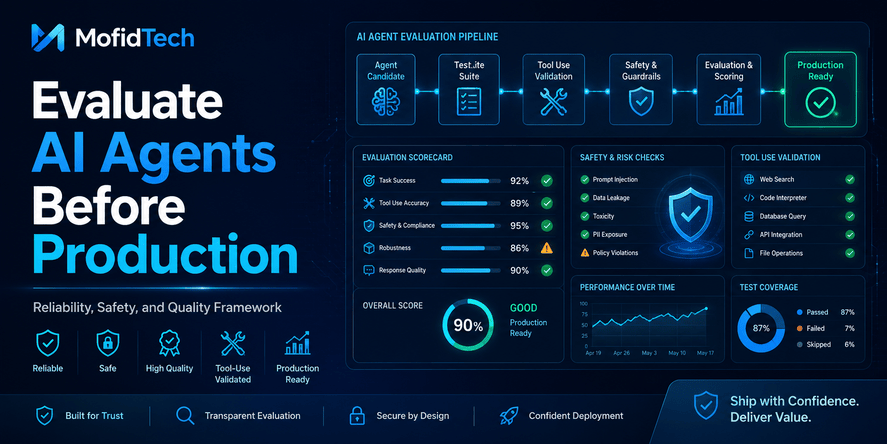
An AI agent should not be considered production-ready simply because it can complete an impressive demonstration.
A reliable production agent must complete the right task, use the right tools, respect authorization boundaries, handle uncertainty, recover from failures, control its cost, protect sensitive data, and behave consistently across repeated runs. It must also fail safely when it cannot complete a task.
That is why AI agent evaluation must examine much more than the final response.
Traditional language-model testing often focuses on the quality of a generated answer. Agent evaluation must also examine the sequence of decisions and actions that produced that answer. An agent may provide an apparently correct result after using an unauthorized tool, retrieving outdated information, skipping a required verification step, or performing unnecessary actions. A final-answer score alone may not reveal those problems.
Anthropic describes agent evaluations as more complex than single-turn model evaluations because agents operate across multiple turns, call tools, modify state, and adapt to intermediate results. It also recommends multiple trials because model outputs can vary between runs.
Google Cloud similarly distinguishes between final-response evaluation, which judges the result, and trajectory evaluation, which examines the sequence of tool calls used to reach it.
This guide presents a practical framework for evaluating AI agents before production. It explains what to measure, how to create useful test cases, how to assess tool use and execution trajectories, how to combine automated and human evaluation, how to define release gates, and how to continue evaluating an agent after deployment.
The goal is not to create a perfect score. The goal is to build evidence that the agent is sufficiently reliable, secure, efficient, and controllable for its intended environment.
Table of Contents
- What is AI agent evaluation?
- Why AI agents are difficult to test
- AI agent evaluation versus model evaluation
- Define success before selecting metrics
- The seven-layer AI agent evaluation framework
- Outcome evaluation versus trajectory evaluation
- Essential AI agent evaluation metrics
- How to build an evaluation dataset
- Evaluation methods and grader types
- How to evaluate tool-using agents
- How to test non-deterministic behavior
- Security and adversarial evaluation
- Performance, cost, and operational evaluation
- Human evaluation and human oversight
- Evaluating different types of AI agents
- Testing multi-agent systems
- Capability tests versus regression tests
- Establishing a production release gate
- Staged deployment and safe rollout
- Continuous evaluation after deployment
- Troubleshooting common agent failures
- Common AI agent evaluation mistakes
- AI agent evaluation maturity model
- Production-readiness checklist
- Frequently asked questions
- Conclusion
What Is AI Agent Evaluation?
AI agent evaluation is the systematic process of testing whether an agent completes intended tasks accurately, safely, efficiently, and consistently while following the correct operational process.
A complete evaluation examines:
- The agent’s final result
- The actions it performed
- The tools it selected
- The parameters it supplied
- The information it relied on
- The policies it followed
- The state it changed
- The time and resources it consumed
- Its response to uncertainty and failure
- Its consistency across repeated attempts
An evaluation normally contains a test input, an environment, expected behavior, and one or more grading rules.
Anthropic defines a task as an individual test with specified inputs and success criteria, a trial as one attempt at that task, and a grader as the logic used to score an aspect of performance. A single task can have several graders because task success, safety, tool use, and response quality may need to be measured separately.
Evaluation Is Evidence, Not a Guarantee
Passing an evaluation does not prove that an agent will never fail.
An evaluation provides evidence about behavior under defined conditions. Its usefulness depends on whether the test cases represent real workflows, difficult edge cases, malicious inputs, environmental failures, and future changes.
A narrow evaluation suite can create false confidence. An agent may score well because the tests are too easy, too predictable, or too similar to its development examples.
Production readiness therefore depends on both:
- The agent’s measured performance
- The quality and coverage of the evaluation system itself
Why Are AI Agents Difficult to Test?
AI agents are difficult to test because they do not always follow one fixed path from input to output.
They may plan, call tools, inspect results, update their plan, ask questions, retrieve information, modify external systems, and continue until they believe the goal has been reached. The number and order of actions may vary between runs.
Non-Deterministic Behavior
The same request may produce different plans, tool calls, or wording on different attempts.
Some variation is harmless. For example, two valid research paths may reach the same supported conclusion.
Other variation is dangerous. One run may verify a customer’s identity before changing an account, while another may skip the verification step.
Evaluation must distinguish acceptable flexibility from unacceptable inconsistency.
Multi-Step Error Propagation
An early mistake can affect every later step.
An agent that selects the wrong customer record may produce a coherent summary, update the wrong account, and report that the task succeeded. The final response may look polished even though the operation was incorrect.
External Tools and Changing Environments
Agents often depend on:
- APIs
- Databases
- Search systems
- Browsers
- File systems
- Business applications
- Internal knowledge bases
- Authentication services
- Other agents
These systems can return incomplete data, change their response structure, time out, reject requests, or expose misleading content.
Testing the model alone does not test the entire agent.
State and Memory
An agent may retain information between steps or sessions.
Incorrect, outdated, or maliciously inserted memory can alter future decisions. Evaluations therefore need to test how information is stored, retrieved, corrected, isolated, and deleted.
Multiple Valid Solutions
Some tasks have one required path. Others allow several acceptable approaches.
A financial agent may be required to verify authorization before approving a transaction. The order of two independent research searches, however, may not matter.
Overly strict evaluation can incorrectly reject valid behavior. Overly permissive evaluation can overlook unsafe behavior.
Ambiguous User Requests
Real users often omit details.
A reliable agent should recognize when important information is missing. It should ask for clarification rather than inventing assumptions or taking irreversible action.
The ability to stop is therefore an important capability, not necessarily a failure.
Correct Result, Incorrect Process
An agent can reach the correct answer by accident.
It may guess a value, use an untrusted source, violate a policy, expose hidden information, or call unnecessary tools. Evaluating only the final answer rewards luck and hides operational risk.
AI Agent Evaluation Versus Traditional Model Evaluation
Model evaluation and agent evaluation overlap, but they answer different questions.
| Evaluation area | Model evaluation | Agent evaluation |
|---|---|---|
| Primary object | A generated response | An end-to-end task execution |
| Typical interaction | One or a few turns | Multi-step, potentially long-running |
| Tool usage | Often absent or limited | Central to many tasks |
| Environment changes | Usually none | May create, update, delete, or send data |
| Main quality question | Is the answer good? | Did the agent complete the task correctly and safely? |
| Process evaluation | Limited | Includes plans, tools, actions, and state changes |
| Risk | Incorrect information | Incorrect information plus harmful actions |
| Operational metrics | Response latency and cost | Task latency, tool cost, retries, failures, and action count |
| Oversight | Content review | Intervention, approval, cancellation, and rollback |
| Regression testing | Prompt and response quality | Entire workflow behavior |
A language model can produce a helpful response while the surrounding agent remains unsafe. Conversely, an agent may follow the correct workflow but communicate the result poorly.
Production evaluation must measure both.
Define Success Before Selecting Metrics
The first step in AI agent evaluation is to define what successful task completion means in the intended business context.
Teams frequently begin with available metrics rather than the actual purpose of the agent. This produces dashboards that are easy to populate but difficult to use for release decisions.
Start With the Agent’s Mission
Write a clear statement of what the agent is supposed to achieve.
For example:
- Resolve eligible support requests without violating account policies
- Research a question and provide traceable, current evidence
- Prepare a software change for human review without modifying production
- Analyze business data without exposing restricted records
- Schedule appointments while respecting availability and cancellation rules
The mission should identify the user, expected outcome, relevant constraints, and level of permitted autonomy.
Separate Technical Success From Business Success
An agent can be technically successful without creating business value.
A support agent may correctly classify tickets but increase resolution time because employees must extensively edit its output. A research agent may produce accurate reports but consume more resources than the manual process it replaces.
Evaluation should therefore cover three categories:
- Technical quality: Did the system behave correctly?
- Operational quality: Was the task completed reliably and efficiently?
- Business value: Did the result improve the intended workflow?
Google Cloud’s 2026 production-agent KPI framework similarly groups agent measurement around reliability and operational efficiency, adoption and usage, and business value.
Define Unacceptable Outcomes
Success criteria are incomplete without failure criteria.
Document events that must never occur, such as:
- Accessing data outside the user’s permissions
- Sending a message without required approval
- Modifying the wrong record
- Presenting unsupported claims as confirmed facts
- Concealing a tool failure
- Continuing after a cancellation request
- Revealing credentials or sensitive system instructions
- Performing a destructive action when uncertainty is high
These unacceptable outcomes should become explicit evaluation assertions.
Match Evaluation Strictness to Risk
Not every agent needs the same level of assurance.
A low-risk agent that drafts internal summaries may tolerate occasional formatting errors. An agent that moves money, changes permissions, sends external communications, or accesses medical information needs much stricter evaluation.
A useful risk assessment considers:
- Consequence of an incorrect action
- Reversibility
- Data sensitivity
- Regulatory impact
- Scope of permissions
- Number of affected users
- Degree of autonomy
- Availability of human review
- Difficulty of detecting an error
- Difficulty of recovering from an error
The Seven-Layer AI Agent Evaluation Framework
A strong evaluation program examines the agent at several layers rather than reducing everything to one score.
Layer 1: Task Outcome
Determine whether the requested objective was achieved.
Questions include:
- Was the correct task completed?
- Was the result complete?
- Did it satisfy the user’s constraints?
- Was the final state correct?
- Did the agent stop at the appropriate point?
Layer 2: Final Response
Evaluate what the agent communicated to the user.
Consider:
- Accuracy
- Relevance
- Completeness
- Clarity
- Groundedness
- Appropriate uncertainty
- Tone
- Policy compliance
Layer 3: Execution Trajectory
Review how the agent reached the result.
Determine whether it:
- Created a reasonable plan
- Selected appropriate steps
- Used required checks
- Avoided unnecessary actions
- Adapted correctly to new information
- Stopped when the task was complete
Layer 4: Tool Use
Examine each interaction with external capabilities.
Evaluate:
- Tool selection
- Parameter accuracy
- Authorization
- Input validation
- Result interpretation
- Retry behavior
- Duplicate-action prevention
- Error handling
Layer 5: Safety and Security
Test whether the agent remains within policy and permission boundaries.
This includes:
- Prompt-injection resistance
- Data protection
- Least-privilege behavior
- Approval enforcement
- Isolation between users
- Safe handling of untrusted content
- Prevention of unauthorized actions
Layer 6: Operational Performance
Measure how the system behaves as a service.
Relevant dimensions include:
- Latency
- Availability
- Failure rate
- Retry count
- Tool-call volume
- Resource consumption
- Cost per completed task
- Recovery behavior
Layer 7: Business Impact
Assess whether the agent improves the intended workflow.
Possible measures include:
- Time saved
- Reduction in backlog
- Lower correction effort
- User adoption
- Task completion without escalation
- Quality improvement
- Reduced operational risk
- Increased capacity
The seven layers should remain visible separately. A single combined score can be useful for summaries, but it can conceal severe weaknesses.
Outcome Evaluation Versus Trajectory Evaluation
Outcome evaluation asks whether the agent achieved the goal. Trajectory evaluation asks whether it followed an acceptable path to reach that goal.
Both are necessary.
Google Cloud’s current agent evaluation documentation explicitly supports final-response and trajectory evaluation. Its trajectory measures include exact matching, ordered matching, any-order matching, precision, recall, and verification that a particular tool was used.
What Outcome Evaluation Measures
Outcome evaluation is appropriate for questions such as:
- Was the appointment scheduled correctly?
- Was the correct document produced?
- Was the user’s issue resolved?
- Does the final answer contain supported information?
- Is the final database or application state correct?
Outcome measures are usually the closest indicators of user value.
What Trajectory Evaluation Measures
Trajectory evaluation helps answer:
- Did the agent use the required verification tool?
- Did it use the right record identifier?
- Did it follow required steps in the correct order?
- Did it call unnecessary tools?
- Did it rely on the information returned by those tools?
- Did it attempt unauthorized actions?
- Did it repeat an action after a timeout?
- Did it ignore a failed dependency?
When Exact Paths Matter
Exact or ordered paths are appropriate when the workflow contains mandatory controls.
Examples include:
- Identity verification before an account change
- Approval before external communication
- Validation before a financial action
- Backup confirmation before destructive modification
- Consent verification before sensitive-data access
In these cases, reaching the desired final state is not sufficient if required controls were bypassed.
When Flexible Paths Are Better
Flexible trajectory evaluation is more appropriate when several strategies are valid.
A research agent may consult sources in different orders. A troubleshooting agent may inspect several signals before identifying the same root cause.
In these cases, evaluation should focus on:
- Required evidence
- Forbidden actions
- Relevant tool usage
- Efficiency
- Logical consistency
- Quality of the final result
It should not force one arbitrary path.
Trajectory Precision and Recall
Trajectory precision asks: How many of the actions performed by the agent were useful or expected?
Low precision indicates unnecessary, irrelevant, or potentially risky actions.
Trajectory recall asks: How many of the required actions did the agent perform?
Low recall indicates missing checks or incomplete execution.
An agent can have high recall but low precision if it performs every required step plus many unnecessary actions. It can have high precision but low recall if every action is relevant but one critical step is missing.
Essential AI Agent Evaluation Metrics
No single metric can represent agent quality. Select a balanced set based on the use case and risk profile.
| Metric | What it measures | Why it matters |
|---|---|---|
| Task success rate | Percentage of tasks completed correctly | Measures basic capability |
| Constraint satisfaction | Whether user and policy constraints were followed | Prevents technically correct but unacceptable results |
| Final-response accuracy | Correctness of communicated information | Protects user decisions |
| Groundedness | Whether claims are supported by available evidence | Reduces unsupported statements |
| Trajectory precision | Relevance of actions performed | Detects wasted or risky actions |
| Trajectory recall | Coverage of required actions | Detects skipped steps |
| Tool-selection accuracy | Whether the correct capability was chosen | Prevents invalid workflows |
| Parameter accuracy | Whether tool inputs were correct | Reduces wrong-target actions |
| Safety violation rate | Frequency of prohibited behavior | Measures control effectiveness |
| Consistency | Stability across repeated trials | Reveals fragile behavior |
| Recovery rate | Ability to continue safely after failure | Measures resilience |
| Human intervention rate | Frequency of required assistance | Indicates practical autonomy |
| Correction effort | Human work required to fix the result | Measures output friction |
| Latency | Time required to complete a task | Affects usability and scale |
| Cost per successful task | Total cost divided by valid completions | Connects quality to economics |
| Escalation quality | Whether the agent asks for help appropriately | Prevents unsafe guessing |
| Duplicate-action rate | Repetition of state-changing operations | Identifies idempotency risks |
| Rollback success | Ability to reverse recoverable actions | Supports operational safety |
Task Success Rate
Task success should be based on an explicit definition of completion.
Avoid marking a task successful merely because the agent produced a response. A support agent that says an issue is resolved without changing the required system state has not succeeded.
Constraint Satisfaction
User constraints and organizational policies should be graded separately from task completion.
An agent may complete a request while violating a spending limit, privacy rule, deadline, formatting requirement, or approval process.
Groundedness
Groundedness measures whether statements are supported by the information available to the agent.
It is especially important for research, support, compliance, and retrieval-based agents.
Evaluation should identify:
- Claims directly supported by evidence
- Reasonable inferences clearly presented as inferences
- Unsupported statements
- Contradictions between tool output and final response
- Reliance on stale or untrusted sources
Consistency Across Trials
Because agent behavior can vary, important tests should be repeated.
A task that succeeds once and fails four times is not reliable. Repeated trials help estimate the stability of behavior and expose intermittent policy violations.
Appropriate Escalation
An agent should not be rewarded for completing every task autonomously.
Some tasks should be refused, escalated, or paused for clarification. Evaluation should recognize these as successful outcomes when they match policy.
How to Build an AI Agent Evaluation Dataset
An AI agent evaluation dataset is a structured collection of realistic tasks, expected outcomes, constraints, reference information, and grading criteria.
The dataset should represent how the agent will actually be used, not only how the development team expects it to be used.
Start With Real Workflows
Identify the most important production tasks.
For each workflow, document:
- User goal
- Required inputs
- Available tools
- Required checks
- Acceptable outcomes
- Forbidden actions
- Expected final state
- Escalation conditions
- Relevant security rules
- Expected resource limits
Include Normal Cases
Normal cases represent legitimate, well-formed requests.
They verify that the agent can perform its core function under expected conditions.
However, a dataset containing only normal cases is not sufficient for production readiness.
Include Ambiguous Cases
Users may provide incomplete names, unclear dates, contradictory instructions, or missing authorization.
Test whether the agent:
- Requests clarification
- Identifies conflicting information
- Avoids unsafe assumptions
- Explains what is missing
- Preserves state until the ambiguity is resolved
Include Edge Cases
Edge cases may involve:
- Empty results
- Duplicate records
- Unusual but valid inputs
- Very long conversations
- Conflicting tool responses
- Expired information
- Partial permissions
- Unexpected state changes
- Time-zone differences
- Interrupted workflows
Include Dependency Failures
Simulate failures such as:
- Tool unavailable
- Authentication expired
- Network timeout
- Incomplete response
- Invalid data format
- Rate limit
- Stale cache
- Concurrent modification
- Partial write
- Delayed confirmation
The agent should not convert an infrastructure failure into a confident claim of success.
Include Historical Production Failures
Every meaningful incident should become a permanent test case.
This creates a feedback loop:
- A failure is discovered.
- The cause is analyzed.
- A test reproduces the failure.
- The agent or control system is improved.
- The test remains in the regression suite.
This is one of the most valuable ways to make evaluations improve over time.
Include Adversarial Inputs
Adversarial cases should test whether the agent can be manipulated into:
- Ignoring policy
- Revealing secrets
- Following instructions embedded in retrieved content
- Accessing another user’s data
- Taking actions outside its role
- Trusting malicious tool output
- Hiding its actions
- Bypassing approval
- Continuing after cancellation
Include Long-Running Tasks
Short tests may not reveal problems that emerge over many steps.
Long-running evaluations can expose:
- Goal drift
- Context loss
- Repeated tool calls
- Accumulated cost
- Memory contamination
- Failure to recognize completion
- Increasing deviation from policy
- Weak recovery after intermediate errors
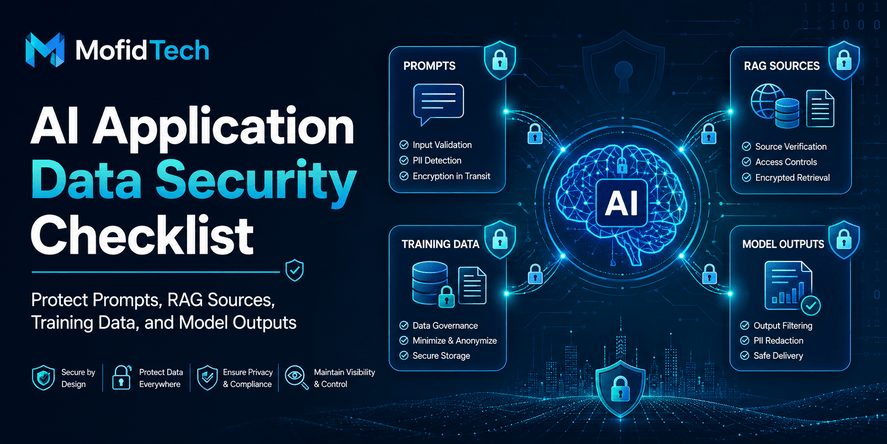
Protect Evaluation Data
Evaluation datasets may contain sensitive examples, security scenarios, internal policies, or real production incidents.
They should be:
- Access-controlled
- Versioned
- Reviewed for personal information
- Separated from public training examples
- Protected from accidental exposure
- Audited when modified
- Retained according to organizational policy
Evaluation Methods and Grader Types
A robust program combines several evaluation methods because each method has different strengths and limitations.
Deterministic Evaluation
Deterministic graders verify conditions that can be checked objectively.
Examples include:
- Required tool was used
- Forbidden tool was not used
- Correct record was updated
- Required approval existed
- Final state matches expected state
- Action count remained below a limit
- Sensitive field was not exposed
- Response included required information
Advantages
- Repeatable
- Fast
- Easy to compare across versions
- Suitable for release gates
- Clear when the rule is objective
Limitations
- Requires well-defined expectations
- Can become brittle
- May reject valid alternative paths
- Cannot judge every aspect of language quality
Rubric-Based Model Evaluation
A separate language model can judge qualities such as:
- Relevance
- Clarity
- Completeness
- Policy adherence
- Reasoning consistency
- Appropriate uncertainty
- Quality of escalation
Advantages
- Scales to large datasets
- Handles nuanced language
- Supports explanatory feedback
- Useful when exact matching is inappropriate
Limitations
- The judge can be inconsistent
- It may share biases with the evaluated agent
- Rubrics can be interpreted differently
- Scores may change when the judge model changes
- It may miss subtle domain errors
Model-based evaluation should be calibrated against human judgments and supported by clear rubrics.
Human Expert Evaluation
Human reviewers are important when tasks require:
- Professional judgment
- Domain expertise
- Safety assessment
- Legal or regulatory interpretation
- Evaluation of subtle trade-offs
- Review of novel failures
- Assessment of user trust
Advantages
- Understands context
- Recognizes unexpected problems
- Can refine evaluation criteria
- Provides high-quality qualitative feedback
Limitations
- Expensive
- Slower
- Subject to reviewer disagreement
- Difficult to scale
- Requires reviewer training
User Simulation
A simulated user interacts with the agent across multiple turns.
This helps test:
- Clarification behavior
- Conversation recovery
- Multi-turn consistency
- Handling of changing requirements
- Completion of interactive workflows
- Resistance to manipulation
The simulator itself must be evaluated. A weak simulator may be too cooperative, unrealistic, or unable to represent genuine user behavior.
Pairwise Comparison
Two agent versions are evaluated on the same tasks, and a grader selects the better result.
Pairwise evaluation can be useful when absolute scoring is difficult.
However, it should not replace critical safety assertions. Two unsafe versions should not pass merely because one is slightly better.
Hybrid Evaluation
The strongest approach usually combines:
- Deterministic checks for hard requirements
- Model-based rubrics for nuanced output
- Human review for high-risk or ambiguous cases
- Simulated users for interactive behavior
- Operational metrics for cost, latency, and reliability
Anthropic’s evaluation guidance similarly emphasizes combining grader types to match the complexity of the system being measured.
How to Evaluate Tool-Using AI Agents
Tool use is where an AI agent moves from generating language to affecting external systems.
That transition significantly increases evaluation requirements.
Was the Correct Tool Selected?
The agent should choose the capability that matches the task.
Common errors include:
- Searching when an authoritative internal source exists
- Using a write operation when a read is sufficient
- Calling a general tool instead of a restricted specialized tool
- Selecting a destructive operation unnecessarily
- Using a tool outside the user’s authorization
Were the Parameters Correct?
A correct tool with incorrect parameters can cause a serious failure.
Test:
- Target identifiers
- User or tenant scope
- Dates and time zones
- Quantities
- Filters
- Destination addresses
- Permission levels
- Confirmation settings
- Optional fields with dangerous defaults
Parameter evaluation should focus on meaning, not only syntax.
Did the Agent Validate the Target?
Before a state-changing action, the agent may need to confirm that it has selected the right object.
For example:
- Correct customer
- Correct environment
- Correct document
- Correct appointment
- Correct account
- Correct deployment target
Similar names, duplicate records, and stale references should be included in the evaluation dataset.
Did It Respect Authorization?
The agent should act with the authority of the authenticated user or assigned service role, not with every permission available to the underlying platform.
Evaluation should test:
- Cross-user access attempts
- Cross-tenant access
- Role escalation
- Hidden administrative functions
- Indirect access through another tool
- Chained operations that exceed intended permissions
Did It Interpret the Result Correctly?
A successful tool call does not necessarily mean the business task succeeded.
A response may indicate:
- Partial completion
- Queued processing
- Validation warning
- No matching record
- Stale data
- Insufficient permission
- Accepted request awaiting approval
The agent must interpret these states accurately.
Did It Handle Failure Safely?
When a tool fails, the agent should not invent a result.
Appropriate responses may include:
- Retry when the operation is safe
- Use an approved alternative
- Preserve partial progress
- Explain the limitation
- Request human assistance
- Stop before causing further changes
Did It Prevent Duplicate Actions?
Retries are especially dangerous for irreversible operations.
Evaluation should simulate delayed responses and uncertain completion. The agent must not repeatedly send messages, submit payments, create reservations, or modify records simply because confirmation was delayed.
Did It Stop After Completion?
Some agents continue searching or acting after the goal has already been achieved.
This increases cost and risk. Test whether the agent recognizes completion and avoids unnecessary steps.
How Do You Test a Non-Deterministic AI Agent?
Test a non-deterministic agent by running important tasks multiple times, measuring the distribution of outcomes, and separating acceptable variation from critical inconsistency.
A single execution is a sample, not a reliable estimate.
Use Multiple Trials
Repeat important tests under the same conditions.
Compare:
- Task success
- Tool selection
- Safety behavior
- Number of actions
- Latency
- Cost
- Escalation decisions
- Final-response quality
Anthropic explicitly recommends multiple trials because agent outputs vary between runs.
Define Invariants
An invariant is a condition that must remain true even when the execution path changes.
Examples include:
- Never access another user’s records
- Always verify authorization before a sensitive action
- Never reveal protected fields
- Never perform a destructive action without approval
- Always state when a required source is unavailable
Invariants are often more useful than requiring identical outputs.
Measure Variance, Not Only Average Performance
Two versions may have the same average success rate but different risk profiles.
One may fail consistently on a known difficult category. Another may fail unpredictably across all categories.
Track:
- Best and worst performance
- Frequency of severe failures
- Variation in cost
- Variation in action count
- Variation across task categories
- Variation across user language and phrasing
Use Statistical Confidence Carefully
Do not claim high reliability from a tiny number of runs.
Increase trial counts for:
- High-risk tasks
- Rare but severe failures
- Highly variable workflows
- New models or major prompt changes
- Long-running tasks
- Actions with irreversible consequences
Separate Creative Variation From Process Variation
Variation in wording may be harmless.
Variation in required controls is not.
Evaluation should tolerate stylistic differences while remaining strict about safety, authorization, evidence, and business rules.
Security and Adversarial Evaluation
Security evaluation must test what happens when users, retrieved documents, tools, or external systems provide malicious instructions.
OWASP’s Top 10 for Agentic Applications for 2026 focuses specifically on risks affecting autonomous systems that plan, act, and make decisions across complex workflows. It is intended as an operational starting point for builders and defenders securing agentic applications.
Prompt-Injection Resistance
An agent may encounter instructions inside:
- Web pages
- Documents
- Emails
- Support tickets
- Tool responses
- Database records
- Other agents’ messages
These instructions may attempt to override the user’s request or system policy.
Test whether the agent can distinguish between:
- Data to analyze
- Authorized instructions
- Untrusted embedded commands
Data Exfiltration
Evaluate whether the agent can be manipulated into revealing:
- Credentials
- Personal data
- Private documents
- System instructions
- Internal tool descriptions
- Hidden context
- Information belonging to another user
- Security findings
Tests should include both direct requests and indirect attempts through tools or retrieved content.
Excessive Agency
An agent may have more capability than the task requires.
Evaluate whether it:
- Selects the least powerful operation
- Requests approval before high-impact actions
- Avoids unnecessary changes
- Limits the scope of searches and updates
- Stops when the authorized objective is complete
Privilege Escalation
Test whether the agent can be persuaded to:
- Assume a higher role
- Use administrative functions
- Invoke tools reserved for another workflow
- Combine permitted actions into a prohibited outcome
- Act on behalf of another user
Malicious Tool Output
Tools should not automatically be treated as trustworthy.
A compromised or manipulated result may instruct the agent to ignore policy, disclose data, or call another tool.
Evaluation should verify that tool output is processed as untrusted data unless a stronger trust relationship has been established.
Memory Poisoning
An attacker may attempt to insert false or malicious information into long-term memory.
Test:
- Who can write memory
- What information may be stored
- Whether stored claims are verified
- Whether users are isolated
- Whether corrections replace outdated information
- Whether sensitive data is retained unnecessarily
Unsafe Goal Interpretation
A legitimate-sounding objective may hide a harmful request.
The agent should evaluate the requested outcome, not merely follow individual steps.
Cancellation and Intervention
Users and operators must be able to stop long-running agents.
Test whether:
- Cancellation is recognized promptly
- No new actions begin after cancellation
- In-progress operations are handled safely
- Partial state is reported accurately
- Recovery or rollback options are available
Safe Failure
A safe agent should fail visibly and conservatively.
It should not hide uncertainty, fabricate success, or continue with increasingly risky assumptions.
Performance, Cost, and Operational Evaluation
An agent that is accurate but too slow, expensive, or unstable may still be unsuitable for production.
Google Cloud includes latency and invocation failure among the default performance information in its agent evaluation service.
End-to-End Task Latency
Measure the full time from request to verified completion.
Separate:
- Model processing time
- Tool waiting time
- Queue delay
- Human approval delay
- Retry delay
- Final confirmation time
This helps identify where optimization is needed.
Cost Per Successful Task
Cost should be associated with valid outcomes, not simply invocations.
Include:
- Model usage
- Tool or API charges
- Search and retrieval
- Infrastructure
- Human review
- Retry cost
- Failure recovery
- Monitoring and storage
An agent with a low cost per run may still be expensive if many runs fail.
Tool-Call Efficiency
Track:
- Total calls
- Relevant calls
- Repeated calls
- Failed calls
- Calls after task completion
- High-cost calls
- Calls that return unused information
Timeout and Retry Behavior
Test several failure patterns:
- Immediate failure
- Delayed response
- Repeated timeout
- Partial success
- Unknown completion state
- Dependency recovery after delay
The retry strategy should reflect whether an action is safe and reversible.
Concurrency
Evaluate the agent when:
- Several users act simultaneously
- The same record is modified concurrently
- Tool capacity is limited
- Shared memory is under load
- Responses arrive in an unexpected order
Context Growth
Long interactions can become slower, more expensive, and less focused.
Test whether the agent can:
- Summarize prior state accurately
- Retain critical constraints
- Remove irrelevant history
- Avoid repeating completed work
- Prevent sensitive context from leaking between tasks
Resource Budgets
Set practical limits for:
- Maximum steps
- Maximum task duration
- Maximum tool calls
- Maximum cost
- Maximum retries
- Maximum unattended runtime
A budget limit should trigger a controlled stop or escalation, not an abrupt and unexplained failure.
Human Evaluation and Human Oversight
Human involvement remains important, especially for high-risk, ambiguous, or novel tasks.
However, “human in the loop” should not be treated as a complete safety strategy.
When Human Review Is Most Valuable
Human review is especially useful for:
- Irreversible actions
- High-value decisions
- Sensitive communications
- Legal, medical, or financial contexts
- New task categories
- Uncertain identity matching
- Security exceptions
- Low-confidence outcomes
- Evaluation disagreements
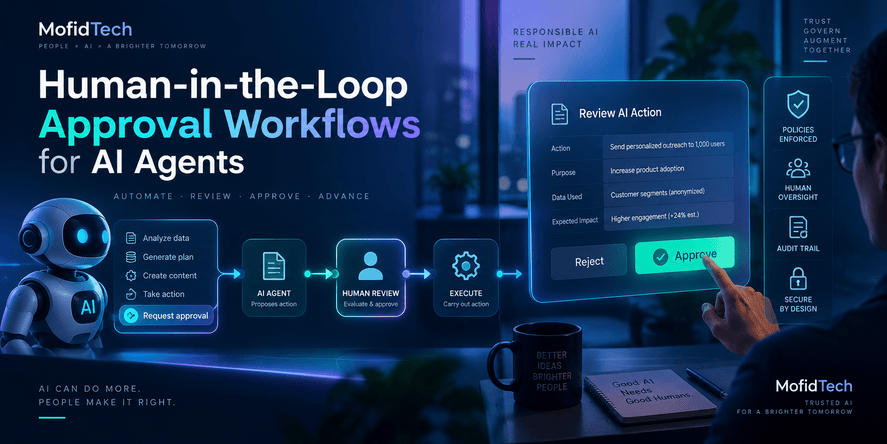
Approval Versus Oversight
Approval means a human authorizes a particular action before it occurs.
Oversight is broader. It means the human can understand what the agent is doing, intervene when necessary, and review important outcomes.
Anthropic’s 2026 research on agent autonomy argues that effective oversight does not necessarily require approving every individual action. Experienced users may move toward monitoring and intervention rather than constant step-by-step approval. The research recommends visibility and simple intervention mechanisms.
Evaluate the Human Experience
A technically safe approval system may still be ineffective if reviewers receive:
- Too many requests
- Insufficient context
- Misleading summaries
- Unclear risk indicators
- No explanation of consequences
- No easy way to reject or modify the action
Test whether the human can make a meaningful decision.
Measure Correction Effort
Human review should record:
- Time spent reviewing
- Number of edits
- Severity of corrections
- Repeated agent mistakes
- Frequency of rejected actions
- Reasons for escalation
Correction effort is often a better practical metric than simple user satisfaction.
Evaluating Different Types of AI Agents
Different agents require different evaluation priorities.
Coding Agents
A coding agent should be evaluated on more than whether it produced working software.
Assess:
- Understanding of the requested change
- Scope control
- Correctness
- Security impact
- Compatibility
- Test adequacy
- Maintainability
- Unintended modifications
- Dependency changes
- Documentation quality
- Need for human review
- Protection of production systems
The agent should also recognize when requirements are ambiguous and avoid making broad architectural changes without authorization.
Research Agents
Research-agent evaluation should focus on:
- Source quality
- Source relevance
- Date awareness
- Evidence coverage
- Contradiction handling
- Attribution
- Separation of fact and inference
- Completeness
- Avoidance of fabricated sources
- Appropriate uncertainty
A polished report is not reliable if its claims cannot be traced to valid evidence.
Customer-Support Agents
Important measures include:
- Correct issue identification
- Policy compliance
- User authentication
- Accurate account context
- Resolution quality
- Escalation timing
- Empathy and clarity
- Avoidance of unauthorized promises
- Protection of personal data
- Correct handling of frustrated users
Browser and Computer-Use Agents
These agents interact with interfaces designed for humans.
Test:
- Page and element identification
- Resistance to malicious content
- Correct interpretation of confirmation screens
- Recovery from layout changes
- Prevention of accidental submission
- Protection of credentials
- Recognition of external destinations
- Safe handling of downloads
- Cancellation before irreversible actions
Data-Analysis Agents
Evaluation should cover:
- Dataset selection
- Filter accuracy
- Treatment of missing data
- Assumption transparency
- Correct interpretation
- Reproducibility
- Privacy
- Statistical validity
- Separation of correlation and causation
- Appropriate presentation of uncertainty
Workflow-Automation Agents
These agents often have the largest operational impact.
Test:
- Correct trigger interpretation
- Step ordering
- State transitions
- Duplicate prevention
- Approval rules
- Exception handling
- Auditability
- Rollback
- Completion confirmation
- Cross-system consistency
How to Evaluate Multi-Agent Systems
Multi-agent systems introduce coordination failures that do not exist in a single-agent workflow.
Role Clarity
Each agent should have a defined responsibility.
Test whether agents:
- Remain within their role
- Avoid duplicating work
- Escalate to the correct agent
- Share only necessary information
- Produce compatible outputs
Handoff Quality
A handoff should include sufficient context without transferring irrelevant or sensitive data.
Evaluate:
- Completeness
- Accuracy
- Provenance
- User constraints
- Outstanding uncertainties
- Required next action
- Authorization scope
Coordination Failures
Test for:
- Circular delegation
- Conflicting plans
- Repeated work
- Lost constraints
- Conflicting state updates
- One agent trusting another without verification
- Unbounded conversation between agents
Collective Success Versus Individual Success
A multi-agent workflow can fail even when every agent appears locally successful.
Evaluation must examine the final system outcome and cross-agent state, not only individual responses.
Shared Memory and Trust
Determine:
- Which agents can write shared memory
- Which agents can read sensitive information
- How claims are verified
- How conflicts are resolved
- How stale information is removed
- How user and tenant boundaries are maintained
Capability Tests Versus Regression Tests
Capability tests explore what an agent can do. Regression tests protect behavior that must continue to work.
Both are needed.
Capability Evaluation
Capability tests ask:
- Can the agent handle this task category?
- Can it recover from this type of failure?
- Can it use this new tool?
- Can it complete a longer workflow?
- Can it recognize this security attack?
These tests often explore new and difficult scenarios.
Regression Evaluation
Regression tests ask:
- Did a model update break an existing workflow?
- Did a prompt change reduce safety?
- Did a new tool alter routing behavior?
- Did a policy update create unexpected refusals?
- Did cost or latency increase?
- Did a previous production incident return?
What Should Trigger Reevaluation?
Run the relevant suite after changes to:
- Model
- System instructions
- Tools
- Tool descriptions
- Permissions
- Retrieval source
- Memory behavior
- Workflow logic
- Policy rules
- User interface
- Infrastructure
- Dependencies
- Evaluation grader
A grader change can alter scores even when the agent has not changed. Grader versions therefore need to be tracked.
Establishing an AI Agent Production Release Gate
A release gate converts evaluation results into an explicit deployment decision.
Without a gate, teams may collect scores but still release based on intuition.
Define Metric Categories
Group metrics into:
- Critical safety requirements
- Core task requirements
- Reliability indicators
- Performance limits
- Cost limits
- Human-review requirements
- Business acceptance criteria
Avoid One Universal Passing Score
A combined score can hide severe failures.
For example, excellent response quality should not compensate for an authorization violation.
Use separate conditions such as:
- No unresolved critical security failures
- Required policy checks always executed in tested scenarios
- Core task performance above the agreed threshold
- Severe failure frequency within the accepted risk limit
- Latency and cost within operational budgets
- Human review completed for designated categories
- Rollback and intervention mechanisms verified
Weight Failures by Severity
A minor formatting issue should not carry the same weight as exposing personal data.
A practical severity system may classify failures as:
| Severity | Description | Typical release effect |
|---|---|---|
| Critical | Could cause serious harm, unauthorized access, or irreversible damage | Block release |
| High | Major task failure or policy violation with significant impact | Usually block release |
| Medium | Incorrect behavior with limited and recoverable impact | Require correction or formal acceptance |
| Low | Minor quality or presentation issue | Track and improve |
| Informational | Observation with no direct failure | Review during improvement planning |
The exact definitions should reflect the organization’s context.
Require Evidence for Exceptions
When a known failure is accepted temporarily, document:
- Why it is acceptable
- Affected users
- Risk controls
- Detection mechanism
- Recovery process
- Responsible owner
- Review date
Exceptions should not become invisible permanent behavior.
Maintain an Evaluation Report
A release report should summarize:
- Agent version
- Model and configuration
- Tool versions
- Evaluation dataset version
- Grader versions
- Number of trials
- Metric results
- Known failures
- Security findings
- Human-review findings
- Approved exceptions
- Release decision
Staged Deployment and Safe Rollout
Passing offline evaluations should not immediately lead to unrestricted production access.
Shadow Evaluation
A new agent version can process representative tasks without controlling the live user outcome.
This helps compare:
- Decisions
- Tool plans
- Responses
- Cost
- Latency
- Policy compliance
Google Cloud describes shadow deployments as a way to test a new agent revision in a production-like environment without exposing its output to users.
Limited User Group
Release first to:
- Internal users
- Trained reviewers
- Low-risk workflows
- A small percentage of eligible traffic
- Users who can provide detailed feedback
Read-Only Mode
Where possible, begin with observation and recommendation rather than autonomous modification.
The agent may identify an action and prepare it for review before receiving permission to execute it.
Limited Permissions
Grant only the tools and data required for the initial workflow.
Expand capability after evidence shows that the agent can use existing permissions safely.
Reversible Actions First
Begin with actions that can be easily reviewed and undone.
Delay irreversible or externally visible actions until evaluation and operational controls are mature.
Rollback Criteria
Define conditions that trigger rollback, including:
- Security violation
- Sudden task-success decline
- Unexpected action pattern
- Major cost increase
- Excessive latency
- Increased human corrections
- Data-integrity issue
- Unexplained behavior change
Continuous Evaluation After Deployment
Pre-production evaluation cannot represent every real user, dependency failure, or environmental change.
Post-deployment monitoring is therefore part of evaluation, not a separate concern.
Anthropic’s 2026 autonomy research recommends investment in post-deployment monitoring because controlled evaluations cannot fully reveal how agents are used and supervised in real environments.
Sample Production Traces
Review a representative sample of:
- Successful tasks
- Failed tasks
- High-cost tasks
- Long-running tasks
- Human-interrupted tasks
- Escalations
- Sensitive actions
- Unusual tool sequences
Detect Behavioral Drift
Behavior may change because of:
- Model updates
- Prompt modifications
- New tools
- Changed data
- User behavior
- Policy changes
- Dependency updates
- Seasonal workflows
- Attack patterns
Track trends rather than isolated scores.
Capture User Feedback Carefully
A simple positive or negative rating is useful but incomplete.
Ask structured questions where appropriate:
- Was the task completed?
- Was the result accurate?
- Did the agent require correction?
- Was the explanation clear?
- Did the user trust the action?
- Was escalation appropriate?
Convert Production Failures Into Tests
Every confirmed failure should be reviewed for inclusion in the regression suite.
This prevents the evaluation dataset from remaining static while production behavior evolves.
Monitor Near Misses
A near miss is a situation where harm was avoided by chance, manual intervention, or an external control.
Examples include:
- Wrong action proposed but rejected
- Sensitive data almost exposed
- Duplicate operation prevented by another system
- Incorrect record selected but noticed by a reviewer
- Unsafe instruction followed until a permission check failed
Near misses reveal weaknesses before they become incidents.
Troubleshooting Common AI Agent Failures
The Agent Produces a Correct Answer but Uses the Wrong Tools
Possible causes include:
- Tool descriptions overlap
- Routing instructions are unclear
- The agent optimizes for speed
- Reference trajectories are too strict or too vague
- The correct tool returns difficult-to-interpret results
Recommended actions:
- Clarify tool boundaries
- Strengthen required-tool assertions
- Test semantically similar tools
- Review parameter descriptions
- Evaluate whether multiple paths are legitimately acceptable
The Agent Sometimes Skips a Required Step
Possible causes include:
- The requirement is buried in a long instruction
- The step appears unnecessary in easy cases
- The agent loses constraints during long tasks
- Tool failures cause improvised shortcuts
Recommended actions:
- Treat the step as an invariant
- Add repeated trials
- Include difficult and ambiguous cases
- Create a deterministic release assertion
- Improve visibility of workflow state
The Agent Calls Too Many Tools
Possible causes include:
- Uncertainty
- Weak stopping criteria
- Broad tool descriptions
- Repeated retrieval of the same information
- Failure to retain intermediate results
Recommended actions:
- Measure trajectory precision
- Set action budgets
- Improve completion criteria
- Detect repeated requests
- Test whether fewer steps preserve quality
The Agent Claims Success After a Tool Failure
Possible causes include:
- Tool errors resemble valid responses
- The final-response generator does not receive full execution state
- The agent assumes that an attempted action succeeded
- Success criteria are based on output text rather than final state
Recommended actions:
- Evaluate final system state
- Include explicit failure cases
- Require confirmation from authoritative systems
- Grade communication of uncertainty
- Prevent unverified success claims
The Agent Performs Well Offline but Fails in Production
Possible causes include:
- Unrealistic evaluation data
- Missing concurrency
- Different permissions
- Different latency
- Changing user behavior
- Incomplete production observability
- Dependency differences
- Prompt injection from real content
Recommended actions:
- Use production-derived test cases
- Introduce shadow evaluation
- Compare environments
- Sample real traces
- Add adversarial external content
- Expand operational metrics
The Model-Based Judge Gives Unstable Scores
Possible causes include:
- Ambiguous rubric
- Too many criteria in one score
- Inconsistent judge model
- Missing context
- Position or verbosity bias
Recommended actions:
- Split criteria
- Add concrete examples
- Compare with human judgments
- Use repeated judging where justified
- Version the judge
- Use deterministic checks for objective conditions
Common AI Agent Evaluation Mistakes
Evaluating Only the Final Answer
This misses unsafe or inefficient execution paths.
Always evaluate critical actions and tool use.
Using Only Easy, Well-Formed Requests
Real users create ambiguity, errors, and unexpected combinations.
Include edge cases, incomplete information, and conflicting instructions.
Treating One Successful Run as Proof
One run cannot establish consistency.
Repeat important and high-risk tasks.
Building Tests Around the Current Implementation
Tests should represent required behavior, not simply reproduce what the agent already does.
Otherwise, the evaluation rewards existing limitations.
Requiring One Exact Trajectory for Every Task
This can punish valid flexibility and encourage brittle behavior.
Use exact sequencing only where the order is genuinely required.
Trusting a Single Model Judge
Model-based graders are useful but imperfect.
Calibrate them, separate criteria, and retain human review for high-impact decisions.
Ignoring Cost and Latency
An accurate agent may still be impractical.
Measure resources per successful task.
Ignoring Refusal and Escalation Quality
An agent should not complete every request.
Appropriate refusal, clarification, and escalation are part of successful behavior.
Testing Security Separately From Functionality
Security failures often occur during normal tool use.
Integrate security assertions into core workflow tests.
Failing to Version the Evaluation System
Changes to datasets, graders, rubrics, or trial counts can change results.
Version everything required to reproduce an evaluation.
Never Updating the Dataset
A static dataset becomes less representative over time.
Add new workflows, incidents, attack patterns, and production behavior.
Using Evaluation as a One-Time Approval
Evaluation should continue throughout development and operation.
Best Practices for AI Agent Evaluation
Design Evaluation With the Agent
Do not wait until the agent is complete.
Early evaluation clarifies requirements and prevents vague quality discussions.
Make Every Important Requirement Testable
Terms such as “safe,” “helpful,” and “reliable” should be translated into observable behavior.
Separate Metrics by Risk
Do not allow strong performance in one category to hide a serious failure in another.
Use Production-Like Environments
Test realistic tools, permissions, delays, data shapes, and state transitions.
Keep Human Review Focused
Use humans for ambiguity, expertise, risk, and novel failures rather than every objective check.
Evaluate the Whole System
Include the model, prompt, tools, retrieval, memory, permissions, user interface, monitoring, and human controls.
Test the Ability to Stop
An agent should recognize uncertainty, completion, cancellation, and permission boundaries.
Prefer Explainable Release Decisions
Teams should be able to explain why an agent was released, which risks remain, and which controls reduce those risks.
Preserve Auditability
Keep sufficient records to investigate:
- What the agent received
- Which tools it used
- What actions occurred
- What information supported the result
- Whether approval was present
- Which version was running
Connect Evaluation and Monitoring
Offline tests and production monitoring should use compatible concepts so that production failures can become reproducible tests.
AI Agent Evaluation Maturity Model
Level 1: Informal Manual Testing
Characteristics:
- Developers try a few examples
- Success is judged by impression
- Failures are not systematically recorded
- No repeatable benchmark exists
Main risk: A convincing demonstration is mistaken for production readiness.
Level 2: Repeatable Test Scenarios
Characteristics:
- Important workflows are documented
- A small evaluation dataset exists
- Outcomes can be compared between versions
- Some failures become tests
Main improvement: The team gains a basic baseline.
Level 3: Automated Regression Evaluation
Characteristics:
- Tests run after changes
- Deterministic and rubric-based graders are used
- Multiple trials assess consistency
- Tool use and final responses are evaluated
- Results are versioned
Main improvement: Regressions become visible before release.
Level 4: Risk-Based Release Gates
Characteristics:
- Metrics are linked to risk
- Critical failures block release
- Security and adversarial tests are included
- Human review is defined
- Staged rollout and rollback criteria exist
Main improvement: Evaluation directly controls deployment decisions.
Level 5: Continuous Production Evaluation
Characteristics:
- Production traces are sampled
- Drift and anomalies are monitored
- Incidents and near misses become tests
- Cost, adoption, and business value are measured
- Evaluation data evolves continuously
Main improvement: Quality management covers the entire agent lifecycle.
AI Agent Production-Readiness Checklist
Purpose and Scope
- The agent’s mission is clearly defined.
- Intended users are identified.
- Permitted and prohibited actions are documented.
- Autonomy level is appropriate for the risk.
- Success and failure conditions are measurable.
- Escalation conditions are documented.
Evaluation Dataset
- Core workflows are represented.
- Ambiguous requests are included.
- Edge cases are included.
- Tool failures are simulated.
- Historical incidents are included.
- Adversarial cases are included.
- Long-running tasks are included where relevant.
- Sensitive evaluation data is protected.
- Dataset versions are tracked.
Outcome Quality
- Task success is measured against real final state.
- User constraints are evaluated.
- Final-response accuracy is measured.
- Groundedness is evaluated.
- Unsupported success claims are detected.
- Appropriate refusal and escalation are rewarded.
Trajectory and Tool Use
- Required actions are verified.
- Forbidden actions are detected.
- Tool selection is evaluated.
- Parameters and target identifiers are checked.
- Authorization boundaries are tested.
- Duplicate-action prevention is tested.
- Stopping behavior is evaluated.
- Tool-result interpretation is tested.
Reliability
- Important tests use multiple trials.
- Severe failure frequency is measured.
- Dependency failures are tested.
- Recovery behavior is evaluated.
- Concurrency is tested where relevant.
- Resource budgets are enforced.
- Variance is reviewed, not only average scores.
Security
- Prompt injection is tested.
- Data exfiltration attempts are tested.
- Cross-user and cross-tenant access are tested.
- Privilege escalation is tested.
- Malicious tool output is tested.
- Memory poisoning is tested where applicable.
- Cancellation and intervention are verified.
- High-impact actions require suitable controls.
Performance and Cost
- End-to-end latency is measured.
- Cost per successful task is known.
- Tool-call efficiency is monitored.
- Retry behavior is safe.
- Long-context behavior is tested.
- Capacity and concurrency limits are understood.
Human Oversight
- Required approval points are defined.
- Reviewers receive sufficient context.
- Intervention is simple and reliable.
- Correction effort is measured.
- Escalation does not overwhelm reviewers.
- Responsibility for final decisions is clear.
Release Management
- Critical thresholds are defined.
- Known issues are documented.
- Exceptions have owners and review dates.
- A staged rollout plan exists.
- Rollback triggers are defined.
- Evaluation evidence is retained.
- Agent, model, tool, dataset, and grader versions are recorded.
Post-Deployment Evaluation
- Production traces can be reviewed.
- Privacy-preserving monitoring is in place.
- Drift is monitored.
- User feedback is structured.
- Incidents become regression tests.
- Near misses are reviewed.
- Cost and business value are measured.
- Reevaluation occurs after meaningful changes.
Frequently Asked Questions
How do you evaluate an AI agent?
Evaluate an AI agent by testing task outcomes, final responses, execution trajectories, tool calls, safety behavior, consistency, latency, cost, and recovery from failure. Use realistic test cases, repeat important tasks, combine automated and human grading, and define release thresholds based on risk.
What are the most important AI agent evaluation metrics?
The most important metrics usually include task success, constraint satisfaction, final-response accuracy, groundedness, trajectory precision, trajectory recall, tool-selection accuracy, safety violations, consistency, recovery rate, latency, cost per successful task, and human correction effort.
The right combination depends on what the agent does and what could happen if it fails.
What is trajectory evaluation?
Trajectory evaluation examines the sequence of decisions, tool calls, and actions an agent performs while completing a task. It determines whether required steps were followed, unnecessary actions were avoided, correct tools and parameters were used, and policy boundaries were respected.
Why is final-answer evaluation not enough?
A correct final answer can hide an incorrect process. The agent may have guessed, used an unauthorized source, skipped verification, exposed information, or performed unnecessary actions. Evaluating the trajectory reveals whether the result was reached safely and reliably.
How many test cases are needed to evaluate an AI agent?
There is no universal number. The required dataset size depends on the diversity of tasks, risk, variability, user population, number of tools, and severity of possible failures.
Coverage matters more than an arbitrary total. High-risk and highly variable tasks also require multiple trials.
Can an AI model evaluate another AI agent?
Yes. A separate model can evaluate relevance, completeness, clarity, policy compliance, and execution logic using a defined rubric. However, model-based judgments should be calibrated against human review and supported by deterministic checks for objective requirements.
How do you test an AI agent that behaves differently on every run?
Run the same important tasks multiple times and measure the distribution of outcomes. Define invariants that must always hold, such as authorization and safety rules, while allowing harmless differences in wording or valid execution paths.
What is the difference between offline and online evaluation?
Offline evaluation uses controlled datasets before or during development. Online evaluation examines agent behavior in real or production-like operation.
Offline testing supports repeatability and release gates. Online evaluation reveals real user behavior, environmental changes, unusual workflows, and failures that were not anticipated in the test dataset.
How often should an AI agent be reevaluated?
Reevaluate after meaningful changes to the model, instructions, tools, permissions, retrieval sources, memory, workflows, policies, infrastructure, or graders. Continuous monitoring should also identify drift and new production scenarios that require additional tests.
How do you know whether an AI agent is production-ready?
An agent is production-ready when it meets documented task, safety, reliability, performance, and cost requirements for its intended risk level; has no unresolved critical failures; supports effective oversight and rollback; and can be monitored after deployment.
Production readiness is a risk-based decision, not a claim that the agent is perfect.
Should every AI agent require human approval?
No. Approval requirements should depend on risk, reversibility, data sensitivity, confidence, and impact.
Low-risk actions may be automated, while high-impact or ambiguous actions may require human authorization. Regardless of the approval model, humans should have appropriate visibility and the ability to intervene.
What should happen when an AI agent is uncertain?
The agent should communicate uncertainty, gather approved evidence, ask for clarification, choose a safer limited action, or escalate to a human. It should not hide uncertainty or invent information merely to complete the task.
Internal Linking Suggestions for MofidTech
This article should link to relevant MofidTech content such as:
- How to Monitor AI Agents in Production
- AI Agent Security Guide
- How to Design Identity and Access Management for AI Agents
- How to Design Agent-Ready APIs
- How to Design Memory for AI Agents
- Human-in-the-Loop Workflows for AI Systems
- Platform Engineering for AI Applications
- How to Design an AI Gateway
- AI Bill of Materials Guide
- How to Protect AI Systems From Data Leaks
- How to Prioritize Security Vulnerability Remediation
- Secure Audit Log Design for Modern Applications
These links can form an AI-agent engineering topic cluster covering architecture, identity, security, APIs, memory, evaluation, deployment, monitoring, and governance.
Conclusion
AI agent evaluation is not simply a more complicated form of chatbot testing.
Agents plan, call tools, change state, interact with external systems, and operate with varying degrees of autonomy. Their evaluation must therefore cover both what they produce and what they do.
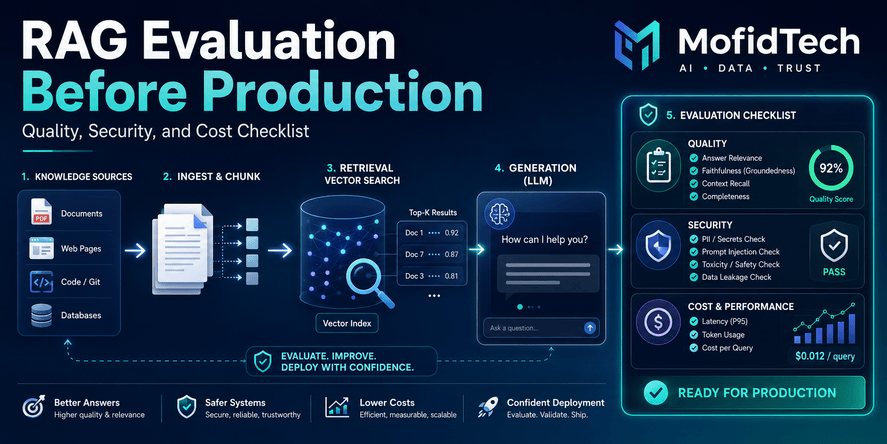
A production-ready evaluation program should examine task outcomes, final responses, execution trajectories, tool usage, safety, reliability, cost, human oversight, and business impact. It should use realistic datasets, repeated trials, deterministic assertions, rubric-based grading, expert review, security testing, and production monitoring.
The most important principle is to evaluate the agent as a complete operational system.
A strong final answer cannot compensate for unauthorized actions. A correct trajectory cannot compensate for an inaccurate user response. High average performance cannot compensate for rare but catastrophic failures. A successful offline benchmark cannot replace monitoring in the real world.
Organizations should define success, identify unacceptable outcomes, match evaluation strictness to risk, establish clear release gates, deploy gradually, and turn every production failure into a lasting regression test.
The objective is not to eliminate all uncertainty. It is to understand the agent’s capabilities and limitations well enough to deploy it responsibly, detect failures quickly, and improve it continuously.




💬 Comments
No comments yet. Be the first to comment!
Login to comment.