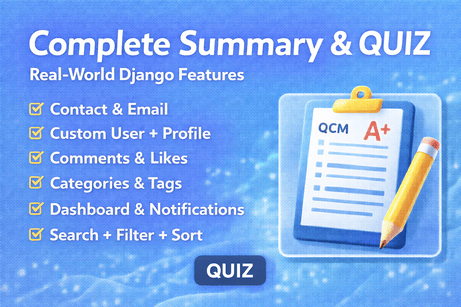
Complete Summary of Tutorials 1 → 11
In this section, we summarize the key concepts and skills learned across Tutorials 36 to 46. These topics represent a major step forward in Django development, transforming a basic project into a fully interactive, user-driven platform.
🔹 Tutorial 1 — Building a Contact Form in Django
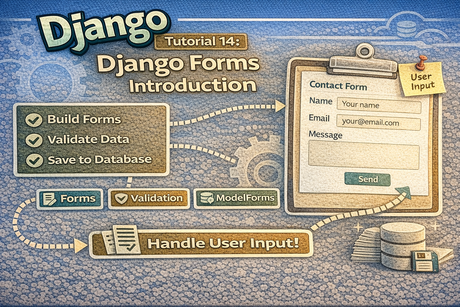
This tutorial introduced how to create a contact form using Django’s forms system. You learned how to define form fields, validate user input, and process submitted data in a view. The contact form acts as a bridge between users and the site owner, making communication possible directly through the website.
🔹 Tutorial 2 — Sending Emails with Django
You extended the contact form by integrating Django’s email system. You learned how to configure email settings and send messages using functions like send_mail(). This allows your application to send notifications, confirmations, or contact messages, making it more dynamic and connected.
🔹 Tutorial 3 — Django Signals
This tutorial introduced signals, a powerful feature that allows Django to automatically execute code when certain events occur. You used signals (such as post_save) to trigger actions like creating a profile immediately after a new user is registered. This helps automate repetitive logic and keeps your application clean and consistent.
🔹 Tutorial 4 — Custom User Model in Django
You learned why and how to create a custom user model instead of relying on Django’s default one. By extending AbstractUser, you added extra fields (like phone or bio) and ensured flexibility for future features. This is a critical best practice for any serious Django project.
🔹 Tutorial 5 — User Profiles in Django
This tutorial expanded the user system by introducing a profile model linked to the user with a OneToOneField. Profiles allow you to store additional user information such as profile pictures, location, and personal data. Combined with signals, profiles are automatically created and managed.
🔹 Tutorial 6 — Comment System in Django
You built a comment system that allows users to interact with content. Each comment is linked to both a user and a post, creating a relationship between content and audience. This feature turns a static website into an interactive platform where users can share feedback and opinions.
🔹 Tutorial 7 — Like / Favorite / Bookmark System
In this tutorial, you added user interaction features:
- Likes → express appreciation
- Favorites → highlight preferred content
- Bookmarks → save content for later
These systems are typically implemented using ManyToManyField, allowing users to interact with multiple posts. This greatly improves user engagement and personalization.
🔹 Tutorial 8 — Category and Tag Systems
You learned how to organize content using:
- Categories → broad classification (e.g., “Web Development”)
- Tags → specific keywords (e.g., “Django”, “API”)
Categories usually use a ForeignKey, while tags use a ManyToManyField. Together, they make content easier to navigate, filter, and understand.
🔹 Tutorial 9 — Dashboard Creation in Django
This tutorial focused on building a user dashboard. A dashboard provides a centralized view of important information, such as:
- total posts
- published vs draft posts
- comments received
- recent activity
It improves the user experience by giving quick access to relevant data and actions.
🔹 Tutorial 10 — Notifications in Django
You implemented a notification system that informs users about important events, such as new comments on their posts. Notifications are stored in the database and include features like:
- unread/read status
- timestamps
- optional links
This system keeps users engaged and aware of activity on the platform.
🔹 Tutorial 11 — Search + Filter + Sort in Django
The final tutorial introduced powerful tools for data exploration:
- Search → find content using keywords
- Filter → restrict results based on conditions (e.g., category)
- Sort → order results (e.g., newest, most viewed)
You used GET parameters and Django ORM queries (Q objects, order_by) to build a dynamic and user-friendly listing page. This feature is essential for handling large datasets.
🔚 Final Overview
Together, these tutorials transform a simple Django project into a complete, professional web application. You moved from basic CRUD functionality to a fully interactive system with:
- user authentication and profiles
- automated processes (signals)
- content creation and organization
- user interaction (comments, likes, bookmarks)
- real-time awareness (notifications)
- communication tools (contact + email)
- advanced data exploration (search/filter/sort)
- personalized user experience (dashboard)
These concepts form the foundation of most real-world Django applications.

💬 Comments
No comments yet. Be the first to comment!
Login to comment.