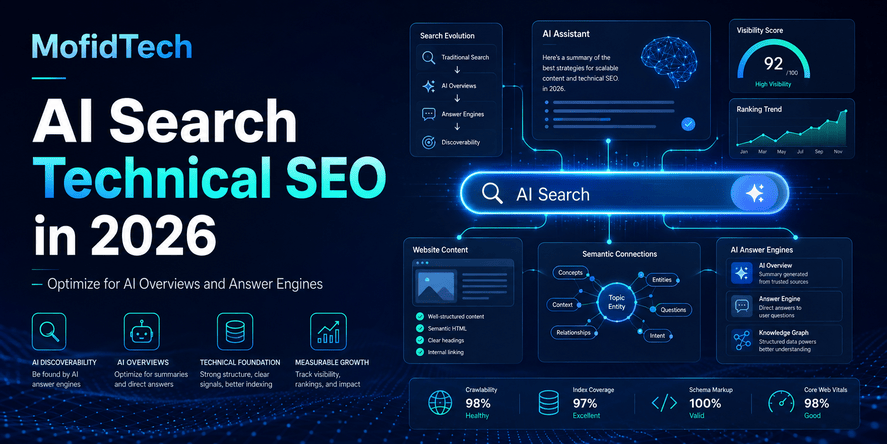
What is AI search technical SEO? AI search technical SEO is the practice of making a website technically accessible, understandable, indexable, and citable across both traditional search engines and AI-powered discovery systems. It builds on normal technical SEO rather than replacing it, while adding explicit decisions about AI crawlers, answer-engine visibility, training permissions, and AI-specific measurement. |
Introduction
Search visibility is no longer a single pipeline. A page may be discovered by a traditional crawler, indexed by a search engine, summarized in an AI Overview, cited by an answer engine, fetched because a user explicitly requested a page, or accessed by a crawler that has a completely different purpose such as model training. These activities can look similar in server logs, but they are not the same business outcome.
For developers and publishers, this creates a new technical SEO problem: the website must remain easy for humans and conventional search engines to use while also being accessible to the AI systems that can generate citations, referrals, and answers. At the same time, publishers may want tighter control over unrelated uses such as training or bulk crawling. The correct response is not to invent a second website for AI. It is to make the existing website technically clear, reliably crawlable, semantically well organized, fast enough to retrieve, and governed by deliberate crawler policies.
Google’s current guidance reinforces this point. Google says that the same foundational SEO practices remain relevant for AI Overviews and AI Mode, that pages need to be indexed and eligible to show with a snippet, and that there is no special AI schema or machine-readable AI file required to appear in those features. OpenAI likewise distinguishes search discovery from model training: OAI-SearchBot is associated with search inclusion, while GPTBot is the control publishers can use for potential training access. This distinction is central to a sensible AI-search strategy.
This guide explains how to build that strategy without code. It focuses on architecture, workflows, decisions, failure modes, measurement, and practical checklists so that developers, publishers, and technical SEO teams can improve AI-search visibility without sacrificing traditional organic traffic.
Table of Contents
- 1. What AI search discoverability actually means
- 2. Traditional SEO and AI search: what changes and what does not
- 3. The AI discovery stack: crawl, index, retrieve, cite, and refer
- 4. Crawler access: robots.txt, noindex, WAFs, CDNs, and rate limits
- 5. Search crawling versus training crawling
- 6. Make important content easy to retrieve and understand
- 7. Internal linking and information architecture for AI discovery
- 8. Structured data: useful, but not a special AI ranking switch
- 9. Content architecture for citation and answer extraction
- 10. Performance and accessibility as AI-readiness factors
- 11. llms.txt in 2026: useful convention or SEO requirement?
- 12. Platform-specific considerations: Google, ChatGPT, Bing, Perplexity
- 13. Measuring AI-search visibility and referrals
- 14. Security and crawler-governance considerations
- 15. Common mistakes and troubleshooting workflow
- 16. Practical AI Search Readiness Checklist
- 17. FAQ
- 18. Real-World Use Cases
- 19. Conclusion
1. What AI Search Discoverability Actually Means
What does it mean for a website to be discoverable in AI search? A website is discoverable in AI search when an AI-powered search or answer system can find relevant pages, access the content it needs, understand the page’s topic and relationships, and use the page as a source or supporting link when answering a user’s question. |
AI-search discoverability is often described as if it were a new ranking system that replaces SEO. That framing is misleading. In practice, discoverability is a chain of technical and editorial conditions. If any important link in the chain fails, visibility can drop even when the content itself is excellent.
The first condition is access. A crawler, search index, or user-triggered fetcher must be able to reach the page. The second is indexability or retrievability, depending on the product. The third is comprehension: the system needs enough clear text, context, and structure to determine what the page is about. The fourth is selection: the system must consider the page relevant and trustworthy enough to use. The fifth is presentation: the product may show a citation, a supporting link, a summary, a title-only reference, or nothing at all.
These stages are important because teams sometimes optimize the wrong problem. A publisher may rewrite hundreds of headings for “AI SEO” when a firewall is returning access-denied responses to the crawler. Another site may publish an llms.txt file while its core article pages are poorly linked and inconsistently canonicalized. A third site may allow every crawler but provide highly generic content that offers little reason for an answer engine to cite it. Technical readiness and content value must work together.
2. Traditional SEO and AI Search: What Changes and What Does Not
The most important strategic principle is continuity: AI-search optimization should extend strong SEO, not replace it. The foundations remain familiar—crawlability, useful content, descriptive titles, sound internal linking, canonical consistency, helpful page experience, structured information, and clear ownership of indexation decisions.
What changes is the number of discovery surfaces and the granularity of crawler control. A site may want Google Search visibility, Google AI Overview visibility, ChatGPT search citations, Bing Copilot citations, and Perplexity referrals while simultaneously limiting use of some content for foundation-model training. That requires distinguishing the purpose of each crawler rather than treating all AI user agents as one category.
Traditional SEO vs. AI Search Optimization
| Area | Traditional SEO | AI-search extension |
|---|---|---|
| Crawl access | Allow search-engine crawlers to reach indexable pages. | Also decide which AI search, training, and user-triggered crawlers should be allowed. |
| Indexability | Use clear indexation and canonical signals. | Keep those signals consistent because many AI search experiences depend on search indexes or retrievable public pages. |
| Content | Create useful, original, people-first pages. | Structure important answers so systems can identify definitions, steps, comparisons, and evidence without losing depth. |
| Internal links | Help users and crawlers discover related pages. | Build topic relationships that make entities, subtopics, and supporting evidence easier to retrieve. |
| Structured data | Describe eligible content and entities consistently. | Use valid structured data where appropriate, but do not expect a special AI-only schema to create visibility. |
| Measurement | Track impressions, clicks, rankings, and conversions. | Add AI citations, generative-search impressions, crawler activity, and referral sources to the measurement model. |
This extension mindset prevents two dangerous extremes. The first is ignoring AI discovery entirely and assuming traditional blue-link reporting tells the full story. The second is chasing speculative “GEO hacks” that undermine established SEO quality. A mature strategy keeps the technical foundation stable while adding measurement and crawler governance for new discovery channels.
3. The AI Discovery Stack: Crawl, Index, Retrieve, Cite, and Refer
Teams can make better decisions when they model AI discovery as a stack rather than a single event. The layers below are not identical across every provider, but they provide a practical engineering framework.
3.1 Crawl or Fetch
A system first needs a way to access information. This may happen through a conventional crawler, a search index, a partner search provider, or a user-triggered fetch. The access path matters because crawler policies and server defenses can treat these requests differently.
3.2 Index or Store Retrieval Signals
Many AI search systems depend on indexes or retrieval layers that determine which pages are candidates for a query. A page that is technically reachable but excluded from the relevant index may still fail to appear. This is why classic indexability and canonical hygiene continue to matter.
3.3 Understand the Page
The system needs to identify the main subject, subtopics, entities, relationships, claims, and useful passages. Clear headings, visible text, consistent terminology, meaningful metadata, and well-designed information architecture make this task easier. Hidden or fragmented content can make a technically reachable page harder to interpret.
3.4 Match the User’s Question
AI search often expands, decomposes, or reformulates a user’s question before selecting sources. A long-form article therefore benefits from covering a topic comprehensively while keeping individual sections focused enough to answer narrower queries. This is one reason detailed guides with strong H2 and H3 structure can serve both traditional SEO and answer engines.
3.5 Cite, Link, or Summarize
The final product may cite a page directly, include it as a supporting link, summarize information without a prominent link, or omit the page entirely. Eligibility does not guarantee presentation. The goal of technical SEO is to remove avoidable barriers; the goal of content strategy is to give the system a strong reason to select the page.
4. Crawler Access: robots.txt, noindex, WAFs, CDNs, and Rate Limits
Is robots.txt enough to control AI visibility? No. robots.txt is an important crawler directive, but it is only one layer. Website owners must also consider indexation directives, CDN and WAF behavior, authentication, bot mitigation, rate limits, redirects, response status, and whether different crawler types serve search, training, or user-triggered requests. |
4.1 Treat robots.txt as a policy surface, not a security boundary
The robots exclusion protocol is a way to express crawling preferences to compliant bots. It is not a replacement for authentication, authorization, or network enforcement. Sensitive information should never rely on robots directives for protection. If content must be private, the application should enforce privacy regardless of crawler identity.
For public content, robots.txt becomes a governance document. Instead of using broad “block all AI” rules by habit, site owners should decide which business outcomes they want. Search discovery may produce citations and referrals. Training access is a different decision. User-triggered page fetching may be different again. Crawler policies should reflect these separate purposes.
4.2 Understand the difference between blocking crawling and preventing indexing
Blocking a crawler from fetching a page can prevent it from reading page-level directives that require page access. In some ecosystems, a blocked URL may still be known from external links or third-party indexes and may appear in a limited form. When the business requirement is “do not show this page in search,” teams need an indexation strategy, not only a crawl-blocking strategy. The exact behavior varies by provider, so policies should be tested against official documentation and real logs.
4.3 Check the infrastructure in front of the application
A frequent failure mode is a mismatch between robots policy and actual infrastructure behavior. The website may appear to allow a crawler while a CDN, WAF, bot-management service, JavaScript challenge, CAPTCHA, geographic restriction, or aggressive rate limit blocks the request before it reaches the application. OpenAI’s current guidance explicitly calls out firewalls, CDNs, bot mitigation, authentication, rate limiting, and crawler IP access as possible causes of failed crawling.
This means AI-search troubleshooting should include infrastructure logs, not only source-code inspection. Developers should verify response status, redirect behavior, challenge pages, and whether legitimate crawler requests are misclassified as abusive automation. A public article that returns a successful response to humans but a forbidden or throttled response to a search crawler is effectively invisible to that crawler.
4.4 Avoid accidental rate-limit discrimination
Rate limiting is necessary for security and stability, but it should be designed with known crawler behavior in mind. A legitimate crawler can generate bursts that look unusual compared with human traffic. If a generic anti-bot rule treats every automated request as hostile, the site may lose visibility without realizing it. Monitoring response codes by user agent and path can reveal this problem.
5. Search Crawling Versus Training Crawling
Should a site allow AI search crawling but block model training? It can. Search discovery and model training are separate purposes for several providers. A publisher can choose policies that support citation and referral opportunities while restricting crawlers or tokens associated with training, provided the provider exposes distinct controls. |
One of the biggest mistakes in AI crawler policy is grouping every bot with “AI” in its name into one allow-or-block decision. Search indexing, answer generation, user-triggered fetching, model training, and advertising validation can have different value and different risk. Mature crawler governance starts with purpose.
5.1 OpenAI: search and training controls are distinct
OpenAI’s publisher guidance distinguishes OAI-SearchBot from GPTBot. OAI-SearchBot is relevant to discovery and inclusion in ChatGPT search summaries and citations. GPTBot is the control publishers can use for content they do not want included in potential model training. This makes it possible to think about search visibility and training permission separately rather than treating them as an all-or-nothing choice.
5.2 Google: Search and Google-Extended are different controls
Google states that Google-Extended is a standalone control for certain uses involving Gemini models and grounding, and that it does not affect inclusion in Google Search or act as a Google Search ranking signal. This reinforces the same principle: a publisher’s policy for model-related use does not have to be identical to its policy for search visibility.
5.3 Perplexity: search crawler behavior is documented separately
Perplexity documents PerplexityBot as the crawler used to surface and link websites in search results, and states that it follows robots.txt directives. Its documentation also distinguishes user-requested fetching behavior from automated search crawling. The operational lesson is that teams should identify each documented user agent and understand its role before creating access policies.
The broader strategy is simple: classify crawlers by purpose, decide the desired business outcome for each class, configure the minimum necessary policy, and verify actual behavior through logs and provider documentation.
6. Make Important Content Easy to Retrieve and Understand
Allowing a crawler is only the first step. The content itself must be available in a form that search and answer systems can reliably interpret. This does not mean stripping the website down to plain text. It means ensuring that the core meaning of a page is not dependent on fragile presentation techniques.
6.1 Keep the primary answer in accessible text
Important definitions, recommendations, steps, comparison points, and conclusions should exist as visible textual content. If the page’s main value appears only inside images, complex client-side widgets, videos without supporting text, or interactions that require several user actions, retrieval systems may have a harder time understanding or citing the page.
6.2 Use descriptive headings that match real user questions
A strong heading does more than improve readability. It creates a clear boundary around a subtopic. Question-based headings are useful when they reflect genuine search intent, but they should not be forced into every section. The best structure combines descriptive topic headings with direct questions where a concise answer is valuable.
6.3 Define important terms before relying on them
Technical content often assumes that readers already understand specialized terminology. For answer-engine visibility, a short definition near the first use can improve clarity for both humans and automated systems. Definitions also create natural featured-snippet and voice-search opportunities.
6.4 Keep facts and recommendations attributable
Pages are more useful when readers can tell which statements are established platform behavior, which are MofidTech recommendations, and which are context-dependent judgments. When discussing rapidly changing crawler behavior, link to authoritative documentation and date-sensitive sources. This helps readers verify the advice and reduces the risk of publishing stale technical claims.
7. Internal Linking and Information Architecture for AI Discovery
Do internal links matter for AI search? Yes. Internal links help search systems discover pages, understand topical relationships, identify important hub pages, and connect supporting explanations. They also improve the human journey from a concise answer to deeper technical guidance. |
Internal linking is one of the most durable investments a technical publication can make. AI search does not eliminate the need for site architecture. In fact, a site that covers a subject comprehensively benefits from making those relationships explicit.
7.1 Build topic hubs rather than isolated articles
A strong MofidTech cluster for AI search could connect articles about technical SEO, structured data, site performance, crawler control, analytics, AI-search measurement, content architecture, and web accessibility. Each page should have a distinct purpose, but the cluster should make it easy for readers and crawlers to move between foundational and advanced material.
7.2 Link using meaningful context
Internal links are most useful when the surrounding sentence explains why the linked page matters. Generic anchors such as “click here” reveal little about the relationship. Descriptive linking also helps reduce orphaned pages and creates clearer semantic pathways across the site.
7.3 Keep high-value pages within a reasonable navigation depth
Important evergreen guides should not be buried behind many archive pages or disconnected taxonomies. Category pages, subcategory pages, related-article modules, breadcrumbs, and editorial links can all help. The objective is not to maximize the number of links; it is to make the information architecture coherent enough that important content is easy to discover repeatedly.
7.4 Avoid taxonomy fragmentation
Technology sites often create overlapping categories and tags that split authority across many near-duplicate archive pages. Before adding a new taxonomy term for every emerging phrase, decide whether it represents a durable information architecture concept. For MofidTech, “AI Search and SEO” can serve as a stable subcategory, while narrower terms such as “AI Overviews” or “Perplexity SEO” are better suited to tags or article-level keywords.
8. Structured Data: Useful, but Not a Special AI Ranking Switch
Is special structured data required for Google AI Overviews? No. Google says there is no special schema.org structured data required for AI Overviews or AI Mode. Existing structured data can still be useful when it accurately represents visible page content and supports eligible search features. |
Structured data remains valuable because it gives machines explicit information about entities and page types. However, the rise of AI search has created a market for claims that a new markup type can unlock AI visibility. Google’s guidance directly cautions against this assumption: no special AI schema is required for its generative search features.
8.1 Use structured data for accuracy, not decoration
The correct goal is consistency between visible content and machine-readable metadata. If a page describes an article, author, organization, breadcrumb path, product, event, or another eligible entity, structured data can reinforce that meaning. It should not claim facts that the page does not visibly support.
8.2 Keep entity information consistent across the site
Organization names, author names, canonical URLs, publication dates, update dates, article titles, and breadcrumbs should not contradict one another across metadata, visible text, and structured data. Consistency helps users and automated systems interpret the site with less ambiguity.
8.3 Prioritize content quality before markup expansion
A technically perfect structured-data layer cannot compensate for generic, thin, or derivative content. Publishers should first ensure that the page offers a useful answer, original synthesis, practical detail, or first-hand expertise. Structured data then supports that content; it does not create the underlying value.
9. Content Architecture for Citation and Answer Extraction
AI answer systems need source material that can be matched to specific questions. Long-form content can perform well when it combines depth with local clarity. The goal is not to make the entire article short. The goal is to make each important section understandable on its own.
9.1 Start important sections with a direct answer
When a heading asks a clear question, answer it early. A one- or two-sentence summary gives readers immediate value, then the section can expand into caveats, examples, trade-offs, and implementation details. This structure works well for featured snippets, AI summaries, and voice queries without sacrificing depth.
9.2 Use comparison tables for decision-heavy topics
Tables are particularly useful when readers need to compare crawler purposes, search platforms, measurement sources, or remediation priorities. A well-designed table compresses relationships that would otherwise require several paragraphs. It also creates clear, extractable facts while still being useful to humans scanning the page.
9.3 Publish original frameworks and diagnostic logic
Generic content is easy for answer engines to summarize from many sources. Original value comes from frameworks that help readers make decisions. For example, a five-layer AI discoverability model—access, indexability, comprehension, selection, measurement—gives readers a reusable way to troubleshoot problems. This kind of synthesis is more defensible than repeating a list of crawler names.
9.4 Include practical checklists, but explain the reasoning
Checklists are excellent for search intent because users often want a fast verification path. However, a checklist without explanation becomes shallow. The strongest long-form guide provides both: a concise checklist for action and detailed sections that explain why each item matters, what can go wrong, and how to interpret the result.
9.5 Update time-sensitive sections deliberately
Crawler names, documentation, and AI-search interfaces can change faster than conventional SEO principles. Mark important update dates, maintain a source list, and periodically review platform-specific sections. An article can remain evergreen if its foundational guidance is stable and its volatile details are clearly isolated for maintenance.
10. Performance and Accessibility as AI-Readiness Factors
Performance is often discussed only in terms of Core Web Vitals and human experience, but reliable delivery also affects automated access. Slow, fragile, or heavily challenged pages can make crawling and retrieval less dependable. A fast site is not guaranteed AI visibility, yet poor delivery creates unnecessary failure modes.
10.1 Prioritize reliable server responses
The first performance objective is reliability. Important public pages should respond consistently, avoid unnecessary redirect chains, and remain available during normal traffic spikes. Repeated server errors, timeouts, or throttling can interfere with both traditional crawling and AI retrieval.
10.2 Keep essential content independent of fragile interactions
Interactive experiences can be valuable, but the main informational content should not disappear when a script fails, a consent layer behaves unexpectedly, or a bot cannot complete an interaction. Progressive enhancement and resilient rendering benefit accessibility, SEO, and automated retrieval at the same time.
10.3 Accessibility can improve machine interpretability
Accessible labels, meaningful document structure, clear landmarks, descriptive link text, and understandable forms primarily exist to support users. They can also make interfaces easier for AI agents and automated systems to interpret. OpenAI’s current publisher and developer guidance specifically points to accessible semantics for agent compatibility in interactive websites.
10.4 Treat performance monitoring as part of visibility monitoring
When AI-search traffic or citations decline, teams should check whether the change coincides with deployment issues, CDN rules, increased response latency, challenge pages, or elevated error rates. Search visibility is partly an infrastructure problem, so observability should connect crawler behavior with application health.
11. llms.txt in 2026: Useful Convention or SEO Requirement?
Do you need llms.txt to appear in Google AI Overviews or AI Mode? No. Google explicitly says that special machine-readable AI files are not required for AI Overviews or AI Mode. llms.txt may still be useful as an optional documentation convention for some tools, but it should not be treated as a ranking requirement or a substitute for crawlable, well-structured pages. |
The llms.txt proposal has attracted significant attention because it offers a simple idea: provide a concise, structured index that helps language-model tools find important documentation. The concept can be useful in certain developer-documentation contexts. The problem begins when publishers assume that publishing the file automatically improves search rankings or answer-engine citations.
11.1 What llms.txt can reasonably do
As a convention, llms.txt can act as an orientation layer for tools that intentionally support it. It can point to important documentation and present a compact site map for language-model workflows. For a technical documentation portal, this may reduce ambiguity and make selected content easier for compatible tools to locate.
11.2 What llms.txt should not be expected to do
It should not be treated as a universal AI crawler directive, a replacement for robots.txt, an indexation control, a security mechanism, or a guaranteed AI-search ranking factor. Google states that no machine-readable AI text file is required for its AI search features. A large 2026 Ahrefs analysis also reported very limited actual fetching of llms.txt files across the domains it measured, reinforcing the need to treat adoption claims cautiously.
11.3 When it may still be worth publishing
A site may choose to publish llms.txt when it has a substantial documentation corpus, serves developer tooling, wants to support compatible agents, and can maintain the file accurately. The cost should be low, the content should not expose anything private, and the team should regard it as an optional compatibility aid rather than a primary SEO initiative.
11.4 What should come first
Before investing time in llms.txt, verify the fundamentals: the important pages are publicly reachable, search crawlers are not blocked, indexation is correct, internal links are strong, canonical signals are consistent, essential content is visible as text, page performance is reliable, and the content itself is useful enough to deserve citation. These improvements benefit both traditional SEO and AI discovery regardless of llms.txt adoption.
12. Platform-Specific Considerations
12.1 Google AI Overviews and AI Mode
Google’s current position is deliberately conservative: foundational SEO remains the path to eligibility. Pages need to meet Google Search technical requirements, be indexed, and be eligible to show with a snippet. Google also states that there is no special schema or AI text file required for AI Overviews or AI Mode. For publishers, the practical focus remains high-quality content, crawlability, internal linking, visible text, good page experience, and accurate structured data.
The major measurement change in 2026 is visibility reporting. Google announced dedicated Search Generative AI performance reports in Search Console and states that these insights were rolled out worldwide on August 31, 2026. That gives site owners a stronger basis for separating generative-search visibility from assumptions and anecdotal testing.
12.2 ChatGPT Search
OpenAI’s publisher guidance says public websites can appear in ChatGPT search and recommends allowing OAI-SearchBot when publishers want their content to be discoverable, surfaced, cited, and linked. OpenAI also notes that referral traffic from ChatGPT can be measured because search-result links include a ChatGPT source parameter. The key strategic distinction is that OAI-SearchBot relates to search visibility, while GPTBot is used for training-related control.
12.3 Bing Copilot and Microsoft AI experiences
Microsoft introduced AI Performance in Bing Webmaster Tools in 2026 to show how publisher content appears across Copilot, Bing’s AI-generated summaries, and selected partner experiences. This matters because it turns AI citations into a measurable publisher metric rather than an informal observation. Sites already using Bing Webmaster Tools should incorporate these reports into their visibility reviews.
12.4 Perplexity
Perplexity documents PerplexityBot as the crawler intended to surface and link websites in search results and states that it follows robots.txt. It also documents user-triggered access separately. Site owners should therefore evaluate both automated crawler access and the broader behavior of user-requested fetching when building a policy, rather than relying on assumptions from older reports.
13. Measuring AI-Search Visibility and Referrals
How should a website measure AI-search performance? Use a multi-source dashboard that combines generative-search impressions, AI citations, referral sessions, crawler activity, indexed-page health, conversions, and content-level engagement. No single metric captures the full value of AI discovery. |
Measurement is where AI-search strategy becomes operational. Teams need to know whether a change improves discovery, creates referrals, or only increases crawler activity. The following measurement layers should be reviewed together.
13.1 Platform-native visibility reports
Use the reporting available inside search platforms when possible. Google Search Console’s generative AI reporting and Bing Webmaster Tools’ AI Performance reports provide direct signals about how content appears in their ecosystems. These sources are more reliable than manually asking an AI product a few questions and treating the answers as a representative benchmark.
13.2 Referral analytics
Track sessions and conversions from AI answer engines. Referral traffic may be lower-volume than traditional search while still producing high-intent visits. Measure not only sessions but also engagement, newsletter signups, account creation, tool usage, and other outcomes that matter to the site.
13.3 Server and CDN logs
Crawler logs reveal whether access policies work in practice. Useful dimensions include crawler identity, response status, path, response time, challenge or block reason, and request volume. Logs can identify cases where the site appears open in robots.txt but is blocked by infrastructure.
13.4 Citation tracking
Citation tracking tools can be useful for directional analysis, but results should be interpreted cautiously because AI answers vary by query wording, time, model, location, and personalization. Rather than obsessing over one answer snapshot, track recurring query families and whether the site appears as a source over time.
13.5 Business outcomes
The ultimate question is whether AI discovery contributes to the site’s goals. For MofidTech, those goals may include qualified readers, tool adoption, course discovery, newsletter growth, account creation, or advertising-supported pageviews. A strategy that increases crawler activity but produces no meaningful user value should be reconsidered.
14. Security and Crawler-Governance Considerations
AI-search readiness should not weaken security. The objective is selective accessibility for public content, not indiscriminate bot access to every endpoint.
14.1 Never expose private content for visibility
Authentication and authorization remain the boundaries for private information. Search directives are not access control. User profiles, administrative pages, private documents, internal APIs, and sensitive account actions should remain protected even if doing so reduces machine discoverability.
14.2 Separate public content paths from sensitive application paths
A clean architecture makes crawler policy easier. Public article and documentation areas can be optimized for discovery, while account, payment, administration, and private-data areas can have stricter controls. This separation reduces the risk that a broad crawler policy creates unintended exposure.
14.3 Verify crawler identity before creating exemptions
User-agent strings can be spoofed. If a site creates special firewall exemptions for known crawlers, the security team should use the provider’s documented verification methods where available, such as published IP ranges or verified-bot mechanisms. A rule that trusts any request claiming to be a well-known crawler can become an abuse path.
14.4 Monitor abnormal crawler behavior
Even approved crawlers can generate operational load, and unknown bots may imitate AI services. Monitor request volume, high-cost paths, response times, and unusual scraping patterns. The site should be able to protect itself from abuse without accidentally blocking the public pages that search crawlers legitimately need.
14.5 Create an explicit crawler policy owner
Crawler governance often falls between SEO, development, security, and infrastructure teams. Assign ownership. Document which crawler classes are allowed, blocked, rate-limited, or reviewed, and record why. Revisit the policy when providers change user agents or when business goals change.
15. Common Mistakes and Troubleshooting Workflow
15.1 Mistake: treating all AI crawlers as identical
This can accidentally block search citation opportunities when the real concern is training access. Classify crawlers by purpose before applying rules.
15.2 Mistake: assuming robots.txt guarantees privacy
It does not. Sensitive content requires proper access control. Robots directives are for compliant crawling behavior, not secrecy.
15.3 Mistake: chasing llms.txt before fixing basic SEO
An optional AI-oriented file cannot rescue broken canonicalization, orphaned pages, weak content, blocked crawlers, or repeated server errors. Fix the foundation first.
15.4 Mistake: adding speculative “AI schema”
Google says no special schema is required for its AI features. Use supported structured data that accurately describes the visible page instead of inventing markup solely because it contains the word AI.
15.5 Mistake: measuring only referral clicks
AI systems can create visibility and brand exposure even when they do not generate a click every time. Balance referral metrics with platform-native impressions, citations, and downstream business outcomes.
15.6 Mistake: ignoring infrastructure blocks
When a page is not appearing, check the full request path: DNS, CDN, WAF, bot rules, rate limits, redirects, application response, indexability, canonical signals, and content retrieval. A developer-focused troubleshooting process should verify each layer rather than rewriting content immediately.
15.7 A Practical Troubleshooting Sequence
- Confirm that the page is public and intended for discovery.
- Verify that the relevant search crawler is allowed by policy.
- Check whether the CDN, WAF, bot-management layer, or rate limiter is blocking or challenging the crawler.
- Verify that the page returns a stable successful response and does not depend on an unnecessary redirect chain.
- Check indexation, canonicalization, and snippet eligibility for traditional search systems.
- Confirm that the main content is visible as text and that the page has a clear title and heading structure.
- Review internal links to ensure the page is discoverable from relevant hubs and articles.
- Check structured data for consistency with visible content where structured data is applicable.
- Review platform-native AI visibility reports and server logs.
- Only after technical barriers are excluded, evaluate whether the content is sufficiently original, useful, and relevant to deserve citation.
16. Practical AI Search Readiness Checklist
Crawler and access readiness
- ☐ Important public pages are reachable without authentication.
- ☐ Search crawlers you want to support are not unintentionally blocked.
- ☐ Training-related crawler decisions are separated from search-discovery decisions where providers support separate controls.
- ☐ CDN, WAF, bot-management, and rate-limit rules have been tested against legitimate crawlers.
- ☐ Sensitive areas are protected by real access control, not crawler directives.
Indexability and technical SEO
- ☐ Canonical signals are consistent and point to the intended primary URLs.
- ☐ Indexation directives match the publication strategy.
- ☐ Important pages return stable responses and avoid unnecessary redirect chains.
- ☐ XML sitemaps and internal links help search systems find important pages.
- ☐ Duplicate and low-value archive pages are managed deliberately.
Content and answer readiness
- ☐ Each major section has a clear purpose and answers a real user question.
- ☐ Important definitions and recommendations are available as visible text.
- ☐ Direct answers appear near the start of question-focused sections.
- ☐ Comparison tables and checklists are used where they genuinely improve understanding.
- ☐ Original analysis, experience, examples, or frameworks distinguish the page from commodity summaries.
- ☐ Time-sensitive claims link to authoritative sources and are reviewed periodically.
Structured data and entities
- ☐ Structured data, when used, matches visible content.
- ☐ Organization, author, article, breadcrumb, and date information are consistent.
- ☐ No unsupported AI-specific markup is added merely to chase visibility.
Performance and accessibility
- ☐ Pages load reliably and do not frequently time out or return errors.
- ☐ Essential information is not trapped behind fragile interactions.
- ☐ Semantic structure, labels, links, and forms are accessible and understandable.
- ☐ Performance and crawler errors are monitored together during troubleshooting.
Measurement
- ☐ Google Search Console generative-AI reporting is reviewed where available.
- ☐ Bing Webmaster Tools AI Performance data is reviewed if Bing visibility matters.
- ☐ Referral analytics track AI answer-engine traffic and conversions.
- ☐ Crawler activity is monitored in server, CDN, or bot-management logs.
- ☐ AI citation tracking is treated as directional evidence, not a perfect ranking metric.
17. Frequently Asked Questions
What is AI search technical SEO?
AI search technical SEO is the technical and structural work that helps a website remain discoverable, retrievable, understandable, and citable across both traditional search engines and AI-powered answer systems. It extends normal technical SEO with crawler-governance and AI-visibility measurement.
Do I need a separate SEO strategy for Google AI Overviews?
You need an extension of your existing SEO strategy, not a replacement. Google says the foundational requirements for Search remain relevant to AI Overviews and AI Mode. Strong crawlability, indexability, useful content, internal links, visible text, page experience, and accurate structured data remain the priorities.
Do I need llms.txt to appear in Google AI search?
No. Google explicitly states that special machine-readable AI files are not required for AI Overviews or AI Mode. llms.txt can be an optional compatibility convention for some documentation tools, but it is not a universal AI-search requirement.
What is the difference between OAI-SearchBot and GPTBot?
OpenAI documents OAI-SearchBot for search discovery and the ability to surface, cite, and link public website content in ChatGPT search. GPTBot is the control publishers can use for content they want to exclude from potential model training. The two purposes should not be treated as identical.
Can I allow AI search crawling while blocking AI training?
In some ecosystems, yes. Providers such as OpenAI and Google expose controls that separate search-related visibility from certain training or model-use decisions. Review each provider’s current documentation before applying rules because crawler names and policies can evolve.
Does structured data guarantee AI citations?
No. Structured data can clarify entities and page types, but it does not guarantee citation or ranking. The visible content still needs to be useful, relevant, trustworthy, and technically accessible. Google also says there is no special AI-only schema required for its generative search features.
Does page speed affect AI search visibility?
Page speed by itself does not guarantee visibility, but reliable and efficient delivery reduces retrieval failures. Timeouts, repeated server errors, heavy challenge pages, and unstable responses can prevent crawlers or user-triggered agents from accessing otherwise valuable content.
Should I block every AI crawler in robots.txt?
Not automatically. First decide what you want from each crawler class. Search crawlers may create citations and referrals, while training crawlers represent a different policy choice. A blanket rule can unintentionally remove valuable discovery channels.
How can I tell whether an AI crawler is being blocked by my infrastructure?
Review CDN, WAF, bot-management, and server logs for the crawler’s requests. Look for forbidden responses, throttling, challenge pages, redirect loops, timeouts, and unusual response patterns. Compare the observed behavior with the provider’s published user-agent and verification guidance.
How should I measure AI-search success?
Combine platform-native generative-search reporting, AI citations, referral sessions, conversions, crawler activity, and traditional SEO performance. The goal is not only to increase bot access, but to create useful visibility that contributes to reader growth and business outcomes.
18. Real-World Use Cases
19.1 A technical blog that wants AI citations without broad training access
A publication may decide that citations and referral traffic are valuable while unrestricted training use is not. The site can document a crawler policy that allows search-oriented bots, limits training-related access where supported, keeps article pages indexable, and monitors whether the policy is producing citations rather than merely crawler volume.
19.2 A SaaS documentation site with strong developer content
A documentation portal can prioritize clean information architecture, visible text, structured navigation, stable URLs, clear versioning, and accessible interface semantics. It may optionally publish llms.txt as a compatibility aid for tools that support the convention, but it should still regard the canonical documentation pages as the authoritative source.
19.3 A site behind aggressive bot protection
A security-conscious site may discover that legitimate search crawlers are being challenged by a generic anti-bot rule. The right solution is not to disable protection globally. The team should verify legitimate crawler identities, create narrowly scoped exceptions where justified, monitor the resulting traffic, and keep sensitive application endpoints protected.
19.4 A content site with good rankings but weak AI visibility
A site that performs well in conventional search but rarely appears in AI answers should first examine measurement and query coverage. It may need stronger direct answers, clearer section boundaries, more original evidence, or better topical clustering rather than a dramatic technical rewrite. Traditional rankings are evidence that the foundation already works; the next step is improving source usefulness for question answering.
19. Conclusion
AI search is changing how people discover technical information, but it does not invalidate the engineering principles that make websites discoverable. The strongest strategy is to keep the technical SEO foundation intact and add a new layer of crawler governance, citation-friendly content architecture, and AI-specific measurement.
Start with the basics that benefit every discovery channel: make important pages publicly reachable, keep indexation and canonical signals consistent, expose core information as clear text, build coherent internal links, maintain reliable performance, use structured data accurately, and publish genuinely useful content. Then make deliberate decisions about which AI crawlers serve search, which relate to training, and which should be restricted.
The key lesson for 2026 is not that every website needs a new AI file or a new markup language. It is that publishers now need a more precise model of who is accessing their content, why they are accessing it, and how that access contributes to visibility and business value. Websites that combine solid SEO with explicit AI-search governance will be better positioned to earn both traditional organic traffic and citations inside answer engines.





💬 Comments
No comments yet. Be the first to comment!
Login to comment.