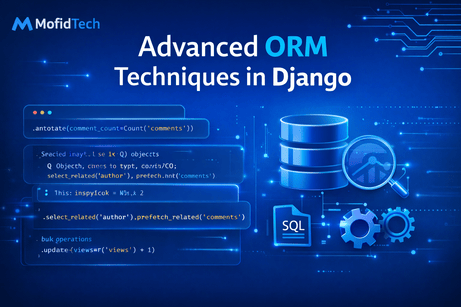
Once a Django developer becomes comfortable with models, basic queries, and CRUD operations, the next major step is learning how to use the ORM in a more advanced and professional way. The Django ORM is one of the strongest parts of the framework because it allows you to interact with the database using Python code instead of writing raw SQL for every operation. At the beginner level, developers usually use simple queries such as all(), filter(), get(), and create(). These are important, but real-world applications quickly demand more. As your project grows, you need to fetch related data efficiently, compute totals, count records, group results, avoid duplicate queries, optimize page speed, and build complex filtering logic that remains readable and maintainable. That is where advanced ORM techniques become essential. They help you write code that is not only correct, but also efficient, clean, and scalable.
A very important mindset to develop is that the ORM is not just a convenience layer for querying the database. It is a complete abstraction that helps you describe data operations in a readable and reusable way. When used well, it can replace a large amount of manual SQL while still giving excellent performance. But when used carelessly, it can create slow queries, repeated database hits, memory waste, and confusing code. This means advanced ORM knowledge is not only about learning more methods. It is about learning how to think about data access. A professional Django developer begins asking questions such as: How many queries is this page executing? Am I loading more data than I need? Can I fetch related objects in one query instead of many? Can I calculate this directly in the database instead of looping in Python? Can I annotate results with extra values? Can I reduce the amount of data transferred from the database? These questions are at the heart of advanced ORM usage.
Let us begin with a simple example model set that we can use throughout this tutorial:
from django.db import models
from django.contrib.auth.models import User

class Category(models.Model):
    name = models.CharField(max_length=100)

    def __str__(self):
        return self.name


class Author(models.Model):
    user = models.OneToOneField(User, on_delete=models.CASCADE)
    bio = models.TextField()

    def __str__(self):
        return self.user.username


class Article(models.Model):
    title = models.CharField(max_length=200)
    content = models.TextField()
    category = models.ForeignKey(Category, on_delete=models.CASCADE, related_name="articles")
    author = models.ForeignKey(Author, on_delete=models.CASCADE, related_name="articles")
    published = models.BooleanField(default=False)
    views = models.PositiveIntegerField(default=0)
    created_at = models.DateTimeField(auto_now_add=True)

    def __str__(self):
        return self.title


class Comment(models.Model):
    article = models.ForeignKey(Article, on_delete=models.CASCADE, related_name="comments")
    name = models.CharField(max_length=100)
    body = models.TextField()
    approved = models.BooleanField(default=False)
    created_at = models.DateTimeField(auto_now_add=True)
These models give us relationships between categories, authors, articles, and comments, which makes them perfect for demonstrating advanced ORM techniques.
One of the most useful advanced ORM skills is chaining QuerySets. In Django, a QuerySet is lazy, which means it does not hit the database immediately when you write it. Instead, Django builds the query progressively, and the actual database request happens only when the data is evaluated. For example:
articles = Article.objects.filter(published=True).order_by('-created_at')At this point, Django has not necessarily fetched the records yet. It is simply preparing the query. This laziness is powerful because it allows you to keep refining queries before execution. You can chain filters, excludes, ordering, and slicing together in a clean and expressive way:
articles = (
    Article.objects
    .filter(published=True)
    .exclude(views__lt=100)
    .order_by('-views')[:10]
)
This query says: give me published articles, exclude those with fewer than 100 views, order them by views descending, and keep only the first 10. The elegance here is that the ORM translates this into SQL while keeping the code readable. Understanding QuerySet laziness is important because it explains why chained ORM operations are efficient and why you should avoid forcing evaluation too early.
A major topic in advanced ORM is lookup expressions. At the beginner level, developers often use simple equality filters such as title="Hello". But Django supports a large number of lookups that make queries much more powerful. For example:
Article.objects.filter(title__icontains="django")
Article.objects.filter(created_at__year=2026)
Article.objects.filter(views__gte=500)
Article.objects.filter(category__name__iexact="Python")
These examples show case-insensitive matching, year-based filtering, greater-than-or-equal comparisons, and filtering across relationships. Lookups are essential because they let you express more precise logic directly in the database query instead of retrieving too much data and filtering it later in Python. Advanced ORM work often consists of combining these lookups strategically.
Now let us move to Q objects, which are extremely important for complex conditions. Normally, multiple filters are combined with logical AND. For example:
Article.objects.filter(published=True, views__gte=100)This means the article must be published and have at least 100 views. But what if you want more complex logic, such as published articles that are either in the Python category or have more than 1000 views? That is where Q objects help:
from django.db.models import Q

articles = Article.objects.filter(
    Q(category__name="Python") | Q(views__gt=1000),
    published=True
)
This query combines OR logic with AND logic. Q objects allow you to build flexible and readable queries involving OR, AND, and NOT conditions. For example:
articles = Article.objects.filter(
    ~Q(category__name="Archived"),
    published=True
)
The ~ operator negates the condition. This is a very powerful technique because many real-world search features and dashboard filters require logic more complex than simple chained filters.
Another key topic is field-to-field comparison using F expressions. Normally, filters compare a field to a fixed value. But sometimes you want to compare one database field to another field directly. Django’s F expressions make this possible. For example, imagine you had a model with price and discount_price, and you want products where the discount price is lower than the original price. Instead of pulling all products into Python and comparing values there, you can let the database do it:
from django.db.models import F

Product.objects.filter(discount_price__lt=F('price'))
Even in our current models, F expressions are useful for updates. Suppose you want to increase article views efficiently when a page is opened:
Article.objects.filter(pk=article.pk).update(views=F('views') + 1)This is much better than doing:
article.views += 1
article.save()
Why? Because the F expression performs the update directly in the database, avoiding race conditions and extra steps. This is one of the clearest examples of advanced ORM design improving both performance and correctness.
Aggregation is another essential advanced technique. Aggregation means calculating summary values from a set of records, such as total count, sum, average, minimum, or maximum. Django provides aggregation tools like Count, Sum, Avg, Min, and Max. For example:
from django.db.models import Count, Avg, Max

total_articles = Article.objects.count()
average_views = Article.objects.aggregate(avg_views=Avg('views'))
max_views = Article.objects.aggregate(max_views=Max('views'))
The result of aggregate() is a dictionary:
{'avg_views': 245.6}Aggregation is useful in dashboards, reports, analytics pages, and admin panels. Instead of looping through records in Python to calculate totals, you let the database do it efficiently.
Closely related to aggregation is annotation. While aggregation produces summary values for an entire QuerySet, annotation adds calculated values to each individual object in the QuerySet. For example, suppose you want every article to include the number of comments it has:
from django.db.models import Count

articles = Article.objects.annotate(comment_count=Count('comments'))
Now each article object in the QuerySet has an extra attribute called comment_count:
for article in articles:
    print(article.title, article.comment_count)
This is extremely useful because it avoids separate count queries for every object. Annotation lets you enrich data at the database level. You can annotate with counts, sums, averages, conditional values, and much more. In modern Django applications, annotated QuerySets are widely used in list pages, dashboards, rankings, and reports.
You can combine annotation with filtering and ordering as well. For example, to get published articles ordered by comment count:
articles = (
    Article.objects
    .filter(published=True)
    .annotate(comment_count=Count('comments'))
    .order_by('-comment_count')
)
This kind of query is elegant, efficient, and very expressive. It is a good example of how the ORM can handle quite sophisticated data retrieval without falling back to raw SQL.
A very important performance topic is select_related(). One of the most common ORM performance problems is the N+1 query problem. Suppose you fetch articles and then access article.author and article.category in a loop. Without optimization, Django may execute one query for the articles and then extra queries for each related author and category. This can become very inefficient. select_related() solves this for foreign keys and one-to-one relationships by performing a SQL join and fetching related objects in the same query:
articles = Article.objects.select_related('author', 'category').all()Now when you access article.author or article.category, Django already has the data. This can dramatically reduce database queries on list pages. For example, if you display 20 articles with their author names and category names, select_related() may turn dozens of queries into just one.
For many-to-many and reverse foreign key relationships, prefetch_related() is the corresponding tool. Suppose you want to display articles and their comments. Since comments are a reverse relationship, select_related() will not help. Instead, use:
articles = Article.objects.prefetch_related('comments').all()Django will perform separate queries, but in an optimized way, then combine the results in Python. The key idea is that prefetch_related() avoids one query per object by batching related data efficiently. In real applications, learning when to use select_related() versus prefetch_related() is one of the most important ORM optimization skills.
A simple rule is this: use select_related() for single-valued relationships like ForeignKey and OneToOneField, and use prefetch_related() for multi-valued relationships like reverse foreign keys and many-to-many relationships. For example:
articles = (
    Article.objects
    .select_related('author', 'category')
    .prefetch_related('comments')
)
This combination is very common on detail pages and rich list pages.
Another advanced technique is limiting selected fields when you do not need full model objects. Sometimes you only need a few fields from the database, not every column. In such cases, values() and values_list() can be very useful. For example:
articles = Article.objects.values('id', 'title', 'views')This returns dictionaries instead of model instances. Or:
titles = Article.objects.values_list('title', flat=True)This returns a list-like QuerySet of titles only. These methods can improve efficiency when you need lightweight data for APIs, dropdowns, summaries, or exports. They also make it clear that you are not using full model behavior.
Similarly, only() and defer() can help control field loading for model instances. For example:
articles = Article.objects.only('id', 'title', 'created_at')This tells Django to load only certain fields immediately. Other fields will be loaded later if accessed. On the other hand:
articles = Article.objects.defer('content')This delays loading the content field, which can be useful if that field is large and unnecessary for the current page. However, these methods should be used carefully. They are useful in optimization scenarios, but overusing them can make code harder to reason about.
Subqueries are another advanced ORM feature. Sometimes you need one query whose logic depends on another query. Django supports this using Subquery and OuterRef. For example, suppose you want to annotate each article with the date of its newest approved comment:
from django.db.models import OuterRef, Subquery

latest_comment = Comment.objects.filter(
    article=OuterRef('pk'),
    approved=True
).order_by('-created_at')

articles = Article.objects.annotate(
    latest_comment_date=Subquery(latest_comment.values('created_at')[:1])
)
This is an advanced but powerful pattern. It lets you perform sophisticated database logic while staying inside the ORM. Subqueries are especially useful in ranking systems, latest-related-object retrieval, and conditional reporting.
Conditional expressions also bring a lot of power to the ORM. Django supports Case and When for conditional annotations and updates. For example, suppose you want to label articles based on popularity:
from django.db.models import Case, When, Value, CharField

articles = Article.objects.annotate(
    popularity=Case(
        When(views__gte=1000, then=Value('High')),
        When(views__gte=500, then=Value('Medium')),
        default=Value('Low'),
        output_field=CharField(),
    )
)
Now each article has a popularity attribute calculated by the database. This is very useful for dashboards, badges, and categorization systems. Instead of writing complex Python logic after fetching the data, you move the logic into the query itself.
Django also allows conditional counting with filtered annotations. For example, suppose you want each article to have both total comments and approved comments:
from django.db.models import Count, Q

articles = Article.objects.annotate(
    total_comments=Count('comments'),
    approved_comments=Count('comments', filter=Q(comments__approved=True))
)
This is a very advanced and practical ORM feature. It helps you build rich data summaries without extra queries or Python loops.
Bulk operations are another important performance topic. Suppose you want to update many objects at once. Instead of looping and calling save() repeatedly, use update():
Article.objects.filter(published=False).update(published=True)This performs a direct SQL update. Similarly, if you want to create many objects at once, use bulk_create():
articles = [
    Article(title='Post 1', content='...', category=cat, author=author),
    Article(title='Post 2', content='...', category=cat, author=author),
]
Article.objects.bulk_create(articles)
For updates on many objects, Django also supports bulk_update():
articles = list(Article.objects.filter(category=cat)[:5])
for article in articles:
    article.views += 100

Article.objects.bulk_update(articles, ['views'])
These bulk methods are useful when importing data, synchronizing records, or performing large admin actions. But they come with an important caveat: they often bypass some model-level behavior such as save() methods and signals. So they should be used when performance matters and when you understand the trade-offs.
Transactions are also closely related to advanced ORM practice. When multiple database operations must succeed or fail together, you should use transaction.atomic(). For example
from django.db import transaction

with transaction.atomic():
    article = Article.objects.create(
        title="New Article",
        content="Content here",
        category=category,
        author=author,
        published=True
    )
    Comment.objects.create(
        article=article,
        name="Admin",
        body="First comment",
        approved=True
    )
If an error happens inside the block, Django rolls back all operations. This is important for consistency. Advanced ORM usage is not just about querying better; it is also about managing data safely.
Another useful technique is exists() versus count(). Suppose you only want to know whether a QuerySet has any results. Many beginners write:
if Article.objects.filter(published=True).count() > 0:
    ...
But this is less efficient than:
if Article.objects.filter(published=True).exists():
    ...
exists() is optimized for checking presence only. Similarly, if you want the first object without raising an exception, use first():
latest_article = Article.objects.filter(published=True).order_by('-created_at').first()These small choices improve both readability and performance.
Slicing and pagination also matter. QuerySets support slicing:
latest_articles = Article.objects.order_by('-created_at')[:5]This translates into SQL LIMIT. It is efficient and very useful for recent posts, top items, and previews. But you should remember that slicing a QuerySet usually evaluates it or restricts further operations, so it should be used thoughtfully.
Another advanced area is custom managers and custom QuerySets. If you repeatedly write the same filters, you can encapsulate them in reusable methods. For example:
from django.db import models

class ArticleQuerySet(models.QuerySet):
    def published(self):
        return self.filter(published=True)

    def popular(self):
        return self.filter(views__gte=500)

class Article(models.Model):
    title = models.CharField(max_length=200)
    content = models.TextField()
    category = models.ForeignKey(Category, on_delete=models.CASCADE, related_name="articles")
    author = models.ForeignKey(Author, on_delete=models.CASCADE, related_name="articles")
    published = models.BooleanField(default=False)
    views = models.PositiveIntegerField(default=0)
    created_at = models.DateTimeField(auto_now_add=True)

    objects = ArticleQuerySet.as_manager()
Now you can write:
Article.objects.published().popular()This makes the code much cleaner and more expressive. Custom QuerySets are one of the most professional ORM patterns because they keep query logic organized and reusable.
At some point, you may need raw SQL. Django supports this through raw() and database cursors, but it should be a last resort rather than the first option. The ORM is usually strong enough for most applications. Raw SQL may be justified for very specialized queries or database-specific features, but it reduces portability and increases complexity. A mature Django developer first explores annotate(), Subquery, Case, F, Q, select_related(), and prefetch_related() before moving to raw SQL.
To become truly good with advanced ORM work, you must also learn to inspect the generated SQL and count queries. Tools like Django Debug Toolbar are extremely helpful in development because they show how many queries a page performs and how long they take. Even without extra tools, you should develop the habit of asking whether your QuerySet is efficient. Pages that show related objects, counts, filters, and rankings often benefit greatly from ORM optimization. Many performance problems in Django projects are not caused by Python itself but by poor ORM usage, especially repeated queries inside loops.
In conclusion, advanced ORM techniques in Django allow you to write powerful, efficient, and expressive database logic while keeping your code in Python. They move you beyond simple CRUD and into the world of scalable data access. Techniques such as Q objects, F expressions, aggregation, annotation, select_related(), prefetch_related(), subqueries, conditional expressions, bulk operations, transactions, and custom QuerySets help you build applications that are both faster and cleaner. The real value of these techniques is not only that they make the database do more work, but that they help you write code with clearer intent. A strong Django developer does not just retrieve data; they shape queries carefully, reduce unnecessary database work, and build reusable query patterns that support the long-term growth of the project. That is why mastering advanced ORM techniques is such an important milestone in professional Django development.
What you learned in this tutorial
In this tutorial, you learned how to use advanced Django ORM features such as QuerySet chaining, lookup expressions, Q objects, F expressions, aggregation, annotation, select_related(), prefetch_related(), values(), values_list(), only(), defer(), subqueries, conditional expressions, filtered counts, bulk operations, transactions, exists(), slicing, and custom QuerySets. You also learned how these techniques improve performance, reduce repeated queries, and make database access cleaner and more scalable.







💬 Comments
No comments yet. Be the first to comment!
Login to comment.