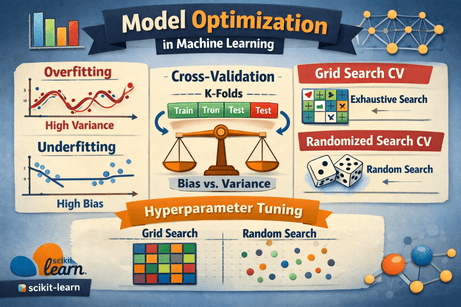
Model optimization is a core skill in machine learning.
A good model is not just accurate on training data — it must generalize well to unseen data.
In this tutorial, you’ll learn how to diagnose model problems and systematically improve performance using proven techniques.
1️⃣ Overfitting vs Underfitting
🔴 Underfitting
A model underfits when it is too simple to capture patterns in the data.
Symptoms
- Poor performance on training data
- Poor performance on test data
Common causes
- Model too simple
- Important features missing
- Insufficient training time
Example
- Linear regression on highly nonlinear data
🔵 Overfitting
A model overfits when it learns noise instead of patterns.
Symptoms
- Excellent training accuracy
- Poor test/validation accuracy
Common causes
- Model too complex
- Too many parameters
- Small dataset
Example
- Very deep decision tree
⚖️ Visual Intuition
| Model Complexity | Training Error | Test Error |
|---|---|---|
| Too simple | High | High |
| Optimal | Low | Low |
| Too complex | Very Low | High |
2️⃣ Bias–Variance Tradeoff
The bias–variance tradeoff explains why models fail to generalize.
🎯 Bias
Error due to wrong assumptions in the model.
- High bias → underfitting
- Example: linear model for nonlinear data
🎯 Variance
Error due to sensitivity to data fluctuations.
- High variance → overfitting
- Example: deep decision tree
⚖️ Tradeoff Summary
| Problem | Bias | Variance |
|---|---|---|
| Underfitting | High | Low |
| Overfitting | Low | High |
| Good Model | Balanced | Balanced |
Goal: find the sweet spot where both bias and variance are minimized.
3️⃣ Cross-Validation
❓ Why Cross-Validation?
A single train/test split can be misleading.
Cross-validation provides a robust estimate of model performance.
🔁 K-Fold Cross-Validation
- Split data into K folds
- Train on K-1 folds
- Validate on the remaining fold
- Repeat K times
- Average the scores
🧠 Advantages
- Better generalization estimate
- Reduces dependence on a single split
- Essential for hyperparameter tuning
🐍 Python Example (scikit-learn)
from sklearn.model_selection import cross_val_score
from sklearn.linear_model import LogisticRegression
from sklearn.datasets import load_iris

X, y = load_iris(return_X_y=True)

model = LogisticRegression(max_iter=200)

scores = cross_val_score(model, X, y, cv=5)

print("Cross-validation scores:", scores)
print("Mean accuracy:", scores.mean())
4️⃣ Hyperparameter Tuning
❓ What Are Hyperparameters?
Parameters set before training, not learned from data.
Examples:
max_depth(Decision Tree)C(Logistic Regression)n_neighbors(KNN)learning_rate(Boosting)
🎯 Why Tune Them?
Default values are not optimal for all datasets.
Hyperparameter tuning helps:
- Reduce overfitting
- Improve accuracy
- Stabilize predictions
5️⃣ GridSearchCV
🔍 What Is Grid Search?
Tries all combinations of hyperparameters.
✔️ Exhaustive
❌ Computationally expensive
🐍 Example: GridSearchCV
from sklearn.model_selection import GridSearchCV
from sklearn.ensemble import RandomForestClassifier

param_grid = {
    'n_estimators': [50, 100, 200],
    'max_depth': [None, 5, 10],
    'min_samples_split': [2, 5]
}

model = RandomForestClassifier(random_state=42)

grid_search = GridSearchCV(
    estimator=model,
    param_grid=param_grid,
    cv=5,
    scoring='accuracy',
    n_jobs=-1
)

grid_search.fit(X, y)

print("Best parameters:", grid_search.best_params_)
print("Best score:", grid_search.best_score_)
🧠 When to Use Grid Search
- Small hyperparameter space
- You want guaranteed best combination
6️⃣ RandomizedSearchCV
🎲 What Is Random Search?
Samples random combinations from hyperparameter distributions.
✔️ Faster
✔️ Scales better
❌ Not exhaustive
🐍 Example: RandomizedSearchCV
from sklearn.model_selection import RandomizedSearchCV
from scipy.stats import randint

param_dist = {
    'n_estimators': randint(50, 300),
    'max_depth': randint(3, 20),
    'min_samples_split': randint(2, 10)
}

random_search = RandomizedSearchCV(
    estimator=RandomForestClassifier(random_state=42),
    param_distributions=param_dist,
    n_iter=20,
    cv=5,
    scoring='accuracy',
    n_jobs=-1,
    random_state=42
)

random_search.fit(X, y)

print("Best parameters:", random_search.best_params_)
print("Best score:", random_search.best_score_)
🧠 When to Use Random Search
- Large parameter space
- Limited computation time
- Complex models
7️⃣ Grid Search vs Random Search
| Feature | GridSearchCV | RandomizedSearchCV |
|---|---|---|
| Speed | Slow | Fast |
| Exhaustive | Yes | No |
| Scalability | Poor | Good |
| Best for | Small spaces | Large spaces |
8️⃣ Best Practices for Model Optimization
✅ Always use cross-validation
✅ Tune hyperparameters after preprocessing
✅ Optimize metrics relevant to the problem
✅ Avoid tuning on test data
✅ Combine with feature engineering











💬 Comments
No comments yet. Be the first to comment!
Login to comment.