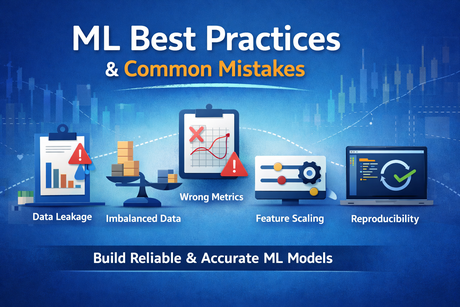
Machine Learning models often fail not because of algorithms, but because of poor practices during data handling, evaluation, and experimentation.
This tutorial covers the most common ML mistakes, explains why they are dangerous, and shows best practices with Python examples to avoid them.
1️⃣ Data Leakage 🚨 (The Silent Model Killer)
🔍 What Is Data Leakage?
Data leakage occurs when information from outside the training dataset is incorrectly used to create the model.
👉 The model learns patterns it should never have access to in real life.
❌ Common Data Leakage Examples
| Mistake | Why It's Wrong |
|---|---|
| Scaling before train/test split | Test data influences training |
| Feature contains future info | Impossible in production |
| Target used indirectly as feature | Artificially high accuracy |
| Data leakage via aggregation | Group-level info leaks labels |
❌ Bad Example (Data Leakage)
from sklearn.preprocessing import StandardScaler

scaler = StandardScaler()
X_scaled = scaler.fit_transform(X)  # ❌ uses all data

X_train, X_test, y_train, y_test = train_test_split(
    X_scaled, y, test_size=0.2
)
✅ Correct Practice (No Leakage)
from sklearn.pipeline import Pipeline
from sklearn.preprocessing import StandardScaler
from sklearn.linear_model import LogisticRegression

pipeline = Pipeline([
    ("scaler", StandardScaler()),
    ("model", LogisticRegression())
])

pipeline.fit(X_train, y_train)
✔️ Pipelines guarantee no leakage
🧠 Best Practices
- Always split data first
- Use Pipeline / ColumnTransformer
- Avoid features based on future events
- Be cautious with group statistics
2️⃣ Imbalanced Datasets ⚖️
🔍 What Is Class Imbalance?
When one class dominates the dataset:
Class 0: 95%
Class 1: 5%
A naive model predicting always Class 0 gets 95% accuracy — but is useless.
❌ Wrong Thinking
"My model has 98% accuracy, so it's good."
🚫 Accuracy is misleading for imbalanced data.
✅ Detecting Imbalance
import pandas as pd

pd.Series(y).value_counts(normalize=True)
✅ Better Metrics for Imbalanced Data
| Metric | Use Case |
|---|---|
| Precision | Cost of false positives |
| Recall | Cost of false negatives |
| F1-score | Balance |
| ROC-AUC | Ranking quality |
| PR-AUC | Rare events |
✅ Handling Imbalance
🔹 1. Class Weights
LogisticRegression(class_weight="balanced")🔹 2. Resampling (SMOTE)
from imblearn.over_sampling import SMOTE

X_res, y_res = SMOTE().fit_resample(X_train, y_train)
🔹 3. Threshold Tuning
y_proba = model.predict_proba(X_test)[:, 1]
y_pred = (y_proba > 0.3).astype(int)
🧠 Best Practices
- Always inspect class distribution
- Never rely on accuracy alone
- Prefer Recall / F1 / AUC
- Tune decision thresholds
3️⃣ Choosing the Wrong Metrics 📉
❌ Common Metric Mistakes
| Problem | Wrong Metric |
|---|---|
| Fraud detection | Accuracy |
| Medical diagnosis | Accuracy |
| Regression with outliers | MSE |
| Ranking systems | RMSE |
✅ Metric Selection Guide
🔹 Regression
| Metric | When to Use |
|---|---|
| MAE | Robust to outliers |
| RMSE | Penalize large errors |
| R² | Overall fit |
🔹 Classification
| Metric | Use |
|---|---|
| Precision | False positives costly |
| Recall | False negatives costly |
| F1-score | Balanced |
| ROC-AUC | Probability ranking |
✅ Example: Confusion Matrix
from sklearn.metrics import confusion_matrix

confusion_matrix(y_test, y_pred)
🧠 Best Practices
- Match metrics to business objective
- Use multiple metrics
- Visualize performance (ROC, PR curves)
- Explain metrics to stakeholders
4️⃣ Feature Scaling Mistakes 📏
🔍 Why Feature Scaling Matters
Some algorithms depend on distance or magnitude.
| Needs Scaling | Doesn’t |
|---|---|
| KNN | Decision Trees |
| SVM | Random Forest |
| Linear Regression | Gradient Boosting |
| Neural Networks |
❌ Common Mistakes
- Scaling target variable by accident
- Using wrong scaler
- Scaling before splitting data
- Forgetting to scale at inference
✅ Correct Scaling with Pipelines
from sklearn.pipeline import Pipeline
from sklearn.preprocessing import StandardScaler
from sklearn.svm import SVC

pipeline = Pipeline([
    ("scaler", StandardScaler()),
    ("model", SVC())
])
🔹 Choosing the Right Scaler
| Scaler | Use Case |
|---|---|
| StandardScaler | Normal distributions |
| MinMaxScaler | Neural networks |
| RobustScaler | Outliers present |
🧠 Best Practices
- Scale features only
- Use Pipelines
- Save scaler for deployment
- Know your algorithm
5️⃣ Reproducibility 🔁 (Often Ignored, Always Critical)
🔍 What Is Reproducibility?
Getting the same results:
- Across runs
- Across machines
- Across collaborators
❌ Common Problems
- No
random_state - Random splits
- Untracked data versions
- Unlogged hyperparameters
✅ Fix Randomness
import numpy as np
import random

np.random.seed(42)
random.seed(42)
train_test_split(X, y, random_state=42)✅ Reproducible Models
RandomForestClassifier(random_state=42)✅ Experiment Tracking (Recommended)
- MLflow
- Weights & Biases
- TensorBoard
- CSV / JSON logging
🧠 Best Practices
- Fix random seeds everywhere
- Version data & code
- Log metrics & parameters
- Save models properly
✅ Final Checklist (Best Practices Summary)
✔️ Split data before preprocessing
✔️ Use pipelines
✔️ Check class imbalance
✔️ Use correct evaluation metrics
✔️ Scale features properly
✔️ Avoid data leakage
✔️ Ensure reproducibility
✔️ Think about deployment early
🎯 Conclusion
Machine Learning success is 80% methodology, 20% algorithms.
Avoiding these common mistakes will dramatically improve model reliability, trust, and real-world performance.












💬 Comments
No comments yet. Be the first to comment!
Login to comment.