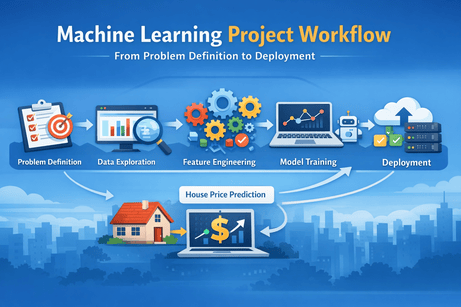
Machine Learning is not just about choosing an algorithm and fitting a model.
In real-world applications, ML is a structured workflow that transforms a vague business problem into a deployed, maintainable solution.
This tutorial walks you through the full Machine Learning project lifecycle, from problem definition to deployment mindset, with a mini end-to-end Python project.
1️⃣ Problem Definition
🎯 Why This Step Is Critical
A poorly defined problem leads to:
- Wrong data collection
- Incorrect evaluation metrics
- Useless models
Rule #1: ML does not solve business problems directly — it solves well-defined prediction tasks.
🔍 Key Questions to Ask
Before touching any data, answer:
| Question | Example |
|---|---|
| What is the objective? | Predict house prices |
| What type of ML problem? | Regression |
| What is the target variable? | price |
| What is the success metric? | RMSE |
| What are constraints? | Interpretability, latency |
🧠 Example
Business goal:
Help a real estate agency estimate house prices automatically.
ML formulation:
- Input: house size, location, number of rooms
- Output: predicted price
- Type: Supervised Learning → Regression
2️⃣ Data Exploration (EDA – Exploratory Data Analysis)
📊 Goal of EDA
EDA helps you:
- Understand data distributions
- Detect missing values
- Identify outliers
- Find relationships between features and target
🔧 Common EDA Steps
- Dataset overview
- Summary statistics
- Missing values
- Correlations
- Visualizations
🧪 Python Example
import pandas as pd
import seaborn as sns
import matplotlib.pyplot as plt

df = pd.read_csv("housing.csv")

df.head()
df.info()
df.describe()
Missing values
df.isnull().sum()
Correlation heatmap
plt.figure(figsize=(8,6))
sns.heatmap(df.corr(), annot=True, cmap="coolwarm")
plt.show()
🧠 Insights You Should Look For
- Which features strongly affect the target?
- Are there redundant features?
- Is the target skewed?
3️⃣ Feature Engineering
⚙️ What Is Feature Engineering?
Feature engineering is the process of transforming raw data into meaningful inputs for ML models.
Better features > better algorithms
🔨 Common Techniques
| Technique | Example |
|---|---|
| Handling missing values | Mean / median imputation |
| Encoding | One-Hot Encoding |
| Scaling | StandardScaler |
| Feature creation | Price per square meter |
| Feature selection | Drop low-importance features |
🧪 Python Example
from sklearn.model_selection import train_test_split
from sklearn.preprocessing import StandardScaler

X = df.drop("price", axis=1)
y = df["price"]

X_train, X_test, y_train, y_test = train_test_split(
    X, y, test_size=0.2, random_state=42
)

scaler = StandardScaler()
X_train_scaled = scaler.fit_transform(X_train)
X_test_scaled = scaler.transform(X_test)
4️⃣ Model Training
🏗️ Choosing a Model
Model choice depends on:
- Problem type
- Dataset size
- Interpretability needs
- Performance requirements
For regression:
- Linear Regression
- Random Forest
- Gradient Boosting
🧪 Python Example (Linear Regression)
from sklearn.linear_model import LinearRegression

model = LinearRegression()
model.fit(X_train_scaled, y_train)
🔁 Iterative Process
Model training is never one-shot:
- Train
- Evaluate
- Tune
- Retrain
5️⃣ Model Evaluation
📐 Why Evaluation Matters
A model that performs well on training data but poorly on new data is overfitting.
📊 Regression Metrics
| Metric | Meaning |
|---|---|
| MAE | Average absolute error |
| RMSE | Penalizes large errors |
| R² | Explained variance |
🧪 Python Example
from sklearn.metrics import mean_absolute_error, mean_squared_error, r2_score
import numpy as np

y_pred = model.predict(X_test_scaled)

mae = mean_absolute_error(y_test, y_pred)
rmse = np.sqrt(mean_squared_error(y_test, y_pred))
r2 = r2_score(y_test, y_pred)

print("MAE:", mae)
print("RMSE:", rmse)
print("R²:", r2)
📈 Visualization
plt.scatter(y_test, y_pred)
plt.xlabel("Actual Prices")
plt.ylabel("Predicted Prices")
plt.title("Actual vs Predicted")
plt.show()
6️⃣ Deployment Mindset (Often Ignored!)
🚀 ML ≠ Jupyter Notebook
A real ML system must be:
- Reproducible
- Scalable
- Monitorable
- Maintainable
🧠 Deployment Considerations
| Aspect | Question |
|---|---|
| Data drift | Will input data change over time? |
| Model updates | How often retrain? |
| Latency | Real-time or batch? |
| Monitoring | Detect performance drop |
| Versioning | Track models & datasets |
🧪 Simple Deployment Example (Concept)
import joblib

joblib.dump(model, "house_price_model.pkl")
joblib.dump(scaler, "scaler.pkl")
Later used in:
- Flask / FastAPI
- Django backend
- Microservices
- Cloud pipelines
7️⃣ Mini End-to-End Project Summary
🏠 House Price Prediction Workflow
1️⃣ Problem Definition
Predict house prices → Regression
2️⃣ Data Exploration
Understand distributions & correlations
3️⃣ Feature Engineering
Scaling, selection, cleaning
4️⃣ Model Training
Linear Regression baseline
5️⃣ Evaluation
MAE, RMSE, R²
6️⃣ Deployment Mindset
Save model, plan monitoring & retraining
✅ Key Takeaways
- Machine Learning is a process, not a model
- Most value comes from:
- Problem understanding
- Data quality
- Feature engineering
- Deployment thinking should start early, not last






💬 Comments
No comments yet. Be the first to comment!
Login to comment.