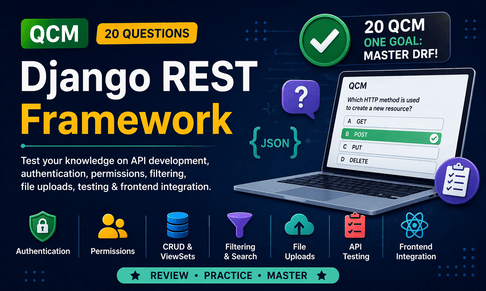
Introduction
Tutorials 1 to 10 form an important stage in learning modern Django development because they move beyond traditional server-rendered pages and introduce the learner to the world of API-driven applications. In these tutorials, the focus is no longer only on displaying HTML templates through Django views, but on transforming Django into a complete backend capable of serving structured data to web applications, mobile apps, and JavaScript frontends. This part of the course therefore represents the transition from “classic Django websites” to full-stack development with Django REST Framework.
The first concept introduced in this sequence is the general idea of Django REST Framework, often called DRF. The learner begins by understanding what an API is, why APIs matter in modern development, and how DRF extends Django with tools specifically designed for building web services. This includes the notion of serializers, API views, request and response handling, and the idea that Django can act not only as a website framework, but also as a strong backend platform for many types of clients. In other words, the learner is introduced to a new way of thinking: instead of returning only HTML pages, the application can now return JSON data in a clean, secure, and structured form.
After this introduction, the tutorials move into the practical creation of a first API. Here, the learner sees how a Django model can be exposed through DRF using serializers, API views, and URL routing. This stage is essential because it turns theory into practice. Instead of only understanding what an API is, the learner actually builds one step by step. This includes working with GET and POST requests, validating data through serializers, and returning JSON responses. The goal at this stage is to help the learner build confidence and understand the full path from database model to API endpoint.
Once the first API is created, the course expands into one of the most important backend development patterns: CRUD operations, meaning Create, Read, Update, and Delete. Through this topic, the learner understands how APIs are used not just to display data, but to fully manage it. This includes creating new records, retrieving existing ones, updating them, and deleting them. The learner also discovers how DRF generic views can reduce repetition and make code cleaner. This is a key part of the course because CRUD APIs are at the heart of most real-world applications, whether the project is a blog, a dashboard, an e-commerce site, or a management system.
The next step in the progression is the study of ViewSets and Routers, which represent a more advanced and elegant way of organizing API logic. Instead of writing multiple separate views for each operation, the learner sees how related API behavior can be grouped inside a single ViewSet class, while routers automatically generate the corresponding URLs. This part is very important because it shows how DRF helps developers write less repetitive code while keeping the project organized and scalable. It also introduces a more resource-oriented mindset in which the API is structured around business entities such as posts, users, books, or products.
After learning how to create and organize APIs, the tutorials move into the fundamental topic of authentication. At this stage, the learner discovers that an API must not only return data correctly, but also identify who is making the request. Different authentication mechanisms are introduced, such as session-based authentication and basic authentication, along with the central role of request.user. The learner understands that authentication is about establishing identity, and that it is the first security layer in any serious API project. This is especially important for endpoints that must be protected, such as user dashboards, private resources, or account-specific operations.
Closely connected to authentication is the next tutorial on permissions, which teaches the learner how to control what different users are allowed to do once they are identified. This part explains the difference between authentication and authorization, showing that knowing who the user is does not automatically mean the user should have access to everything. Built-in permission classes such as AllowAny, IsAuthenticated, and IsAuthenticatedOrReadOnly are introduced, alongside object-level permission logic such as owner-based access. This tutorial is especially important because it teaches how to secure endpoints in a realistic way, for example by allowing everyone to read content but only the owner to edit or delete it.
The sequence then continues with an essential topic for real-world APIs: pagination, filtering, and search. At this point, the learner understands that APIs do not only need to return data securely, but also efficiently and intelligently. When datasets become large, returning all records at once is not practical, so pagination is introduced to split results into manageable pages. Filtering allows the client to request only relevant subsets of data, while search helps users find matching records easily. This tutorial is particularly useful because it makes APIs more user-friendly, scalable, and professional, and it introduces tools such as query parameters, filter backends, and search fields.
Another highly practical topic covered in this block is uploading files via API. Here, the learner moves beyond text and JSON data and discovers how an API can accept documents, images, and other uploaded files. This includes understanding the difference between ordinary JSON payloads and multipart form data, using fields such as FileField and ImageField, and configuring parsers like MultiPartParser. This tutorial is valuable because file uploads are a common requirement in modern applications, whether for user avatars, course materials, product images, or downloadable resources. It also teaches the learner that DRF builds on Django’s existing file handling system while exposing it through API endpoints.
After building, securing, and extending APIs, the tutorials then address a crucial professional practice: API testing. At this point, the learner discovers that writing an API is not enough; it must also be tested to ensure that it behaves correctly and remains reliable as the project evolves. This includes using APITestCase, APIClient, and APIRequestFactory to simulate requests and verify responses. The learner sees how to test status codes, returned JSON, authentication rules, validation errors, and database changes. This part is fundamental because it introduces the habits of quality assurance and maintainability, which are essential in any serious development workflow.
Finally, the block concludes with connecting Django to frontend frameworks, a topic that brings all the previous lessons together in a modern full-stack context. Here, the learner understands how Django can serve as a backend API for frontend technologies such as React. Different architectural patterns are discussed, including same-origin setups and fully decoupled frontends. Important concepts such as data fetching, CSRF handling, and CORS are introduced, showing how frontend and backend communicate securely and efficiently. This final tutorial is particularly important because it places Django REST Framework inside the broader ecosystem of modern web development, where the backend often powers rich JavaScript interfaces rather than only server-rendered pages.
Taken together, Tutorials 61 to 70 provide the learner with a strong foundation in API development using Django REST Framework. They do not only teach isolated technical features, but gradually build a complete picture of how modern backend systems are designed. The learner begins by understanding what DRF is, then learns how to build APIs, organize them with CRUD patterns and ViewSets, secure them with authentication and permissions, improve them with pagination, filtering, and file uploads, validate them through testing, and finally connect them to frontend frameworks. In this sense, this section of the course is not just a collection of lessons, but a complete roadmap toward building real-world API-driven applications with Django.
That is why the following QCM is important: it helps review the essential concepts, vocabulary, and practical ideas introduced in this sequence, ensuring that the learner has not only followed the tutorials, but also understood the logic that connects them all.
💬 Comments
No comments yet. Be the first to comment!
Login to comment.