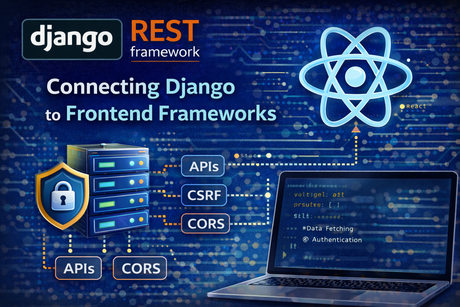
Connecting Django to a frontend framework means deciding how the frontend and backend share responsibilities. In modern projects, Django often provides the API and business logic, while a frontend such as React handles the interactive user interface. Django REST Framework is designed for this style of architecture, and its official docs explicitly cover AJAX, CSRF, and CORS because browser-based frontends commonly consume Django APIs this way.
At a high level, there are three common integration patterns. The first is a Django-rendered frontend where Django templates generate the pages and JavaScript adds interactivity. The second is a same-origin frontend app, where a frontend bundle is served from the same site as Django. The third is a decoupled frontend, where Django and the frontend run on different origins, often with Django serving JSON and the frontend making cross-origin HTTP requests. The right choice affects authentication, CSRF, deployment, and developer workflow. DRF’s docs make this especially clear by separating same-origin AJAX concerns from CORS concerns.
1. The big architectural question
Before writing code, you need to answer one question: Is Django rendering the UI, or is Django serving data to another UI? If Django renders the UI with templates, you usually stay close to classic Django conventions. If a frontend framework renders the UI, Django becomes more of an API backend. DRF’s views, authentication, and testing tools all make this backend role practical.
This choice changes the whole project structure. In a template-first project, your main concerns are template rendering, CSRF in normal forms, and maybe a little JavaScript. In a decoupled frontend project, your main concerns become API design, authentication strategy, CORS, and state management in the frontend. MDN’s CORS guide explains that browsers restrict cross-origin requests unless the server explicitly permits them, which is exactly why decoupled frontends need extra backend configuration.
2. Pattern one: Django templates plus frontend components
The simplest way to “connect Django to a frontend framework” is sometimes not to separate them at all. You can let Django render the page and use frontend components inside those pages. This works well for dashboards, admin-like tools, forms, and sites where SEO and server-rendered content matter. DRF is not required for this pattern, although APIs may still help for specific interactive widgets.
In this model, Django controls routing and page rendering. The frontend framework enhances pieces of the page rather than owning the whole application shell. This approach keeps authentication simpler because everything usually stays on the same origin, and same-origin AJAX requests can rely on Django’s normal session flow. DRF’s AJAX/CSRF guide says that for same-origin AJAX, you typically use SessionAuthentication, and unsafe requests need a CSRF token in the HTTP header.
3. Pattern two: same-origin SPA or bundled frontend
A second pattern is to build the frontend with a framework such as React and serve the built assets from Django or the same site origin. Here, the frontend feels like a single-page app, but it is still same-origin relative to Django. That means you avoid most CORS issues because the browser sees both the frontend and backend as the same site. DRF’s docs distinguish same-origin AJAX from cross-origin scenarios for exactly this reason.
This pattern is attractive because it combines a richer frontend experience with simpler security rules than a fully separate origin. Session-based authentication often remains viable, but CSRF still matters for unsafe requests such as POST, PUT, PATCH, and DELETE. DRF’s auth docs note that CSRF handling differs slightly in REST framework because it supports both session and non-session authentication, and login views should always have CSRF validation applied.
4. Pattern three: fully decoupled frontend and Django API
The third pattern is the most common in “modern frontend + Django backend” discussions: the frontend runs separately, perhaps on another port in development or another domain in production, while Django exposes APIs. In this setup, the frontend talks to Django using fetch, XHR, or a data library. React’s docs emphasize general component and hook composition rather than prescribing one transport library, so plain fetch remains a perfectly valid integration method.
The moment the frontend and backend live on different origins, CORS becomes part of the design, not an optional detail. MDN explains that CORS is an HTTP-header-based mechanism allowing a server to indicate which other origins may access its resources, and browsers may perform a preflight request before the actual request. That means a decoupled frontend needs explicit backend permission to talk to Django from the browser.
5. Why APIs are the bridge
When Django connects to a frontend framework, the API becomes the contract between them. Django models and business rules remain on the backend, but serializers and API views define what the frontend may send and receive. That contract should be stable, documented, and intentionally designed. DRF’s homepage highlights serialization, authentication policies, and schemas because these are exactly the pieces that make frontend-backend integration workable.
This is why many teams move logic out of templates and into structured API endpoints. A frontend component does not need to know about Django models directly; it only needs to know the request and response format. The cleaner the API contract, the easier it is for the frontend to evolve independently. DRF’s documentation around views and documentation reinforces that APIs should be understandable both to machines and to developers.
6. A simple example architecture
Suppose you have a Book model in Django and want a React frontend to show and create books. Django might expose:
GET /api/books/POST /api/books/GET /api/books/<id>/
while React fetches that data and renders the interface. This is the most common mental model for connecting Django to a frontend framework: Django owns the data and validation; the frontend owns the presentation and interactivity. DRF’s API views and serializer system are built for exactly that kind of separation.
A minimal Django viewset or generic view can provide the API, and the frontend simply consumes JSON. The frontend should not duplicate backend validation logic as the source of truth; it can add client-side validation for usability, but the server remains authoritative. This division of responsibility keeps the architecture maintainable as the project grows.
7. Frontend data fetching
On the frontend side, the basic connection usually starts with HTTP requests. In React, that may be done with fetch inside effects or custom hooks, or through a framework-level data system if you are using a more opinionated stack. React’s docs encourage extracting reusable logic into custom hooks, which is a natural fit for API request code such as useBooks() or useCurrentUser().
A simple example with fetch might look like this:
import { useEffect, useState } from "react";

export function useBooks() {
  const [books, setBooks] = useState([]);
  const [loading, setLoading] = useState(true);
  const [error, setError] = useState(null);

  useEffect(() => {
    fetch("http://localhost:8000/api/books/")
      .then((res) => {
        if (!res.ok) throw new Error("Failed to load books");
        return res.json();
      })
      .then((data) => setBooks(data))
      .catch((err) => setError(err.message))
      .finally(() => setLoading(false));
  }, []);

  return { books, loading, error };
}
This frontend code is simple, but whether it succeeds depends on how Django is configured for same-origin or cross-origin access. That is why frontend fetching and backend security must be designed together.
8. Same-origin requests and CSRF
If your frontend runs on the same origin as Django and uses session authentication, CSRF protection becomes central. DRF’s AJAX/CSRF/CORS topic says that to make AJAX requests, you need to include the CSRF token in the HTTP header, following Django’s CSRF guidance. It also notes that same-origin AJAX typically relies on SessionAuthentication.
That means a same-origin POST from JavaScript is not “special” just because it is an API call. It still needs the CSRF token when using sessions. This is one of the most common beginner integration bugs: GET works, so the developer assumes the connection is correct, but POST fails because the CSRF token was not included. DRF’s docs are explicit that unsafe requests need CSRF handling in that scenario.
A typical same-origin frontend request might look like:
fetch("/api/books/", {
  method: "POST",
  headers: {
    "Content-Type": "application/json",
    "X-CSRFToken": csrfToken,
  },
  body: JSON.stringify({
    title: "Mastering Django",
    author: "William",
    published_year: 2026,
  }),
});
The important thing here is not only the JSON body, but also the CSRF header.
9. Cross-origin requests and CORS
If your frontend runs on another origin, the browser enforces CORS. MDN explains that a server must indicate which origins are allowed using headers such as Access-Control-Allow-Origin, and browsers may perform a preflight request first. Without the right CORS response headers, the browser blocks the frontend even if Django returned a technically valid HTTP response.
This means that “the API works in Postman” does not guarantee that it works in the browser. Postman is not subject to browser CORS rules in the same way. A decoupled frontend requires the browser-facing HTTP layer to be configured intentionally, not just the backend business logic. MDN’s CORS error references make this very concrete: missing Access-Control-Allow-Origin or invalid credential settings cause the browser to reject the request.
10. Credentials and cross-origin authentication
Cross-origin authentication has an extra complication: credentials. MDN states that Access-Control-Allow-Credentials: true tells browsers whether credentials may be included in cross-origin requests, and that this is the only valid value if you want credentialed requests. MDN also notes that using credentials is incompatible with a wildcard Access-Control-Allow-Origin: * value.
This matters a lot if you want your decoupled frontend to use Django sessions or cookies. The frontend must send credentials, and the backend must explicitly allow them. That means your architecture choices are not just about convenience; they directly affect how authentication works in the browser. This is one reason many teams either keep frontend and backend same-origin or choose a token-based scheme for decoupled apps.
A credentialed frontend request may look like this:
fetch("http://localhost:8000/api/profile/", {
  method: "GET",
  credentials: "include",
});
But that only works if the backend’s CORS and credential headers are configured correctly.
11. Choosing an authentication strategy
Authentication strategy depends on the integration pattern. For same-origin Django-served frontends, session authentication is often the smoothest choice because it fits naturally with Django login and CSRF protection. DRF’s AJAX/CSRF guide and authentication docs support this pattern clearly.
For a fully decoupled frontend, session auth can still work, but CORS and credential handling become more complex. Many teams choose token-style approaches for decoupled clients because they avoid some cookie-related complications, though they come with their own trade-offs. DRF’s authentication guide emphasizes that authentication is pluggable, which is exactly why different frontend architectures can use different strategies.
12. React-specific practical guidance
If you are connecting Django to React, one important current reality is that Create React App is no longer the recommended starting point for new apps. React officially announced that Create React App is being deprecated for new applications and recommends migrating to frameworks or build tools like Vite, Parcel, or RSBuild. So when someone says “React frontend with Django backend” today, the modern setup usually means a framework or a lighter build tool rather than CRA.
React’s newer docs also reflect a broader ecosystem where rendering and data fetching may happen in different places depending on the framework. For plain client-side integration with Django APIs, you can still use fetch and custom hooks. For framework-based React applications, data fetching may be handled by that framework’s routing or server features. React’s docs note, for example, that in Server Components environments, fetching may happen on the server side rather than solely in the browser.
13. State management and API boundaries
When connecting Django to a frontend framework, not all state should live in the same place. Backend state includes persistent business data such as users, books, orders, and permissions. Frontend state includes UI concerns like modal visibility, loading spinners, current tab, and form drafts. React’s docs about props, context, and custom hooks are useful here because they help organize frontend state cleanly without confusing it with backend data.
A good integration keeps the boundary clear. The backend owns truth for persistent application data and validation. The frontend owns how that data is presented and manipulated interactively. Mixing those responsibilities carelessly often leads to duplicated logic and hard-to-debug bugs. This is why a clean API contract matters so much in frontend-backend systems.
14. File uploads from frontend frameworks
Connecting Django to a frontend framework often includes uploads: profile images, documents, or media. In those cases, the frontend should send multipart form data rather than JSON, and Django/DRF should use file-capable parsers on the backend. DRF’s field docs explicitly say that FileField and ImageField are suitable with MultiPartParser or FileUploadParser, not ordinary JSON parsing.
A React upload example may look like:
const formData = new FormData();
formData.append("title", "My Report");
formData.append("file", selectedFile);

fetch("http://localhost:8000/api/documents/upload/", {
  method: "POST",
  body: formData,
  credentials: "include",
});
This is a good example of why “frontend framework integration” is not only about fetching JSON. Real-world connections often include multipart requests, auth, and validation together.
15. Pagination, filtering, and search in frontend integration
As soon as the frontend displays real lists, the API design starts shaping the user experience. Pagination, filtering, and search should be first-class API features because frontend frameworks commonly build list views around them. DRF’s homepage and docs emphasize pagination and related API concerns because these behaviors are fundamental to frontend consumption, not optional extras.
A frontend list page may call URLs like:
/api/books/?page=2&search=django&ordering=-created_at
That lets the frontend stay thin and declarative. Instead of downloading everything and filtering client-side, it tells Django what it needs. This is one of the main strengths of API-driven architecture: the frontend stays responsive, while Django handles the heavy querying and validation.
16. Error handling between frontend and Django
A frontend framework should never assume every backend response is successful. It must handle validation errors, permission denials, authentication failures, and network issues cleanly. DRF’s API design around status codes and structured errors helps a lot here because the frontend can translate backend responses into user-visible messages. The browsable API and DRF’s human-friendly resource pages are also useful during development because they make backend behavior easier to inspect before the frontend is finished.
This is another reason a clear boundary helps. The backend should provide consistent status codes and predictable response shapes. The frontend should interpret those results and present meaningful feedback. When both sides follow that discipline, integration becomes much easier to maintain.
17. Documentation matters more in decoupled systems
When Django and the frontend are separated, API documentation becomes much more important. DRF’s documentation page specifically highlights multiple ways to document your API, because an API shared across frontend and backend teams needs a readable contract. Schema generation is especially useful in these cases because it makes available endpoints and parameters easier to inspect systematically.
In a template-only Django app, the view and template often evolve together in one codebase. In a decoupled system, the frontend may be developed independently, by another person or even another team. That is why API documentation, consistent serializers, and stable endpoint conventions matter so much more once you adopt a frontend framework.
18. Development workflow differences
Frontend-backend integration also changes the development workflow. In same-origin setups, a single Django app may be enough for local development. In decoupled setups, developers often run Django on one port and the frontend dev server on another, which immediately introduces CORS and origin differences. MDN’s CORS guide is directly relevant here because even a simple local setup like localhost:8000 and localhost:5173 is cross-origin from the browser’s perspective if the port differs.
This is why developers often think, “It only fails in development.” In reality, the browser is correctly enforcing origin rules. Good local integration means designing for the same browser constraints that production will face, not treating them as accidental annoyances.
19. Common mistakes
One of the most common mistakes is assuming that any frontend can call any Django API without backend changes. Browsers require CORS for cross-origin requests, and MDN’s documentation makes clear that missing Access-Control-Allow-Origin headers block access.
Another frequent mistake is using session auth across origins without understanding credential requirements. MDN documents that credentialed requests need Access-Control-Allow-Credentials: true, and wildcard origins do not work with credentials.
A third mistake is forgetting CSRF when the frontend is same-origin and uses session authentication. DRF’s AJAX/CSRF guide explicitly says you need the CSRF token in the HTTP header for AJAX requests using sessions.
A fourth mistake is thinking React or another frontend framework replaces the need for API design. It does not. The frontend only becomes easier to build when the backend contract is clean, documented, and stable. DRF’s emphasis on schemas, serializers, and documented API behavior exists for this reason.
20. A practical recommendation
For many projects, the best starting point is not the most complicated architecture. If your app is mostly Django and just needs richer interactivity, keep the frontend same-origin and start simple. If you need a truly separate frontend application, treat the API as a product: design the authentication approach early, handle CORS deliberately, and document the contract. DRF’s docs around AJAX, CSRF, CORS, authentication, and browsable APIs all support that practical progression.
For React specifically, start with a modern toolchain rather than Create React App, since React has deprecated CRA for new apps. Keep data fetching in reusable hooks or framework-level loaders, and let Django remain the authority for validation, permissions, and persistence.
Conclusion
Connecting Django to frontend frameworks is really about choosing an architecture and then aligning the security, API, and deployment model with that choice. DRF’s official docs highlight AJAX, CSRF, and CORS because frontend integration depends on them, while MDN’s CORS documentation explains the browser rules that make cross-origin integration succeed or fail. React’s current docs and announcements also matter here because the frontend ecosystem has moved away from older defaults like Create React App.
The most important idea to remember is this: Django and a frontend framework connect well when the boundary is clear. Django should expose a stable, secure API and own business logic. The frontend should own rendering, interaction, and client-side experience. Once that split is designed well, the whole stack becomes much easier to build and maintain.




💬 Comments
No comments yet. Be the first to comment!
Login to comment.