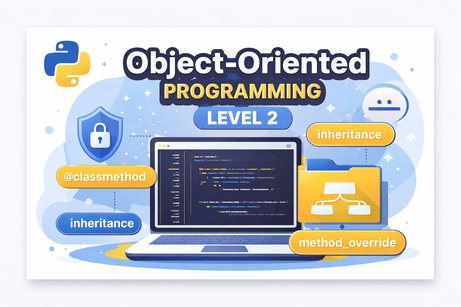
🔷 Introduction
In the beginner stage, you learned how to create classes and objects. Now it's time to go deeper and explore advanced Object-Oriented Programming concepts used in real-world applications.
This lesson will help you understand how to design scalable, reusable, and maintainable systems using OOP.
You will learn:
✔ Class vs instance attributes
✔ Class methods & static methods
✔ Inheritance (single & multiple)
✔ Method overriding
✔ Encapsulation (private attributes)
✔ Magic (dunder) methods
🟩 1. Class Attributes vs Instance Attributes
✅ Instance attributes
Defined inside __init__ and belong to each object:
class Car:
    def __init__(self, brand):
        self.brand = brand
✅ Class attributes
Shared by all objects:
class Car:
    wheels = 4  # class attribute

    def __init__(self, brand):
        self.brand = brand
Example:
c1 = Car("Toyota")
c2 = Car("BMW")

print(c1.wheels)  # 4
print(c2.wheels)  # 4
🟩 2. Class Methods & Static Methods
🔹 Class Method (@classmethod)
Works with the class, not the instance:
class Student:
    school = "MofidTech"

    @classmethod
    def change_school(cls, name):
        cls.school = name
🔹 Static Method (@staticmethod)
Independent utility function:
class Math:
    @staticmethod
    def add(a, b):
        return a + b

print(Math.add(2, 3))
🟩 3. Inheritance
Inheritance allows one class to reuse another.
🔹 Single Inheritance
class Animal:
    def speak(self):
        print("Animal sound")

class Dog(Animal):
    def bark(self):
        print("Woof")
🔹 Multiple Inheritance
class A:
    def method_a(self):
        print("A")

class B:
    def method_b(self):
        print("B")

class C(A, B):
    pass
🟩 4. Method Overriding
Child class modifies parent behavior:
class Animal:
    def speak(self):
        print("Animal sound")

class Dog(Animal):
    def speak(self):
        print("Woof")
🟩 5. Encapsulation (Private Attributes)
Use _ or __ to protect attributes:
class Bank:
    def __init__(self, balance):
        self.__balance = balance  # private

    def get_balance(self):
        return self.__balance
Access:
b = Bank(1000)
print(b.get_balance())
🟩 6. Magic (Dunder) Methods
Special methods that define behavior:
Example: __str__
class Person:
    def __init__(self, name):
        self.name = name

    def __str__(self):
        return f"Person: {self.name}"

p = Person("Ali")
print(p)
Example: __len__
class MyList:
    def __init__(self, items):
        self.items = items

    def __len__(self):
        return len(self.items)
Example: Operator Overloading
class Number:
    def __init__(self, value):
        self.value = value

    def __add__(self, other):
        return self.value + other.value
🟧 7. Exercises (Hidden Solutions)
Exercise 1 — Class vs Instance Attribute
Create a class Book with:
- class attribute: category
- instance attribute: title
Exercise 2 — Class Method
Create a class method that updates a class variable.
Exercise 3 — Inheritance
Create a class Vehicle and a subclass Car.
Exercise 4 — Encapsulation
Create a class with a private variable and getter.
Exercise 5 — Dunder Method
Create a class with __str__.
🟦 Conclusion
In this lesson, you explored advanced OOP concepts that are essential for real-world development:
- Code reuse with inheritance
- Better structure with encapsulation
- Powerful customization with dunder methods
- Cleaner design using class/static methods
These concepts are heavily used in frameworks like Django, Flask, and FastAPI.









💬 Comments
No comments yet. Be the first to comment!
Login to comment.