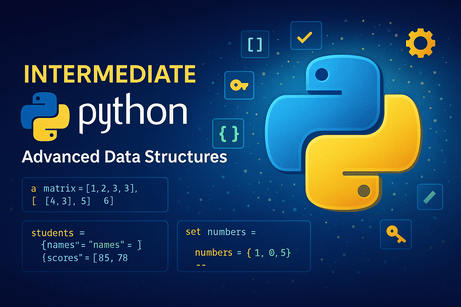
🔷 Introduction
As you move beyond beginner-level Python, one of the first skills you need to strengthen is the ability to work with complex data structures. In real-world applications—APIs, databases, machine learning pipelines, web scrapers—data often arrives in nested or mixed forms: lists inside dictionaries, dictionaries inside lists, queues for processing, sets for filtering unique values, and more.
This lesson explores intermediate data structures that will help you manage, organize, and manipulate data efficiently as your programs grow in complexity.
🟩 1. Nested Lists
Nested lists (lists inside lists) represent matrices, grids, tables, or grouped information.
✅ Example: 2D list (matrix)
matrix = [
    [1, 2, 3],
    [4, 5, 6],
    [7, 8, 9]
]

print(matrix[1][2])  # 6
💡 When to use nested lists
- Grids in games (Tic-Tac-Toe, Sudoku)
- Tables or spreadsheets
- Pixel or image data
🟩 2. Dictionaries of Lists & Lists of Dictionaries
Dictionaries of Lists
Useful when storing multiple values under categories:
students = {
    "names": ["Sara", "Adam", "Lina"],
    "scores": [85, 92, 78]
}

print(students["names"][1])  # Adam
Lists of Dictionaries
This is one of the most common data structures in APIs and databases:
users = [
    {"id": 1, "name": "Ali"},
    {"id": 2, "name": "Yassine"},
    {"id": 3, "name": "Salma"}
]

print(users[2]["name"])  # Salma
💡 When it matters
- JSON responses from APIs
- Database rows
- Configurations
🟩 3. Tuples vs Namedtuples
Tuples are immutable ordered collections:
point = (10, 20)
Namedtuples add structure + readability:
from collections import namedtuple

Point = namedtuple("Point", ["x", "y"])
p = Point(10, 20)

print(p.x, p.y)
💡 Why use namedtuples?
- More readable than tuples
- Lightweight alternative to classes
🟩 4. Sets & Set Operations
A set is an unordered collection of unique items.
numbers = {1, 2, 3, 3, 4}
print(numbers)  # {1, 2, 3, 4}
Set operations
a = {1, 2, 3}
b = {3, 4, 5}

print(a | b)  # union
print(a & b)  # intersection
print(a - b)  # difference
💡 Where sets are used
- Removing duplicates
- Fast membership checking
- Mathematical operations
🟩 5. Stacks & Queues
(Using list and deque)
A. Stack (LIFO – Last In First Out)
stack = []
stack.append("A")
stack.append("B")
stack.append("C")

print(stack.pop())  # C
Used in:
- Undo systems
- Backtracking algorithms
- Expression evaluation
B. Queue (FIFO – First In First Out)
Using collections.deque (fast):
from collections import deque

queue = deque(["A", "B", "C"])

queue.append("D")
print(queue.popleft())  # A
Used in:
- Task scheduling
- Processing logs
- Simulations
🟧 6. Exercise Block (with hidden solutions)
Exercise 1
Create a 3×3 matrix and print its diagonal.
Exercise 2
You have the following list of dictionaries. Print the name of the oldest person.
people = [
   {"name": "Sara", "age": 22},
   {"name": "Adam", "age": 30},
   {"name": "Lina", "age": 27}
]
Exercise 3
Remove duplicates from a list using a set.
🟦 Conclusion
This lesson introduced the intermediate data structures that professionals use daily to manage complex information. Mastering them will significantly boost your ability to build real-world Python applications, especially when dealing with APIs, files, or databases









💬 Comments
No comments yet. Be the first to comment!
Login to comment.