🔷 Introduction
Most real-world applications need to store and manage data permanently. Instead of using files, developers rely on databases to organize, query, and scale data efficiently.
In this lesson, you will learn how to use SQLite, a lightweight database built into Python, to perform basic database operations.
You will learn:
✔ What a database is
✔ How to use SQLite with Python
✔ CRUD operations (Create, Read, Update, Delete)
✔ Executing SQL queries
✔ Fetching and displaying data
🟩 1. What is a Database?
A database is a structured collection of data.
Example:
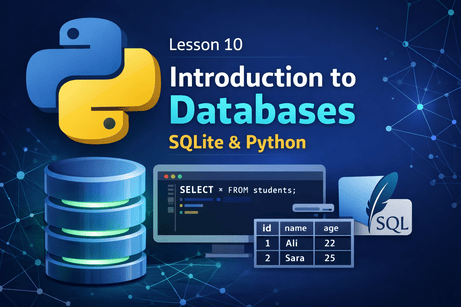
| id | name | age |
|---|---|---|
| 1 | Ali | 22 |
| 2 | Sara | 25 |
SQLite stores data in a file (.db).
🟩 2. Using SQLite in Python
Python includes SQLite via the sqlite3 module.
🔹 Import and connect
import sqlite3

conn = sqlite3.connect("students.db")
cursor = conn.cursor()
✔ conn → connection to database
✔ cursor → executes SQL commands
🟩 3. Creating a Table
cursor.execute("""
CREATE TABLE IF NOT EXISTS students (
    id INTEGER PRIMARY KEY,
    name TEXT,
    age INTEGER
)
""")
🟩 4. Insert Data (CREATE)
cursor.execute("INSERT INTO students (name, age) VALUES (?, ?)", ("Ali", 22))
conn.commit()
✔ Use ? to prevent SQL injection
🟩 5. Read Data (SELECT)
cursor.execute("SELECT * FROM students")
rows = cursor.fetchall()

for row in rows:
    print(row)
🟩 6. Update Data (UPDATE)
cursor.execute("UPDATE students SET age = ? WHERE name = ?", (23, "Ali"))
conn.commit()
🟩 7. Delete Data (DELETE)
cursor.execute("DELETE FROM students WHERE name = ?", ("Ali",))
conn.commit()
🟩 8. Closing Connection
conn.close()✔ Always close the database connection
🟩 9. Full Example
import sqlite3

conn = sqlite3.connect("students.db")
cursor = conn.cursor()

cursor.execute("""
CREATE TABLE IF NOT EXISTS students (
    id INTEGER PRIMARY KEY,
    name TEXT,
    age INTEGER
)
""")

cursor.execute("INSERT INTO students (name, age) VALUES (?, ?)", ("Sara", 25))

cursor.execute("SELECT * FROM students")
for row in cursor.fetchall():
    print(row)

conn.commit()
conn.close()
🟧 10. Exercises (Hidden Solutions)
Exercise 1 — Create a table
Exercise 2 — Insert data
Exercise 3 — Select data
Exercise 4 — Update data
Exercise 5 — Delete data
🟦 Conclusion
In this lesson, you learned how to:
✔ Connect Python to a database
✔ Create tables
✔ Insert, read, update, and delete data
✔ Execute SQL queries
✔ Manage persistent data
These skills are essential for:
- Web applications (Django, Flask)
- APIs
- Data storage systems
- Backend development
🚀 Mini Project — Student Manager (SQLite CRUD App)
Project idea
Build a small Python application that manages students using SQLite.
The app should allow the user to:
- add a student
- view all students
- update a student
- delete a student
This is a classic CRUD application:
- C → Create
- R → Read
- U → Update
- D → Delete
🧩 What learners will practice
With this project, learners will practice:
- connecting to SQLite with
sqlite3 - creating a table
- inserting records
- selecting and displaying records
- updating data
- deleting data
- using SQL safely with placeholders (
?) - organizing a menu-driven Python program
📁 Simple Project Structure
student_manager/
│
├── main.py
└── students.db
✅ Full Solution
🔍 Explanation of the project
1. Database connection
def connect_db():
    conn = sqlite3.connect("students.db")
    return conn
This function opens a connection to the SQLite database.
If the file does not exist, SQLite creates it automatically.
2. Table creation
CREATE TABLE IF NOT EXISTS studentsThis ensures the table exists before the program starts working with data.
Each student has:
id→ unique identifiername→ student nameage→ student age
3. Add student
The app asks the user for a name and age, then inserts the student into the database using:
INSERT INTO students (name, age) VALUES (?, ?)Using ? placeholders is safer than building SQL strings manually.
4. View students
The program fetches all students:
SELECT * FROM studentsThen prints them in a readable format.
5. Update student
The user enters a student ID, then the new values.
The app updates the row using:
UPDATE students SET name = ?, age = ? WHERE id = ?6. Delete student
The user provides the student ID, and the app deletes the corresponding row:
DELETE FROM students WHERE id = ?▶️ Example usage
=== Student Manager ===
1. Add student
2. View students
3. Update student
4. Delete student
5. Exit
Choose an option: 1
Enter student name: Sara
Enter student age: 24
Student added successfully.
Then:
Choose an option: 2

--- Student List ---
ID: 1, Name: Sara, Age: 24
🧠 Skills reinforced
This project helps learners reinforce:
- SQL basics
- Python + SQLite integration
- CRUD workflow
- user input validation
- persistent storage
- menu-driven application design
🛠 Suggested improvements
Your challenge is to extend the project by adding:
- search student by name
- sort students by age
- prevent duplicate names
- export students to CSV
- split the app into modules
- create a GUI version with Tkinter
- add email field
- validate age range







💬 Comments
No comments yet. Be the first to comment!
Login to comment.