🔷 Introduction
Python is famous for writing powerful logic in very few lines of code.
Two of the most important tools that make Python “Pythonic” are:
- List Comprehensions — compact syntax for creating lists
- Generator Expressions — memory-efficient expressions for processing data lazily
These tools are essential for writing clean, efficient, and readable code, especially when dealing with transformations, filtering, and data pipelines.
Today you will learn:
✔ The structure and syntax of list comprehensions
✔ How to add conditions inside comprehensions
✔ Nested comprehensions
✔ Difference between lists and generators
✔ How to write generator expressions
✔ When to use generators for performance
Let’s begin!
🟩 1. What Is a List Comprehension?
A list comprehension is a concise way to create a list using this pattern:
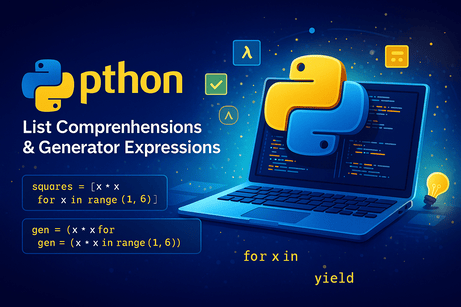
new_list = [expression for item in iterable]
Example: Square numbers from 1 to 5
squares = [x * x for x in range(1, 6)]
print(squares)   # [1, 4, 9, 16, 25]
This replaces a longer loop:
squares = []
for x in range(1, 6):
    squares.append(x * x)
🟩 2. Comprehensions With Conditions
You can filter items by adding an if condition:
evens = [x for x in range(10) if x % 2 == 0]
print(evens)   # [0, 2, 4, 6, 8]
Example: Get names longer than 4 letters
names = ["Ali", "Mouad", "Sara", "Yassine"]
long_names = [n for n in names if len(n) > 4]
print(long_names)
🟩 3. Nested List Comprehensions
Useful for flattening structures or creating grids.
Example: Flatten a 2D list
matrix = [[1,2,3],[4,5,6],[7,8,9]]
flat = [num for row in matrix for num in row]
print(flat)  # [1,2,3,4,5,6,7,8,9]
Equivalent to nested loops:
flat = []
for row in matrix:
    for num in row:
        flat.append(num)
🟩 4. Dictionary & Set Comprehensions
Yes — comprehensions also work with dicts and sets.
Dictionary comprehension:
squares = {x: x*x for x in range(5)}
print(squares)
Set comprehension:
unique_squares = {x*x for x in range(-3, 4)}
print(unique_squares)
🟩 5. Generator Expressions
A generator expression looks like a list comprehension but uses parentheses instead of brackets:
gen = (x * x for x in range(1, 6))
What’s the difference?
- List comprehension: builds the whole list in memory
- Generator expression: produces values one at a time, only when needed (lazy evaluation)
Example:
gen = (x * x for x in range(1, 6))

for value in gen:
    print(value)
Generator expressions are excellent for large datasets, streams, and files.
🟩 6. When Should You Use Generators?
Use a generator when:
- You are processing very large data (millions of records)
- You don’t need to store everything in memory
- You want to improve performance
Examples:
✔ Reading a huge file line by line
✔ Streaming data from an API
✔ Processing logs
🟧 7. Exercise Block (Solutions Hidden)
Exercise 1 — Create a list of cubes using a comprehension
Create a list of the cubes of numbers from 1 to 10.
Exercise 2 — Filter names that start with the letter “A”
Given:
names = ["Ali", "Sara", "Amine", "Yassine", "Amina"]
Create a list containing only names that start with "A".
Exercise 3 — Flatten the following nested list
nested = [[1, 2], [3, 4], [5, 6]]
Output should be: [1, 2, 3, 4, 5, 6].
Exercise 4 — Create a generator that yields even numbers from 0 to 20
Exercise 5 — Build a dictionary using a comprehension
Create:
{1:1, 2:4, 3:9, 4:16}
🟦 Conclusion
List comprehensions and generator expressions are two of the most powerful tools in Python. They help you:
- write cleaner code
- process data efficiently
- reduce errors
- improve performance
Mastering these techniques is essential for writing professional, Pythonic code.









💬 Comments
No comments yet. Be the first to comment!
Login to comment.