📚 What Has Been Covered (Tutorials 1 → 8)
Before starting the quiz, here is a quick recap of the key concepts covered in each tutorial. This will help you review and consolidate your understanding.
✅ Tutorial 1 — Building a Simple Blog with Django
In this tutorial, you learned how to build your first real Django application: a blog system.
You created a Post model, displayed a list of posts, and built a detail page for each post. This introduced the core flow of a Django app: models → views → templates.
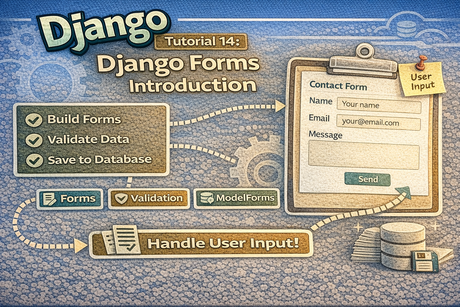
✅ Tutorial 2 — Django Forms Introduction
This tutorial introduced how Django handles user input through forms.
You learned how to create HTML forms, handle GET and POST requests, and retrieve submitted data inside views.
✅ Tutorial 3 — Django Forms with forms.py
You improved your form handling by using Django’s forms.py.
You learned how to define structured forms, add validation, customize fields, and make your code cleaner and more maintainable.
✅ Tutorial 4 — ModelForms in Django
In this tutorial, you discovered how to simplify form creation using ModelForm.
Instead of manually defining fields, Django automatically generates forms based on your models, making development faster and less error-prone.
✅ Tutorial 5 — CRUD Application in Django
You built a complete CRUD system (Create, Read, Update, Delete).
You implemented:
- Creating new posts
- Viewing posts
- Updating posts
- Deleting posts
This is one of the most important real-world skills in Django development.
✅ Tutorial 6 — Template Inheritance and Reusable Layouts
You learned how to structure your frontend using template inheritance.
By creating a base.html, you avoided repeating code and ensured a consistent design across all pages using {% extends %} and {% block %}.
✅ Tutorial 7 — Django Messages Framework
This tutorial showed how to improve user experience using messages.
You learned how to display feedback such as:
- “Post created successfully”
- “Post updated”
- “Post deleted”
This makes your application more interactive and user-friendly.
✅ Tutorial 8 — Handling 404 and Custom Error Pages
You learned how Django handles missing pages and how to create a custom 404.html.
You also learned to use:
Http404get_object_or_404()
This ensures your application handles errors gracefully and professionally.
🎯 Summary
Across these tutorials, you moved from basic Django concepts to building a fully functional mini web application, including:
- Dynamic content with models
- User input with forms
- Full CRUD operations
- Clean UI structure with templates
- User feedback with messages
- Professional error handling
You are now ready to test your knowledge with the quiz below 🚀





💬 Comments
No comments yet. Be the first to comment!
Login to comment.