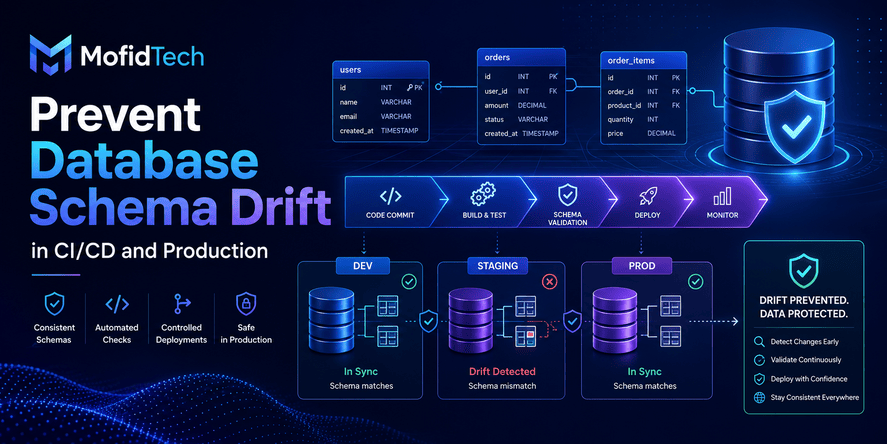
How to Prevent Database Schema Drift in CI/CD and Production
Direct answer Database schema drift is prevented by defining one authoritative schema source, routing every change through a reviewed migration workflow, restricting direct production modification, checking the live schema before deployment, reconciling emergency hotfixes immediately, and continuously monitoring important environments for unexpected differences. |
Database schema drift is one of the most dangerous forms of technical inconsistency because it often remains invisible until the next deployment, incident, audit, or data-integrity failure. A database may continue serving traffic even after its actual structure has diverged from the schema expected by the application and recorded by the migration system. The apparent stability creates false confidence. The next change then runs against assumptions that are no longer true.
The problem affects small teams that occasionally edit a production database manually, large organizations with separate development and database-administration responsibilities, software-as-a-service platforms with hundreds of tenant databases, and modern teams that use multiple frameworks or AI coding agents to generate changes rapidly. The tools differ, but the underlying engineering challenge is the same: the live database, migration history, application model, and intended architecture must tell a consistent story.
This guide explains how schema drift happens, why it creates operational and security risk, how to detect it, how to prevent it through CI/CD and governance, and how to resolve existing drift without treating production data as disposable. It uses practical workflows and decision frameworks rather than code, commands, or configuration snippets.
Table of Contents
- 1. What database schema drift means
- 2. Why schema drift is dangerous
- 3. The most common causes of schema drift
- 4. Where drift appears across the delivery lifecycle
- 5. What a reliable drift-detection system contains
- 6. Comparing schema drift detection strategies
- 7. How to prevent schema drift
- 8. Integrating drift controls into CI/CD
- 9. Handling emergency production hotfixes safely
- 10. Resolving existing schema drift without losing data
- 11. Managing drift in multi-tenant and fleet databases
- 12. Security and compliance considerations
- 13. Performance and availability considerations
- 14. Comparing tool and workflow categories
- 15. Real-world schema drift scenarios
- 16. Common mistakes
- 17. Troubleshooting schema drift problems
- 18. Governance, ownership, and useful metrics
- 19. A phased implementation roadmap
- 20. Practical checklists
- 21. Frequently asked questions
- 22. Conclusion
1. What Is Database Schema Drift?
Database schema drift is a difference between the database structure a team expects and the structure that actually exists in a live environment. The expected structure may be represented by migration files, a declarative schema model, an ORM model, a versioned snapshot, or another approved definition. The actual structure is what the database engine currently contains after every deployment, hotfix, manual change, restore, and administrative operation.
A drift condition exists when those two states no longer match in a meaningful way. The difference might involve tables, columns, data types, defaults, indexes, constraints, sequences, views, triggers, functions, extensions, ownership, privileges, or other database objects. Some differences immediately break an application. Others remain dormant until a specific query path, migration, maintenance task, or failover occurs.
The four states that must stay aligned
- The intended schema: the architecture the team has approved and wants every relevant environment to reach.
- The migration history: the ordered record of changes that are believed to have been applied.
- The live schema: the structure currently present in the database engine.
- The application expectation: the tables, fields, constraints, and behavior assumed by the deployed application version.
A mature workflow does not assume that one of these states is automatically correct. It verifies their relationship. For example, a migration tracker may report that a change was applied even though the operation completed only partially, an administrator may add an emergency index without recording it, or an old application version may still expect a column that a later schema removed.
Schema drift is not the same as a failed migration
A failed migration is an execution event: an intended change did not complete successfully. Schema drift is a state: the database differs from the intended or recorded structure. A failed migration can create drift, but drift can also result from a successful manual change, a restored backup, an environment-specific script, a tool that automatically synchronizes models, or an edited migration history.
Schema drift is not data drift
Schema drift concerns structure and database behavior. Data drift usually refers to changing statistical properties, formats, distributions, or values in the stored data. A database can have a perfectly aligned schema while the data violates business expectations. Conversely, the data can appear correct while the schema contains an unauthorized trigger, missing constraint, or altered index.
Featured-snippet definition Database schema drift occurs when the actual structure of a database no longer matches its approved schema definition or migration history. It is commonly caused by manual production changes, emergency hotfixes, multiple migration tools, partial deployments, or inconsistent environment promotion. |
2. Why Schema Drift Is Dangerous
It makes deployments non-deterministic
A deployment is predictable only when the starting state is known. Versioned migrations are normally planned and reviewed under the assumption that the target database matches the last approved version. Drift breaks that assumption. The same migration may succeed in staging and fail in production because production contains an extra object, lacks a constraint, uses a different data type, or has already received part of the intended change.
It hides operational risk until the worst moment
Many drift conditions do not affect normal traffic immediately. An extra index may even improve performance. A disabled constraint may allow writes that appear successful. A renamed object may affect only a background process. The delayed effect means the inconsistency is often discovered during a release, an incident, a scaling event, an audit, or a recovery operation, when the team is already under pressure.
It weakens rollback and recovery plans
Rollback procedures depend on accurate knowledge of what changed and what state existed before the release. When unrecorded changes are present, a rollback can remove an object another system relies on, recreate an obsolete definition, or fail because the expected predecessor state never existed. Backup restoration can also reintroduce an old drift condition if the restored snapshot is not compared with the current approved schema.
It can damage data integrity
Missing foreign keys, altered defaults, relaxed nullability, inconsistent character sets, changed collations, disabled triggers, and divergent validation constraints can allow data that other environments reject. Once invalid or incompatible data accumulates, fixing the schema is no longer only a structural task. The team must also clean, transform, or reconcile data before restoring the intended constraints.
It creates security and compliance gaps
Unauthorized tables, overly broad privileges, altered ownership, hidden triggers, and unreviewed functions can change how sensitive data is accessed or modified. Even benign emergency work becomes an audit problem when the organization cannot explain who changed production, why the change was necessary, whether it was reviewed, and how the approved source was reconciled afterward.
It multiplies risk across tenant fleets
In a multi-tenant architecture with separate schemas or databases, a small difference can become a fleet problem. A few tenants may receive a hotfix, a deployment may stop halfway through a rollout, or region-specific operations may produce different states. Future migrations then need to handle several starting points, increasing complexity and making failures harder to reproduce.
3. The Most Common Causes of Schema Drift
Direct production changes
The classic cause is a manual modification made directly in production. The change may be an emergency index, a new column, a repaired constraint, a permission adjustment, or an object created to support reporting. The production issue may be solved, but the approved migration history remains unchanged. Drift begins the moment the live database and source of truth diverge.
Emergency hotfixes that are never reconciled
Emergency work is sometimes necessary. The drift does not come from urgency alone; it comes from treating the hotfix as complete when production is stable. A safe hotfix is a temporary divergence followed by a mandatory reconciliation step that updates the authoritative schema, migration history, documentation, tests, and lower environments.
Multiple tools writing the same schema
A team may use a migration framework, an ORM auto-synchronization feature, a database administration tool, infrastructure automation, and a reporting platform that creates its own objects. Each tool can be individually reasonable, yet the combined system has no single owner. Drift becomes likely when more than one mechanism can create or alter objects without a shared approval and recording process.
Edited or deleted migration history
Migration files that have already been applied should normally be treated as immutable historical records. Editing or deleting them changes the story used to reconstruct an environment. A new database created from the modified history may differ from an existing production database even though both report the same application version.
Partial or interrupted deployments
Some database operations are transactional; others are not, and behavior varies by database engine and object type. Network loss, timeouts, locks, process termination, or deployment cancellation can leave a target in an intermediate state. The migration tracker may or may not represent that state accurately. Verification after failure is therefore essential.
Long-lived branches and parallel teams
Two teams may independently change the same table, rename related fields, or introduce migrations from the same starting point. Even when source-control conflicts are resolved, the combined migration order may produce an unintended schema. Shared development databases make the problem worse because one branch can modify a schema used by another branch.
Environment-specific changes
Staging may contain debugging objects, production may use additional indexes, and one region may have an extension unavailable elsewhere. Some differences are intentional, but unclassified differences are still operational risk. The system must distinguish approved environment-specific variation from unexplained drift.
Backup restores, clones, and refreshes
Restoring a backup returns the database to the schema state captured at backup time, not automatically to the current application state. Cloning production into staging can also introduce objects that do not belong in the staging workflow. Every restore or refresh should include schema verification and controlled forward migration.
AI-generated database changes
AI coding assistants and agents can accelerate model edits, migration creation, test generation, and deployment preparation. Speed increases the number of changes a team can produce, but it does not guarantee that the proposed migration matches production reality, preserves data, follows organizational naming conventions, or integrates with the existing migration graph. Human review and live-state verification become more important as generation becomes faster.
4. Where Drift Appears Across the Delivery Lifecycle
Environment | Typical drift pattern | Primary risk | Recommended control |
|---|---|---|---|
| Local development | Manual experimentation or model synchronization bypasses migration history. | A migration works only on the author’s machine. | Use disposable local databases, reproducible migration history, and branch-isolated environments. |
| Shared development | Multiple branches or tools modify the same database. | Developers observe inconsistent state and generate conflicting changes. | Avoid shared mutable schemas where possible; reset or recreate from the approved source. |
| CI test database | The database is reused, cached, or not rebuilt from the complete history. | Tests validate a state that cannot be reproduced. | Create clean test states and verify reconstruction from the full approved history. |
| Staging | Manual fixes and test-only objects accumulate. | Staging stops representing production deployment conditions. | Treat staging as controlled, observable, and regularly reconciled. |
| Production | Hotfixes, DBA changes, partial releases, or external tools alter the schema. | Future releases fail or silently behave differently. | Restrict write access, run pre-deployment checks, monitor drift, and reconcile hotfixes. |
| Tenant or regional fleet | Rollouts stop mid-wave or selected targets receive special changes. | Tenants start from different versions and require different remediation paths. | Track target state individually, canary changes, verify every wave, and alert on outliers. |
The important principle is that drift prevention is not only a production concern. Production drift often begins earlier when local experimentation, branch workflows, or shared environments create inconsistent migration histories. A reliable system keeps every transition reproducible from development through deployment.
5. What a Reliable Drift-Detection System Contains
An explicit source of truth
The organization must state what defines the intended schema. Depending on the workflow, this may be an ordered migration history, a declarative schema model, a reviewed database project, or a signed snapshot. Ambiguity is dangerous. If developers believe the ORM model is authoritative while database administrators believe the live production schema is authoritative, differences will be resolved inconsistently.
Schema introspection
Detection requires reading the actual metadata of the target database. The process should capture all object categories relevant to the application, not only tables and columns. Indexes, constraints, views, triggers, functions, sequences, extensions, ownership, and privileges may affect correctness, performance, and security.
Normalization before comparison
Databases may represent equivalent definitions differently. Object order, generated names, default expressions, type aliases, implicit indexes, and database-specific formatting can produce noisy differences. A useful drift system normalizes equivalent states so that engineers focus on meaningful change rather than cosmetic variation.
A baseline and comparison target
The current live schema must be compared with something trustworthy: the schema reconstructed from approved migrations, a versioned desired-state model, a signed snapshot captured after the last verified deployment, or another controlled reference. Comparing production only with staging is insufficient because both environments may be wrong in different ways.
Difference classification
Not every difference deserves the same response. A mature system classifies drift as destructive, additive, security-sensitive, performance-related, environment-approved, tool-generated, or unknown. Classification determines whether a deployment should be blocked, reviewed, remediated immediately, or documented as an accepted exception.
Actionable evidence
An alert should explain which objects differ, when the difference was first observed, which environment is affected, who may have made the change, and what approved state is expected. A vague “schema mismatch” message increases recovery time and encourages teams to bypass the check.
A response workflow
Detection without ownership produces ignored alerts. Every drift event needs a responsible team, a severity rule, an investigation path, and a deadline for reconciliation. The response should preserve evidence before any automatic correction changes the target again.
6. Comparing Schema Drift Detection Strategies
Strategy | How it works | Strengths | Limitations | Best use |
|---|---|---|---|---|
| Migration history verification | Checks whether recorded migrations and checksums match the approved repository. | Fast; catches edited or missing history. | May not detect out-of-band structural changes. | Every deployment pipeline. |
| Schema reconstruction comparison | Builds the expected schema from the complete migration history and compares it with the target. | Validates reproducibility and detects real structural differences. | Needs an isolated reference database and additional time. | Development, CI, release qualification. |
| Declarative desired-state comparison | Compares the live database with a versioned target model. | Clear end state; useful across different starting states. | Generated plans still require review, especially for data movement and renames. | Platform teams and controlled state-based delivery. |
| Versioned schema snapshots | Compares the target with a trusted snapshot captured at an approved version. | Efficient and understandable; useful for large schemas. | Snapshots must be protected, refreshed correctly, and tied to a version. | Pre-deployment checks and fleet rollouts. |
| Continuous schema monitoring | Periodically inspects important databases and alerts when objects change. | Finds drift between releases and supports auditability. | Can create noise; requires secure metadata access and ownership. | Production and regulated environments. |
| Post-deployment verification | Compares the resulting schema with the intended release state. | Confirms that the deployment produced the expected result. | Detects the problem after change has begun. | All high-risk releases. |
The strongest design uses several strategies together. Migration-history checks protect the record. Pre-deployment schema comparison protects the starting state. Post-deployment verification protects the resulting state. Continuous monitoring protects the time between releases.
7. How to Prevent Database Schema Drift
Establish one controlled path for schema changes
Every intentional database change should enter through a defined workflow that includes design, review, testing, approval, deployment, and verification. The workflow may support both developer-authored migrations and DBA-authored changes, but it must produce one auditable history. A change that exists only in a database administration session is not complete.
Use least privilege for production modification
Application accounts should not have broad schema-modification privileges. Human production access should be limited, time-bound where possible, strongly authenticated, and logged. The goal is not to block legitimate administration. It is to make uncontrolled change exceptional, visible, and accountable.
Treat applied migrations as immutable records
Once a migration has reached a shared or production environment, changing its contents rewrites history. Corrections should normally be represented by a new reviewed change. This preserves reproducibility and lets teams explain how each environment reached its current state.
Promote the same reviewed artifact across environments
Regenerating database changes independently for staging and production can produce different results. The approved migration package, desired-state definition, or reviewed deployment artifact should be promoted rather than recreated. Environment parameters may differ, but the intended structural transition should remain traceable.
Separate experimentation from migration history
Developers need fast ways to explore schema designs. The safest pattern is to experiment in disposable or isolated databases, then convert the final design into a reviewed migration path. Prototyping tools that directly synchronize a schema are useful locally, but they should not quietly become the production delivery mechanism.
Define an emergency hotfix protocol before an incident
Teams often create drift because they invent process under pressure. A documented hotfix protocol should define who can authorize direct production work, how evidence is captured, how the change is reviewed afterward, how the authoritative source is updated, and how all other environments are brought into alignment.
Make drift checks deployment gates
A warning that can be ignored indefinitely is not a control. For production and other high-value targets, unexplained drift should block deployment until the team classifies it. Approved environment-specific differences can be recorded as policy exceptions, but unknown divergence should not be silently accepted.
Assign ownership across development, operations, and database teams
Schema delivery crosses organizational boundaries. Developers understand application assumptions, database specialists understand engine behavior and data movement, platform teams control pipelines, and security teams care about access and auditability. A shared responsibility model prevents gaps in which everyone assumes another team will reconcile the change.
8. Integrating Drift Controls into CI/CD
During pull-request review
- Confirm that a schema change is intentional and tied to an application or operational requirement.
- Review the migration and the resulting schema, not only the model change that generated it.
- Identify destructive operations, long locks, data backfills, renames, type conversions, and compatibility risks.
- Verify that the change can coexist with the currently deployed application during rolling or phased releases.
- Require an explicit recovery or forward-fix plan for high-risk changes.
During continuous integration
CI should prove that the approved migration history can create the expected schema from a clean starting point. It should also test upgrades from supported prior versions when the application may encounter databases that are not all at the same release. The resulting schema should be compared with the intended application model or approved snapshot.
Before deployment
The pipeline should inspect the target and verify that it matches the expected starting state. It should check migration history, important structural objects, version markers, and policy exceptions. When the target has drifted, the deployment should stop before applying new changes because the reviewed plan was not created for the actual starting point.
During deployment
The deployment system should record timing, target identity, approved release, responsible actor, applied changes, warnings, and failures. High-risk transitions may need maintenance windows, staged execution, online migration patterns, or explicit operational checkpoints. The migration should not be treated as a black box simply because it is automated.
After deployment
Post-deployment verification confirms that the live schema reached the intended version and that no step produced an unexpected object or omitted a required one. Application health, query performance, background processing, replication, and data-integrity indicators should also be checked because a structurally correct result can still produce operational problems.
Between deployments
Periodic monitoring closes the gap between release events. It is especially valuable where privileged administrators, vendor tools, reporting systems, or emergency processes can modify production. Alerts should be routed to the same operational channels used for other reliability and security events.
Recommended CI/CD control chain Review the intended change → reconstruct and validate the expected schema → compare the target with the expected starting state → approve the deployment plan → apply the change → verify the resulting schema → monitor for later out-of-band changes. |
9. Handling Emergency Production Hotfixes Safely
A production hotfix is not automatically bad practice. Refusing all emergency database intervention can prolong an outage or data-integrity incident. The objective is to control the temporary divergence and remove it quickly.
- Declare the incident and identify the exact operational need. Avoid expanding the hotfix into unrelated cleanup.
- Capture the pre-change schema state and relevant evidence so the team can understand what changed later.
- Use the smallest reversible or forward-correctable change that addresses the incident.
- Apply the change through an authorized, logged path with at least one independent reviewer when circumstances permit.
- Verify application health, database health, and the intended effect immediately after the change.
- Create the equivalent reviewed migration or desired-state update in the authoritative repository.
- Apply or account for the change in development, testing, staging, replicas, tenant targets, and disaster-recovery environments.
- Run drift detection again and close the incident only when the approved source and live environments are reconciled.
The most important cultural rule is that “service restored” and “change complete” are different milestones. Service restoration ends the immediate incident. Change completion requires reconciliation, documentation, verification, and prevention of recurrence.
10. Resolving Existing Schema Drift Without Losing Data
Step 1: Freeze uncontrolled change
Before remediation, stop nonessential schema modification and pause deployments that depend on the unknown state. Continuing to change the target while investigating it creates a moving baseline and can destroy evidence.
Step 2: Capture and inventory the actual state
Record the live structure, migration history, application version, database version, installed extensions, privileges, and relevant deployment logs. In a fleet, collect the state of every target or a sufficiently complete inventory to identify clusters of equivalent schemas.
Step 3: Determine the authoritative intent
The repository is often authoritative, but not always. A production hotfix may represent a necessary change that has not yet been recorded. A migration file may also be wrong or incomplete. Engineers must determine which differences are desired, which are accidental, and which require business or security approval.
Step 4: Classify every difference
Difference type | Typical example | Likely action |
|---|---|---|
| Approved but unrecorded | Emergency index or constraint fix. | Add it to the authoritative history and propagate it safely. |
| Unauthorized or accidental | Manual table, altered privilege, removed constraint. | Remove or reverse it after impact analysis and evidence capture. |
| Partially applied change | Some objects from a migration exist while others do not. | Build a state-aware completion or repair plan. |
| Intentional environment variation | Production-only monitoring object. | Document and encode an approved exception policy. |
| Legacy difference | Old tenant or restored database follows an earlier path. | Migrate through a validated compatibility path. |
| Unknown | Difference has no owner or clear purpose. | Escalate; do not automatically delete it. |
Step 5: Protect data before structural correction
A schema difference may have allowed data that the intended schema cannot accept. Before restoring a constraint, changing a type, or removing a field, inspect affected data and application dependencies. Take an appropriate backup or recovery checkpoint and verify that restoration procedures are usable.
Step 6: Choose a remediation direction
- Make the database match the repository when the live difference is accidental and the approved definition remains correct.
- Make the repository match the database when the live change is necessary, reviewed, and should become the official design.
- Create a new target state when both sides contain useful changes or when simply choosing one would lose data or functionality.
- Use a staged compatibility path when applications, tenants, or replicas cannot move to the final state simultaneously.
Step 7: Reconcile history, not only structure
A database can be structurally correct while the migration tracker remains wrong. Future deployments will still be unsafe if the system believes a migration was applied when it was not, or if a necessary hotfix is missing from the history. Remediation must align both the physical schema and the recorded transition history.
Step 8: Test the repair from realistic starting states
Test the remediation against a representative copy or safely constructed equivalent of the affected state. Validate data preservation, application compatibility, lock behavior, runtime, rollback or forward-fix options, and the resulting schema. In fleets, test each distinct drift cluster rather than assuming one plan fits all targets.
Step 9: Apply progressively and verify
Use a canary database, low-risk tenant, or staging environment that accurately represents the drifted state. Expand in controlled waves, monitor health, and compare every repaired target with the approved result. Close the remediation only when monitoring shows no remaining unexplained differences.
Do not “fix” production by resetting it Resetting or recreating a disposable development database can be appropriate. Production databases contain durable state, integrations, audit history, and business data. Production drift requires reconciliation and data-aware migration, not a destructive reset. |
11. Managing Drift in Multi-Tenant and Fleet Databases
A fleet changes schema drift from a single-target issue into a population-management problem. Each tenant database, regional database, customer-managed deployment, or isolated schema can have a different version, operational history, maintenance window, and exception set.
Maintain a target inventory
Track each target’s current application version, schema version, last successful migration, last drift check, approved exceptions, maintenance constraints, and ownership. A fleet cannot be managed safely through a single global “production is version 12” assumption.
Group targets by actual state
Before rollout, compare targets and group those with equivalent starting schemas. Each group can then receive a plan validated for its state. Outliers should be investigated rather than forced through the majority path.
Use canaries and rollout waves
Start with a representative low-risk target, verify the result, then expand gradually. A successful canary does not prove every target is safe, but it validates the deployment mechanics and observability before the blast radius increases.
Design compatibility windows
During phased rollout, old and new application versions may coexist with old and new schemas. Prefer additive transitions, delayed removals, and explicit compatibility periods. A destructive change should occur only after all dependent application versions and background processes have moved away from the old structure.
Control tenant-specific customization
Custom fields, indexes, or integrations can create legitimate variation. Encode such differences as supported extensions or policy-managed exceptions. Unstructured customization turns every tenant into a unique product and makes automated migration increasingly fragile.
12. Security and Compliance Considerations
Schema drift can be a security signal
An unexpected trigger, function, view, user, role, or privilege change may indicate unauthorized activity, compromised credentials, an unsafe vendor integration, or an administrator bypassing policy. Security-sensitive object categories should receive higher alert severity and faster investigation than cosmetic differences.
Protect the source of truth
Migration files, desired-state models, snapshots, and approval records are security assets. If an attacker or unauthorized insider can modify both production and the expected reference, ordinary drift detection may report no difference. Use protected branches, review requirements, signed artifacts where appropriate, and tamper-evident audit logs.
Separate duties for high-risk changes
The person proposing a destructive or privilege-related schema change should not be the only person approving and applying it. Separation of duties reduces mistakes and creates stronger evidence for regulated environments. Emergency procedures can be faster while still requiring retrospective review.
Minimize sensitive metadata exposure
Drift tools need metadata access, but they do not always need access to table contents. Use narrowly scoped credentials, secure connectivity, encrypted transport, controlled log retention, and redaction of sensitive identifiers. Treat generated schema diagrams and reports as potentially sensitive because they reveal system structure.
Retain an auditable change trail
For each production schema change, retain the business reason, technical proposal, reviewer, deployment identity, time, target, result, verification evidence, incident link when applicable, and reconciliation status. Auditability is not only a compliance exercise; it dramatically shortens investigation when drift appears.
13. Performance and Availability Considerations
Drift detection should be lightweight and scheduled intelligently
Metadata inspection is usually less expensive than scanning business data, but very large catalogs, complex dependency graphs, or frequent checks can still create load. Production monitoring should use efficient catalog access, reasonable frequency, and timeouts. Continuous does not have to mean constant.
Schema correctness does not guarantee safe migration runtime
A target may have no drift and still be unsafe to modify during peak traffic. Table rewrites, index builds, constraint validation, type conversions, and lock acquisition can affect availability. Drift checks protect the starting state; migration risk analysis protects the transition.
Observe database and application behavior together
After a structural change, monitor lock waits, replication lag, error rates, query latency, resource consumption, background jobs, connection pools, and business transactions. Some problems appear only under live workload or on replicas. Post-deployment schema verification should therefore be combined with operational monitoring.
Avoid synchronized fleet impact
Applying the same heavy migration to every tenant or region simultaneously can create a resource spike even when each target is individually safe. Stagger rollouts, control concurrency, and stop expansion when early waves show abnormal duration or load.
14. Comparing Tool and Workflow Categories
No single product choice automatically prevents drift. The team must understand the operating model each category supports and close the surrounding governance gaps.
Category | Typical model | Strong fit | Important caution |
|---|---|---|---|
| Versioned migration tools | Apply ordered, immutable changes and record what ran. | Teams that value explicit history, reviewable transitions, and controlled promotion. | History alone may not reveal direct database changes unless live-state drift checking is added. |
| Declarative schema tools | Compare current state with a desired end state and plan the transition. | Platform-managed delivery, fleets, and environments with varied starting states. | Generated transitions still need data, lock, rename, and compatibility review. |
| ORM migration systems | Derive or manage migrations near the application model. | Application teams that want schema changes integrated with normal development. | Model synchronization and development conveniences must not bypass production review. |
| Continuous monitoring platforms | Inspect live schemas periodically and alert on change. | Production oversight, compliance, and environments with multiple actors. | Alerts need normalization, ownership, and a safe remediation workflow. |
| Database comparison tools | Compare two schemas, snapshots, or environments on demand. | Investigation, release validation, and legacy estates. | Environment-to-environment comparison is useful only when the reference is trustworthy. |
| Custom pipeline controls | Combine metadata queries, approvals, policies, and existing CI/CD systems. | Organizations with specific engines, controls, or integration requirements. | Custom solutions require sustained maintenance and careful coverage of database objects. |
How current tools approach the problem
Current documentation across major database change-management ecosystems reflects several common patterns: reconstructing expected schemas in isolated environments, comparing live targets with versioned models or snapshots, running checks before deployment, detecting changes continuously, and treating fleet targets individually. These capabilities are most effective when paired with restricted production access, immutable history, and an explicit hotfix process.
Examples include Flyway workflows that perform drift checks before generating target-specific fleet deployments, Liquibase capabilities for comparing schemas and producing drift reports, Prisma Migrate workflows that detect divergence between migration history and development schemas, and Atlas workflows that verify the target state before applying versioned migrations. Product capabilities and licensing change over time, so teams should evaluate current documentation and test behavior in their own database engines.
15. Real-World Schema Drift Scenarios
Scenario 1: The emergency production index
A slow query causes an outage. A database administrator creates an index directly in production, restoring acceptable performance. The next migration attempts to create an index with the same purpose but a different name and definition. Without a pre-deployment drift check, the release may fail, create redundant storage and write overhead, or leave environments with different query plans. The correct response is to capture the emergency change, decide the approved definition, add it to the authoritative history, and reconcile all environments.
Scenario 2: A constraint removed to unblock imports
A team temporarily removes a constraint so a critical data import can complete. The constraint is never restored, and invalid records accumulate. Months later, a deployment tries to strengthen the same constraint and fails. Structural remediation now requires data analysis and cleanup. The lesson is that temporary schema relaxation must have an owner, expiration condition, data-quality monitoring, and a verified restoration step.
Scenario 3: A multi-tenant rollout stops halfway
A release updates 60 percent of tenant databases before an operational issue stops the rollout. The deployment is later resumed without a reliable inventory of which targets completed each step. Some tenants receive the same change twice; others miss a follow-up change. A fleet-aware system should record per-target state, verify starting schemas, group targets by state, and resume in controlled waves.
Scenario 4: A restored database returns to an old schema
A disaster-recovery exercise restores a production backup from several weeks earlier. The data is valid for the recovery point, but the schema predates recent application changes. Starting the current application immediately produces errors. Recovery plans must include identifying the restored schema version, applying validated forward migrations, and verifying the result before traffic is redirected.
Scenario 5: Two automation systems modify the same database
The application pipeline manages tables and columns, while an analytics platform automatically creates views and helper objects. A broad drift check reports constant differences and is eventually disabled. The better design assigns object ownership, excludes only documented platform-managed objects, and continues monitoring the application-owned schema and security-sensitive metadata.
Scenario 6: An AI-generated migration assumes a clean starting state
An AI assistant proposes a migration based on the application model and repository history. Production contains an undocumented hotfix that changes the same column. The proposal looks correct in review and passes clean-database tests but fails in production. AI can accelerate authoring, but target-state inspection and independent review are what make deployment safe.
16. Common Mistakes That Make Drift Worse
- Comparing production with staging and assuming staging is automatically correct.
- Checking only migration version tables while ignoring the actual live schema.
- Automatically deleting every unexpected object without identifying its owner or business purpose.
- Editing old migrations after they have been applied to shared environments.
- Allowing several tools to modify the same object categories without ownership boundaries.
- Treating production hotfix reconciliation as optional follow-up work.
- Resetting a drifted production database as if it were a disposable development environment.
- Ignoring indexes, constraints, triggers, functions, privileges, or extensions because tables and columns match.
- Running continuous monitoring without alert classification, responsible owners, or remediation deadlines.
- Blocking every deployment for approved environment differences instead of encoding explicit exceptions.
- Assuming a generated migration is safe because it came from a trusted ORM, platform, or AI assistant.
- Failing to verify restored backups, replicas, tenant databases, and disaster-recovery targets.
17. Troubleshooting Schema Drift Problems
The drift report is too noisy
First determine whether the differences are semantic or cosmetic. Normalize generated names, object ordering, database-specific defaults, and equivalent type representations. Then define ownership boundaries and approved environment exceptions. Do not solve noise by disabling broad categories that may include security-sensitive changes.
The database and migration history disagree
Preserve both states, identify the last verified version, and determine whether changes were applied outside the migration system or whether the tracker is incomplete. Reconcile the physical schema and the history together. Changing only the tracker can hide a structural problem; changing only the structure can leave future deployments confused.
Staging passes but production fails
Compare both environments with the authoritative source rather than only with each other. Review production hotfixes, extensions, permissions, data volume, locks, object ownership, and deployment history. The failure may be caused by drift, but it can also come from workload or data conditions not represented in staging.
A drift check blocks an urgent release
Do not bypass the check without understanding the difference. Classify the drift, assess whether it conflicts with the pending change, capture evidence, and choose a controlled path: reconcile before release, incorporate the live change into the plan, or approve a time-bound exception with explicit risk ownership and immediate follow-up.
Different tools report different schemas
Compare their object coverage, normalization rules, permissions, database versions, and interpretation of implicit objects. One tool may ignore privileges or triggers, while another includes system-generated indexes. Establish the object categories that matter to your application and security model, then choose a consistent reference representation.
A fleet contains many unique drift states
Stop treating the fleet as one target. Inventory every schema, cluster equivalent states, identify outliers, and build remediation plans for each cluster. The proliferation of unique states is also a product-design signal: tenant customization and operational exceptions may need stricter boundaries.
18. Governance, Ownership, and Useful Metrics
A practical responsibility model
Role | Primary responsibility |
|---|---|
| Application developers | Describe application expectations, create or review schema changes, and preserve compatibility. |
| Database specialists | Assess engine behavior, data movement, locks, performance, backup, and recovery implications. |
| Platform or DevOps team | Implement pipeline gates, credentials, target inventory, evidence retention, and deployment observability. |
| Security team | Define privileged-access controls, high-severity object categories, audit requirements, and incident escalation. |
| Technical lead or change authority | Approve risk, resolve source-of-truth disputes, and ensure hotfix reconciliation is completed. |
| Service owner | Own availability, business impact, maintenance windows, and final acceptance of production changes. |
Metrics that reveal process health
- Number of unexplained drift events by environment and severity.
- Mean time from drift detection to classification and reconciliation.
- Percentage of production schema changes that followed the approved pipeline.
- Number of emergency hotfixes still awaiting repository reconciliation.
- Percentage of deployments that completed pre- and post-deployment schema verification.
- Number of fleet targets outside the supported schema-version window.
- Rate of drift-related deployment failures or incident escalations.
- Age of the oldest approved exception and whether it still has a valid owner.
Metrics should improve behavior, not encourage concealment. A team that reports more drift after introducing monitoring may be healthier than a team that reports none because it does not look. Focus on detection coverage, reconciliation speed, recurrence, and reduction of uncontrolled change.
19. A Phased Implementation Roadmap
Phase 1: Establish visibility
- Document the current source of truth and every tool or actor that can modify schemas.
- Inventory production, staging, tenant, regional, replica, and recovery databases.
- Capture baseline schemas and compare high-value targets with the approved history.
- Classify existing differences before enabling hard deployment blocks.
- Define ownership and an emergency hotfix reconciliation process.
Phase 2: Add preventive controls
- Restrict direct schema modification and separate application runtime privileges from deployment privileges.
- Protect applied migration history from modification.
- Add clean reconstruction tests and schema comparison to continuous integration.
- Add pre-deployment target verification and post-deployment result verification.
- Promote the same reviewed database-change artifact across environments.
Phase 3: Operationalize monitoring
- Schedule production drift checks and route alerts to responsible teams.
- Prioritize security-sensitive objects and unexplained privilege changes.
- Track hotfix reconciliation and exception expiry as operational work.
- Create dashboards for target version, drift status, and rollout state.
- Run periodic recovery tests that verify restored schema alignment.
Phase 4: Scale to fleets and advanced governance
- Group targets by actual schema state before deployment.
- Use canary targets, controlled waves, compatibility windows, and automated stop conditions.
- Encode supported tenant variation instead of relying on undocumented customization.
- Retain tamper-evident evidence for regulated or high-risk systems.
- Review metrics and recurring drift causes as part of architecture and reliability planning.
20. Practical Checklists
Schema drift prevention checklist
- A single authoritative schema source is documented.
- Every intentional schema change has a reviewed and auditable path.
- Applied migrations are treated as immutable history.
- Application runtime accounts cannot modify the schema.
- Production human access is restricted, authenticated, and logged.
- Experimental synchronization is limited to disposable or isolated environments.
- The same approved artifact is promoted across environments.
- Emergency hotfixes require reconciliation before closure.
- Environment-specific differences are documented as explicit exceptions.
- Backups, clones, replicas, and recovery targets are schema-verified.
Pre-deployment checklist
- The target identity and current application version are confirmed.
- Migration history matches the approved repository.
- The live schema matches the expected starting state.
- Any difference has been classified and approved.
- The migration has been reviewed for data loss, locks, duration, and compatibility.
- A backup or recovery point appropriate to the risk is available and tested.
- Monitoring, responsible operators, and stop conditions are ready.
- The plan accounts for replicas, tenants, regions, and background workers.
- A rollback or forward-fix strategy is documented.
- The resulting schema will be verified after deployment.
Drift remediation checklist
- Uncontrolled changes and dependent deployments are paused.
- The actual schema, history, logs, and application version are preserved.
- The intended state is confirmed with the relevant owners.
- Every difference is classified as approved, accidental, partial, intentional, legacy, or unknown.
- Data impact is assessed before restoring constraints or removing objects.
- The remediation direction is selected explicitly.
- Both physical structure and migration history will be reconciled.
- The repair is tested from the affected starting state.
- The rollout is progressive and observable.
- Post-remediation monitoring confirms that unexplained drift is gone.
21. Frequently Asked Questions
What is database schema drift in simple terms?
Database schema drift means the live database no longer has exactly the structure the team expects. The difference may come from a manual change, an emergency hotfix, an incomplete deployment, a restored backup, or a second tool that modifies the schema.
How can I detect schema drift before deployment?
Compare the target database’s actual metadata with a trusted expected state, such as a schema reconstructed from approved migrations, a versioned desired-state model, or a signed snapshot. Also verify migration history and checksums. Unexplained differences should be reviewed before the new migration begins.
Can a database work normally while it has schema drift?
Yes. Drift may affect only a rarely used query, a future migration, a background task, security permissions, or data validation. This is why drift can remain hidden for a long time and then appear during a release or incident.
Are manual production changes always forbidden?
Not necessarily. Emergency intervention can be justified, but it should be authorized, logged, minimal, verified, and followed by immediate reconciliation of the authoritative schema and other environments. The dangerous practice is an unrecorded change with no owner or follow-up.
Is checking the migration version table enough?
No. A version table records what the migration system believes happened. It may not reveal manual changes, tool-generated objects, partially applied operations, or altered privileges. Reliable detection compares the actual schema as well as the recorded history.
How is schema drift different from migration rollback?
Schema drift is an unexpected difference between actual and intended database structure. Rollback is a response to a planned change that must be reversed. Drift may make rollback unsafe because the assumed prior state is inaccurate.
Should staging and production always have identical schemas?
They should match for application-owned structures unless there is a documented reason for variation. Monitoring objects, engine-specific extensions, or environment controls may differ, but those differences should be approved and excluded narrowly rather than ignored.
How should a team fix drift when production contains the correct hotfix?
Treat the live change as a candidate for the new approved state. Review it, represent it in the authoritative schema or migration history, test it, propagate it to other environments, and verify that every target and record now agree.
Can schema drift cause security vulnerabilities?
Yes. Unexpected privileges, ownership, triggers, functions, views, or disabled constraints can expose data or alter behavior. Drift monitoring should therefore classify security-sensitive object changes as high priority.
How often should production drift checks run?
The frequency depends on change rate, risk, and who can modify the database. High-value systems may check before every deployment and periodically between releases. The goal is to detect unauthorized change quickly without creating excessive metadata load or alert noise.
How do multi-tenant systems prevent drift?
Maintain per-target state, compare each tenant or database before rollout, group equivalent starting states, use canaries and waves, record every result, and constrain tenant customization. A single global version label is not enough when rollout can be partial.
Can AI-generated migrations be trusted?
They can be useful drafts, but they should be reviewed like any other high-impact database change. The reviewer must consider production state, data preservation, locking, compatibility, naming, security, and migration history. Live-state drift checks remain essential.
22. Conclusion
Database schema drift is not merely a tooling inconvenience. It is a loss of confidence in the starting state of a critical system. Once the live database, migration history, application model, and intended design diverge, deployments become less predictable, recovery becomes harder, security evidence weakens, and data-integrity problems can accumulate silently.
The solution is a layered operating model. Define one authoritative source. Route intentional changes through review. Restrict uncontrolled production modification. Treat applied migrations as historical records. Verify the target before deployment and the result afterward. Monitor important environments between releases. Reconcile emergency hotfixes before considering them complete. In fleets, manage every target according to its actual state rather than a global assumption.
Teams do not need to implement every advanced control immediately. Start by gaining visibility and clarifying ownership. Then add reliable checks to CI/CD, production access controls, and a practical remediation process. The result is not only fewer migration failures. It is a database delivery system that engineers can explain, reproduce, audit, and improve.
💬 Comments
No comments yet. Be the first to comment!
Login to comment.