Introduction
Modern applications are no longer used only by humans. They are also used by machines, scripts, cloud services, automation tools, CI/CD pipelines, containers, APIs, bots, background jobs, monitoring systems, and now AI agents.
Every one of these systems needs some form of identity to access data, call APIs, deploy software, read files, connect to databases, or trigger workflows. These identities are called non-human identities.
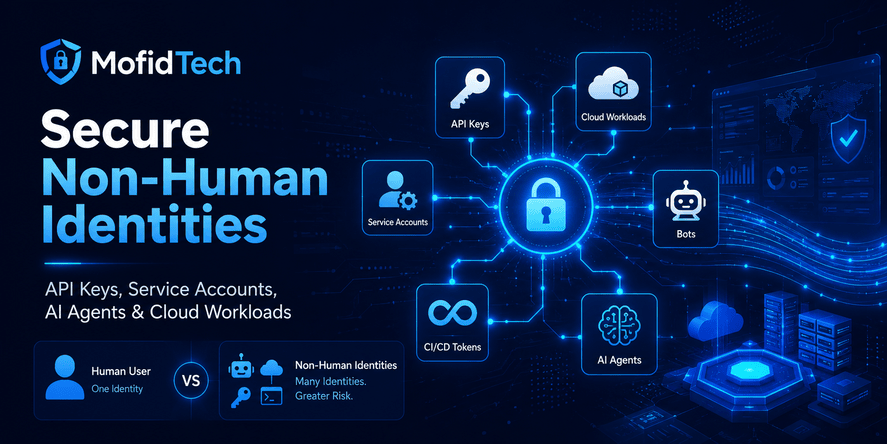
A non-human identity is any digital identity used by software, automation, infrastructure, or a machine process instead of a person. Examples include API keys, service accounts, cloud workload identities, CI/CD tokens, bot accounts, database credentials, integration accounts, and AI agent permissions.
Non-human identities are powerful because they allow systems to work automatically. But they are also dangerous when they are not managed correctly. A forgotten API key, an overprivileged service account, a leaked CI/CD token, or an AI agent with excessive permissions can become an attacker’s easiest path into your application.
This is why non-human identity security has become one of the most important topics in modern cybersecurity, DevOps, cloud computing, API security, and AI application design. Microsoft describes workload identities as applications, service principals, and managed identities, while NIST’s Zero Trust Architecture includes both person and non-person entities in identity and access management.
For developers, the main lesson is simple: every machine identity should be treated as a real security principal, not as a small technical detail hidden inside configuration.
Table of Contents
- What Are Non-Human Identities?
- Why Non-Human Identities Matter
- Common Types of Non-Human Identities
- Why Non-Human Identities Are Risky
- Non-Human Identity Security and Zero Trust
- How AI Agents Change the Identity Security Problem
- Common Mistakes Developers Make
- Best Practices for Securing Non-Human Identities
- Non-Human Identity Security Checklist
- Comparison Table: Weak vs Strong Identity Governance
- Real-World Use Cases
- Security Considerations
- Performance and Operational Considerations
- Troubleshooting Non-Human Identity Problems
- FAQ
- Conclusion
What Are Non-Human Identities?
A non-human identity is a digital identity used by a system, application, service, device, automation workflow, or machine process to authenticate and access resources.
Unlike a human user, a non-human identity does not log in through a normal username and password form. It usually authenticates through a token, certificate, API key, secret, service account, managed identity, workload identity, or another automated credential.
In simple terms:
A human identity represents a person. A non-human identity represents software, infrastructure, automation, or a machine process.
Examples of Non-Human Identities
Common examples include:
- API keys used by applications to call external services
- Service accounts used by backend systems
- CI/CD tokens used by deployment pipelines
- Cloud workload identities used by virtual machines, containers, or serverless functions
- Database credentials used by applications
- Bot accounts used for automation
- Webhook secrets used by integrations
- Monitoring agent credentials
- Backup service credentials
- AI agent identities used to access tools, files, APIs, or business systems
These identities often operate silently in the background. They may run every minute, every hour, every day, or whenever a user action triggers them.
Human Identity vs Non-Human Identity
| Identity Type | Represents | Common Authentication Method | Main Risk |
|---|---|---|---|
| Human identity | A person | Password, MFA, SSO, passkey | Phishing, account takeover |
| Non-human identity | Software or automation | API key, token, certificate, secret, managed identity | Secret leakage, overprivilege, forgotten access |
| AI agent identity | Autonomous or semi-autonomous AI workflow | Tool permissions, API credentials, delegated access | Tool misuse, privilege abuse, unintended actions |
The key difference is that human access is often visible and controlled through login systems, while non-human access is often hidden inside infrastructure, deployment workflows, environment variables, cloud platforms, and integration settings.
Why Non-Human Identities Matter
Non-human identities matter because modern software depends on automation.
A web application may need to send emails, process payments, upload files, connect to a database, call an AI model, store logs, trigger background tasks, interact with a cloud provider, and deploy updates automatically. Each action may require a different credential or identity.
Without non-human identities, modern applications would not work efficiently. But without proper governance, these identities can create serious security gaps.
They Often Have Powerful Access
Many non-human identities have access to sensitive systems. For example, a service account may be able to read customer data. A CI/CD token may be able to deploy production code. A cloud workload identity may be able to access storage, databases, logs, or secrets.
If an attacker steals one of these identities, they may not need to hack a password or bypass multi-factor authentication. They can simply use the machine credential directly.
They Are Easy to Forget
Human employees appear in HR systems, directories, and access reviews. Non-human identities are often created by developers, DevOps engineers, cloud administrators, third-party tools, or temporary projects.
Over time, organizations may forget:
- Who created the identity
- Why it exists
- Which system uses it
- What permissions it has
- Whether it is still needed
- When it was last rotated
- Whether it has ever been audited
This creates a major security problem: unknown identities become unknown attack paths.
They Are Growing Faster Than Human Identities
In many modern environments, there are far more machine identities than human users. Every application, microservice, deployment pipeline, integration, cloud resource, and automation process may need its own identity.
As systems become more automated, the number of non-human identities grows quickly. AI agents make this even more important because autonomous systems may need access to tools, documents, APIs, and business workflows.
OWASP’s Agentic Applications security work highlights risks such as agent goal hijacking, tool misuse, identity and privilege abuse, insecure inter-agent communication, and rogue agents, showing that identity governance is now central to AI agent security.
Common Types of Non-Human Identities
Non-human identities appear in many forms. Developers should understand the most common types because each one has different risks and protection methods.
API Keys
An API key is a credential used to authenticate an application or service when calling an API.
API keys are common because they are simple to use. They are used for email providers, payment platforms, maps, AI services, analytics tools, storage services, and many other integrations.
The problem is that API keys are often long-lived and easy to leak. They may appear in old files, logs, screenshots, browser bundles, forgotten repositories, or shared documentation.
A secure API key should be:
- Limited to the minimum required access
- Restricted by environment when possible
- Rotated regularly
- Stored in a secure secrets system
- Never exposed in public client-side code
- Monitored for abnormal usage
Service Accounts
A service account is an identity used by an application, background service, automation process, or system component.
Service accounts are common in backend applications, cloud environments, deployment systems, databases, and enterprise platforms.
A service account should never be treated like a shared human account. It should have a clear owner, clear purpose, limited permissions, and monitoring.
CI/CD Tokens
CI/CD tokens are used by software delivery pipelines to build, test, publish, and deploy applications.
These tokens are very sensitive because they may allow changes to production environments. If a CI/CD token is stolen, an attacker may be able to modify code, inject malicious dependencies, change deployment settings, or access production secrets.
A CI/CD identity should be scoped carefully. It should only have the permissions needed for a specific pipeline stage.
Cloud Workload Identities
A workload identity is an identity assigned to a software workload such as an application, service, script, container, virtual machine, or serverless function.
Microsoft’s documentation describes workload identities in Microsoft Entra as applications, service principals, and managed identities. Managed identities can reduce the need for developers to manage credentials manually.
This is important because many security incidents happen when long-lived secrets are stored in unsafe places. Managed identities and workload identity federation can help reduce secret exposure when implemented correctly.
Database Credentials
Applications often use non-human credentials to connect to databases.
These credentials can be risky when they are shared across environments, reused across applications, or given broad permissions. A web application usually does not need full administrative database access for normal operation.
Database identities should be separated by environment and role. Development, staging, production, analytics, backups, and migrations should not all use the same identity.
Bot Accounts
Bot accounts are used for automation in chat platforms, project management tools, monitoring systems, customer support workflows, and internal operations.
A bot may post alerts, create tickets, update records, send notifications, or trigger workflows. If it has too much access, a compromised bot can become a serious security risk.
Webhook Secrets
Webhooks allow one system to notify another system when an event happens. They often use secrets to verify that the request is legitimate.
Webhook secrets should be protected like any other credential. A leaked webhook secret may allow attackers to trigger fake events or manipulate application workflows.
AI Agent Identities
AI agents are a newer and more complex category of non-human identity.
An AI agent may read documents, call APIs, search internal systems, create tickets, summarize data, send emails, generate reports, trigger workflows, or interact with other tools.
This creates a new security challenge: the agent is not just storing a credential; it may also be making decisions. That means its identity, permissions, boundaries, and audit logs must be carefully designed.
Why Non-Human Identities Are Risky
Non-human identities are risky because they are often powerful, persistent, poorly monitored, and difficult to inventory.
Long-Lived Credentials
Many API keys and service account credentials are created once and then forgotten for months or years.
Long-lived credentials increase risk because attackers have more time to discover and abuse them. If a credential is leaked and never rotated, it can remain useful indefinitely.
Short-lived credentials reduce this risk because they expire automatically.
Excessive Permissions
A common mistake is giving a non-human identity more access than it needs.
For example, a service that only needs to read files may receive permission to read, write, delete, and administer storage. A deployment pipeline that only needs to deploy one application may receive access to multiple environments.
This violates the principle of least privilege. CISA describes zero trust as minimizing uncertainty while enforcing accurate, least-privilege, per-request access decisions.
Shared Identities
Shared identities make accountability difficult.
If five applications use the same service account, it becomes hard to know which application performed a specific action. If a problem occurs, teams may struggle to identify the source.
Dedicated identities are safer because each system has its own traceable access.
No Clear Owner
Every non-human identity should have an owner. The owner is responsible for reviewing access, rotating secrets, removing unused credentials, and responding to incidents.
When an identity has no owner, it becomes a security orphan.
Poor Logging
Many teams log human logins but do not properly log machine-to-machine actions.
This is a mistake. Non-human identities can perform sensitive actions, so their activity should be visible in logs and monitoring systems.
Forgotten Test Credentials
Development and staging credentials are often less protected than production credentials. However, attackers can still abuse them.
A test key may provide access to real services, internal systems, cloud resources, or sensitive data. Even when it does not provide production access, it may reveal architecture details that help attackers.
Non-Human Identity Security and Zero Trust
Zero Trust is a security model based on the idea that trust should not be granted automatically. Every access request should be verified based on identity, context, permissions, and risk.
NIST SP 800-207 describes Zero Trust Architecture as moving security away from static network perimeters and toward users, assets, and resources. It also explicitly includes person and non-person entities in identity and access management.
For non-human identities, Zero Trust means:
- Do not trust a service just because it is inside your network
- Do not give broad access to internal systems by default
- Verify every machine-to-machine request
- Limit permissions to the exact task required
- Continuously monitor behavior
- Revoke unused access
- Separate environments and responsibilities
Why Network Location Is Not Enough
In older systems, internal services were often trusted because they were inside the private network. This is no longer enough.
Modern applications run across cloud platforms, containers, serverless systems, APIs, third-party integrations, remote teams, and external automation tools. A request from an internal network does not automatically mean it is safe.
The identity of the workload matters more than its location.
Least Privilege for Machines
Least privilege means giving an identity only the access it needs to perform its job.
For non-human identities, this means:
- A read-only service should not have write access
- A staging pipeline should not deploy to production
- A monitoring tool should not modify business data
- A backup service should not manage users
- An AI agent should not access tools unrelated to its task
Least privilege reduces the damage that can happen if an identity is compromised.
How AI Agents Change the Identity Security Problem
AI agents make non-human identity security more urgent because they can combine credentials, reasoning, tool access, and autonomous actions.
Traditional automation follows predefined logic. An AI agent may interpret instructions, choose tools, summarize context, make decisions, and take actions across systems.
This creates new risks.
AI Agents Need Their Own Identities
An AI agent should not simply inherit a human user’s full permissions.
If an employee has access to email, documents, tickets, customer records, and deployment systems, an AI agent helping that employee should not automatically receive the same access.
Instead, the AI agent should have a dedicated identity with limited scope.
Tool Access Must Be Limited
AI agents often become useful because they can use tools. But tool access is also where risk begins.
An agent may be connected to:
- File storage
- Calendar
- Databases
- APIs
- Ticketing systems
- Cloud platforms
- Developer tools
- Internal search systems
- Customer support tools
Each tool should be evaluated separately. The agent should only access tools required for its purpose.
OWASP identifies tool misuse and identity and privilege abuse among the important risks for agentic applications, which reinforces the need for scoped access and strong governance.
AI Agents Should Be Auditable
Every important agent action should be logged.
Teams should be able to answer:
- Which agent performed this action?
- What user or workflow triggered it?
- What tool did it use?
- What data did it access?
- What permission allowed the action?
- Was the action approved by a human?
- Was the output reviewed?
Without auditability, AI agents become difficult to govern.
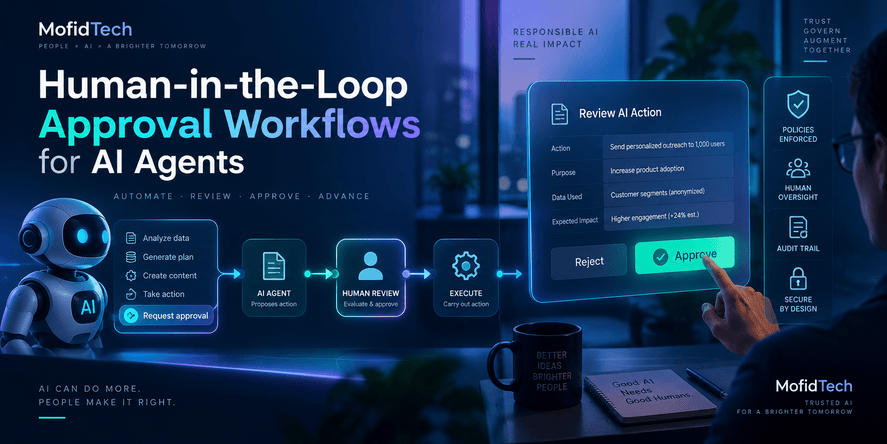
Human Approval Is Still Necessary for Sensitive Actions
AI agents should not automatically perform high-risk actions without review.
Sensitive actions may include:
- Deleting data
- Changing permissions
- Sending external emails
- Modifying production settings
- Deploying code
- Accessing confidential records
- Creating new credentials
- Approving financial operations
For high-risk workflows, human approval should remain part of the process.
Common Mistakes Developers Make
Non-human identity problems often come from simple mistakes, not advanced attacks.
Mistake 1: Using One Credential Everywhere
Using the same API key or service account across development, staging, and production is dangerous.
If the development environment is compromised, the attacker may gain access to production systems.
Each environment should have separate identities and credentials.
Mistake 2: Giving Admin Access “Just to Make It Work”
Developers sometimes give broad permissions to avoid debugging access problems.
This may solve the immediate problem, but it creates long-term risk. A service that only needs to read one resource should not receive administrator access.
Mistake 3: Not Tracking Who Owns the Identity
Every non-human identity should have an owner.
The owner can be a team, system owner, or responsible engineer. Without ownership, nobody knows who should rotate, review, or delete the identity.
Mistake 4: Forgetting Old Credentials
Old credentials are common after migrations, testing, temporary integrations, or abandoned projects.
Unused credentials should be removed. If a credential is not needed, it should not exist.
Mistake 5: Storing Secrets in Unsafe Places
Secrets should not be stored in public repositories, shared documents, chat messages, screenshots, browser code, or unprotected files.
A secret should be stored in a secure secrets management system or platform-specific secret storage solution.
Mistake 6: Not Monitoring Machine Activity
Many teams monitor human user activity but ignore service accounts and automation identities.
This is risky because machine identities often have powerful access and may operate outside normal working hours.
Mistake 7: Treating AI Agents Like Normal Scripts
AI agents are not always predictable in the same way as traditional scripts. They may interpret prompts, read context, and choose tools dynamically.
Because of that, they need stricter identity design, tool boundaries, audit logs, and human approval for sensitive actions.
Best Practices for Securing Non-Human Identities
Securing non-human identities requires a structured approach. The goal is not only to protect secrets, but also to govern the identity lifecycle.
1. Build an Identity Inventory
You cannot secure what you cannot see.
Create an inventory of all non-human identities, including:
- API keys
- Service accounts
- CI/CD tokens
- Cloud workload identities
- Database credentials
- Bot accounts
- Webhook secrets
- Monitoring agents
- Backup accounts
- AI agent identities
For each identity, record:
- Name
- Purpose
- Owner
- Environment
- Permissions
- Creation date
- Last used date
- Rotation policy
- Expiration policy
- Related application or service
This inventory should be reviewed regularly.
2. Assign Ownership
Every non-human identity should have a clear owner.
The owner should know:
- Why the identity exists
- What system uses it
- What permissions it has
- How to rotate it
- When it should be deleted
- What to do if it is compromised
Ownership prevents orphaned identities from accumulating.
3. Apply Least Privilege
Every identity should receive only the permissions it needs.
A good permission review asks:
- What action does this identity need to perform?
- Which resource does it need to access?
- Does it need read access, write access, or administrative access?
- Does it need access all the time?
- Can access be limited to one environment?
- Can access be time-limited?
- Can high-risk actions require approval?
Least privilege should be the default, not an afterthought.
4. Use Short-Lived Credentials When Possible
Short-lived credentials reduce the value of stolen secrets.
Instead of using permanent API keys or long-lived tokens, use temporary credentials, managed identities, identity federation, or platform-native authentication methods when possible.
Managed identities are useful because they can reduce the need for developers to manually handle credentials in supported cloud environments.
5. Separate Environments
Development, staging, testing, and production should use separate identities.
This prevents a problem in one environment from spreading to another.
For example:
| Environment | Identity Strategy |
|---|---|
| Development | Limited test credentials with no production access |
| Staging | Separate credentials that resemble production but do not expose real production permissions |
| Production | Strongly controlled identities with monitoring and approval |
| CI/CD | Dedicated pipeline identities with scoped deployment permissions |
Environment separation is one of the simplest and most effective controls.
6. Rotate Secrets Regularly
Credential rotation reduces long-term exposure.
Rotation should happen:
- On a defined schedule
- When an employee leaves a sensitive role
- After a suspected leak
- After a vendor or integration change
- When permissions change
- When a project is migrated or retired
Rotation should be planned carefully so applications do not break.
7. Remove Unused Identities
Unused identities are unnecessary risk.
A non-human identity should be removed if:
- It has not been used for a long time
- The related project was retired
- The integration was replaced
- The owner is unknown
- The environment no longer exists
- The permissions are no longer justified
Deletion is often better than keeping old credentials “just in case.”
8. Monitor Behavior
Non-human identity activity should be logged and monitored.
Look for unusual patterns such as:
- Access from unexpected locations
- Access at unusual times
- Sudden spikes in API calls
- Attempts to access unauthorized resources
- Use of old or deprecated credentials
- Failed authentication attempts
- Privilege escalation attempts
- AI agent actions outside expected workflows
Monitoring helps detect compromise early.
9. Protect Secrets Properly
Secrets should be stored securely, not scattered across files and tools.
A secure secrets strategy should include:
- Centralized storage
- Access control
- Rotation support
- Audit logs
- Environment separation
- Encryption
- Limited visibility
- Emergency revocation process
The goal is to make secrets difficult to leak and easy to revoke.
10. Design AI Agents With Permission Boundaries
AI agents should have carefully scoped identities.
For each AI agent, define:
- What the agent is allowed to do
- What tools it can use
- What data it can access
- Which actions need human approval
- What logs must be kept
- How the agent can be disabled
- Who owns the agent
- How the agent’s permissions are reviewed
AI agent security is not only about the model. It is also about identity, access, tools, and governance.
Non-Human Identity Security Checklist
Use this checklist when reviewing a web application, cloud system, API platform, DevOps workflow, or AI agent environment.
Identity Inventory Checklist
- All API keys are documented
- All service accounts are documented
- All CI/CD tokens are documented
- All cloud workload identities are documented
- All database credentials are documented
- All bot accounts are documented
- All AI agent identities are documented
- Every identity has an owner
- Every identity has a purpose
- Every identity is linked to an application or workflow
- Unused identities are removed
Permission Review Checklist
- Each identity follows least privilege
- No identity has unnecessary administrator access
- Production identities are separated from development identities
- Read-only tasks use read-only permissions
- Sensitive actions require approval
- AI agents do not inherit full human permissions
- Third-party integrations have limited access
- Permissions are reviewed regularly
Secret Protection Checklist
- Secrets are not stored in public repositories
- Secrets are not shared in chat messages
- Secrets are not exposed in frontend code
- Secrets are not stored in plain text documents
- Secrets are stored in a secure system
- Secrets can be rotated safely
- Secrets can be revoked quickly
- Old secrets are removed after rotation
Monitoring Checklist
- Non-human identity activity is logged
- Failed authentication attempts are monitored
- Abnormal API usage is detected
- Access to sensitive data is audited
- CI/CD activity is monitored
- AI agent tool usage is logged
- Alerts exist for suspicious behavior
- Logs include enough context for investigation
Incident Response Checklist
- There is a process to revoke compromised credentials
- Owners know how to rotate secrets
- Teams know which systems depend on each identity
- Logs can show what the identity accessed
- High-risk identities have emergency disable options
- AI agents can be paused or disabled
- Post-incident reviews include permission cleanup
Comparison Table: Weak vs Strong Identity Governance
| Area | Weak Practice | Strong Practice |
|---|---|---|
| Ownership | Unknown service accounts | Every identity has an owner |
| Permissions | Broad administrator access | Least privilege access |
| Environments | Same key across all environments | Separate credentials per environment |
| Credential lifetime | Long-lived secrets | Short-lived or rotated credentials |
| Monitoring | No machine identity logs | Continuous activity monitoring |
| AI agents | Full inherited user access | Dedicated scoped agent identity |
| Secrets storage | Stored in files or chats | Stored in secure secrets management |
| Cleanup | Old keys kept forever | Unused identities removed |
| Incident response | Manual confusion | Clear revocation and rotation process |
| Auditing | No traceability | Every action linked to an identity |
Real-World Use Cases
Use Case 1: A Web Application Calling an Email Provider
A web application needs to send account verification emails and password reset messages.
The application uses an API key for the email provider. If this key is leaked, an attacker may send fake emails, damage reputation, or abuse the account.
A secure design would limit the API key to the required email-sending permissions, store it securely, monitor email volume, and rotate it when needed.
Use Case 2: A CI/CD Pipeline Deploying to Production
A CI/CD pipeline needs permission to deploy an application.
If the pipeline token has broad cloud administrator access, a compromised pipeline could modify infrastructure, access secrets, or deploy malicious code.
A secure design would use a dedicated deployment identity with only the permissions required for deployment. Production deployment should also include approval controls for sensitive systems.
Use Case 3: A Backend Service Accessing a Database
A backend application needs to read and write application data.
It should not use a database administrator account for normal operations. Instead, it should use an application-specific identity with limited permissions.
This reduces damage if the application credential is leaked.
Use Case 4: A Cloud Function Processing Uploaded Files
A cloud function processes uploaded documents and stores results.
It should only access the specific storage area and services required for processing. It should not have access to unrelated databases, user accounts, or administrative settings.
Use Case 5: An AI Agent Helping With Support Tickets
An AI support agent summarizes support tickets and suggests responses.
It may need access to ticket text and knowledge base articles, but it may not need access to billing data, user passwords, production logs, or administrative settings.
A secure design would give the agent a dedicated identity, limit tool access, log every action, and require human approval before sending sensitive responses.
Security Considerations
Non-human identity security is a security architecture problem, not only a developer convenience issue.
Credential Theft
Attackers often look for exposed credentials because they can provide direct access to systems.
Credentials may leak through:
- Public repositories
- Logs
- Misconfigured storage
- Screenshots
- Chat tools
- Build artifacts
- Browser-side code
- Compromised developer machines
- Third-party integrations
A secure system assumes that credentials may eventually leak and prepares detection, rotation, and revocation processes.
Privilege Escalation
A low-risk identity can become dangerous if it has a path to higher privileges.
For example, a service account may not be an administrator, but it may have permission to create new tokens, modify roles, or access a secret store.
Permission reviews should look not only at direct access, but also at indirect escalation paths.
Lateral Movement
If one identity can access many systems, an attacker can move from one system to another.
Environment separation, network segmentation, scoped permissions, and identity-based access control reduce lateral movement.
Third-Party Risk
Third-party tools often need non-human identities to connect to your systems.
Before granting access, ask:
- What data does the vendor need?
- What permissions are required?
- Can access be limited?
- Can the vendor’s actions be logged?
- How is the credential stored?
- What happens when the contract ends?
- How quickly can access be revoked?
AI Agent Misuse
AI agents can misuse tools if they are manipulated, misconfigured, or given excessive authority.
Security teams should treat agent tool access as a serious permission boundary. The question is not only “Can the model answer correctly?” but also “What can the agent do if something goes wrong?”
Performance and Operational Considerations
Security controls should not make systems unreliable. Good non-human identity security balances protection with operational stability.
Rotation Should Not Break Applications
Secret rotation must be planned carefully.
A strong rotation process includes:
- Testing in non-production environments
- Clear ownership
- Safe rollout
- Monitoring after rotation
- Rollback planning
- Removal of old credentials after confirmation
The goal is to rotate credentials without causing downtime.
Short-Lived Credentials Need Reliable Automation
Short-lived credentials improve security, but they require reliable systems for renewal and authentication.
If the renewal process fails, applications may lose access. Teams should monitor credential refresh failures and design systems to recover safely.
Logging Should Be Useful, Not Excessive
Logging every action is useful, but too much noise can hide important signals.
Logs should capture meaningful events such as authentication, authorization failure, sensitive resource access, permission changes, credential creation, credential use, and unusual behavior.
Ownership Must Fit Team Workflows
Identity governance fails when it is too bureaucratic.
A practical process should integrate with existing workflows:
- Application ownership
- DevOps reviews
- Cloud resource reviews
- Security audits
- Incident response
- Deployment processes
- AI agent approval workflows
The more natural the process, the more likely teams will follow it.
Troubleshooting Non-Human Identity Problems
Problem: An Application Suddenly Cannot Access a Service
Possible causes:
- Credential expired
- Secret was rotated but not updated everywhere
- Permission was removed
- Identity was disabled
- Network or policy rules changed
- The application is using the wrong environment credential
Best response:
- Check recent identity changes
- Confirm which identity the application is using
- Review permission assignments
- Check authentication logs
- Verify whether the credential was rotated or revoked
- Confirm environment separation
Problem: A Service Account Has Too Many Permissions
Possible causes:
- Permissions were added temporarily and never removed
- The account was reused by multiple systems
- Developers used admin access to avoid access errors
- No regular review process exists
Best response:
- Identify what the service actually needs
- Remove unnecessary permissions gradually
- Create separate identities for separate workloads
- Monitor for failures after reducing permissions
- Document the correct access model
Problem: Nobody Knows Who Owns an API Key
Possible causes:
- The key was created during an old project
- The creator left the team
- There is no identity inventory
- The key name is unclear
- The key is shared across systems
Best response:
- Review usage logs
- Identify which system calls the API
- Assign ownership
- Replace the key with a properly documented identity
- Remove the old key after migration
Problem: An AI Agent Accessed the Wrong Tool
Possible causes:
- Tool permissions were too broad
- The agent lacked clear boundaries
- A user prompt manipulated the workflow
- No approval step existed
- Tool routing was not controlled
Best response:
- Disable the risky tool access temporarily
- Review agent logs
- Limit the agent’s identity permissions
- Add human approval for sensitive actions
- Separate low-risk and high-risk tools
- Review the agent’s task design
Best Practices Summary
The best way to secure non-human identities is to manage them like first-class identities.
A secure approach includes:
- Inventory
- Ownership
- Least privilege
- Environment separation
- Secure secret storage
- Short-lived credentials when possible
- Regular rotation
- Unused identity cleanup
- Continuous monitoring
- Strong audit logs
- AI agent permission boundaries
- Clear incident response
Non-human identity security is not only for large enterprises. Even a small web application can have API keys, database credentials, deployment tokens, email provider keys, analytics tokens, and AI service credentials.
The earlier you organize these identities, the easier your application will be to secure as it grows.
FAQ
What is a non-human identity?
A non-human identity is a digital identity used by software, automation, infrastructure, a service, a bot, a workload, or an AI agent instead of a person. Examples include API keys, service accounts, CI/CD tokens, cloud workload identities, database credentials, and bot accounts.
Are API keys non-human identities?
Yes. An API key is a type of non-human identity because it allows an application or system to authenticate and access an API without a human login.
Why are service accounts risky?
Service accounts are risky because they often have powerful permissions, long-lived credentials, and weak monitoring. If a service account is compromised, an attacker may be able to access sensitive systems or data.
What is workload identity?
A workload identity is an identity assigned to a software workload such as an application, script, container, virtual machine, or serverless function. Microsoft Entra describes workload identities as applications, service principals, and managed identities.
How do you secure API keys?
API keys should be stored securely, limited to the minimum required permissions, separated by environment, rotated regularly, monitored for abnormal use, and removed when no longer needed.
Should AI agents have their own identities?
Yes. AI agents should have dedicated identities with limited permissions. They should not automatically inherit full human access. Their tool usage should be logged, reviewed, and restricted based on their purpose.
What is the principle of least privilege?
The principle of least privilege means giving an identity only the minimum access required to perform its task. For non-human identities, this prevents API keys, service accounts, pipelines, and agents from having unnecessary power.
How often should secrets be rotated?
The correct rotation frequency depends on risk, sensitivity, and system design. High-risk credentials should be rotated more often. Credentials should also be rotated after suspected exposure, employee changes, vendor changes, project migrations, or permission changes.
What is the difference between a service account and a managed identity?
A service account is a general identity used by a system or application. A managed identity is a platform-managed identity, often used in cloud environments, that can reduce the need for developers to manually manage credentials.
Why is non-human identity security important for DevOps?
DevOps workflows use many non-human identities, including CI/CD tokens, deployment credentials, cloud identities, container registry credentials, and automation accounts. If these identities are compromised, attackers may affect the software supply chain or production systems.
How can developers audit non-human identities?
Developers can audit non-human identities by creating an inventory, reviewing permissions, checking last-used activity, identifying owners, removing unused credentials, separating environments, and monitoring machine-to-machine activity.
What is the biggest mistake in non-human identity security?
The biggest mistake is treating machine credentials as hidden technical details instead of real identities. Every non-human identity should have ownership, purpose, permissions, monitoring, and a lifecycle.
Conclusion
Non-human identities are now at the center of modern application security.
Every API key, service account, CI/CD token, cloud workload, bot, webhook secret, database credential, and AI agent identity can become a security risk if it is unmanaged. These identities often have direct access to important systems, yet they are frequently forgotten, overprivileged, shared, or poorly monitored.
The solution is not to avoid automation. Automation is essential for modern software. The solution is to govern machine access with the same seriousness as human access.
A secure application should know which non-human identities exist, who owns them, what they can access, when they were last used, how they are monitored, and how they can be revoked.
For developers, DevOps engineers, cloud teams, and AI builders, the key message is clear:
Do not secure only your users. Secure your machines, services, pipelines, and agents too.
As applications become more automated and AI agents become more capable, non-human identity security will become even more important. Teams that build strong identity governance now will be better prepared for secure cloud systems, safer APIs, reliable DevOps workflows, and responsible AI automation.
💬 Comments
No comments yet. Be the first to comment!
Login to comment.