Introduction
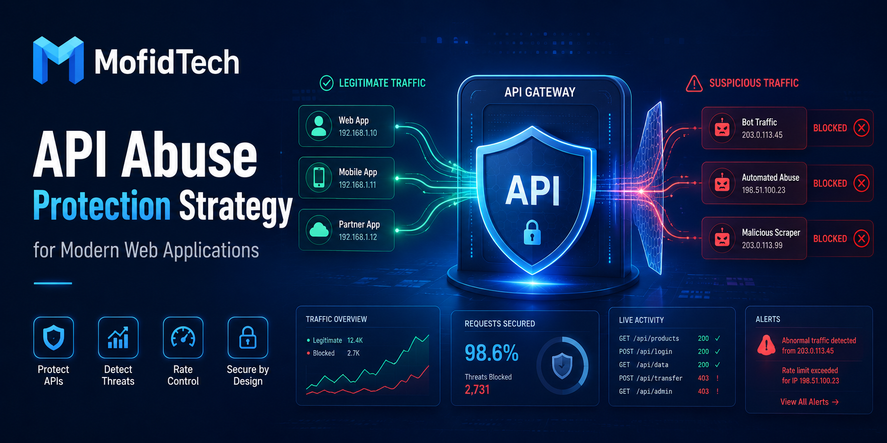
Modern web applications depend on APIs more than ever. A single website may use APIs for login, account creation, search, payments, dashboards, mobile apps, admin panels, third-party integrations, AI features, notifications, analytics, and customer support. APIs are no longer a hidden technical layer. They are the nervous system of modern digital products.
This also makes APIs attractive targets.
Attackers do not always need to break encryption, exploit a server vulnerability, or bypass a firewall. Sometimes they only need to use your API in a way you did not expect. They may send thousands of login attempts, scrape public data, create fake accounts, abuse discount logic, test stolen credentials, overload expensive endpoints, or use valid accounts to perform suspicious actions at scale.
That is why API abuse protection is different from basic API security. Traditional API security focuses on preventing unauthorized access and technical vulnerabilities. API abuse protection focuses on stopping harmful behavior, even when the requests look technically valid.
The OWASP API Security Top 10 highlights major API risks such as broken object-level authorization, broken authentication, unrestricted resource consumption, and unsafe consumption of APIs. These risks show that API protection must include authentication, authorization, resource control, monitoring, and abuse detection, not only basic endpoint protection.
This article explains how to build a practical API abuse protection strategy for modern web applications without relying on code examples. It is written for developers, students, engineers, and technical website owners who want to understand the concepts, decisions, risks, and best practices behind strong API protection.
This article also follows the MofidTech editorial rule of producing large, practical, SEO-ready, AI-search-friendly technical content without code examples or copy-paste snippets.
Table of Contents
- What Is API Abuse?
- API Abuse vs API Security
- Why API Abuse Is Increasing
- Common Types of API Abuse
- Why Rate Limiting Alone Is Not Enough
- High-Risk API Endpoints
- How to Build an API Abuse Protection Strategy
- Practical API Protection Controls
- Authentication and Session Protection
- Bot Protection and Human Verification
- Business Logic Abuse Protection
- Monitoring, Logging, and Detection
- Incident Response for API Abuse
- API Abuse Protection Checklist
- Common Mistakes Developers Make
- Best Practices for Long-Term API Security
- Comparison Tables
- Troubleshooting Guide
- FAQ
- Conclusion
What Is API Abuse?
API abuse is the misuse of an API through automated, excessive, fraudulent, or unintended behavior. It happens when someone uses API functionality in a way that harms the system, the business, or other users.
API abuse does not always mean the attacker has found a classic software vulnerability. In many cases, the API is working exactly as designed, but the design allows harmful behavior at scale.
For example, a login API is supposed to accept email and password attempts. A search API is supposed to return results. A registration API is supposed to create accounts. A checkout API is supposed to process purchases. The problem begins when these normal features are used too often, too quickly, too cheaply, or for the wrong purpose.
A strong API abuse protection strategy asks a simple question:
What behavior should be allowed, what behavior should be slowed down, and what behavior should be blocked?
This is different from only asking whether a request is authenticated or whether the endpoint exists.
Simple Definition
API abuse is harmful or excessive use of an API, often through automation, bots, stolen credentials, fake accounts, scraping, or manipulation of business workflows.
Practical Example
Imagine a website with a public search feature. A normal user may search a few times per session. A bot may send thousands of searches per hour to copy product data, extract user information, or overload the backend. The search endpoint may be public and intentionally accessible, but the behavior is abusive.
That is the core challenge of API abuse protection: distinguishing legitimate usage from harmful usage.
API Abuse vs API Security
API security and API abuse protection are closely related, but they are not the same thing.
API security focuses on whether access is allowed, whether data is protected, whether authentication works, and whether vulnerabilities exist. API abuse protection focuses on how the API is being used over time.
A request can be authenticated and still be abusive. A user can have a valid account and still misuse the system. A bot can follow the correct API format and still cause damage.
API Security Answers Questions Like:
Is the user authenticated?
Is the user authorized?
Is sensitive data protected?
Are tokens handled safely?
Are endpoints exposed unnecessarily?
Are API inputs validated?
Are permissions enforced correctly?
API Abuse Protection Answers Questions Like:
Is this user acting like a real user?
Is this request volume normal?
Is this endpoint being used too aggressively?
Is this account part of a suspicious pattern?
Is this behavior likely automated?
Is someone extracting data at scale?
Is a business rule being manipulated?
Both layers are necessary. API security protects the doors. API abuse protection watches how people behave after they reach the doors.
Why API Abuse Is Increasing
API abuse is increasing because modern applications expose more functionality through APIs, and attackers now have better automation tools.
Many applications are API-first. Mobile apps, single-page applications, dashboards, partner integrations, AI tools, and background services all depend on APIs. This creates more endpoints, more traffic, more tokens, and more opportunities for misuse.
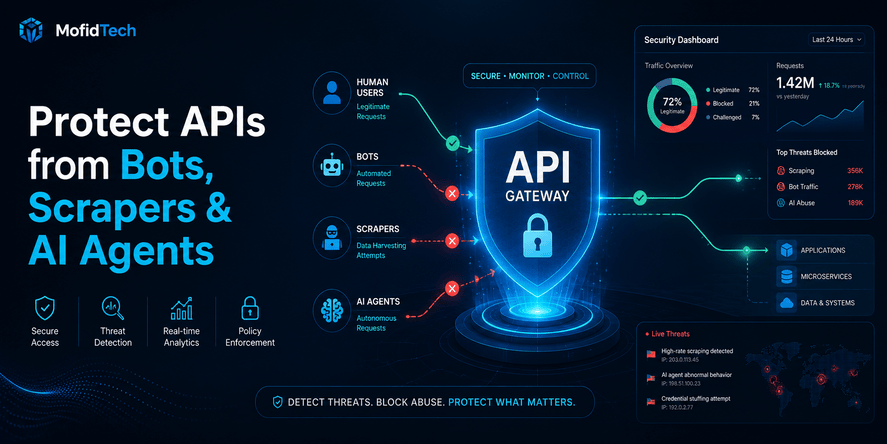
Attackers also benefit from automation. Bots can test credentials, create accounts, scrape content, rotate IP addresses, simulate browsers, and adapt to blocking rules. Cloudflare’s 2025 Signals Report described how attackers use bots for credential stuffing, distributed denial-of-service attacks, scraping, and fraud at machine speed, while AI can increase the realism and adaptability of some attacks.
More APIs Means More Attack Surface
Every new endpoint is a new path into the application. Even if an endpoint is not sensitive by itself, it can become dangerous when combined with other endpoints.
For example:
A public product search endpoint can support scraping.
A password reset endpoint can support account discovery.
A registration endpoint can support fake account creation.
A pricing endpoint can support competitive data extraction.
A user profile endpoint can expose personal information if authorization is weak.
A checkout endpoint can be abused for fraud or discount manipulation.
Automation Changes the Risk
A human may make ten requests. A bot can make ten thousand. A human may test one login. A credential stuffing tool can test thousands of stolen username and password combinations. A normal customer may create one account. A fraud system may create hundreds.
The danger is not only the request itself. The danger is scale.
AI Agents Add New Complexity
AI agents and automated browser tools can interact with websites and APIs in more human-like ways. They may perform tasks across multiple pages, follow instructions, and generate dynamic behavior. This does not mean every AI agent is malicious, but it does mean that web applications need better controls for automated behavior.
Google has also described AI agents as an emerging area in its guidance for website owners, showing that AI-driven interactions are becoming important for both search and web infrastructure.
Common Types of API Abuse
API abuse appears in many forms. Some attacks are clearly malicious. Others look like normal usage until the scale, pattern, or business impact becomes visible.
Credential Stuffing
Credential stuffing happens when attackers use stolen username and password combinations from other data breaches to try logging into your application.
The attacker does not need to know your users’ passwords directly. They rely on password reuse. If a user used the same password on another compromised website, the attacker may try it on your login API.
Credential stuffing is dangerous because each individual login attempt may look normal. The pattern becomes visible only when you analyze volume, failure rates, IP behavior, device signals, account targeting, and timing.
Brute-Force Login Attempts
Brute force attacks attempt many password guesses against one or more accounts. Unlike credential stuffing, which uses known leaked combinations, brute force often relies on guessing.
Brute force can target:
Admin accounts
Common usernames
Email addresses
Student accounts
Customer accounts
API tokens
Partner accounts
Login endpoints need special protection because they are high-value targets.
Fake Account Creation
Attackers may abuse registration APIs to create fake accounts. These accounts can be used for spam, fraud, scraping, referral abuse, review manipulation, promo code abuse, phishing, or reputation attacks.
Fake account abuse is especially common on platforms with free registration, free trials, referral rewards, comment systems, marketplaces, and digital services.
Scraping and Data Extraction
Scraping happens when automated systems extract data from your API at scale. Some scraping may be harmless, but abusive scraping can create business, security, privacy, and performance problems.
Examples include:
Copying product catalogs
Extracting prices
Harvesting user profiles
Collecting email addresses
Copying article content
Monitoring inventory
Duplicating public datasets
Training unauthorized systems on proprietary content
Scraping is not always blocked by authentication. Sometimes authenticated users can still scrape if the API allows too much access.
Business Logic Abuse
Business logic abuse happens when someone manipulates the intended workflow of an application without necessarily exploiting a technical vulnerability.
Examples include:
Using a discount more times than intended
Creating many accounts to receive free trials
Reserving inventory without buying
Triggering repeated password reset emails
Bypassing intended usage limits
Manipulating referral rewards
Using search or export features to extract large datasets
Abusing refund or cancellation flows
This type of abuse is difficult because the API may be technically secure, but the business rules are incomplete.
Token Misuse
API tokens, session tokens, refresh tokens, and access tokens can be misused if they are stolen, shared, reused too long, or not limited properly.
Token misuse can include:
Using a stolen token from another device
Continuing to use old tokens after password changes
Using tokens from suspicious locations
Sharing tokens between automated systems
Using long-lived tokens without monitoring
Replaying tokens across sessions
Token security is not only about generating tokens. It is also about controlling token lifetime, scope, revocation, and behavior.
Resource Exhaustion
Some API endpoints are expensive. They may trigger database searches, file processing, AI operations, reports, exports, image processing, email sending, or external service calls.
Attackers may abuse these endpoints to increase costs, slow the application, or cause service instability.
OWASP includes unrestricted resource consumption as a major API security risk, which is directly connected to excessive API usage and abuse prevention.
Enumeration Attacks
Enumeration happens when attackers use APIs to discover valid users, records, IDs, emails, phone numbers, order numbers, or account identifiers.
Examples include:
Testing whether an email exists
Guessing user IDs
Checking which phone numbers are registered
Discovering valid coupon codes
Finding order references
Testing student IDs or employee IDs
Checking available usernames
Even small information leaks can help attackers prepare larger attacks.
Why Rate Limiting Alone Is Not Enough
Rate limiting is important, but it is not a complete API abuse protection strategy.
Rate limiting controls how many requests can be made in a given time period. It is useful for reducing excessive traffic, slowing brute-force attempts, protecting expensive endpoints, and limiting accidental overload.
However, attackers can bypass simple rate limits by using distributed IP addresses, multiple accounts, different devices, rotating proxies, or slower attack patterns.
What Rate Limiting Can Help With
Rate limiting can help reduce:
Very high request volume
Simple brute-force attempts
Accidental client loops
Excessive search requests
Repeated password reset attempts
Heavy export usage
Basic scraping behavior
Some denial-of-service patterns
What Rate Limiting Cannot Fully Solve
Rate limiting cannot fully solve:
Low-and-slow abuse
Distributed credential stuffing
Fake account creation using many identities
Business logic manipulation
Abuse from authenticated users
Scraping spread across many accounts
Token misuse
Fraudulent behavior that stays below request thresholds
Better Approach
A better approach is layered protection.
Use rate limiting as one layer, but combine it with authentication controls, authorization checks, behavior analysis, device signals, bot detection, fraud rules, logging, alerting, and business-specific limits.
API abuse protection should not depend on one control.
High-Risk API Endpoints
Not every API endpoint has the same risk. A good strategy starts by identifying which endpoints are most likely to be abused.
Login Endpoints
Login endpoints are often attacked through credential stuffing, brute force, account takeover attempts, and automated password guessing.
Protection should consider:
Failed login patterns
Successful logins from unusual locations
Multiple accounts targeted from the same source
One account targeted from many sources
Repeated login attempts after password reset
Suspicious device changes
Registration Endpoints
Registration endpoints can be abused for fake accounts, spam, referral fraud, trial abuse, and platform manipulation.
Protection should consider:
Email verification
Phone verification when appropriate
Account creation velocity
Device and IP reputation
Disposable email patterns
Repeated registrations from similar signals
Suspicious profile behavior after signup
Password Reset Endpoints
Password reset endpoints can be abused for account discovery, inbox flooding, harassment, and social engineering.
Protection should consider:
Consistent response messages
Request limits per account and per source
Email sending controls
Monitoring unusual reset activity
Avoiding user enumeration
Short-lived secure reset links
Search Endpoints
Search endpoints are frequently abused for scraping, enumeration, and resource exhaustion.
Protection should consider:
Search frequency
Query complexity
Result depth
Pagination limits
Authenticated vs anonymous behavior
Expensive filters
Repeated extraction patterns
Export and Report Endpoints
Export endpoints can expose large volumes of data and consume system resources.
Protection should consider:
Permission levels
Export frequency
Data volume limits
Audit logs
Approval workflows for sensitive exports
Background processing controls
Notification of large exports
Payment and Checkout Endpoints
Payment and checkout endpoints are targets for fraud, card testing, inventory abuse, coupon abuse, and purchase manipulation.
Protection should consider:
Payment attempt patterns
Coupon validation abuse
Cart manipulation
Repeated checkout failures
Suspicious account behavior
Inventory reservation patterns
Fraud scoring
Admin and Internal APIs
Admin APIs are high-impact targets. Even low-volume abuse can be serious.
Protection should consider:
Strong authentication
Role-based authorization
Multi-factor authentication
Audit logs
Session controls
IP or device restrictions where appropriate
Unusual admin activity alerts
How to Build an API Abuse Protection Strategy
A good API abuse protection strategy is not a single tool. It is a system of decisions, controls, monitoring, and response processes.
The goal is not to block every suspicious request immediately. The goal is to reduce abuse while preserving a good experience for legitimate users.
Step 1: Map Your API Surface
Start by listing your API endpoints and grouping them by purpose.
Useful categories include:
Authentication
Registration
Password reset
User profile
Search
Content access
Payments
File uploads
Exports
Admin actions
Third-party integrations
AI or automation features
Notifications
Support and contact forms
For each category, ask:
What data does this endpoint expose?
What action does it perform?
Can it trigger emails, payments, or external services?
Can it consume expensive resources?
Can it be used repeatedly?
Can it affect other users?
Can it reveal whether an account exists?
This creates a risk map.
Step 2: Identify Abuse Scenarios
For each important endpoint, define possible abuse scenarios.
For example:
Login endpoint: credential stuffing
Registration endpoint: fake accounts
Search endpoint: scraping
Export endpoint: data extraction
Password reset endpoint: account discovery
Checkout endpoint: coupon abuse
Comment endpoint: spam
Profile endpoint: user enumeration
File upload endpoint: storage abuse
This helps you protect against real behavior, not vague threats.
Step 3: Define Normal Behavior
You cannot detect abnormal behavior unless you understand normal behavior.
For each endpoint, estimate:
How often should a normal user use it?
How many requests are expected per session?
How many failed attempts are acceptable?
How much data should be returned?
How often should this action happen per day?
What patterns are normal for mobile users?
What patterns are normal for admins?
What patterns are normal for integrations?
Normal behavior will differ by endpoint. A dashboard may refresh often. A password reset should not be used repeatedly. A search endpoint may receive more traffic than a profile update endpoint.
Step 4: Apply Layered Controls
Use multiple controls instead of relying on one.
A strong strategy may include:
Authentication
Authorization
Rate limits
Quotas
Session controls
Token controls
Behavior monitoring
Bot detection
CAPTCHA or challenges
Email verification
Device signals
IP reputation
Audit logs
Alerting
Manual review
Temporary blocking
Progressive friction
Layered controls make abuse harder and reduce false positives.
Step 5: Monitor and Improve
API abuse patterns change over time. Protection rules should not be static.
Review:
Traffic spikes
Failed login rates
Registration patterns
Search usage
Export activity
Blocked requests
False positives
Support complaints
Endpoint latency
Unusual account behavior
Security alerts
A protection strategy becomes stronger when it learns from real traffic.
Practical API Protection Controls
API abuse protection should be practical. Not every website needs enterprise-level fraud systems, but every serious web application needs basic layers.
Rate Limits
Rate limits control request frequency.
They can be applied by:
IP address
User account
Session
API token
Device fingerprint
Endpoint
Organization
Geographic pattern
Combination of signals
The best rate limits are context-aware. A login endpoint should have stricter limits than a public content endpoint. An export endpoint should have stricter limits than a normal page view endpoint.
Quotas
Quotas define how much usage is allowed over a longer period.
Examples include:
Number of API requests per day
Number of exports per month
Number of account creations per device
Number of password resets per day
Number of messages sent per hour
Number of search results viewed per session
Quotas are useful for SaaS products, dashboards, AI tools, and applications with resource costs.
Authentication Controls
Authentication should verify identity reliably, but it should also resist abuse.
Useful controls include:
Strong password policies
Multi-factor authentication for sensitive accounts
Secure password reset workflows
Suspicious login detection
Session invalidation after password changes
Protection against account enumeration
Monitoring of failed login patterns
OWASP identifies broken authentication as one of the major API security risks because authentication weaknesses can allow attackers to compromise tokens or assume user identities.
Authorization Controls
Authorization decides what an authenticated user can access.
Many API incidents happen because the API checks whether the user is logged in but does not properly check whether the user owns the requested object.
For example, a user should not be able to access another user’s invoice, profile, file, order, or private message by changing an identifier.
OWASP lists broken object-level authorization as the top API security risk in its 2023 API Security Top 10.
Progressive Friction
Progressive friction means increasing verification only when risk increases.
Instead of forcing every user to solve a challenge, the system can add friction when behavior becomes suspicious.
Examples include:
Temporary delay
Email verification
Additional login confirmation
CAPTCHA
Multi-factor authentication prompt
Reduced access
Manual review
Temporary account hold
This approach protects the system without punishing normal users.
Bot Detection
Bot detection looks for signs that traffic is automated.
Signals may include:
Request frequency
Navigation patterns
Header consistency
Device behavior
Session behavior
IP reputation
User-agent anomalies
Mouse or touch behavior where appropriate
Repeated patterns across accounts
Known automation infrastructure
Cloudflare’s bot management materials describe account takeover, bulk account creation, credential stuffing, and mobile app abuse as use cases for bot protection.
Logging and Audit Trails
Good logs are essential for detecting and investigating abuse.
Important log categories include:
Authentication events
Failed login attempts
Password reset requests
Account creation events
Sensitive data access
Export activity
Payment attempts
Permission changes
Admin actions
Blocked requests
Suspicious behavior alerts
Logs should help answer:
Who did what?
When did it happen?
From where?
Using which account or token?
Which endpoint was involved?
Was the action successful?
Was it repeated?
Was it part of a larger pattern?
Alerting
Alerts should focus on meaningful patterns, not every small anomaly.
Useful alerts include:
Sudden increase in failed logins
Many accounts targeted from one source
One account targeted from many sources
Spike in registrations
Unusual export volume
Repeated password reset requests
High error rate on one endpoint
Traffic from suspicious regions
Abuse of expensive operations
Unexpected admin activity
Good alerts help teams respond quickly without creating alert fatigue.
Authentication and Session Protection
Authentication endpoints deserve special attention because they are the gateway to user accounts.
Protect Login Without Hurting Real Users
A login system should not simply block users after a few failed attempts. Real users forget passwords. Attackers automate attempts. The challenge is to separate mistakes from abuse.
Good login protection considers:
Number of failed attempts
Time between attempts
Number of accounts targeted
Device history
Location changes
Known user behavior
Password reset activity
Risk level of the account
Whether the account has sensitive permissions
A normal user failing twice should not be treated like a bot testing hundreds of accounts.
Avoid User Enumeration
User enumeration happens when the API reveals whether an email, username, or account exists.
For example, different messages for “email not found” and “wrong password” can help attackers build lists of valid accounts.
A safer approach is to use neutral messages that do not reveal account existence. This is especially important for login, registration, password reset, and account recovery flows.
Protect Password Reset
Password reset flows are often abused because they send emails and reveal account behavior.
Good protection includes:
Neutral response messages
Request limits
Short-lived reset links
One-time-use reset links
Secure token handling
Email sending limits
Monitoring of repeated reset attempts
Protection against inbox flooding
User notification after successful password changes
Session Risk Monitoring
A session should not be trusted forever simply because login succeeded.
Watch for:
Sudden location changes
Device changes
Unusual activity after login
Access to many records quickly
Repeated sensitive actions
Token reuse from strange environments
High-risk account changes
Session security is part of abuse protection because stolen sessions are often used in ways that look authenticated but abnormal.
Bot Protection and Human Verification
Bots are one of the main drivers of API abuse. However, bot protection should be used carefully.
Not all automation is bad. Search engine crawlers, monitoring tools, accessibility tools, partner integrations, and legitimate business automation may all interact with web systems. The goal is to block harmful automation, not every automated request.
When to Use CAPTCHA
CAPTCHA can help when there is clear risk, but it should not be the only protection.
Useful places for CAPTCHA or challenge-based protection may include:
Suspicious login attempts
Repeated registration attempts
Password reset abuse
Comment spam
Contact form abuse
High-risk anonymous actions
Traffic that looks automated
However, CAPTCHA can hurt accessibility and user experience. It can also be bypassed by advanced attackers or outsourced solving services. Use it as one layer, not as the entire strategy.
Better Than Always Showing Challenges
Instead of showing CAPTCHA to every user, use risk-based challenges.
For example:
A normal returning user may continue without challenge.
A new device may require extra verification.
A suspicious IP may receive a challenge.
A user making too many attempts may be slowed down.
A high-risk action may require confirmation.
This protects the application while keeping normal usage smooth.
Bot Protection for APIs
API bots may not interact with a visual browser. That means traditional web-only bot defenses may not be enough.
API bot protection should consider:
Token behavior
Endpoint usage patterns
Request timing
Repeated identifiers
Header anomalies
Account behavior
Rate across multiple signals
Invalid request patterns
Error rates
Suspicious automation signatures
The best bot protection combines technical signals with business context.
Business Logic Abuse Protection
Business logic abuse is one of the most underestimated API risks.
A system may be technically secure but still easy to abuse because the product rules are incomplete.
Examples of Business Logic Abuse
A user creates many free trial accounts.
A customer applies a discount repeatedly.
A bot reserves products without buying.
A user exports more data than intended.
A referral system rewards fake accounts.
A booking system is used to block availability.
A password reset system is used to harass users.
A comment system is used for spam.
A voting system is manipulated by fake accounts.
Why Business Logic Abuse Is Difficult
Traditional security tools may not detect it because each request appears valid.
The endpoint works.
The user may be authenticated.
The input format is correct.
The action is allowed.
The response is normal.
The problem is the pattern.
How to Reduce Business Logic Abuse
Define business limits clearly.
Ask:
How often should this action happen?
Who is allowed to perform it?
What should happen after repeated use?
What patterns suggest fraud?
What actions require verification?
What data should be visible?
What should be logged?
When should a human review be triggered?
Business logic protection requires collaboration between developers, security teams, product managers, and operations teams.
Monitoring, Logging, and Detection
API abuse protection depends on visibility. You cannot protect what you cannot observe.
What to Monitor
Important monitoring areas include:
Request volume by endpoint
Failed authentication attempts
Successful logins after many failures
Password reset frequency
Registration volume
Search request patterns
Export activity
Payment failures
Account changes
Admin activity
Error rates
Response times
Blocked requests
Unusual geographic patterns
Repeated requests for sequential records
Useful Abuse Signals
Some signals are weak alone but powerful together.
Examples:
Many failed logins from one IP
Many IPs targeting one account
Many new accounts from one device
Many searches with similar patterns
Many requests for sequential IDs
High export activity from one user
Many password resets for one email
Many payment failures from one session
Repeated requests just below rate limits
Different accounts using the same device pattern
Good detection combines signals.
Avoid False Positives
False positives happen when legitimate users are blocked or challenged incorrectly.
To reduce false positives:
Use progressive controls
Avoid relying only on IP address
Consider account history
Allow recovery paths
Monitor support complaints
Review blocked traffic
Use temporary restrictions before permanent blocks
Create allowlists carefully for trusted integrations
Separate suspicious behavior from confirmed abuse
Security should protect the product without damaging the user experience.
Incident Response for API Abuse
Even with strong protection, abuse can still happen. A response plan helps reduce damage.
Step 1: Confirm the Pattern
Before blocking aggressively, confirm what is happening.
Ask:
Which endpoint is affected?
When did the activity begin?
Is it still happening?
How many users are affected?
Which accounts, IPs, tokens, or devices are involved?
Is data being accessed or modified?
Is the system under performance pressure?
Is this a known integration or legitimate traffic spike?
Step 2: Contain the Abuse
Containment actions may include:
Temporarily reducing limits
Blocking suspicious sources
Disabling high-risk actions
Invalidating suspicious tokens
Requiring additional verification
Pausing exports
Protecting affected accounts
Adding emergency monitoring
Temporarily disabling vulnerable workflows
Containment should be proportional. Blocking too broadly can harm legitimate users.
Step 3: Investigate Impact
Determine what happened.
Important questions:
Was data accessed?
Was data changed?
Were accounts compromised?
Were emails sent?
Were payments attempted?
Were fake accounts created?
Were resources consumed?
Were third-party services affected?
Did the abuse exploit a design weakness?
Step 4: Improve Controls
After the incident, update the protection strategy.
Possible improvements:
Adjust rate limits
Add endpoint-specific quotas
Improve logging
Add alerts
Strengthen authentication
Improve authorization checks
Update business rules
Add verification steps
Improve admin visibility
Create new abuse dashboards
Review product flows
A good incident response turns abuse into better protection.
API Abuse Protection Checklist
Pre-Production Checklist
Before launching an API, review:
- Have all endpoints been documented?
- Are high-risk endpoints identified?
- Are authentication requirements clear?
- Are authorization checks enforced?
- Are sensitive actions logged?
- Are rate limits defined for risky endpoints?
- Are password reset flows protected?
- Are registration flows protected?
- Are search and export endpoints limited?
- Are expensive operations controlled?
- Are error messages safe?
- Are API responses avoiding unnecessary data exposure?
- Are admin endpoints strongly protected?
- Are suspicious behaviors monitored?
- Is there a plan for abuse incidents?
Production Monitoring Checklist
After launch, monitor:
- Login failure rates
- Registration spikes
- Password reset patterns
- Search volume
- Export activity
- Payment failures
- API error rates
- Endpoint latency
- Traffic from unusual sources
- Suspicious account behavior
- Blocked request trends
- Support complaints related to access issues
- Unexpected increases in infrastructure cost
Incident Response Checklist
During abuse incidents, check:
- Which endpoint is targeted?
- Which users are affected?
- Which accounts are suspicious?
- Which tokens should be revoked?
- Which limits should be tightened?
- Is data exposure possible?
- Is performance affected?
- Should users be notified?
- Should logs be preserved?
- What rule or design change will prevent recurrence?
Common Mistakes Developers Make
Mistake 1: Protecting Only Login Endpoints
Login protection is important, but many other endpoints can be abused.
Search, registration, password reset, exports, comments, checkout, profile lookup, and file upload endpoints also need protection.
Mistake 2: Trusting Authenticated Users Too Much
A logged-in user is not automatically safe.
Authenticated users can scrape data, abuse free trials, manipulate workflows, share tokens, or use stolen accounts.
Always combine authentication with authorization, behavior monitoring, and business limits.
Mistake 3: Using Only IP-Based Rate Limits
IP-based limits are useful but incomplete.
Many users may share one IP, especially in schools, companies, public networks, universities, and mobile networks. Attackers may also rotate IPs.
Better protection uses multiple signals, including account, session, token, device, endpoint, and behavior.
Mistake 4: Blocking Too Aggressively
Strong blocking can create user frustration if it catches legitimate users.
Use progressive friction where possible. Slow down suspicious behavior, request verification, reduce access temporarily, or require confirmation before permanent blocking.
Mistake 5: Ignoring Business Logic
Many abuse cases are not technical vulnerabilities. They are product rule failures.
If a promotion can be used 100 times by creating fake accounts, the problem is not only security. It is business logic.
Mistake 6: Not Logging Enough Context
A log that only says “request blocked” is not enough.
Good logs need context: user, endpoint, time, action, source, token, result, and pattern.
Mistake 7: Treating All Endpoints Equally
Different endpoints have different risks.
A public article endpoint does not need the same controls as a password reset endpoint. A payment endpoint does not need the same rules as a theme preference endpoint.
Mistake 8: Forgetting About Cost Abuse
Some API endpoints trigger expensive operations. Abuse can increase cloud bills, email costs, AI usage costs, storage costs, or database load.
Cost protection is part of API abuse protection.
Best Practices for Long-Term API Security
Build Security Into API Design
Do not wait until abuse happens. API protection should be part of design.
Before creating an endpoint, ask:
Can this endpoint be abused?
What is the worst-case scenario?
What limits are needed?
What should be logged?
Who should access it?
How often should it be used?
What happens if it is automated?
Use Least Privilege
Users, tokens, and integrations should only have the access they need.
Avoid broad permissions. Limit access by role, scope, purpose, and context.
Limit Data Exposure
APIs should return only the data needed for the current action.
Avoid exposing internal IDs, unnecessary personal data, hidden fields, system metadata, or excessive records.
Protect Expensive Operations
Any endpoint that triggers heavy processing should have stronger protection.
Examples:
Reports
Exports
AI processing
Image processing
Bulk operations
Email sending
Payment attempts
Search with complex filters
File uploads
Review API Logs Regularly
Logs are not useful if nobody reviews them.
Create recurring reviews for:
Authentication anomalies
Registration abuse
Export patterns
Search behavior
Admin actions
Error spikes
Traffic changes
Blocked requests
Test Abuse Scenarios
Security testing should include abuse scenarios, not only vulnerability scanning.
Test:
Can a user access another user’s data?
Can someone create too many accounts?
Can someone send too many password reset emails?
Can someone scrape records through pagination?
Can someone guess valid IDs?
Can someone repeatedly use a promotion?
Can someone overload expensive endpoints?
Can a token be reused after account changes?
Keep Protection Rules Updated
Traffic changes over time. A rule that works today may fail later.
Review limits after:
Product launches
Marketing campaigns
New mobile apps
New API integrations
New pricing plans
New AI features
New regions
Security incidents
Traffic growth
Comparison Tables
API Security vs API Abuse Protection
| Area | API Security | API Abuse Protection |
|---|---|---|
| Main question | Is access allowed? | Is behavior acceptable? |
| Focus | Authentication, authorization, data protection | Automation, misuse, fraud, excessive usage |
| Example risk | User accesses another user’s data | Bot scrapes thousands of records |
| Main controls | Permissions, tokens, validation | Rate limits, monitoring, behavior analysis |
| Failure pattern | Unauthorized access | Harmful use of allowed features |
| Best approach | Secure design and testing | Layered detection and response |
Rate Limiting vs Behavior Detection
| Area | Rate Limiting | Behavior Detection |
|---|---|---|
| Measures | Request frequency | Usage patterns |
| Good for | Simple excessive traffic | Advanced abuse patterns |
| Weakness | Can be bypassed by distributed attacks | Requires good monitoring and tuning |
| Example | Limit login attempts | Detect many accounts targeted by one pattern |
| Best use | First protection layer | Deeper abuse detection layer |
Blocking vs Progressive Friction
| Area | Blocking | Progressive Friction |
|---|---|---|
| Action | Stops request immediately | Adds verification or limits |
| Best for | Confirmed abuse | Suspicious behavior |
| Risk | False positives | Slight user friction |
| Example | Block known malicious source | Ask for verification after unusual login |
| User experience | Can be harsh | More flexible |
Troubleshooting Section
Problem: Many Failed Login Attempts
Possible causes:
Credential stuffing
Brute-force attack
Users forgetting passwords
Bot testing leaked credentials
Attackers targeting admin accounts
Recommended response:
Review failure patterns. Check whether many accounts are targeted from the same sources or whether one account is targeted from many sources. Add stronger login protection, progressive delays, suspicious login detection, and account protection for high-risk users.
Problem: Sudden Spike in New Accounts
Possible causes:
Marketing campaign
Bot registration
Fake account creation
Trial abuse
Spam preparation
Referral abuse
Recommended response:
Compare account behavior after signup. Fake accounts often show repeated patterns, low engagement quality, disposable email use, repeated device signals, or immediate abuse attempts.
Problem: Search Endpoint Is Consuming Too Many Resources
Possible causes:
Scraping
Expensive queries
Automated discovery
Poor pagination limits
Overly broad filters
Accidental frontend loop
Recommended response:
Review query patterns, result depth, repeated searches, and endpoint cost. Add reasonable limits, caching strategy, monitoring, and protection for expensive search behavior.
Problem: Users Are Being Blocked Incorrectly
Possible causes:
Rate limits too strict
Shared IP addresses
Mobile network behavior
Corporate networks
University networks
Poor bot detection signals
No account-based context
Recommended response:
Review blocked traffic. Use progressive friction instead of immediate blocking. Combine IP signals with account, session, endpoint, and behavior signals.
Problem: API Costs Are Increasing Unexpectedly
Possible causes:
Resource-heavy endpoint abuse
AI feature abuse
Export abuse
Email sending abuse
File upload abuse
Third-party API misuse
Poor quota design
Recommended response:
Identify which endpoints drive cost. Add quotas, approval flows, usage dashboards, and alerts for expensive operations.
Real-World Use Cases
SaaS Dashboard
A SaaS dashboard may expose APIs for reports, users, billing, exports, and integrations. Abuse may involve excessive exports, token sharing, account takeover attempts, or scraping customer data.
Protection should focus on role-based permissions, export limits, audit logs, token scopes, and suspicious activity alerts.
E-Commerce Website
An e-commerce website may face inventory scraping, checkout abuse, coupon abuse, fake accounts, payment testing, and review manipulation.
Protection should focus on bot detection, checkout risk controls, coupon rules, account behavior, and payment monitoring.
Educational Platform
An educational platform may have student accounts, login portals, course data, certificates, and admin tools.
Protection should focus on account enumeration, password reset abuse, student data access, admin security, and bulk data extraction.
Content Website
A content website may expose APIs for articles, search, comments, newsletters, and user profiles.
Protection should focus on scraping, comment spam, fake newsletter signups, search abuse, and content duplication.
AI Tool Platform
An AI-powered web application may expose expensive endpoints for generation, summarization, classification, or automation.
Protection should focus on quotas, cost monitoring, account abuse, prompt abuse, automated usage, and fair usage limits.
Security Considerations
API abuse protection is part of security, but it must be aligned with privacy, usability, and compliance.
Protect Personal Data
Avoid returning unnecessary personal data through APIs. Even authenticated APIs should follow data minimization principles.
Secure Tokens
Tokens should be protected with appropriate lifetime, scope, revocation, and monitoring.
Monitor Admin Actions
Admin activity should always be logged and reviewed. Admin APIs have high impact.
Reduce Information Leakage
Error messages should not reveal sensitive details such as account existence, internal IDs, permission structure, or backend behavior.
Prepare for Account Takeover
Account takeover can happen when credentials are stolen elsewhere. Protect users through suspicious login detection, multi-factor authentication, password reset security, and session monitoring.
Performance Considerations
API abuse is not only a security issue. It is also a performance issue.
Excessive API usage can slow databases, increase server load, overload queues, consume third-party quotas, and increase cloud costs.
Protect Expensive Endpoints First
Some endpoints deserve stronger limits because they cost more.
Examples:
Search
Reports
Exports
AI operations
File processing
Image processing
Email sending
Payment attempts
Bulk updates
Use Caching Carefully
Caching can reduce load for repeated safe requests. However, caching does not replace security. Sensitive data and personalized responses require careful handling.
Watch Database Load
API abuse often appears as database pressure. Search endpoints, filtering, sorting, pagination, and repeated object lookup can become expensive.
Monitor Cost-Based Abuse
Modern applications often depend on paid services. Abuse can increase bills for email, SMS, AI models, storage, bandwidth, and third-party APIs.
Cost monitoring should be part of the abuse protection dashboard.
FAQ
1. What is API abuse?
API abuse is the harmful, excessive, automated, or unintended use of an API. It can include credential stuffing, scraping, fake account creation, token misuse, resource exhaustion, and business logic manipulation.
2. Is API abuse the same as hacking?
Not always. Hacking often involves exploiting a vulnerability, while API abuse may use normal API features in harmful ways. An API can be technically functional and still be abused.
3. Is rate limiting enough to stop API abuse?
No. Rate limiting is useful, but it is only one layer. Advanced abuse may use many accounts, many IP addresses, low request rates, or valid authenticated sessions. A complete strategy also needs monitoring, authentication controls, authorization checks, bot detection, and business rules.
4. Which API endpoints should be protected first?
Start with login, registration, password reset, search, payment, checkout, export, admin, and any endpoint that exposes sensitive data or triggers expensive operations.
5. How do bots abuse APIs?
Bots can send repeated requests, test stolen credentials, create fake accounts, scrape data, trigger password resets, submit spam, abuse search, or manipulate business workflows.
6. What is credential stuffing?
Credential stuffing is an attack where stolen username and password combinations from other breaches are tested against your application. It works because many users reuse passwords across websites.
7. How can developers detect credential stuffing?
Developers can look for unusual failed login patterns, many accounts targeted from similar sources, successful logins after repeated failures, suspicious device changes, and traffic patterns that differ from normal user behavior.
8. Should every API use CAPTCHA?
No. CAPTCHA should be used carefully. It can help with suspicious behavior, but it can also hurt user experience and accessibility. Risk-based challenges are usually better than showing CAPTCHA to everyone.
9. What is business logic abuse?
Business logic abuse happens when someone manipulates intended product workflows, such as using promotions repeatedly, creating fake trial accounts, reserving inventory without buying, or abusing referral systems.
10. How can small websites protect APIs without expensive tools?
Small websites can start with endpoint mapping, strong authentication, authorization checks, reasonable rate limits, password reset protection, logging, alerting, manual review of suspicious patterns, and careful limits on expensive actions.
11. How is API abuse related to bot protection?
Many API abuse cases are automated by bots. Bot protection helps detect and stop automated behavior, but it should be combined with account-based, session-based, and business-specific controls.
12. How often should API protection rules be reviewed?
API protection rules should be reviewed after major product changes, traffic growth, new integrations, incidents, marketing campaigns, and changes in user behavior. Regular reviews help prevent outdated controls.
Conclusion
API abuse protection is now essential for modern web applications. APIs power login systems, dashboards, search, payments, mobile apps, admin tools, integrations, and AI features. As applications become more API-driven, attackers increasingly target normal API behavior instead of only looking for classic vulnerabilities.
The key lesson is simple: a request can be valid and still be abusive.
A strong API abuse protection strategy combines security, monitoring, business logic, performance awareness, and user experience. Rate limiting matters, but it is not enough. Authentication matters, but it is not enough. Bot detection matters, but it is not enough. Real protection comes from layers.
Developers should begin by mapping endpoints, identifying high-risk workflows, defining normal behavior, applying practical controls, monitoring suspicious patterns, and improving defenses after incidents. The best API protection strategy does not only block attackers. It also protects real users, preserves performance, reduces fraud, controls costs, and improves trust.
For MofidTech readers, this topic is especially important because it connects backend development, cybersecurity, DevOps, API design, AI-era automation, and practical software engineering. It is not a temporary trend. It is a long-term requirement for building reliable digital products.



💬 Comments
No comments yet. Be the first to comment!
Login to comment.