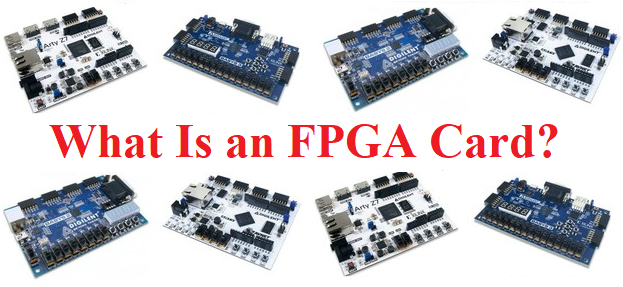
An FPGA card is a programmable electronic board that contains:
✔️ FPGA chip (the main programmable logic device)
✔️ Additional components
- Memory (RAM, Flash)
- I/O connectors (GPIO pins)
- Power regulators
- Communication interfaces (USB, JTAG, Ethernet, PCIe…)
You use special tools to program the internal circuitry of the FPGA chip. Unlike a CPU that follows instructions sequentially, an FPGA reconfigures its hardware to implement any digital logic you design.
🧠 How an FPGA Works (Concept)
Inside the FPGA are:
1️⃣ Configurable Logic Blocks (CLBs)
These are small logic units made of:
- LUTs (Look-Up Tables) → used to implement logic gates
- Flip-flops → used for memory/storage
CLBs are like LEGO bricks—you combine them to build bigger circuits.
2️⃣ Routing Network
Thousands of programmable wires that connect CLBs in any way you want.
This enables you to create:
- Adders
- Multipliers
- State machines
- Entire processors
- Signal processing pipelines
3️⃣ I/O Blocks
They handle communication with external devices:
- Sensors
- Motors
- HDMI / VGA screens
- SPI / I2C / UART devices
- High-speed interfaces (Ethernet, PCIe…)
4️⃣ Block RAM (BRAM)
Internal memory used for:
- Buffers
- Temporary storage
- Data processing pipelines
5️⃣ DSP Blocks
Dedicated hardware for:
- Fast multiplication
- Signal processing
- AI acceleration
These blocks make FPGAs extremely good for digital signal processing, image processing, communication systems, and AI acceleration.
🧩 What Makes an FPGA Different from CPU or GPU?
| Feature | CPU | GPU | FPGA |
|---|---|---|---|
| Execution | Sequential | Parallel (many cores) | Fully customizable hardware parallelism |
| Flexibility | Limited | Moderate | Very high – hardware can be redesigned anytime |
| Speed | Good | Very high | Real-time, deterministic, ultra-low latency |
| Power efficiency | Medium | Medium | Very high for custom logic |
| Programming | Software | Software | Hardware description (VHDL/Verilog) |
🛠 How Do You Program an FPGA?
You do not write Python or C directly.
You use HDL languages:
✔️ Verilog
✔️ VHDL
✔️ (or high-level tools like Vivado HLS using C/C++)
You describe:
- Logic gates
- Data paths
- Finite State Machines (FSMs)
- Clock domains
The FPGA vendor tools (Xilinx Vivado, Intel Quartus…) convert your design into a configuration file called bitstream.
When loaded onto the FPGA, it reconfigures the internal hardware.
🎯 What Is an FPGA Card Used For?
⭐ 1. Digital Signal Processing (DSP)
- Filters
- FFT
- Audio/video processing
- Radar / sonar
⭐ 2. Communication Systems
- Modulation/demodulation
- OFDM
- 5G/4G prototyping
- SDR (Software-defined radio)
⭐ 3. Robotics / Embedded Systems
- Motor control
- Sensor fusion
- Real-time control systems
⭐ 4. Cryptography & Security
- SHA, AES encryption
- Blockchain accelerators
- Low-latency financial algorithms
⭐ 5. AI / Machine Learning Acceleration
- Custom neural networks
- CNN acceleration
- Edge AI devices
⭐ 6. Custom Hardware Prototyping
Instead of waiting months for an ASIC, engineers use FPGAs to:
- Test their own chip designs
- Validate new architectures
🔌 Examples of FPGA Cards (Brands)
✔️ Xilinx (AMD)
- Artix-7
- Kintex-7
- Virtex
- Zynq (FPGA + ARM processor)
✔️ Intel (formerly Altera)
- Cyclone
- Arria
- Stratix
✔️ Lattice
- iCE40
- ECP5
🧳 What Comes on an FPGA Development Board?
Typical FPGA card includes:
- FPGA chip
- USB/JTAG programmer
- GPIO headers (40-pin, like Raspberry Pi)
- HDMI / VGA / Audio ports
- Ethernet
- On-board LEDs and switches
- Power inputs
- RAM blocks (DDR3/DDR4)
- External Flash
It’s basically a laboratory for building your own hardware systems.
🏁 In Simple Terms
An FPGA card allows you to design your own digital circuit exactly as you want, and implement it in real hardware instantly, without manufacturing a new chip.
It is:
💡 Faster than software
💡 More flexible than hardware
💡 Perfect for real-time, high-performance systems



💬 Comments
No comments yet. Be the first to comment!
Login to comment.