Introduction
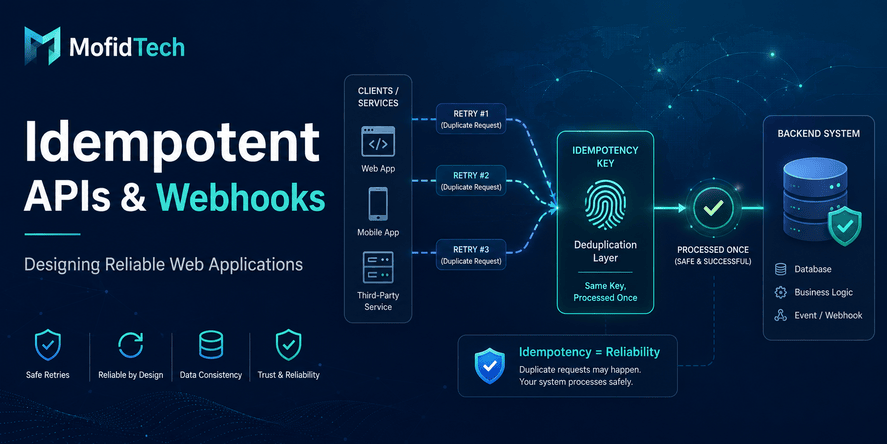
Reliable web applications are not only built by writing clean business logic. They are built by assuming that networks fail, users click twice, payment providers retry, browsers resend requests, queues redeliver jobs, and webhook providers may send the same event again.
This is where idempotency becomes essential.
An idempotent API or webhook workflow is designed so that repeating the same operation does not accidentally repeat the business action. In practice, this means a customer should not be charged twice because of a timeout, an order should not be created twice because a user clicked twice, and a webhook should not update the same subscription incorrectly because the provider sent the same event again.
Idempotency is a key concept in HTTP, backend architecture, payment systems, distributed systems, and production reliability. MDN defines an idempotent HTTP method as one where the intended server effect of one identical request is the same as several identical requests.
For modern applications, however, the challenge is bigger than HTTP method theory. Many real-world operations use methods and workflows that are not automatically idempotent. Creating a payment, placing an order, registering a user, processing a webhook, generating an invoice, or launching a background job can all produce duplicate effects if they are not designed carefully.
This guide explains how to design idempotent APIs and webhooks without using code examples. It focuses on architecture, workflows, risks, mistakes, best practices, and production-ready thinking for developers and technical teams.
Table of Contents
- What Are Idempotent APIs?
- Why Idempotency Matters in Production Applications
- Common Situations That Create Duplicate Actions
- Idempotent HTTP Methods Explained
- Why POST and Webhook Workflows Need Special Care
- How Idempotency Keys Work
- Designing Idempotent API Operations
- Designing Idempotent Webhook Consumers
- Handling Retries, Timeouts, and Unknown Outcomes
- Database and Storage Considerations
- Idempotency and Distributed Systems
- Security Considerations
- Performance Considerations
- Observability and Troubleshooting
- Common Mistakes
- Best Practices Checklist
- Comparison Tables
- Real-World Use Cases
- FAQ
- Conclusion
What Are Idempotent APIs?
An idempotent API is an API designed so that repeating the same request does not create repeated side effects.
In simple terms, if a client sends the same request once or sends it several times because of a retry, the final intended business result should remain the same.
For example, an idempotent order creation workflow should not create three orders if the same order request is sent three times. An idempotent payment workflow should not charge a customer twice if the client retries after a network timeout. An idempotent webhook consumer should not process the same external event repeatedly as if it were new every time.
Simple Definition of Idempotency
Idempotency means that repeating the same operation produces the same intended result as performing it once.
This does not always mean the technical response is identical every time. The first request may create a resource. A repeated request may return the previously created result. A later request may indicate that the operation has already been completed. The important point is that the business action is not duplicated.
Idempotency Is About Business Effects
Many developers think idempotency is only about HTTP methods. That is only part of the story.
In real applications, idempotency is mostly about business effects:
| Operation | Non-Idempotent Risk | Idempotent Goal |
|---|---|---|
| Create order | Multiple orders created | Only one order is created |
| Charge payment | Customer charged twice | One payment is recorded |
| Send invoice | Duplicate invoices sent | Invoice is sent once |
| Process webhook | Same event applied multiple times | Event is processed once |
| Register account | Duplicate accounts created | One account is created |
| Start background job | Job runs many times | Job result is not duplicated |
A technically successful API can still be unreliable if it does not protect the business from duplicate effects.
Idempotency Is Not the Same as Validation
Validation checks whether a request is acceptable.
Idempotency checks whether the same request has already been handled.
For example, validation may confirm that an order has a valid customer, a valid product, and a valid payment method. Idempotency checks whether this specific order creation attempt has already produced an order before.
Both are important, but they solve different problems.
Why Idempotency Matters in Production Applications
Idempotency matters because production systems are exposed to uncertainty.
A developer may imagine that an API request follows a simple path: the client sends a request, the server processes it, and the client receives a response. In reality, many things can happen between those steps.
The server may complete the operation but the response may never reach the client. A mobile connection may drop. A load balancer may time out. A browser may resubmit a form. A payment provider may retry an event. A background worker may restart. A user may refresh a page during checkout.
Without idempotency, these ordinary failures can become serious data problems.
Duplicate Payments
Payment workflows are one of the clearest examples. If a payment request times out, the client may not know whether the payment succeeded. Retrying the request without idempotency can create a second payment attempt.
Stripe documents idempotency keys as a way for clients to safely retry requests without accidentally performing the same operation twice.
This principle applies beyond Stripe. Any financial, billing, subscription, checkout, donation, marketplace, wallet, or invoice system should treat duplicate actions as a serious reliability risk.
Repeated Orders
In e-commerce or marketplace applications, duplicate order creation can happen when a customer clicks the checkout button multiple times, refreshes a confirmation page, or retries after a slow response.
The damage is not only technical. Duplicate orders can affect stock, shipping, accounting, customer support, payment reconciliation, and user trust.
Broken Retry Logic
Retries are necessary in reliable systems. If a temporary network failure occurs, retrying can improve success rates. But retries are dangerous when the operation is not idempotent.
A retry-safe system asks: “Can this action be attempted again without creating a second business effect?”
If the answer is no, the retry mechanism can transform a temporary failure into a permanent data integrity problem.
Inconsistent Data Across Services
Modern applications often use multiple services: payment providers, email systems, analytics tools, CRMs, notification platforms, and internal APIs. If one service receives a duplicate action and another does not, the system can become inconsistent.
For example, the database may show one order, the payment provider may show two charges, and the email service may send three confirmation messages.
Idempotency helps keep distributed workflows predictable.
Lower Support Cost
Duplicate actions create support tickets. Customers report double payments, repeated emails, incorrect invoices, duplicate accounts, or confusing order histories.
Good idempotency design reduces these problems before they reach users.
Common Situations That Create Duplicate Actions
Duplicate actions are not rare edge cases. They are normal outcomes of real-world web application behavior.
User Double-Clicking
A user may click a submit button more than once because the page looks slow, the network is unstable, or the interface does not show clear progress.
Frontend prevention can reduce this problem, but it is not enough. The backend must still protect the operation because clients cannot be fully trusted.
Browser Refresh or Resubmission
Some workflows can be repeated when a user refreshes a page, returns to a previous screen, or resubmits a form. This is especially common in checkout, registration, booking, and document upload flows.
Network Timeouts
A timeout does not always mean the server failed. It may mean the server completed the action but the client did not receive the response.
This creates an unknown outcome. The client may retry, and the server must be able to recognize whether the same action has already happened.
Mobile Connectivity Problems
Mobile applications often operate under unstable network conditions. Requests may be retried automatically, delayed, or sent after reconnection.
Idempotency is especially important for mobile-first applications, field applications, delivery apps, transport systems, and offline-capable workflows.
Webhook Redelivery
Webhook providers may allow redelivery or may retry failed events depending on the platform. GitHub, for example, documents webhook redelivery as a way to recover from downtime or test an application.
Even when a provider does not automatically retry every failed event, a receiving system should still be designed to handle duplicates safely.
Background Job Retries
Background workers often retry failed jobs. If the job sends an email, updates a status, creates a transaction, or calls an external API, repeating it without idempotency can create duplicate effects.
Distributed System Failures
In distributed systems, partial failure is normal. One service may succeed while another fails. A message may be delivered twice. A queue consumer may crash after completing the action but before marking the message as done.
Idempotency is one of the most important tools for making these systems reliable.
Idempotent HTTP Methods Explained
HTTP already includes the idea of method semantics. Some methods are safe, some are idempotent, and some are neither guaranteed to be safe nor idempotent.
MDN explains that safe methods do not alter server state, and that all safe methods are idempotent, but not all idempotent methods are safe. For example, PUT and DELETE can be idempotent while still changing server state.
Safe Methods
Safe methods are intended for read-only operations. They should not change the server state in a meaningful way.
Examples include:
| Method Type | Typical Purpose | Expected State Change |
|---|---|---|
| Read operation | Fetch information | No meaningful change |
| Metadata operation | Check available options | No meaningful change |
| Header-only operation | Inspect response metadata | No meaningful change |
Safe methods are usually easier to retry because they should not create new business effects.
Idempotent but Unsafe Methods
Some methods can change server state but are still idempotent by design.
For example, setting a resource to a specific known state can be idempotent. If the same update is repeated, the resource remains in that same state.
Deleting a resource can also be considered idempotent when the intended final state is “the resource no longer exists.” The first request removes it. Later identical requests do not remove it again because it is already gone.
However, developers must be careful. Business behavior, audit logs, notifications, billing events, and side effects can make an operation non-idempotent even when the HTTP method seems idempotent in theory.
Non-Guaranteed Idempotent Methods
POST and PATCH are not guaranteed to be idempotent by default. MDN notes that POST and PATCH are not guaranteed to be idempotent.
This is important because many real-world actions use POST-like semantics:
- Create an order
- Create a payment
- Submit a form
- Register a user
- Upload a document
- Send a message
- Start a workflow
- Process a webhook event
These operations need explicit idempotency design.
Why POST and Webhook Workflows Need Special Care
Many business actions are naturally non-idempotent unless you design them otherwise.
Creating a new order twice creates two orders. Sending a notification twice sends two notifications. Charging a customer twice charges them twice. Processing the same webhook twice may update the same record incorrectly.
POST Often Means “Create Something New”
When a client sends a create request, the server may generate a new resource every time. This is normal behavior unless the server has a way to recognize that the request is a retry of a previous attempt.
That recognition usually requires an idempotency key, a business-level unique reference, or a stored processing record.
Webhooks Are Event-Driven, Not User-Driven
Webhooks are different from normal user requests. The client is another system, not your own frontend. The event may arrive late, arrive twice, arrive out of order, or be redelivered after an operational problem.
Your webhook consumer should not assume that every received event is new.
External Providers Cannot Protect Your Internal State
A payment provider may send event identifiers. A SaaS platform may sign webhook payloads. A marketplace may provide delivery IDs. These are useful, but your application must still decide how to store, verify, and process them.
The provider delivers the event. Your system is responsible for making event processing safe.
How Idempotency Keys Work
An idempotency key is a unique value associated with a specific operation attempt. It allows the server to recognize repeated requests that are meant to represent the same action.
The client sends an operation with an idempotency key. The server stores the key with the result or processing status. If the same key appears again, the server does not repeat the business action. Instead, it returns the previous result, reports the current status, or safely rejects an inconsistent retry.
What an Idempotency Key Represents
An idempotency key should represent one unique business attempt.
For example:
| Business Action | What the Key Should Represent |
|---|---|
| Checkout attempt | One attempt to create one order |
| Payment creation | One attempt to charge for one transaction |
| File upload confirmation | One attempt to attach one file to one record |
| Subscription change | One attempt to apply one subscription update |
| Booking request | One attempt to reserve one slot |
The key should not be reused for different actions. Reusing the same key for unrelated operations can cause incorrect responses and blocked operations.
The Lifecycle of an Idempotent Request
A typical idempotent request follows this logical lifecycle:
- The client prepares a unique operation identity.
- The server receives the request.
- The server checks whether this operation identity has already been seen.
- If it is new, the server starts processing.
- The server stores the result or processing status.
- If the same request is repeated, the server returns the stored outcome or safe status.
- If the same key is used with different request details, the server treats it as suspicious or invalid.
This design protects both the client and server from uncertainty.
Idempotency Key Scope
Scope defines where a key must be unique.
A key may be unique per user, per account, per organization, per endpoint, per payment intent, per order attempt, or globally across the system.
Choosing the wrong scope can create problems.
| Scope Choice | Risk |
|---|---|
| Too narrow | Duplicate actions may still happen |
| Too broad | Valid operations may be blocked |
| No business context | Hard to troubleshoot |
| No expiration strategy | Storage grows unnecessarily |
| No request matching | Key reuse may hide client bugs |
A good scope reflects the business action being protected.
Idempotency Key Expiration
Idempotency records do not always need to be stored forever. Many systems use an expiration window based on the expected retry period.
The right retention period depends on the operation. A payment operation may require longer retention than a simple form submission. A webhook event may need retention based on the provider’s retry and redelivery behavior.
The key principle is simple: keep idempotency records long enough to protect realistic retries and investigations, but not so long that storage grows without control.
Designing Idempotent API Operations
Designing an idempotent API means thinking about the entire business workflow, not only the HTTP endpoint.
Start with the Business Action
Before designing the technical mechanism, define the action clearly.
Ask:
- What business action is being performed?
- What would count as a duplicate?
- What is the expected final state?
- What should happen if the client retries?
- What should happen if the first attempt is still processing?
- What should happen if the same key is used with different details?
- How long should the result be remembered?
- What should be logged for audit and troubleshooting?
Idempotency is easier when the business meaning is clear.
Identify High-Risk Operations
Not every endpoint needs the same level of idempotency. Focus first on operations where duplicates are costly.
High-risk operations include:
- Payments
- Refunds
- Orders
- Reservations
- Account creation
- Subscription changes
- Invoice generation
- Email or SMS sending
- Document submission
- Webhook processing
- Background job execution
- External service calls
Read-only operations are usually lower risk, but they may still need caching, rate limiting, or abuse protection.
Return a Predictable Result
When a repeated request is received, the server should behave predictably.
Possible responses include:
| Situation | Preferred Behavior |
|---|---|
| First request completed successfully | Return the original successful result |
| First request is still processing | Return a clear in-progress status |
| First request failed before execution | Allow a safe retry |
| First request failed after partial execution | Return a clear failure or reconciliation status |
| Same key used with different details | Reject or flag the request |
| Key expired | Treat according to documented policy |
The client should not need to guess what happened.
Match the Request Details
A common mistake is storing only the idempotency key and ignoring the request details.
If the same key is used with different data, it may indicate a client bug, user error, replay attempt, or integration problem.
A strong idempotency design checks whether the repeated request matches the original intent. If the key is the same but the business details are different, the server should avoid silently processing the new request.
Design for Concurrent Requests
Duplicate requests may arrive at almost the same time.
For example, a user double-clicks a button, or a client retries aggressively after a timeout. Two identical requests may reach the server before either one has completed.
A reliable design must handle this race condition. The system should ensure that only one request becomes the owner of the operation, while the others wait, return an in-progress status, or receive the stored result when available.
This usually requires a storage-level guarantee, not only application-level checking.
Designing Idempotent Webhook Consumers
Webhook idempotency is one of the most important reliability patterns in modern applications.
A webhook is a message from an external system telling your application that something happened. Examples include payment succeeded, subscription canceled, invoice paid, repository updated, user created, file processed, or shipment status changed.
The receiving application should assume that webhook events can be duplicated.
Use Provider Event Identity
Most webhook providers include some form of event identifier, delivery identifier, transaction identifier, or object identifier. Your system should store enough information to know whether an event has already been processed.
The exact identifier depends on the provider and the event type.
A reliable webhook consumer does not ask, “Did I receive a request?” It asks, “Have I already processed this event or business change?”
Separate Receiving from Processing
A webhook endpoint should usually do the minimum necessary to accept the event safely, verify it, record it, and schedule processing.
This separation improves reliability. The receiving layer can respond quickly, while the processing layer can handle business logic, retries, and reconciliation.
Even without showing code, the principle is clear: receiving and processing are different responsibilities.
Track Processing Status
For each webhook event, store a processing status.
Useful states include:
| Status | Meaning |
|---|---|
| Received | The event arrived and was recorded |
| Verified | The event passed authenticity checks |
| Processing | Business logic is being applied |
| Processed | The event was successfully handled |
| Ignored | The event was valid but not relevant |
| Failed | Processing failed and needs retry or review |
| Duplicate | The event was already handled |
This makes webhook behavior easier to troubleshoot.
Handle Out-of-Order Events
Webhooks may not always arrive in the order you expect.
For example, a subscription update event may arrive before a subscription creation event, or a payment confirmation may arrive before your local order state is fully ready.
To handle this, your system should not blindly apply every event in arrival order. It should check the current state, compare timestamps or version information when available, and avoid moving records backward incorrectly.
Make Event Processing State-Aware
A good webhook consumer is state-aware.
For example, if an invoice is already marked as paid, receiving the same payment event again should not mark it as paid again, send another email, or trigger another accounting update.
The consumer should recognize that the desired final state is already achieved.
Handling Retries, Timeouts, and Unknown Outcomes
The hardest reliability problem is not always failure. It is uncertainty.
A client sends a request. The server processes it. But the client never receives the response. Did the operation fail? Did it succeed? Is it still processing? Should the client retry?
Without idempotency, the client has no safe answer.
Timeout Does Not Mean Failure
A timeout means the client did not receive an answer in time. It does not prove that the server did nothing.
The server may have completed the operation successfully, partially completed it, or still be processing it.
Idempotency allows the client to retry safely because the server can identify whether the operation already exists.
Retry Policy Must Match Idempotency Design
Retries should be designed together with idempotency.
A retry policy should define:
- Which operations can be retried safely
- How many times a client should retry
- How long to wait between retries
- What response means the operation is still processing
- When to stop retrying and show a user-friendly message
- How to reconcile uncertain outcomes
Retries without idempotency are dangerous. Idempotency without clear retry behavior is incomplete.
Avoid “Retry Everything” Thinking
Not every operation should be retried automatically without thought.
For example, sending a notification, charging a payment method, creating a legal document, or submitting an official request may require careful handling.
The safer question is not “Can we retry?” but “Can we retry without causing a duplicate business effect?”
Database and Storage Considerations
Idempotency depends heavily on reliable storage.
The server must remember which operations have already been seen, what result they produced, and whether they are still being processed.
Store the Right Data
An idempotency record may include:
| Data Element | Purpose |
|---|---|
| Idempotency key | Recognizes repeated operation attempts |
| User or account identity | Prevents cross-user confusion |
| Endpoint or operation type | Defines the scope |
| Request fingerprint or summary | Detects mismatched retries |
| Processing status | Shows whether the operation is complete |
| Result reference | Points to the created order, payment, or resource |
| Created time | Supports expiration and auditing |
| Last seen time | Helps identify retry patterns |
| Error information | Supports troubleshooting |
| Security verification status | Helps detect suspicious behavior |
The exact design depends on the application, but the principle is consistent: store enough information to make safe decisions later.
Use Business-Level Uniqueness
Sometimes the best idempotency protection is a natural business constraint.
For example, a system may define that a specific invoice number can only exist once, a specific external event can only be processed once, or a specific payment reference can only be attached to one order.
Business-level uniqueness helps protect the system even when application logic fails.
Protect Against Race Conditions
If two duplicate requests arrive at the same time, both may check for an existing record and find nothing. Without a stronger guarantee, both may proceed.
This is why idempotency should be backed by reliable storage rules and atomic operation ownership. The system must ensure that only one request can claim the operation identity.
Plan Expiration Carefully
Idempotency storage cannot grow forever without a retention strategy.
When deciding how long to keep records, consider:
- Provider retry windows
- Payment dispute and reconciliation needs
- Audit requirements
- Customer support needs
- Storage cost
- Privacy and data minimization
- Compliance requirements
A simple form submission may need a short window. A payment or legal transaction may require longer retention.
Idempotency and Distributed Systems
Idempotency becomes even more important when your application uses multiple services.
A modern web application may include a frontend, backend API, database, message queue, background worker, payment provider, email service, analytics system, and third-party webhook providers.
Each boundary creates uncertainty.
Partial Failure Is Normal
In a distributed system, one step may succeed while another fails.
For example:
- The order is created.
- The payment succeeds.
- The confirmation email fails.
- The background worker retries.
- The webhook arrives again.
- The user refreshes the page.
Without idempotency, every recovery action can create new duplicates.
Idempotency Supports Eventual Consistency
Eventual consistency means different parts of a system may temporarily disagree but should converge toward the correct state.
Idempotency helps because repeated messages and retries can be applied safely until the system reaches the desired final state.
Idempotency Does Not Replace Transactions
Idempotency is not the same as a database transaction.
A transaction protects a specific set of database changes. Idempotency protects the meaning of repeated operations over time, across retries, external services, and distributed workflows.
Reliable systems often need both.
Security Considerations
Idempotency is primarily a reliability pattern, but it also has security implications.
Idempotency Is Not Authentication
An idempotency key does not prove who the user is. It only identifies a repeated operation attempt.
Every protected operation still needs proper authentication, authorization, validation, and permission checks.
Avoid Predictable Keys
If clients generate idempotency keys, those keys should not be easy to guess. Predictable keys can create security and abuse risks, especially if the key scope is too broad.
A malicious actor should not be able to guess another user’s operation identity.
Bind Keys to User Context
An idempotency key should be interpreted within the correct user, account, organization, or integration context.
If a key is accepted globally without user context, one client may accidentally or maliciously interfere with another client’s operation.
Detect Mismatched Retries
If the same key is used with different request details, the system should treat it carefully.
Possible causes include:
- Client bug
- Integration mistake
- Accidental key reuse
- Replay attempt
- Malicious manipulation
- Poor retry implementation
The safest approach is to reject or flag the mismatch rather than silently process it.
Combine with Rate Limiting
Idempotency prevents duplicate business effects. Rate limiting prevents excessive traffic and abuse.
They are complementary, not interchangeable.
A system may correctly avoid duplicate orders but still suffer from too many repeated requests. Rate limits, abuse detection, and monitoring are still needed.
Performance Considerations
Idempotency adds storage checks, metadata, and sometimes locking or coordination. Poor implementation can affect performance, but good design keeps the cost reasonable.
Keep the Idempotency Check Efficient
The system should be able to quickly answer: “Have we already seen this operation?”
This means idempotency records should be searchable by the right key and scope. The storage design should avoid slow full-table scans or ambiguous matching.
Do Not Store Unnecessary Payloads Forever
Storing full request and response data may help debugging, but it can increase storage, privacy, and compliance risk.
A balanced approach stores enough information for safety and troubleshooting without keeping unnecessary sensitive data longer than needed.
Separate Hot and Historical Data
Frequently checked idempotency records may need fast access. Older records may be moved, archived, summarized, or expired based on business and compliance needs.
Avoid Overusing Idempotency Everywhere
Not every operation needs complex idempotency handling.
Use stronger idempotency mechanisms for high-risk operations. Use lighter protections for lower-risk flows. This keeps the system simpler and more maintainable.
Observability and Troubleshooting
A reliable idempotency design must be observable.
If duplicate actions happen, the team should be able to understand why. If retries are common, the team should be able to identify the source. If webhook events fail, the team should know whether they were received, verified, processed, ignored, or duplicated.
What to Log
For sensitive systems, logs should be useful without exposing private information.
Important logging fields may include:
| Log Information | Why It Helps |
|---|---|
| Operation type | Shows which workflow is affected |
| Request identity | Helps correlate retries |
| User or account context | Helps isolate impact |
| Processing status | Shows where the workflow stopped |
| Duplicate detection result | Confirms idempotency behavior |
| External event ID | Helps reconcile webhooks |
| Result reference | Connects retries to final resource |
| Error category | Supports troubleshooting |
| Timestamp | Reconstructs the sequence of events |
Logs should avoid unnecessary sensitive data.
Useful Metrics
Teams should monitor:
- Number of idempotent requests
- Number of duplicate retries
- Number of key mismatches
- Number of webhook duplicates
- Number of webhook processing failures
- Average processing time
- In-progress operations that remain stuck
- Expired keys reused by clients
- Duplicate prevention events by endpoint
- Retry rate by client or integration
These metrics help detect integration problems before users complain.
Troubleshooting Duplicate Actions
When duplicate actions occur, investigate the full path:
- Did the client send the request multiple times?
- Did a timeout occur?
- Did the server process both attempts?
- Was an idempotency key missing?
- Was the key reused incorrectly?
- Did concurrent requests bypass protection?
- Did a webhook arrive more than once?
- Did a background job retry after partial success?
- Was a database uniqueness rule missing?
- Did an external service send multiple event types for the same business change?
The goal is not only to fix the duplicate record. The goal is to identify why the system allowed it.
Common Mistakes in Idempotent API and Webhook Design
Mistake 1: Thinking Frontend Protection Is Enough
Disabling a button after the first click is useful, but it is not a complete solution.
Users can refresh pages, mobile apps can retry, requests can be replayed, browsers can resubmit, and external systems can redeliver events. The backend must enforce idempotency.
Mistake 2: Using the Same Key for Different Actions
An idempotency key should represent one operation attempt. Reusing it for multiple actions can cause incorrect responses, blocked operations, or hidden data problems.
Mistake 3: Not Checking Request Mismatch
If the same key is used with different details, the system should not blindly trust it.
A mismatch may reveal a serious client integration bug.
Mistake 4: Ignoring Concurrent Requests
Two duplicate requests can arrive at the same time. If the system only checks for an existing record but does not protect the creation of that record, both requests may proceed.
Mistake 5: Treating Webhooks as Always Unique
Webhook consumers should expect duplicates. They should store event identities, track processing status, and make processing state-aware.
Mistake 6: Processing Before Verification
Webhook events should be verified before business logic is applied. Processing unverified events can create security and data integrity risks.
Mistake 7: Forgetting Side Effects
An operation may be idempotent in the database but not in its side effects.
For example, the system may avoid creating a duplicate order but still send duplicate confirmation emails or duplicate analytics events.
Mistake 8: No Expiration Policy
Keeping idempotency records forever without planning can create unnecessary storage and privacy concerns.
Mistake 9: Expiring Too Soon
Expiring records too quickly can allow duplicates if retries, webhook redeliveries, or support investigations happen after the expiration window.
Mistake 10: No Operational Dashboard
If the team cannot see duplicate retries, failed webhook processing, or stuck operations, idempotency problems remain hidden until customers report them.
Best Practices Checklist
API Idempotency Checklist
| Check | Why It Matters |
|---|---|
| Identify high-risk operations | Focus protection where duplicates are costly |
| Require operation identity for risky actions | Allows safe retry recognition |
| Bind identity to user or account context | Prevents cross-user interference |
| Store processing status | Handles in-progress and repeated requests |
| Store result reference | Allows returning the original outcome |
| Detect request mismatch | Prevents accidental key reuse |
| Protect concurrent requests | Avoids race conditions |
| Define expiration policy | Controls storage and retry safety |
| Log duplicate attempts | Supports debugging |
| Document client retry behavior | Helps API consumers integrate correctly |
Webhook Idempotency Checklist
| Check | Why It Matters |
|---|---|
| Verify webhook authenticity | Prevents fake events |
| Store provider event identity | Detects duplicates |
| Track processing status | Improves reliability |
| Separate receipt from processing | Reduces timeout risk |
| Handle duplicate events safely | Prevents repeated business effects |
| Handle out-of-order events | Protects state transitions |
| Make processing state-aware | Avoids moving records backward |
| Monitor failures and retries | Supports operations |
| Keep audit records | Helps reconciliation |
| Provide manual replay strategy | Supports recovery after downtime |
Security Checklist
| Check | Why It Matters |
|---|---|
| Use authentication and authorization | Idempotency does not replace access control |
| Avoid predictable operation identities | Reduces guessing risk |
| Bind keys to the correct user or tenant | Prevents accidental sharing |
| Reject mismatched retries | Detects bugs or abuse |
| Limit retry volume | Prevents traffic abuse |
| Avoid logging sensitive payloads | Protects privacy |
| Verify webhook signatures | Confirms event authenticity |
| Monitor suspicious reuse | Detects integration or attack patterns |
Observability Checklist
| Check | Why It Matters |
|---|---|
| Track duplicate request count | Shows retry behavior |
| Track key mismatch count | Reveals client bugs |
| Track webhook duplicate count | Helps provider integration |
| Track stuck in-progress operations | Finds workflow failures |
| Track retry source | Identifies problematic clients |
| Track operation result references | Supports support teams |
| Track expiration reuse | Reveals retention problems |
Comparison Tables
Idempotency Versus Related Concepts
| Concept | Main Purpose | Solves Duplicate Actions? |
|---|---|---|
| Validation | Ensures request data is acceptable | No |
| Authentication | Confirms user identity | No |
| Authorization | Confirms permission | No |
| Rate limiting | Controls request volume | Partially, but not business duplicates |
| Database transaction | Groups database changes safely | Partially within one transaction |
| Idempotency | Makes repeated operations safe | Yes |
| Observability | Helps detect and investigate issues | No, but supports reliability |
API Idempotency Versus Webhook Idempotency
| Area | API Idempotency | Webhook Idempotency |
|---|---|---|
| Request source | Usually your client or integration partner | External event provider |
| Main risk | Retry creates duplicate action | Event is processed more than once |
| Common identity | Idempotency key or business reference | Event ID or provider delivery identity |
| Typical operation | Create payment, order, account, booking | Payment succeeded, subscription updated, repository changed |
| Main challenge | Unknown outcome after timeout | Duplicate or out-of-order events |
| Best protection | Store operation identity and result | Store event identity and processing state |
Retry Behavior With and Without Idempotency
| Scenario | Without Idempotency | With Idempotency |
|---|---|---|
| Client timeout after successful order | Retry may create another order | Retry returns or references the original order |
| Payment request retried | Customer may be charged twice | Same payment attempt is recognized |
| Webhook delivered twice | Business logic may run twice | Duplicate event is ignored or safely acknowledged |
| Background job restarts | Side effect may repeat | Job result is recognized |
| User double-clicks submit | Duplicate record may be created | One business action is completed |
Real-World Use Cases
Payment Processing
Payment systems are the classic idempotency use case.
A customer clicks “Pay.” The server sends a payment request. The payment succeeds, but the response times out. The frontend does not know what happened. Without idempotency, retrying may create another charge.
With idempotency, the retry is associated with the same payment attempt. The server or payment provider can return the original result instead of creating a duplicate charge.
E-Commerce Checkout
Checkout workflows often combine inventory, payment, order creation, invoice generation, confirmation emails, and shipping preparation.
Each step can fail or retry. Idempotency helps ensure that one checkout attempt produces one order, one payment, and one consistent record.
Booking and Reservation Systems
Booking systems are sensitive because duplicate actions can affect limited resources.
A hotel room, medical appointment, legal consultation, classroom, parking slot, or event ticket should not be reserved twice due to a retry.
Idempotency helps connect the user’s booking attempt to one final reservation.
User Registration
Duplicate account creation can happen when a registration form is submitted more than once.
A strong registration workflow should protect unique identities such as email addresses and phone numbers, but it should also handle repeated registration attempts gracefully.
Invoice Generation
Invoices often have legal, accounting, or tax implications. Generating duplicate invoices can create administrative problems.
Idempotency helps ensure that one billable event creates one invoice.
Email and Notification Sending
Sending duplicate emails or SMS messages can harm user trust.
A notification workflow should track whether a message for a specific event has already been sent, especially for payment confirmations, legal notices, password resets, account alerts, and appointment reminders.
Webhook-Based Subscription Updates
Subscription platforms often notify your application when a user upgrades, cancels, renews, or fails payment.
If the same event is processed twice, the user’s status may be updated incorrectly, emails may be repeated, or billing records may become inconsistent.
A webhook consumer should check whether the event has already been processed and whether the current state still needs to change.
Background Job Processing
Background jobs are often retried automatically after failure. This is useful, but risky.
If a job generates reports, sends messages, charges customers, updates external systems, or changes business records, it should be designed to avoid repeated side effects.
Security Considerations for Sensitive Applications
Idempotency is especially important in applications that handle sensitive or high-value operations.
Examples include:
- Legal management systems
- Healthcare appointment platforms
- Financial dashboards
- Educational registration systems
- Government portals
- SaaS billing systems
- Marketplace platforms
- Document management systems
- Identity verification systems
In these applications, duplicate actions can create legal, financial, administrative, or privacy problems.
Legal and Administrative Systems
In a legal application, duplicate receipt generation, repeated document submission, or repeated appointment creation can create confusion and operational risk.
Idempotency helps ensure that one official action remains one official action.
Healthcare and Appointment Systems
In healthcare or appointment scheduling, duplicate bookings can affect availability, patient experience, staff planning, and data quality.
The backend should protect critical actions even if the user interface already tries to prevent repeated clicks.
Financial Systems
Financial systems need strong protection against duplicate transactions, duplicate invoices, duplicate refunds, and inconsistent account balances.
Idempotency is not optional in these workflows. It is a reliability requirement.
Performance Considerations for Large Applications
As applications grow, idempotency design must scale.
A small project may store a few idempotency records per day. A large SaaS product may process millions of API requests, webhook events, background jobs, and retries.
Choose Efficient Lookup Strategy
The system should find idempotency records quickly using the correct operation identity and scope.
Slow idempotency checks can affect every critical request.
Keep Records Lean
Do not store unnecessary sensitive data in idempotency records. Store what is needed to detect duplicates, validate request consistency, return the result, and troubleshoot problems.
Archive or Expire Old Records
A retention policy should balance reliability, compliance, debugging, storage cost, and privacy.
Avoid Excessive Global Locks
Concurrency protection is important, but poorly designed locking can reduce performance. The system should protect each operation identity without blocking unrelated operations unnecessarily.
Troubleshooting Section: How to Diagnose Duplicate API or Webhook Problems
Problem: A Customer Was Charged Twice
Possible causes:
- The payment request was retried without an idempotency key.
- The same key was not reused during retry.
- The payment provider was called twice from different workflows.
- A background job retried after partial success.
- The local order and payment states were not reconciled.
- The webhook event was processed more than once.
Recommended investigation:
- Compare payment provider records with local records.
- Check whether the same user action generated multiple operation identities.
- Review timeout logs.
- Review webhook delivery history.
- Check whether confirmation logic created duplicate side effects.
Problem: The Same Webhook Was Processed Twice
Possible causes:
- The provider redelivered the event.
- The receiving endpoint did not store event identity.
- The system stored receipt but not processing status.
- A worker crashed after processing but before marking completion.
- Manual redelivery was triggered.
- Two consumers processed the same event.
Recommended investigation:
- Identify the external event ID.
- Check local processing history.
- Check whether business state changed more than once.
- Review worker retry logs.
- Confirm whether the duplicate was safely ignored or incorrectly applied.
Problem: Idempotency Key Mismatch Errors Are Increasing
Possible causes:
- Client is reusing keys across different actions.
- Mobile app retry logic is incorrect.
- Frontend generates keys too early or too late.
- Multiple browser tabs share the same operation identity.
- Integration partner misunderstood the API documentation.
Recommended investigation:
- Group mismatches by client version or integration.
- Compare operation type and request summary.
- Review recent frontend or API changes.
- Improve API documentation and error messages.
Problem: Many Operations Are Stuck as In Progress
Possible causes:
- Worker failure
- External service timeout
- Missing status update after completion
- Database transaction issue
- Queue processing delay
- Unexpected exception during finalization
Recommended investigation:
- Review the processing pipeline.
- Identify whether the business action completed.
- Reconcile with external providers.
- Add recovery logic for stuck operations.
- Improve monitoring around state transitions.
How to Explain Idempotency to Non-Technical Stakeholders
For technical teams, idempotency is an architectural concept. For business teams, it is easier to explain through risk.
A simple explanation is:
Idempotency prevents the same action from being accidentally performed more than once when a user retries, a network fails, or an external system sends the same event again.
Business benefits include:
- Fewer duplicate payments
- Fewer duplicate orders
- Fewer customer complaints
- More reliable checkout
- Better financial reconciliation
- Better auditability
- Lower support workload
- More trust in automated systems
This makes idempotency a business reliability feature, not only a developer concern.
Best Practices for Documentation
If your API is used by external clients, document idempotency clearly.
Your documentation should explain:
- Which operations support idempotency
- When clients should send an idempotency key
- How clients should generate unique operation identities
- Whether keys are scoped by account, user, or endpoint
- How long keys are remembered
- What happens when a request is retried
- What happens when the same key is used with different details
- What response clients should expect for in-progress operations
- How clients should handle timeout uncertainty
- Which operations should not be retried automatically
Good documentation prevents integration mistakes.
Best Practices for Client Applications
Backend idempotency is essential, but client behavior still matters.
Client applications should:
- Avoid sending duplicate requests unnecessarily.
- Show clear loading states.
- Avoid enabling repeated submission during critical operations.
- Reuse the same operation identity for retries of the same action.
- Generate a new operation identity for a genuinely new action.
- Treat timeouts as unknown outcomes, not guaranteed failures.
- Follow the API’s documented retry policy.
- Show user-friendly messages when an operation is still processing.
The best reliability comes from both client and server working together.
Best Practices for Webhook Providers and Consumers
If you build a platform that sends webhooks, help consumers handle reliability.
A good webhook provider should:
- Include stable event identifiers.
- Sign webhook payloads.
- Document retry behavior.
- Provide delivery history.
- Support manual redelivery when useful.
- Avoid changing event meaning without versioning.
- Provide timestamps and object references.
- Clearly explain event ordering expectations.
A good webhook consumer should:
- Verify authenticity.
- Store event identity.
- Track processing status.
- Make processing idempotent.
- Avoid assuming event order.
- Reconcile with the provider when uncertain.
- Monitor failures and duplicates.
Webhook reliability is a shared responsibility.
FAQ: Idempotent APIs and Webhooks
1. What is an idempotent API?
An idempotent API is an API where repeating the same request does not repeat the business effect. For example, if a client retries the same payment creation request after a timeout, an idempotent design prevents the customer from being charged twice.
2. Why is idempotency important in APIs?
Idempotency is important because networks, browsers, mobile apps, servers, and external systems can fail or retry. Without idempotency, retries can create duplicate payments, duplicate orders, repeated emails, inconsistent records, and support problems.
3. What is an idempotency key?
An idempotency key is a unique operation identity used to recognize repeated attempts of the same action. The server stores the key and uses it to return the previous result or avoid repeating the business operation.
4. Are all HTTP methods idempotent?
No. Some HTTP methods are idempotent by design, while others are not guaranteed to be. Safe read-oriented methods are idempotent, and some state-changing methods can be idempotent. POST and PATCH are not guaranteed to be idempotent by default, so many business workflows need explicit idempotency design.
5. Is idempotency only needed for payments?
No. Payments are a common example, but idempotency is also important for orders, bookings, account creation, invoice generation, webhook processing, background jobs, document submission, notifications, and any operation where duplicates can cause harm.
6. Why do webhooks need idempotency?
Webhooks need idempotency because the same event may be delivered more than once, manually redelivered, retried after failure, or processed again after a worker problem. A webhook consumer should store event identity and avoid applying the same business event repeatedly.
7. How do you prevent duplicate webhook processing?
To prevent duplicate webhook processing, verify the event, store its provider event identity, track processing status, and check whether the event has already been processed before applying business logic. The system should also handle out-of-order events and repeated deliveries safely.
8. What should happen if the same idempotency key is used with different data?
The system should treat it as a mismatch. This may indicate a client bug, accidental key reuse, or suspicious behavior. A safe API should not silently process a different action under an existing operation identity.
9. How long should idempotency records be stored?
The retention period depends on the operation. It should be long enough to cover realistic retries, webhook redeliveries, payment reconciliation, support investigations, and compliance needs. It should not be so long that unnecessary data is stored forever.
10. Does idempotency replace database transactions?
No. Database transactions and idempotency solve different problems. Transactions protect a set of database changes during execution. Idempotency protects repeated operation attempts over time, especially across retries, timeouts, webhooks, and distributed workflows.
11. Can frontend protection replace backend idempotency?
No. Disabling a submit button or showing a loading state helps the user experience, but it cannot guarantee reliability. The backend must enforce idempotency because requests can be retried, duplicated, replayed, or sent from external systems.
12. Is idempotency a security feature?
Idempotency is mainly a reliability feature, but it has security implications. It should be combined with authentication, authorization, request validation, webhook verification, rate limiting, abuse detection, and safe logging.
Conclusion
Idempotency is one of the most important design principles for reliable APIs and webhook-based systems.
It protects applications from duplicate payments, repeated orders, unsafe retries, repeated webhook processing, background job duplication, and inconsistent business state. It is especially important in modern web applications because systems are increasingly distributed, event-driven, mobile-connected, and dependent on third-party APIs.
A strong idempotency design starts with a clear business question: “What should happen if this same action is attempted more than once?”
From there, teams can define operation identity, idempotency key scope, request matching, processing status, retry behavior, webhook event tracking, storage rules, expiration policies, security controls, and observability.
For MofidTech readers, the most important lesson is this:
Reliable applications are not built by assuming every request happens once. They are built by assuming that requests may happen more than once and designing the system so that repeated attempts remain safe.
Idempotent APIs and webhooks are not only advanced backend concepts. They are practical production safeguards that every serious developer, software engineer, and technical team should understand.




💬 Comments
No comments yet. Be the first to comment!
Login to comment.