🚀 Introduction
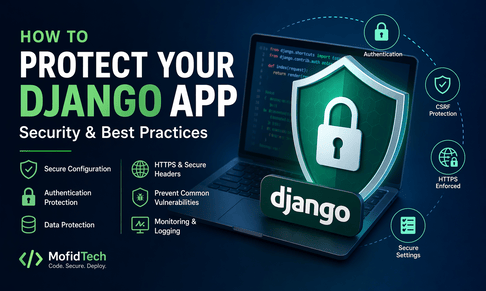
Security is not an optional feature in modern web applications—it is a fundamental requirement. When you build a Django application, you inherit a framework that already implements many security mechanisms out of the box. However, relying only on defaults is not enough. Real-world applications face threats such as injection attacks, session hijacking, data leaks, and misconfigurations that can expose sensitive information. This guide will take you deep into 20 essential security practices that every Django developer must implement to build robust, production-ready applications.
🧩 Part 1: Keep Django and Dependencies Updated
One of the simplest yet most critical practices is keeping your Django version and dependencies updated. Security vulnerabilities are constantly discovered and patched. Running an outdated version exposes your application to known exploits. Django releases security patches regularly, and ignoring them is equivalent to leaving your door unlocked.
pip install --upgrade django
pip list --outdated
You should also use tools like pip-audit:
pip install pip-audit
pip-audit
Regular updates ensure that vulnerabilities like SQL injection bypasses or authentication flaws are patched before attackers exploit them.
🧩 Part 2: Use Environment Variables for Secrets
Never hardcode sensitive data like SECRET_KEY, database passwords, or API keys in your source code. Instead, use environment variables to keep secrets out of version control.
import os

SECRET_KEY = os.environ.get("DJANGO_SECRET_KEY")
DEBUG = os.environ.get("DEBUG") == "True"
For production, you can use .env files with python-decouple:
pip install python-decouplefrom decouple import config
SECRET_KEY = config("SECRET_KEY")This prevents accidental leaks when pushing code to GitHub.
🧩 Part 3: Disable DEBUG in Production
Running your app with DEBUG = True in production is a critical mistake. It exposes stack traces, environment variables, and internal logic to attackers.
DEBUG = False
ALLOWED_HOSTS = ["yourdomain.com"]
When DEBUG is enabled, Django displays detailed error pages, which attackers can use to understand your system and find vulnerabilities.
🧩 Part 4: Configure Allowed Hosts Properly
The ALLOWED_HOSTS setting protects against Host header attacks. Always define it explicitly.
ALLOWED_HOSTS = ["mofidtech.com", "www.mofidtech.com"]Without this, attackers can manipulate request headers to perform cache poisoning or redirect attacks.
🧩 Part 5: Use HTTPS Everywhere
Encrypting traffic using HTTPS prevents man-in-the-middle attacks. You should enforce HTTPS in Django:
SECURE_SSL_REDIRECT = True
SESSION_COOKIE_SECURE = True
CSRF_COOKIE_SECURE = True
If you are using Nginx and Docker (like your setup), ensure certificates from Let’s Encrypt are correctly configured.
🧩 Part 6: Protect Against CSRF Attacks
Django includes built-in protection against CSRF, but you must use it correctly.
<form method="post">
    {% csrf_token %}
    <input type="text" name="username">
</form>
Without CSRF tokens, attackers could trick users into performing unwanted actions.
🧩 Part 7: Use Django Authentication System
Avoid building your own authentication system. Django provides a secure one.
from django.contrib.auth.models import User
from django.contrib.auth import authenticate

user = authenticate(username="admin", password="1234")
It includes password hashing, permissions, and protection against common attacks.
🧩 Part 8: Strong Password Hashing
Django uses secure hashing algorithms by default (PBKDF2). You can strengthen it:
PASSWORD_HASHERS = [
    "django.contrib.auth.hashers.Argon2PasswordHasher",
]
Install Argon2:
pip install argon2-cffiStronger hashing makes brute-force attacks much harder.
🧩 Part 9: Prevent SQL Injection
Django ORM automatically protects against SQL injection, but avoid raw queries.
❌ Dangerous:
User.objects.raw(f"SELECT * FROM users WHERE name = '{username}'")✅ Safe:
User.objects.filter(username=username)Always rely on ORM unless absolutely necessary.
🧩 Part 10: Escape User Input (XSS Protection)
Django templates escape HTML by default.
{{ user_input }}Avoid using safe unless necessary:
{{ user_input|safe }}Using safe blindly can expose your app to cross-site scripting attacks.
🧩 Part 11: Secure Cookies
Cookies store sensitive session data. Configure them securely:
SESSION_COOKIE_HTTPONLY = True
SESSION_COOKIE_SECURE = True
This prevents JavaScript access and ensures cookies are sent only over HTTPS.
🧩 Part 12: Use Content Security Policy (CSP)
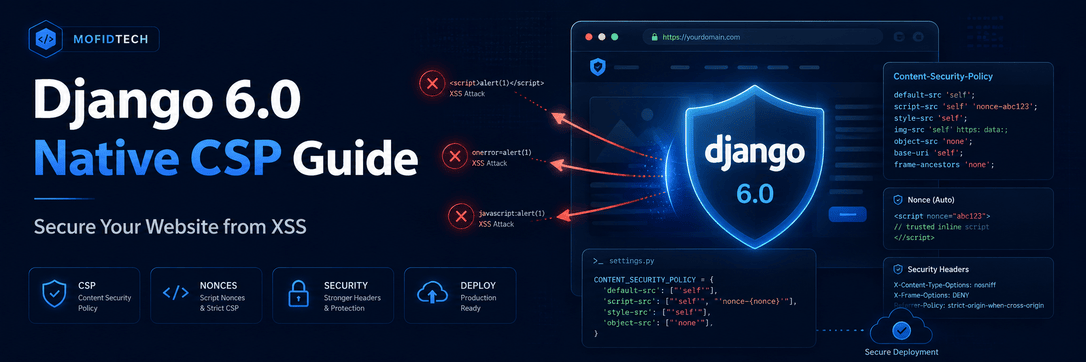
CSP helps prevent XSS by restricting resource loading.
Install:
pip install django-cspCSP_DEFAULT_SRC = ("'self'",)
CSP_SCRIPT_SRC = ("'self'",)
This ensures scripts can only run from trusted sources.
🧩 Part 13: Limit Login Attempts
Prevent brute-force attacks by limiting login attempts.
pip install django-axesINSTALLED_APPS += ["axes"]Want to go further with Django Axes? Read this article : How to Use django-axes in Django: Complete Guide to Login Protection and Brute-Force Defense
This blocks repeated failed login attempts automatically.
🧩 Part 14: Use Secure Headers
Django provides security headers:
SECURE_BROWSER_XSS_FILTER = True
X_FRAME_OPTIONS = "DENY"
SECURE_CONTENT_TYPE_NOSNIFF = True
These headers protect against clickjacking and MIME attacks.
🧩 Part 15: Validate and Sanitize Input
Always validate user input using Django forms:
from django import forms

class ContactForm(forms.Form):
    email = forms.EmailField()
Validation prevents malformed or malicious data from entering your system.
🧩 Part 16: Use Permissions and Groups
Control access using Django’s permission system.
from django.contrib.auth.decorators import permission_required

@permission_required("app.view_data")
def secure_view(request):
    pass
This ensures only authorized users can access sensitive resources.
🧩 Part 17: Protect File Uploads
Validate uploaded files carefully:
def validate_file(file):
    if file.size > 2 * 1024 * 1024:
        raise ValidationError("File too large")
Never trust file extensions—check MIME types and store files securely.
🧩 Part 18: Logging and Monitoring
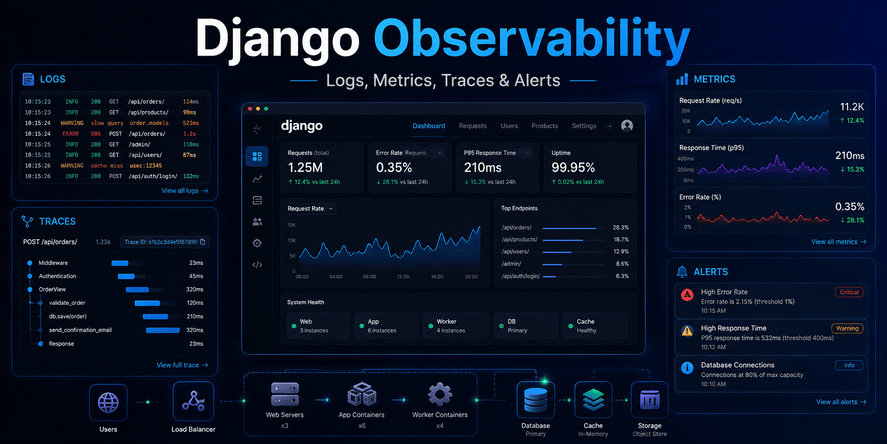
Enable logging to detect suspicious activity.
LOGGING = {
    "version": 1,
    "handlers": {
        "file": {
            "class": "logging.FileHandler",
            "filename": "security.log",
        },
    },
    "root": {
        "handlers": ["file"],
        "level": "WARNING",
    },
}
Logs help you detect attacks early.
🧩 Part 19: Use Rate Limiting
Limit API requests to prevent abuse.
pip install django-ratelimitfrom ratelimit.decorators import ratelimit
@ratelimit(key="ip", rate="5/m")
def my_view(request):
pass
This protects against bots and DDoS attempts.
🧩 Part 20: Regular Security Audits
Finally, security is an ongoing process. Use automated tools:
pip install bandit
bandit -r .
Also perform manual reviews and penetration testing regularly.
🏁 Conclusion
Securing a Django application is not about applying one or two fixes—it is about building a layered defense strategy. From environment configuration and authentication to headers, rate limiting, and monitoring, each layer adds protection against different types of attacks. By following these 20 best practices, you transform your Django application from a basic project into a production-grade secure platform.




💬 Comments
No comments yet. Be the first to comment!
Login to comment.