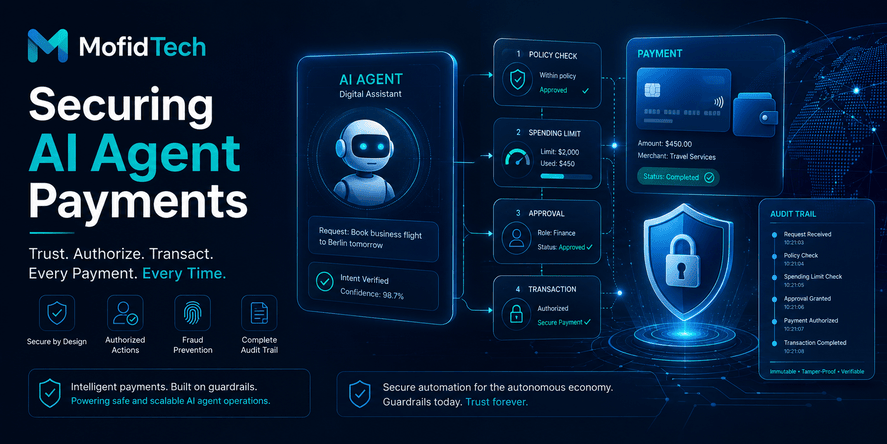
How to Secure AI Agent Payments: Identity, Spending Limits, Authorization, Fraud Controls, and Auditability
AI agents are moving from recommendation to action. A conventional assistant can compare products, summarize options, or suggest a supplier. An agentic system can go further: it can select an option, initiate a checkout, use a delegated payment method, approve a recurring purchase within a policy, or trigger a machine-to-machine payment without a person clicking a final button every time.
That change is not merely a user-interface improvement. It changes the security model of digital commerce. Most online payment systems were designed around an assumption that a human is present at the moment of purchase or has previously created a tightly defined recurring-payment arrangement. An autonomous agent breaks that assumption because software may make decisions over time, combine information from multiple sources, call external tools, and act while the user is absent.
The security objective is therefore not to make an AI agent “trusted” in a vague sense. The objective is to make every financially meaningful action provably constrained. A safe design should be able to answer five questions before money moves: Which agent is acting? On whose behalf? What exactly is it allowed to buy? Under what limits and conditions? What evidence will remain if the transaction is disputed later?
This guide presents a practical architecture for answering those questions. It focuses on identity, delegated authority, spending controls, transaction-bound credentials, fraud detection, human approval, observability, auditability, incident response, privacy, and operational governance. It does not depend on one vendor or protocol, because the principles must survive even as the agentic-commerce ecosystem changes.
The core principle Do not give an AI agent a general-purpose payment credential and hope that prompt instructions will constrain its behavior. Put enforceable financial policy outside the model, at the identity, authorization, payment, and risk-control layers. |
Table of Contents
- 1. What are AI agent payments?
- 2. Why traditional payment security is not enough
- 3. The seven-control security model
- 4. Agent identity and principal identity
- 5. Delegated authorization and intent
- 6. Spending limits and policy guardrails
- 7. Transaction-bound payment credentials
- 8. Fraud detection and risk scoring
- 9. Human approval and step-up controls
- 10. Auditability, evidence, and accountability
- 11. Secure reference architecture
- 12. Real-world use cases
- 13. Protocols and industry approaches
- 14. Privacy and data minimization
- 15. Reliability and performance
- 16. Common mistakes
- 17. Troubleshooting agentic payment failures
- 18. Implementation checklist
- 19. Governance and operating model
- 20. FAQ
- 21. Conclusion
1. What Are AI Agent Payments?
AI agent payments are financial transactions in which an AI-enabled software agent participates in the decision or execution process on behalf of a person, business, or another authorized principal. The agent may only prepare a purchase for confirmation, or it may have limited authority to complete transactions autonomously within predefined rules.
The important distinction is not whether artificial intelligence appears somewhere in the workflow. Many payment systems already use machine learning for fraud detection. Agentic payments are different because the AI system acts as a delegated economic actor. It can decide, initiate, negotiate, select, or pay within a task-oriented workflow.
1.1 A spectrum of autonomy
| Mode | What the agent does | Typical security posture |
|---|---|---|
| Advisory | Finds and compares options but cannot initiate payment. | Conventional account security; no direct payment authority. |
| Assisted checkout | Builds a cart or payment request, but a human confirms the final transaction. | Strong session binding, explicit confirmation, transaction integrity. |
| Delegated purchase | Completes transactions within defined merchant, category, amount, and time limits. | Delegated credentials, policy enforcement, risk scoring, full audit. |
| Autonomous recurring action | Reorders, renews, or pays when a policy condition is met. | Budget envelopes, rate limits, anomaly detection, periodic reauthorization. |
| Machine-to-machine payment | Software services pay each other for data, compute, or APIs. | Service identity, cryptographic authorization, metering, settlement controls. |
Security should become stricter as autonomy increases. A system that merely recommends a hotel does not need the same controls as an agent that can purchase travel, modify a booking, and pay additional fees while the traveler is asleep.
2. Why Traditional Payment Security Is Not Enough
Traditional online checkout usually has a visible interaction surface: a user reviews a price, chooses a payment method, authenticates when required, and submits the order. Even where stored credentials or recurring payments exist, the allowed relationship is usually narrowly defined by a merchant agreement, a subscription, or a tokenized wallet flow.
An AI agent introduces a new intermediary between intent and transaction. That intermediary is probabilistic, can process untrusted content, may call many tools, and may interpret vague instructions. A prompt such as “keep our cloud costs under control” is not a payment authorization. A model response such as “this looks like the best supplier” is not evidence that the user authorized a charge. Security has to translate human intent into enforceable machine policy.
2.1 New failure modes
- Prompt injection or malicious content influences the agent into choosing an attacker-controlled merchant or payment destination.
- The agent misunderstands quantity, currency, delivery terms, subscription duration, cancellation policy, or taxes.
- A compromised tool or connector modifies the price or beneficiary after the agent has evaluated the purchase.
- A stolen agent credential is replayed outside its intended task or timeframe.
- The agent accumulates many individually small transactions that exceed the user’s intended budget.
- A legitimate merchant request is altered in transit so that the payment no longer matches the user-approved intent.
- The agent acts correctly, but the organization cannot later explain why the transaction was allowed or which policy evaluated it.
- Risk systems calibrated for human browsing misclassify agent behavior because agents can operate faster, continuously, and across different interaction patterns.
Security boundary Natural-language instructions belong to the decision layer. Financial constraints belong to deterministic enforcement layers. The payment system must never rely on the model to remember its own spending rules. |
3. The Seven-Control Model for Secure Agentic Payments
A practical security architecture can be organized around seven controls. Each control addresses a different failure mode, and no single control replaces the others.
| Control | Question it answers | Primary outcome |
|---|---|---|
| 1. Agent identity | Which software agent is making this request? | Prevents anonymous or spoofed agent activity. |
| 2. Principal and delegation | Who authorized this agent, and for what purpose? | Connects actions to a human or organization. |
| 3. Policy and spending limits | What is the maximum authority this agent has right now? | Caps financial exposure. |
| 4. Transaction binding | Is the credential usable only for the intended merchant, amount, and context? | Reduces replay and credential misuse. |
| 5. Fraud and anomaly controls | Does this request look legitimate even though it is authorized? | Detects abuse, compromise, and abnormal behavior. |
| 6. Step-up approval | When must a human or stronger control intervene? | Adds friction only when risk justifies it. |
| 7. Audit and accountability | Can the organization reconstruct what happened later? | Supports disputes, compliance, forensics, and learning. |
The model is deliberately layered. Authorization says that an action is permitted; fraud detection asks whether the request is suspicious anyway. Spending limits constrain exposure; transaction binding narrows how a credential can be used. Auditability does not stop a bad transaction, but it determines whether the organization can understand, contain, and resolve one.
4. Agent Identity and Principal Identity
A payment system needs to identify both the agent and the principal behind the agent. These are related but different identities. The agent is the software actor. The principal is the person, business, department, service account, or other entity whose authority the agent exercises.
4.1 Why agent identity matters
If every AI action appears to the payment gateway as a generic backend service, the organization loses the ability to distinguish one agent from another. That makes least privilege, incident containment, revocation, risk scoring, and accountability much harder. Each payment-capable agent should therefore have a distinct, verifiable identity with its own lifecycle.
- Unique agent identifier and owner.
- Cryptographic or platform-backed authentication appropriate to the environment.
- Explicit list of capabilities the agent may request.
- Environment binding so production authority cannot be reused in test or development contexts.
- Credential expiration and rotation.
- Immediate revocation path.
- Attestation or provenance signals where supported by the ecosystem.
- Clear mapping to the user, organization, workload, or business process represented by the agent.
4.2 Principal identity must not disappear
An agent should not become an accountability sink. A secure payment request should preserve who delegated authority, which account or business unit owns the budget, and whether the delegation is still valid. For consumer use, that may be the authenticated customer. For enterprise use, it may be a department, procurement account, cost center, or workload identity.
The result is a chain of authority: principal → agent → task → transaction. Breaking any link in that chain should prevent or escalate the payment.
5. Delegated Authorization: Turning Intent into Enforceable Permission
Delegated authorization is the heart of safe agentic payments. It converts a broad human request into a bounded permission that can be evaluated without asking the language model to police itself.
Good delegation answers five questions: what the agent can buy, from whom, for how much, during what period, and under which conditions. The result should be machine-enforceable and revocable.
5.1 Separate task intent from payment authority
The agent may reason about goals such as “rebook my flight if the delay exceeds three hours” or “buy replacement parts when stock falls below the threshold.” The payment layer should see a narrower authorization: approved merchant categories, maximum total cost, approved currencies, permitted time window, delivery constraints, and whether subscriptions or recurring commitments are allowed.
5.2 Authorization should be contextual
- Purpose: travel, office supplies, compute capacity, spare parts, data access, or another defined use case.
- Merchant scope: a specific merchant, approved merchant list, marketplace, or category.
- Amount: per-transaction maximum, cumulative budget, and possibly a minimum threshold for human review.
- Time: one transaction, a task window, a day, a billing period, or a project duration.
- Geography and currency: where the merchant may be located and which currencies are acceptable.
- Product constraints: allowed categories, excluded items, subscription restrictions, or quantity limits.
- Delivery constraints: approved addresses, virtual-service destinations, or business facilities.
- Risk conditions: stronger approval for new merchants, unusual prices, cross-border payments, or policy exceptions.
Authorization design rule Grant an agent the smallest useful authority that still lets it complete its task. A delegation that is too broad turns a software error into a financial incident; a delegation that is too narrow creates endless approval prompts and encourages users to disable safeguards. |
6. Spending Limits and Financial Guardrails
Spending limits are the most direct way to cap the impact of a malfunctioning or compromised agent. They should be enforced by the payment or authorization infrastructure, not stored only in a prompt, conversation history, or application configuration that the agent can influence.
6.1 Use multiple limits, not one global ceiling
| Limit type | Example purpose | Risk addressed |
|---|---|---|
| Per transaction | No single purchase above an approved threshold. | Large one-off loss or misinterpretation. |
| Cumulative period | Daily, weekly, monthly, or project budget. | Many small purchases that exceed intent. |
| Merchant limit | Maximum spend at one merchant or marketplace. | Concentration of loss and compromised seller. |
| Category limit | Separate envelopes for travel, compute, supplies, or advertising. | Cross-purpose misuse. |
| Velocity limit | Maximum number of purchases or payment attempts per period. | Automation loops and rapid abuse. |
| Recurring commitment limit | Cap subscription value or duration. | Long-lived obligations hidden by small initial charges. |
| Exception threshold | Amount or risk score that triggers human approval. | High-impact or unusual decisions. |
A useful pattern is to treat financial authority as a budget envelope. The agent can operate freely inside the envelope, but the envelope has hard boundaries. When a transaction would cross one of those boundaries, the system either declines it or requests additional approval.
6.2 Limits should be stateful
Per-transaction limits alone are insufficient. An agent that cannot spend more than $100 at once could still make fifty $99 purchases. The policy system therefore needs state: prior authorizations, pending transactions, completed settlements, refunds, reserved funds, and commitments that have not yet been charged.
Stateful budgeting is especially important for travel, cloud services, procurement, and subscriptions because the final cost may emerge across several related transactions rather than one checkout.
7. Transaction-Bound Credentials: Make Stolen Authority Less Useful
A reusable payment credential is dangerous when placed behind an autonomous system. A safer approach is to use delegated or tokenized payment credentials that are limited to a specific transaction context. The goal is simple: even if the credential is intercepted, it should be difficult or impossible to reuse for a different merchant, amount, purpose, or time window.
7.1 What should be bound to the transaction?
- The intended merchant or merchant identity.
- The exact amount or a narrowly defined maximum amount.
- The currency.
- The order or cart identifier.
- The authorized agent identity.
- The principal or funding source.
- The expiration time.
- The permitted payment rail or account.
- The purpose or task identifier when the system supports it.
Modern agentic-payment initiatives increasingly reflect this principle. Stripe describes shared payment tokens that can be scoped to a transaction, while Google’s AP2 approach emphasizes verifiable evidence of authorization and intent. The architectural lesson is broader than any one implementation: minimize the value of credential theft by narrowing what a credential can accomplish.
7.2 Protect against time-of-check/time-of-use changes
A critical agentic-commerce risk occurs when the agent evaluates one transaction but the payment system executes another. Prices can change, carts can be modified, merchant routing can change, and external tools can be compromised. The system should therefore compare the final payment request with the authorized transaction context immediately before execution.
If the amount, beneficiary, product set, delivery destination, or contractual commitment has materially changed, the original approval should no longer be treated as valid. The correct response is re-evaluation or step-up confirmation, not silent continuation.
8. Fraud Detection for Agent-Initiated Payments
Authorization does not prove legitimacy. A compromised but correctly authenticated agent can still make fraudulent requests. Fraud controls must therefore evaluate agentic transactions independently of the authorization decision.
8.1 Agent behavior creates new risk signals
- Agent identity, software version, environment, and trust status.
- Principal identity and account history.
- How recently the delegation was created or modified.
- Whether the merchant is new to this user, organization, or agent.
- Difference between expected and actual price.
- Purchase velocity and repeated retries.
- Unusual time of day or geography relative to the principal and merchant.
- Changes in tool chain, network path, device or workload context.
- Whether the purchase follows a suspicious prompt, external content, or unexpected redirection.
- Whether multiple agents are coordinating around the same funding source.
- Whether the transaction resembles known account-takeover or merchant-fraud patterns.
The key is to avoid assuming that machine speed is automatically malicious or automatically trusted. Agents may legitimately transact continuously, so risk models need an agent-aware baseline. The right comparison may be this agent’s normal behavior for this principal and task, not the browsing pattern of a human shopper.
8.2 Risk controls should be able to stop the payment
A fraud model that only produces a dashboard score after settlement is insufficient. High-risk signals should feed an enforcement path: deny, delay, reduce the permitted amount, require stronger authentication, require explicit human confirmation, or route the transaction for review.
9. Human Approval and Step-Up Controls
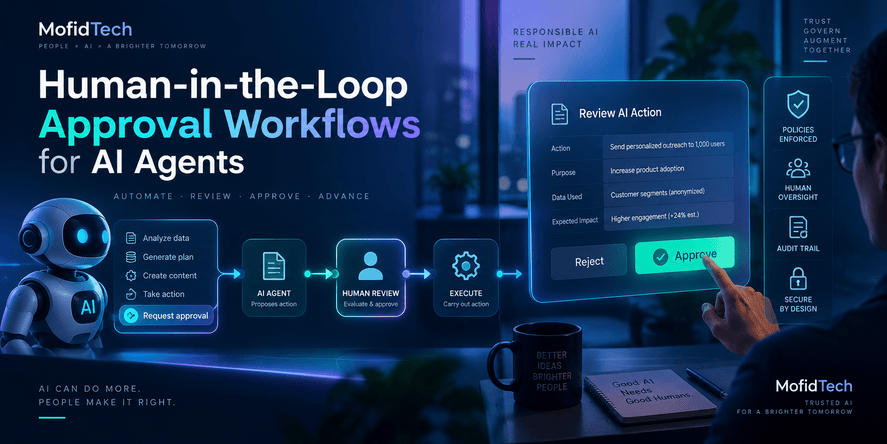
Human approval remains valuable, but requiring it for every transaction defeats much of the purpose of agentic commerce. The better design is risk-based step-up: routine, low-risk transactions proceed automatically, while unusual or consequential transactions require additional confirmation.
9.1 When should a human be brought back into the loop?
- First purchase from a new merchant or beneficiary.
- Price materially exceeds the estimate the user approved.
- Transaction exceeds a soft threshold even if it remains below the hard maximum.
- Purchase creates a subscription, financing obligation, cancellation penalty, or long-term commitment.
- Cross-border or unusual-currency payment.
- Change in delivery address or beneficiary.
- High-risk merchant category or restricted product.
- Multiple failed payment attempts.
- Fraud score or anomaly score exceeds a threshold.
- Policy conflict or ambiguity in the user’s instructions.
- The agent cannot explain the material reason for selecting the transaction.
- Risk controls detect suspicious external instructions or prompt injection.
Step-up approval should show the user the exact decision that needs approval, not a vague “Allow agent?” prompt. At minimum, the user should see merchant, amount, currency, important product or service details, recurring commitment if any, and the reason the system is asking for confirmation.
10. Auditability, Evidence, and Accountability
Agentic payments create an evidence problem. When a human clicks a checkout button, the interaction itself often becomes part of the record. When software acts autonomously, the organization must deliberately preserve evidence that explains why the action was considered authorized and safe.
10.1 What should an audit record capture?
| Evidence | Why it matters |
|---|---|
| Principal identity and authentication context | Shows who delegated authority. |
| Agent identity and version | Shows which software actor executed the task. |
| Delegation or mandate identifier | Connects the payment to an approved scope. |
| Task or intent summary | Explains the business purpose without relying only on raw conversation text. |
| Policy version and decision | Shows which controls allowed, denied, or escalated the request. |
| Merchant and transaction details | Captures beneficiary, amount, currency, items, and commitments. |
| Risk signals and outcome | Explains fraud or anomaly evaluation. |
| Human approval evidence when applicable | Shows who approved the exception and what they saw. |
| Credential/token reference | Supports traceability without storing sensitive credential material. |
| Payment authorization and settlement result | Completes the financial timeline. |
| Refund, dispute, or reversal events | Preserves the post-payment lifecycle. |
The record should be tamper-evident, access-controlled, retained according to business and legal requirements, and designed to minimize exposure of sensitive payment and personal data. A useful audit trail is not a raw dump of every prompt. It is a structured evidence package that can reconstruct the authorization chain.
10.2 Accountability must be assigned before launch
Organizations should decide in advance who owns the outcome when an agent makes a mistake. Product teams own user experience; security teams own control design; payment teams own processing and dispute workflows; business owners define acceptable budgets and merchant scope; compliance teams determine regulatory obligations. If these responsibilities are unclear before production, they will be much harder to resolve during an incident.
11. A Secure Reference Architecture for Agentic Payments
A robust design separates reasoning from enforcement. The language model or planning agent can propose an action, but the action passes through independent components that authenticate, authorize, score risk, issue constrained payment authority, and record evidence.
11.1 Recommended logical layers
- User or business principal: defines the goal and delegates authority.
- Agent runtime: reasons about the task and proposes a purchase or payment action.
- Tool and commerce gateway: validates that the requested commerce operation is structurally valid and permitted for this agent.
- Identity layer: verifies the agent and principal identities and checks revocation status.
- Policy engine: evaluates merchant, product, amount, velocity, time, geography, and business rules.
- Risk engine: evaluates fraud, anomalies, reputation, and contextual signals independently of policy.
- Approval service: requests human confirmation when step-up rules are triggered.
- Payment credential service: issues or selects a constrained payment credential rather than exposing a reusable secret.
- Payment processor or financial rail: executes authorization and settlement.
- Audit and observability layer: records decisions, correlations, failures, approvals, and transaction lifecycle events.
Architecture test If the agent runtime is fully compromised, can it exceed the delegated spending budget, pay a different merchant, or hide the transaction from the audit system? If the answer is yes, too much financial control lives inside the agent. |
11.2 Fail closed on ambiguity in financial authority
The system should distinguish between an agent being unable to complete a task and an agent being permitted to take financial risk. If identity cannot be verified, delegation cannot be resolved, policy data is stale, or the final transaction no longer matches the approved context, the payment path should stop or escalate. Availability should not override financial authorization.
11.3 Threat-model the entire transaction chain
A useful threat model should follow the payment from the original human intent to the final financial outcome. Focusing only on the language model misses most of the places where an attacker can alter authority or transaction data. The relevant attack surface includes the user account, agent runtime, retrieval sources, browser or commerce tools, merchant APIs, identity services, policy engine, risk service, token service, payment processor, webhook or event channel, and the audit pipeline.
For each boundary, ask what an attacker could impersonate, modify, replay, suppress, or observe. Then ask whether the next layer independently verifies the information it receives. This prevents a weak upstream component from becoming a source of unquestioned truth for the payment system.
| Threat | Example agentic-payment scenario | Primary controls |
|---|---|---|
| Prompt or content injection | A product page tells the agent to ignore the user’s budget and pay a different seller. | Treat external content as untrusted; deterministic policy; merchant verification; transaction binding. |
| Agent impersonation | An attacker submits payment requests using a stolen or fabricated agent identity. | Strong agent authentication; short-lived credentials; attestation or trust signals; revocation. |
| Delegation theft | A valid mandate is copied and reused for another task. | Bind delegation to agent, principal, purpose, time, and transaction context; prevent replay. |
| Merchant substitution | The beneficiary changes between product selection and payment. | Verified merchant identity; final beneficiary comparison; signed or tamper-evident transaction context. |
| Price or cart manipulation | The final amount or items differ from what the policy approved. | Recalculate policy immediately before payment; amount/cart binding; step-up on material changes. |
| Tool compromise | A commerce connector modifies requests or returns fabricated confirmation. | Tool isolation; least privilege; response validation; independent payment-state verification. |
| Budget bypass | The agent splits a large purchase into many smaller charges. | Cumulative, velocity, merchant, and category budgets with pending-transaction accounting. |
| Replay and retry abuse | The same authorization is submitted multiple times after a timeout. | Nonce or one-time semantics; idempotent transaction identifiers; replay detection. |
| Audit suppression | A compromised component executes payment but omits or alters the evidence. | Independent event capture; append-only or tamper-evident logs; reconciliation with processor records. |
| Post-payment deception | The agent claims a refund or cancellation occurred when it did not. | Authoritative settlement, refund, and dispute state from payment and merchant systems. |
The most important exercise is to imagine the agent as compromised. Security architecture should assume that the model can be manipulated or that one of its tools can return malicious information. The external enforcement layers should still prevent the compromised agent from creating unlimited financial loss.
12. Real-World Use Cases and Their Security Profiles
12.1 Consumer travel agent
A travel agent may search flights, hotels, and ground transport, then rebook when disruptions occur. The security challenge is that travel involves changing prices, multiple merchants, cancellation rules, and time pressure. A good delegation might permit the agent to spend up to a trip budget, but require approval when changing destination, booking a non-refundable fare, or exceeding an allowed price difference.
12.2 Enterprise procurement agent
A procurement agent can reorder approved supplies or select from preferred vendors. Here, identity and business policy are central. The agent should be tied to a department or cost center, restricted to approved categories and vendors, and prevented from bypassing procurement thresholds merely by splitting an order into smaller purchases.
12.3 Cloud and infrastructure agent
An infrastructure agent may purchase compute capacity, external APIs, data, or software licenses. Machine-speed purchasing can be useful during incidents or workload spikes, but costs can accelerate quickly. Cumulative budgets, service-specific limits, anomaly detection, and short authorization windows are essential. The agent should not be able to convert a temporary scaling decision into an open-ended subscription without explicit authority.
12.4 Inventory and industrial automation
An industrial or IoT system may reorder consumables or spare parts when stock or sensor conditions cross a threshold. The security model should include supplier allowlists, quantity limits, price variance checks, delivery-location controls, and protection against manipulated sensor data. A compromised sensor should not be able to trigger unlimited purchases.
12.5 Machine-to-machine data or service payments
Agents may pay for datasets, model inference, specialized APIs, compute jobs, or other digital services. These flows can be high-frequency and low-value, which makes manual approval impractical. Strong workload identity, metering, cumulative spend controls, and automatic dispute or service-quality rules become more important than a conventional checkout experience.
13. Agentic Payment Protocols and Industry Approaches
The industry is converging on a common idea: agentic commerce requires explicit evidence of identity, authority, intent, and constraints. Implementations differ, but several major initiatives illustrate the direction of travel.
| Initiative | Security idea relevant to developers | Practical takeaway |
|---|---|---|
| Visa Trusted Agent Protocol / Intelligent Commerce | Recognizing trusted agents and connecting agent identity with secure commerce controls. | Merchants need a way to distinguish legitimate agents from automation abuse and malicious bots. |
| Google Agent Payments Protocol (AP2) | Authorization, authenticity, accountability, and verifiable digital credentials. | A payment should carry evidence that the agent had authority and that the transaction reflects that authority. |
| Stripe / OpenAI Agentic Commerce Protocol | Merchant-controlled checkout flows and scoped payment tokens for agentic transactions. | Keep merchants in control and minimize credential exposure by scoping payment authority. |
| Mastercard Agent Pay for Machines | Credentialing, permissioning, spending limits, machine transaction support, and settlement. | Machine payments need explicit identity and enforceable permission boundaries. |
| UPI agentic-payment work in India | Rule-based payments, spending limits, identity checks, and liability considerations reported in 2026. | Large payment ecosystems are beginning to treat agent authority and liability as first-class design concerns. |
Developers should resist the temptation to choose a protocol first and design security second. Start with the control model: identity, delegation, limits, transaction binding, risk, approval, and audit. Then select protocols and payment providers that can express and enforce those controls.
14. Privacy and Data Minimization
Agentic commerce can expose more context than conventional checkout because the agent may know the user’s preferences, schedule, location, purchase history, business goals, and conversation history. That context is useful for decision-making, but most of it does not need to be sent to the merchant or payment processor.
14.1 Share only what each participant needs
- Merchants need information required to price, fulfill, support, and legally process the order—not the user’s entire conversation.
- Payment providers need the data required to authorize, process, and protect the transaction—not unrelated task context.
- Risk systems should use well-defined signals rather than indiscriminate copies of private prompts and documents.
- Audit systems should store structured summaries and decision evidence where possible, with sensitive raw context protected or excluded.
- Agents should not receive full payment credentials if a scoped token or delegated payment mechanism can perform the same task.
Data minimization improves more than privacy. It reduces breach impact, limits lateral movement, makes compliance easier, and reduces the number of systems that become part of the sensitive payment-data environment.
15. Reliability and Performance Considerations
Security controls add network calls, policy evaluations, risk scoring, and sometimes human interaction. Poorly designed controls can make agentic commerce unreliable. The solution is not to remove security; it is to engineer the control plane for predictable behavior.
15.1 Design for idempotency and retries
Agents are naturally persistent. If a payment request times out, an agent may try again. Without transaction identifiers and idempotent processing, a network failure can become duplicate charges. The payment workflow should distinguish a retry of the same intended transaction from a new purchase attempt.
15.2 Separate authorization from settlement state
An agent should understand whether a payment is proposed, approved, authorized, captured, settled, refunded, or disputed. Treating every successful API response as “paid” creates reconciliation errors and may cause duplicate fulfillment or additional payment attempts.
15.3 Cache carefully
Identity metadata and policy data can be cached for performance, but revocation and budget state are security-sensitive. A long cache lifetime may allow a revoked delegation or exhausted budget to remain usable. Systems should define which decisions can tolerate stale data and which require authoritative checks.
15.4 Degrade safely
If the fraud service, policy engine, or identity provider is unavailable, the system should have a documented fallback based on transaction risk. Low-risk transactions may be delayed; high-value or high-risk autonomous payments should not silently bypass unavailable controls. Financial safety should take priority over task completion.
15.5 Model the payment as a state machine, not a single action
An autonomous purchase is rarely one atomic event. The agent may discover an offer, reserve inventory, request a quote, obtain policy approval, receive a payment credential, authorize a payment, wait for capture, observe fulfillment, and later request a refund. Each stage has different security meaning. Treating them all as one generic “payment” status makes both automation and incident response fragile.
A mature system defines allowed state transitions and the authority required for each one. An agent that may authorize a $50 purchase does not automatically have authority to increase the order to $80, convert it into a subscription, change the beneficiary, or accept a cancellation penalty. Material changes should create a new authorization decision rather than silently inheriting the old one.
This state-machine view also improves reconciliation. The application can identify whether failure occurred before authorization, after authorization but before capture, after capture but before fulfillment, or during refund. That distinction matters because the safe recovery action is different at each stage.
15.6 Test the controls adversarially before production
Agentic payment testing should go beyond conventional functional checkout tests. The system needs adversarial scenarios that intentionally try to make the agent exceed its authority or misinterpret transaction state. Security teams should test the enforcement path independently from the model so a persuasive model response cannot hide a control failure.
- Inject malicious instructions into product descriptions, emails, web pages, documents, and tool responses to test whether financial policy remains intact.
- Change merchant identity, beneficiary, price, tax, shipping cost, currency, or cart contents after the agent makes its selection.
- Replay the same delegated credential and the same payment request from another agent, environment, or time window.
- Split purchases across many transactions to test cumulative and velocity limits.
- Create simultaneous requests that race against the same remaining budget.
- Revoke the agent or delegation while a transaction is in progress and verify which stages are blocked.
- Take the policy engine, fraud service, audit service, identity provider, or merchant API partially offline and verify safe degradation.
- Force timeouts and retries to confirm idempotency and duplicate-payment protection.
- Test refund, reversal, chargeback, and failed-fulfillment flows rather than stopping at successful authorization.
- Attempt to make the agent hide, summarize incorrectly, or reinterpret a declined transaction; authoritative financial state should remain external to the model.
Production readiness should be based on observable enforcement outcomes, not on the agent’s verbal behavior. An agent can say it respected a budget while the underlying system still permits overspending. The payment control plane is the source of truth.
16. Common Mistakes When Securing AI Agent Payments
Putting the card or account credential directly in the agent environment. A compromised agent, tool, plugin, log, or prompt could expose a reusable financial credential. Prefer tokenized, delegated, or transaction-bound authority.
Treating the prompt as the spending policy. Prompts are instructions to a probabilistic model, not a deterministic authorization system. Enforce financial rules outside the model.
Using only a per-transaction limit. Attackers and runaway automation can split spend into many smaller transactions. Add cumulative and velocity limits.
Approving “the agent” rather than a specific scope. An approval such as “allow shopping” is too broad. Bind permission to purpose, merchant scope, amount, time, and commitment type.
Ignoring changes after approval. The cart, merchant, price, address, or subscription terms may change. Revalidate the final transaction before execution.
Assuming authenticated means safe. A valid agent credential can be stolen or misused. Apply independent fraud and anomaly checks.
Logging everything indiscriminately. Raw prompts and payment details can create a privacy and security liability. Store structured evidence and protect sensitive context.
No revocation path. Users and administrators must be able to stop an agent immediately, including active delegations and outstanding payment authority.
No incident ownership. When an agent buys the wrong thing, teams should already know who can freeze the agent, reverse transactions, preserve evidence, and communicate with the user.
Testing only happy paths. Security testing should include manipulated prices, prompt injection, compromised tools, duplicate retries, stale policies, partial outages, refunds, and dispute scenarios.
17. Troubleshooting Agentic Payment Failures
Agentic payment failures can come from the AI layer, authorization policy, risk controls, merchant integration, payment processor, or settlement rail. Troubleshooting should therefore follow the transaction correlation identifier across layers rather than focusing only on the model output.
| Symptom | Likely causes | What to examine |
|---|---|---|
| Agent says payment succeeded, but merchant has no order | Agent interpreted an intermediate response as final; checkout or capture failed. | Order state, payment state, processor response, idempotency record. |
| Repeated authorization failures | Expired delegation, budget exhausted, merchant outside scope, stale identity, or changed transaction. | Delegation status, policy decision details, merchant identity, current amount. |
| Duplicate charges | Agent retried after timeout without idempotent correlation. | Transaction IDs, retry history, capture records, fulfillment events. |
| Legitimate purchases constantly require approval | Risk thresholds too sensitive or policy too narrow for normal behavior. | Baseline agent behavior, soft limits, merchant familiarity, approval reasons. |
| Unexpected merchant or beneficiary | Prompt injection, tool compromise, redirect, catalog poisoning, or merchant substitution. | Original intent, tool chain, merchant verification, final transaction binding. |
| Spend exceeds intended budget despite per-purchase compliance | Missing cumulative budget or pending-authorizations accounting. | Period totals, reserved funds, pending transactions, split orders. |
| Cannot explain why a transaction was allowed | Insufficient structured logging or policy versioning. | Decision evidence, policy version, agent/principal mapping, approval record. |
| Revoked agent still attempts purchases | Credential cache or downstream token remains valid. | Revocation propagation, token expiration, cache lifetime, session termination. |
18. Implementation Checklist Before Enabling Autonomous Payments
Use this checklist as a production-readiness review. A system does not need maximum sophistication on day one, but every item should have an intentional answer.
- ☐ Every payment-capable agent has a distinct identity and accountable owner.
- ☐ The principal behind every agent action can be identified.
- ☐ Delegations are explicit, revocable, time-bounded, and purpose-bounded.
- ☐ Merchant scope and product/category restrictions are enforceable.
- ☐ Per-transaction, cumulative, and velocity limits are enforced outside the model.
- ☐ Pending commitments and reserved funds count against budgets where appropriate.
- ☐ Payment credentials are tokenized or scoped; reusable secrets are not exposed to the agent unnecessarily.
- ☐ Final transaction details are revalidated immediately before execution.
- ☐ Fraud and anomaly checks are independent of basic authorization.
- ☐ High-risk transactions trigger step-up authentication or human approval.
- ☐ Human approval screens show merchant, amount, currency, commitments, and reason for escalation.
- ☐ Retries are idempotent and cannot create duplicate charges.
- ☐ Payment, order, fulfillment, refund, and dispute states are correlated.
- ☐ Logs preserve the authorization chain without unnecessarily storing sensitive payment data or private prompts.
- ☐ Administrators and users can revoke agent authority immediately.
- ☐ Incident response procedures cover agent compromise, wrong purchase, duplicate payment, merchant fraud, and leaked credentials.
- ☐ Tests include prompt injection, tool compromise, changed prices, stale policy data, service outages, and replay attempts.
- ☐ Business owners have approved acceptable loss limits and autonomy levels.
- ☐ Compliance and legal teams have reviewed applicable payment, consumer, privacy, AML, sanctions, and record-retention obligations.
- ☐ The organization periodically reviews whether the agent still needs the authority it was granted.
19. Governance and Operating Model
Secure agentic payments are not a one-time integration. They are an operating capability. Policies, merchant relationships, fraud patterns, models, tools, and payment protocols all change. Organizations need governance that keeps financial authority aligned with business intent.
19.1 Define autonomy tiers
One useful governance technique is to classify agents by autonomy tier. Tier 0 may have no payment capability. Tier 1 can prepare purchases for confirmation. Tier 2 can autonomously execute low-value transactions within a narrow policy. Tier 3 may handle larger or recurring commitments but requires stronger identity, risk controls, and oversight. Higher tiers should require formal approval and periodic review.
19.2 Review policies using actual behavior
After deployment, review how often transactions are approved, denied, escalated, refunded, disputed, or manually corrected. Too many escalations may mean the policy is unrealistic. Too few may mean it is overly permissive. The goal is not the fewest alerts; it is the best balance between safe autonomy and useful automation.
19.3 Treat agent capabilities as privileged access
The ability to move money is a privileged capability. Grant it through formal access management, review it periodically, and remove it when the agent, project, user, or business process no longer needs it. This is the financial equivalent of least privilege.
19.4 Map agentic controls to existing security and payment governance
Organizations rarely need a completely separate governance universe for agentic payments. Many controls already exist in identity and access management, payment security, fraud prevention, secure software development, third-party risk, privacy, and incident response. The practical task is to extend those controls to recognize the agent as a new delegated actor.
For example, identity governance can own agent registration and revocation; payment security can own credential handling and segmentation; fraud teams can calibrate agent-aware risk signals; privacy teams can define which conversational context may be shared; procurement can define approved merchants and categories; and incident response can add playbooks for compromised agents and unauthorized autonomous transactions.
PCI Security Standards Council guidance on AI in payment environments and NIST’s AI Risk Management Framework are useful governance references, but they do not replace payment-network rules, consumer-protection obligations, sanctions and AML requirements, contractual responsibilities, or local law. Organizations should map the concrete agent use case to the obligations that actually apply in each market and payment rail.
19.5 Define measurable operating indicators
Governance becomes useful when teams can see whether controls are working. Metrics should measure both safety and usability. A system that blocks every payment may be secure but useless; a system that never escalates may be convenient but dangerously permissive.
- Percentage of autonomous transactions completed without human intervention.
- Approval-escalation rate and the most common escalation reasons.
- Policy-denial rate by rule, merchant, category, and agent.
- Fraud or anomaly alerts per thousand agentic transactions.
- Duplicate-payment attempts prevented by idempotency controls.
- Budget-limit violations or near-limit events.
- Average time to propagate agent or delegation revocation.
- Refund, dispute, and wrong-purchase rate for agentic versus human-initiated transactions.
- Number of transactions lacking complete decision evidence.
- Frequency of policy overrides and whether overrides later correlate with incidents.
- Percentage of payment-capable agents reviewed and reauthorized within the required governance period.
These indicators help teams tune policy rather than relying on anecdotes. They also reveal whether a particular agent, merchant, tool, or business workflow is producing disproportionate risk.
20. Frequently Asked Questions
What are AI agent payments?
AI agent payments are transactions where an AI-enabled software agent participates in selecting, initiating, or completing a payment on behalf of an authorized person or organization. The agent may require final human confirmation or may operate autonomously within predefined limits.
How do you secure an AI agent that can make payments?
Use layered controls: verify the agent and principal, issue narrow delegated authority, enforce spending and merchant limits outside the model, use transaction-bound or tokenized credentials, score fraud risk, require step-up approval for exceptions, and preserve a structured audit trail.
Should an AI agent ever have access to a full payment card or bank credential?
Prefer not to expose reusable payment credentials when a tokenized, delegated, or transaction-scoped mechanism can accomplish the task. The less reusable authority the agent holds, the smaller the impact of compromise.
Can an AI agent make payments without human approval?
Yes, but only when the organization deliberately allows autonomous payments within hard constraints. Low-value, routine, well-understood transactions are better candidates than unusual purchases, new merchants, high-value transactions, or long-term commitments.
What spending limits should an AI payment agent have?
Use several limits together: per transaction, cumulative period budget, merchant or category budget, velocity limits, and special thresholds for recurring commitments. The limits should match the financial impact the organization is willing to accept without human intervention.
What is delegated authorization in agentic commerce?
Delegated authorization is a bounded permission from a principal to an agent. It defines what the agent may buy, from whom, for how much, during what period, and under which conditions. It should be machine-enforceable and revocable.
What is a transaction-bound payment credential?
It is payment authority that is useful only within a narrow transaction context, such as a specific merchant, amount, cart, currency, or expiration time. This reduces the value of a stolen token because it cannot easily be reused for another purchase.
How is fraud detection different for AI agent payments?
Fraud systems must consider agent identity, delegation context, machine-speed behavior, unusual merchants, price changes, tool-chain anomalies, and rapid retries. They should compare the agent with its expected behavior rather than assuming normal human browsing patterns.
How can prompt injection affect agentic payments?
Malicious content can try to influence an agent’s decision, redirect it to an attacker-controlled merchant, or alter transaction details. The payment layer should not trust model reasoning alone; merchant verification, transaction binding, hard limits, and independent policy checks should constrain the outcome.
Who is responsible when an AI agent makes the wrong purchase?
Responsibility depends on contracts, payment rules, local law, and the specific system, but organizations should establish internal ownership before launch. The audit trail should show the principal, agent, delegation, policy decision, risk evaluation, approval evidence, and payment outcome so disputes can be investigated.
How long should AI payment logs be retained?
Retention should follow applicable payment, accounting, privacy, security, and legal requirements. Keep enough structured evidence to investigate and resolve disputes, but avoid retaining sensitive payment credentials or unrelated private conversation data longer than necessary.
Are agentic payments the same as recurring payments?
No. A recurring payment follows a predefined billing relationship. An agentic payment may involve a software agent making a new decision about merchant, product, amount, or timing within delegated authority. That decision-making freedom creates additional identity, authorization, and audit requirements.
21. Conclusion
AI agent payments can make digital commerce more useful because they allow software to complete tasks instead of merely recommending actions. The same autonomy that creates convenience, however, also turns errors, compromised tools, prompt injection, and stolen credentials into direct financial risks.
The safest architecture treats an AI agent as a delegated actor with constrained authority. Identity establishes who is acting. Delegation establishes whose authority the agent is using. Policy and spending limits cap exposure. Transaction-bound credentials reduce the value of stolen authority. Fraud controls detect suspicious behavior even when authentication succeeds. Step-up approval adds human judgment when risk rises. Auditability connects the entire chain so the organization can explain and resolve what happened.
This architecture is more durable than any individual protocol. Visa, Google, Stripe, OpenAI, Mastercard, and national payment ecosystems are exploring different technical approaches, but the core requirements are converging around trust, authorization, limits, evidence, and accountability. Developers who design those controls first will be better prepared as agentic commerce moves from experiments into routine software infrastructure.
The practical goal is not to eliminate autonomy. It is to make autonomy financially bounded, observable, revocable, and accountable.

💬 Comments
No comments yet. Be the first to comment!
Login to comment.