Introduction
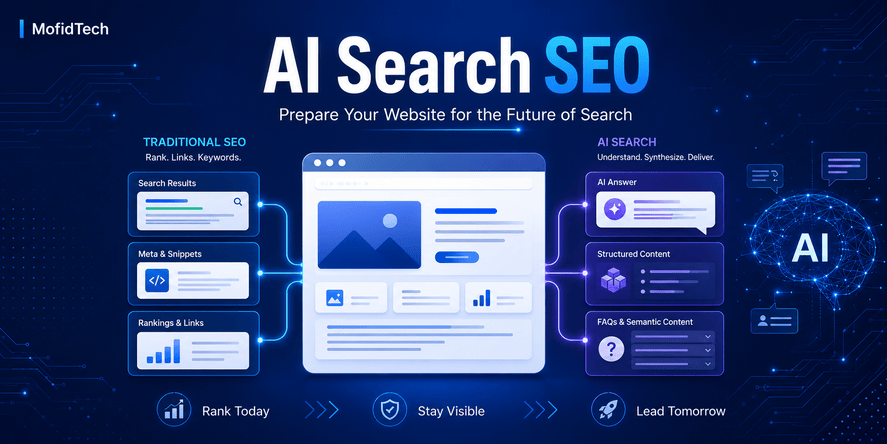
Search is changing. For many years, website owners optimized pages mainly for classic search results: blue links, snippets, featured snippets, image results, and rich results. Today, search engines are increasingly adding AI-generated answers directly inside the search experience. Google has official documentation for AI features such as AI Overviews and AI Mode, explaining how website owners should think about content visibility in these new search experiences.
This does not mean that traditional SEO is dead. In fact, the opposite is true. Technical SEO, helpful content, crawlability, page quality, internal linking, and authority still matter. The difference is that websites now need to be prepared for two worlds at the same time: traditional search results and AI-powered answer experiences.
For MofidTech readers, this topic is especially important because many developers build websites, blogs, documentation platforms, SaaS products, e-commerce stores, and educational portals. A technically good website is no longer only about design, speed, and security. It also needs clear content structure, strong metadata, reliable information, and a strategy for how AI systems may interpret, summarize, and cite its pages.
This article explains how to prepare your website for AI search without sacrificing traditional SEO traffic. It focuses on practical strategy, technical thinking, content structure, risks, mistakes, checklists, and long-term recommendations — without code.
Table of Contents
- What AI search means for website owners
- Why traditional SEO still matters
- How AI search can affect organic traffic
- What developers must understand about AI search visibility
- How to structure content for AI search
- Technical SEO foundations for AI-era websites
- Content quality signals that matter more than ever
- AI crawlers, robots rules, and content access control
- How to protect traditional SEO traffic
- How to update old articles for AI search
- Common mistakes to avoid
- AI search optimization checklist
- Comparison: traditional SEO vs AI search optimization
- Real-world use cases
- FAQ
- Conclusion
What AI Search Means for Website Owners
AI search refers to search experiences where the search engine or AI assistant generates a direct answer instead of only showing a list of links. These answers may summarize multiple sources, compare options, explain concepts, recommend next steps, or answer complex questions in a conversational format.
Examples include:
| Search Experience | What It Does |
|---|---|
| Traditional search results | Shows ranked links, snippets, images, videos, and rich results |
| Featured snippets | Extracts a short answer from one page |
| AI Overviews | Generates a broader AI answer using multiple sources |
| AI Mode-style search | Allows more conversational, multi-step search experiences |
| AI chat search | Answers questions inside chat-style interfaces |
| Answer engines | Provide direct answers with citations or source references |
Google has described AI features as part of the evolving Search experience, including AI Overviews and AI Mode. Google also published guidance specifically for site owners who want to understand how content may appear in generative AI search features.
For website owners, this creates a major shift. In the past, the goal was usually to rank high enough that users clicked your link. Now, a user may receive an AI-generated answer before clicking anything. That creates both risk and opportunity.
The risk is that users may not click because the answer is already visible. The opportunity is that trusted, well-structured, authoritative content may be cited, referenced, or surfaced in new AI search experiences.
Why Traditional SEO Still Matters
AI search does not remove the need for traditional SEO. Search engines still need to discover pages, understand them, evaluate quality, and decide which sources are trustworthy. A page that is blocked, slow, poorly structured, thin, duplicated, or confusing is unlikely to perform well in either traditional search or AI search.
Traditional SEO still matters because it provides the foundation for visibility. Search systems still depend on signals such as:
| SEO Foundation | Why It Still Matters |
|---|---|
| Crawlability | Search engines must be able to access the page |
| Indexability | Pages must be eligible to appear in search |
| Clear titles | Search systems need to understand the topic |
| Helpful headings | Readers and search engines need structure |
| Internal links | Helps discovery and topical authority |
| Page performance | Improves user experience |
| Mobile usability | Most users search from mobile devices |
| Content quality | AI search needs reliable sources |
| Structured data | Helps search systems understand page entities and context |
Google’s structured data documentation explains that structured data can help pages become eligible for specific search result features, but it must follow Google’s guidelines and content policies.
The practical lesson is simple: do not abandon SEO. Instead, improve SEO so that your content is easier for both traditional search engines and AI systems to understand.
How AI Search Can Affect Organic Traffic
AI search can affect traffic in several ways.
The most obvious impact is reduced clicks for some informational queries. When users ask simple questions and receive a complete answer directly in the search result, they may not need to visit a website. This is often called a zero-click search experience.
For example, queries like “what is API rate limiting,” “difference between authentication and authorization,” or “how does DNS work” may be answered directly by AI summaries. Websites that publish educational content may feel this change more than websites offering unique tools, products, calculators, downloads, or deep expert analysis.
However, AI search does not affect every query equally.
| Query Type | AI Search Impact |
|---|---|
| Simple definition queries | High risk of fewer clicks |
| Basic how-to questions | Medium to high risk |
| Deep technical guides | Still strong click opportunity |
| Product comparisons | Mixed impact |
| Local service searches | Depends on platform and intent |
| Transactional searches | Often still click-driven |
| Tool-based searches | Strong opportunity if the tool solves the problem |
| Expert analysis | Strong opportunity when depth matters |
This is why MofidTech should focus on deep, practical, trustworthy articles rather than shallow definition posts. A short article explaining “what is SEO” may be replaced by an AI answer. A detailed guide about preparing a developer-built website for AI search, including technical structure, quality risks, internal linking, monitoring, and tool ideas, is harder to replace.
What Developers Must Understand About AI Search Visibility
Developers often think about SEO only as metadata, page speed, and URLs. Those things are important, but AI search adds another layer: machine readability.
A page must be easy for systems to understand. That does not mean writing robotic content. It means organizing information clearly.
AI search systems benefit from pages that:
- Explain one topic clearly.
- Use logical headings.
- Answer common questions directly.
- Include definitions where useful.
- Compare alternatives.
- Explain risks and limitations.
- Use consistent terminology.
- Provide original insights.
- Avoid misleading claims.
- Separate beginner explanations from advanced sections.
- Include author or website trust signals.
- Avoid thin AI-generated filler.
For developers, this means website architecture and content architecture must work together. A strong article should not be hidden inside a confusing page layout, overloaded with scripts, lacking metadata, or disconnected from the rest of the site.
Good AI search SEO is not only a writing task. It is a full website quality task.
How to Structure Content for AI Search
Start With a Clear Search Intent
Before writing or optimizing a page, identify the search intent. Search intent means the reason behind the search.
For example, a user searching “AI search SEO” may want to know:
- What AI search means.
- Whether SEO is still useful.
- How to appear in AI Overviews.
- Whether AI search will reduce traffic.
- How to structure content for AI tools.
- How to protect existing rankings.
A strong article should answer the full intent, not just the keyword.
Use Direct and Descriptive Headings
AI systems and readers both benefit from headings that clearly describe the section. Avoid vague headings such as “Important Things” or “More Details.” Instead, use headings like:
- How AI Search Can Reduce Organic Clicks
- Technical SEO Foundations for AI Search
- How to Structure FAQs for Answer Engines
- Common Mistakes That Hurt AI Search Visibility
Good headings help readers scan the page and help search systems understand the article structure.
Answer Key Questions Early
A page optimized for AI search should not hide the main answer too far down the page. The introduction should quickly explain the topic, why it matters, and what the reader will learn.
This does not mean writing short content. It means making the value clear early.
Include Definitions, Comparisons, and Frameworks
AI search often responds well to content that explains relationships between concepts. Useful formats include:
| Content Format | Why It Helps |
|---|---|
| Definitions | Clarify terms |
| Comparison tables | Help users choose between options |
| Checklists | Make advice actionable |
| Decision frameworks | Help readers evaluate alternatives |
| FAQs | Match natural language questions |
| Mistake lists | Help users avoid problems |
| Use cases | Connect theory to practice |
| Troubleshooting logic | Helps solve real problems |
These formats also make articles more useful for human readers.
Add FAQ Sections
FAQ sections are useful because AI search and conversational search often process natural language questions. A strong FAQ section can capture long-tail queries and clarify practical doubts.
However, FAQs should not be fake or repetitive. Each answer should add value.
Use Original Experience
AI search can summarize common knowledge easily. What it cannot easily replace is original experience, practical judgment, and real-world context.
For MofidTech, that means articles should include:
- Developer-focused explanations.
- Practical website scenarios.
- Deployment and CMS considerations.
- Security and performance trade-offs.
- Mistakes from real projects.
- Decision frameworks.
- Practical recommendations.
This makes the content more valuable than generic AI-generated summaries.
Technical SEO Foundations for AI-Era Websites
Crawlability
Crawlability means search engines can access your pages. If important pages are blocked, hidden, broken, or difficult to discover, they may not appear in search.
For AI-era SEO, crawlability matters because AI search systems often depend on indexed or discoverable web content. A page that cannot be crawled is unlikely to contribute to AI search visibility.
Developers should make sure important pages are reachable through internal links, not only through search forms or dynamic interactions.
Indexability
Indexability means a page is eligible to be stored and shown in search results. A page may be crawlable but still not indexable because of technical rules, duplicate content, canonical issues, or quality problems.
A website prepared for AI search should have a clean index strategy. Not every page needs to be indexed. Thin tag pages, duplicate archive pages, search result pages, and low-value filtered pages can create quality problems.
Clean URL Structure
A good URL should be readable, stable, and descriptive. For example, a slug like prepare-website-for-ai-search-seo is clearer than a random ID or unclear phrase.
Clean URLs help users, search engines, and content managers understand the page topic.
Metadata Quality
Metadata still matters. A strong SEO title and meta description can improve traditional search click-through rates. Even when AI search appears, users may still click results that look more trustworthy and relevant.
A good meta title should be clear, concise, and aligned with the page. A good meta description should explain the benefit of reading the article.
Structured Data
Structured data helps search engines understand certain types of information on a page. Google’s documentation explains supported structured data features and emphasizes that structured data should follow technical and quality guidelines.
For a technical blog like MofidTech, structured data may be useful for:
- Articles.
- Breadcrumbs.
- Organization information.
- FAQ-style content where appropriate.
- Author information.
- Educational content.
Structured data should not be used to misrepresent content. It must match what users can actually see on the page.
Internal Linking
Internal links help connect related content and build topical authority. If MofidTech publishes many isolated articles with no connection between them, search engines may struggle to understand the site’s expertise.
For AI search readiness, internal linking should connect topics such as:
- AI search and technical SEO.
- Web performance and search visibility.
- Content quality and developer-built websites.
- Website architecture and crawlability.
- AI tools and content production risks.
A strong internal linking strategy turns separate articles into a knowledge base.
Page Experience
A page that is slow, unstable, overloaded with ads, or difficult to read can lose user trust. Even if content is good, poor experience reduces engagement.
Important page experience factors include:
- Fast loading.
- Mobile-friendly layout.
- Readable typography.
- Stable layout.
- Clear navigation.
- Accessible colors.
- Reasonable ad placement.
- Good image optimization.
AI search may change discovery, but users still judge the website experience after clicking.
Content Quality Signals That Matter More Than Ever
Helpful Content
AI search increases the pressure on websites to publish content that is genuinely helpful. Generic articles that repeat common definitions without depth are more vulnerable.
Helpful content usually has:
- A clear audience.
- A specific problem.
- Practical explanations.
- Real-world scenarios.
- Accurate information.
- Logical structure.
- Clear conclusions.
- Useful next steps.
Expertise and Trust
Trust is critical in technical content. Developers need accurate guidance because bad advice can lead to security issues, performance problems, deployment failures, or poor architecture decisions.
Trust signals include:
- Clear author or website identity.
- Updated content.
- Accurate explanations.
- No exaggerated claims.
- References to official documentation when needed.
- Transparent limitations.
- Practical experience.
Avoid Thin AI-Generated Content
AI tools can help with drafting, brainstorming, editing, and structure. But publishing large volumes of generic AI-written content can damage a website’s quality.
Thin AI content often has these problems:
- It sounds confident but says little.
- It repeats the same ideas.
- It lacks real examples.
- It avoids trade-offs.
- It gives vague advice.
- It does not answer practical problems.
- It has no original perspective.
MofidTech should use AI as an assistant, not as a replacement for editorial judgment.
Update Old Articles
AI search rewards freshness where freshness matters. Technical articles become outdated when tools, platforms, security practices, or search features change.
For example, an article about SEO from 2021 may not discuss AI Overviews, AI Mode, structured content for answer engines, or AI crawlers. Updating old articles helps preserve rankings and improve relevance.
AI Crawlers, Robots Rules, and Content Access Control
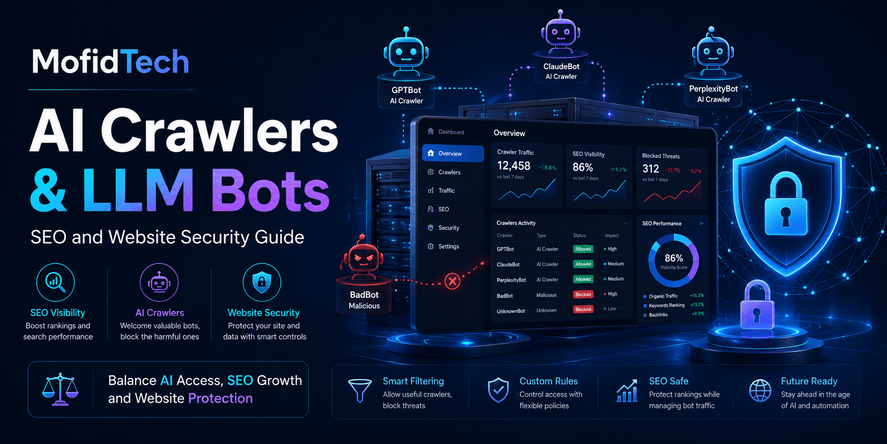
AI crawlers are bots used by AI companies or search platforms to access web content. Some are used for search indexing, some for AI training, some for retrieval, and some may have mixed purposes.
Website owners now face a strategic question: should they allow or block AI crawlers?
There is no universal answer.
Why Some Publishers Block AI Crawlers
Publishers may block AI crawlers because they worry about:
- Content being used without fair compensation.
- AI answers reducing traffic.
- Excessive crawling costs.
- Loss of control over copyrighted material.
- Brand content being summarized inaccurately.
Cloudflare has written about AI crawler control and noted that robots rules express crawling preferences, while stronger technical controls may be needed when site owners want enforcement.
Why Blocking Everything Can Be Risky
Blocking every AI crawler may reduce exposure in AI search platforms. If AI assistants cannot access your content, they may not cite it, summarize it, or recommend it.
For websites that depend on visibility, a strict blocking strategy may protect content from some uses but also reduce future discovery opportunities.
Publisher Control Is Becoming a Bigger Issue
The debate around AI search and publisher control is becoming more serious. Recent reporting shows that UK regulatory action has pushed for more publisher control over Google’s AI search features, including opt-out mechanisms and attribution expectations.
This shows that AI search is not only a technical topic. It is also a business, legal, and publishing strategy topic.
Practical Recommendation
For most educational websites, including a site like MofidTech, the best approach is not emotional blocking or blind allowing. The best approach is strategic control.
Website owners should:
- Understand which bots access the site.
- Monitor server logs or analytics where possible.
- Separate search visibility crawlers from training crawlers when possible.
- Protect premium or private content.
- Keep public educational content visible if organic discovery matters.
- Review crawler policy regularly.
- Avoid blocking important search engines accidentally.
How to Protect Traditional SEO Traffic
Preparing for AI search should not damage traditional SEO. A good strategy protects both.
Keep Optimizing for Clicks
Even if AI summaries appear, users still click when they need depth, trust, tools, examples, or decision support.
To protect clicks, your search result should clearly communicate value. Strong titles and descriptions should suggest that the page offers more than a short answer.
For example:
Weak title:
AI Search SEO
Stronger title:
How to Prepare Your Website for AI Search Without Losing SEO Traffic
The second title tells the reader there is a practical benefit.
Offer Depth AI Summaries Cannot Fully Replace
AI summaries are useful for quick answers. But users still need detailed guides when making decisions.
Your article should include:
- Detailed explanations.
- Real-world scenarios.
- Risk analysis.
- Checklists.
- Tables.
- Troubleshooting guidance.
- Practical frameworks.
- Internal links to deeper resources.
This gives readers a reason to click.
Build Tools, Not Only Articles
Tools are harder for AI search to replace. If MofidTech offers calculators, checkers, generators, and audit tools, users have a reason to visit the site directly.
For this topic, a strong tool idea is an AI Search Readiness Checker.
Build Brand Recognition
In an AI search world, brand matters more. If users recognize MofidTech as a reliable source, they are more likely to click even when a short AI answer appears.
Brand authority comes from consistency, quality, design, trust, and usefulness.
Create Topic Clusters
A single article can rank, but a cluster builds authority. For this topic, MofidTech could create a cluster around:
- AI search SEO.
- Technical SEO for developers.
- Website performance.
- Structured data.
- Content quality.
- AI-generated content risks.
- Internal linking.
- Search visibility monitoring.
This helps both users and search systems understand the site’s expertise.
How to Update Old Articles for AI Search
Many websites already have useful articles that can be improved for AI search. Updating existing content is often faster than creating new content from zero.
Step 1: Identify Articles With Existing Traffic
Start with articles that already receive impressions or clicks. These pages have proven potential.
Step 2: Improve the Introduction
Make the introduction clear, direct, and useful. Explain what the article covers and who it helps.
Step 3: Add Better Headings
Replace vague headings with specific, descriptive ones. A heading should explain the value of the section.
Step 4: Add FAQs
Add real questions users may ask. Each answer should be concise but useful.
Step 5: Add Comparison Tables
Tables help users understand trade-offs quickly. They are especially useful for technical decision-making.
Step 6: Add Practical Checklists
Checklists make articles more actionable and increase perceived value.
Step 7: Improve Internal Links
Connect the article to related MofidTech content. This improves navigation and topical authority.
Step 8: Add or Improve Structured Data
Where appropriate, add structured data that accurately represents the page content and follows Google’s guidelines. Google states that structured data should follow both technical and quality guidelines to be eligible for rich result features.
Step 9: Update the Date Only When the Content Is Truly Updated
Do not change dates only for SEO. Update the actual content, then show that it has been refreshed.
Common Mistakes to Avoid
Mistake 1: Thinking SEO Is Dead
SEO is not dead. It is evolving. Websites still need crawlable, indexable, useful, trusted, and well-structured content.
Mistake 2: Writing Only for AI
Do not write awkward content just to please algorithms. The primary reader is still a human.
Mistake 3: Publishing Shallow AI Content
Large amounts of low-value content can weaken a site. Quality is more important than volume.
Mistake 4: Ignoring Technical SEO
AI search cannot save a website with broken indexing, poor performance, duplicate pages, and confusing architecture.
Mistake 5: Blocking Crawlers Without Strategy
Blocking AI crawlers may protect content in some cases, but it can also reduce visibility in AI-driven discovery. The decision should be based on business goals.
Mistake 6: Forgetting Internal Links
Internal links help both humans and search systems understand your website. Do not publish isolated articles.
Mistake 7: Ignoring Author and Brand Trust
Anonymous, generic content is less persuasive. Show why your website deserves trust.
Mistake 8: Overusing FAQs
FAQs should answer real questions. Do not add repetitive questions only for SEO.
Mistake 9: Misusing Structured Data
Structured data must match visible content. Do not mark up content that users cannot see.
Mistake 10: Ignoring Analytics
AI search may change traffic patterns. Website owners need to monitor impressions, clicks, rankings, referrals, and engagement.
AI Search Optimization Checklist
Content Checklist
| Check | Goal |
|---|---|
| The article targets a clear search intent | Helps satisfy the user’s real need |
| The introduction explains the value quickly | Reduces bounce risk |
| Headings are descriptive | Improves readability and machine understanding |
| The article includes original insight | Avoids generic content |
| The article answers common questions | Supports conversational search |
| The article includes comparisons | Helps decision-making |
| The article includes practical checklists | Makes content actionable |
| The content is updated | Improves trust and relevance |
Technical Checklist
| Check | Goal |
|---|---|
| Important pages are crawlable | Enables discovery |
| Important pages are indexable | Enables search visibility |
| URLs are clean and stable | Improves clarity |
| Metadata is unique and useful | Improves search presentation |
| Structured data is accurate | Supports rich understanding |
| Mobile layout is usable | Improves experience |
| Page speed is acceptable | Reduces frustration |
| Internal links connect related topics | Builds authority |
Trust Checklist
| Check | Goal |
|---|---|
| Content is accurate | Builds credibility |
| Claims are not exaggerated | Avoids misinformation |
| Sources are used when needed | Supports factual reliability |
| Author or site identity is clear | Builds trust |
| Content has practical value | Increases user satisfaction |
| Old pages are updated | Prevents outdated advice |
Monitoring Checklist
| Check | Goal |
|---|---|
| Track organic impressions | See visibility changes |
| Track click-through rate | Detect zero-click impact |
| Track top queries | Understand user demand |
| Track AI referral traffic where visible | Measure new discovery channels |
| Review crawl logs | Understand bot behavior |
| Monitor ranking changes | Identify affected pages |
| Compare old and updated articles | Measure improvement |
Traditional SEO vs AI Search Optimization
| Area | Traditional SEO | AI Search Optimization |
|---|---|---|
| Main goal | Rank and get clicks | Be understood, cited, summarized, and clicked when depth is needed |
| Content style | Keyword-targeted and user-focused | Intent-focused, structured, clear, answer-ready |
| Technical priority | Crawlability, indexing, speed, metadata | Same foundations plus strong semantic clarity |
| Best content formats | Guides, lists, tutorials, reviews | Guides, FAQs, comparisons, definitions, frameworks |
| Risk | Low ranking or low CTR | Zero-click answers and reduced visibility control |
| Opportunity | Organic traffic | AI citations, brand visibility, tool-based visits |
| Best strategy | Strong SEO fundamentals | Strong SEO fundamentals plus AI-readable structure |
The key lesson is that AI search optimization is not a replacement for SEO. It is an extension of SEO.
Real-World Use Cases
Use Case 1: A Developer Blog
A developer blog publishes tutorials about APIs, databases, Python, and Linux. Many articles answer common questions. AI search may summarize basic answers, reducing clicks for simple topics.
The solution is to publish deeper guides with practical decision-making, troubleshooting, security risks, architecture explanations, and checklists. The blog should also build internal links between related articles.
Use Case 2: A Django Website With Educational Articles
A Django-based website like MofidTech can improve AI search readiness by making sure articles have strong metadata, clean slugs, structured headings, categories, tags, FAQs, and internal links.
The website should avoid publishing short generic posts. Instead, it should focus on large, useful, professional articles that solve real developer problems.
Use Case 3: A SaaS Company
A SaaS company may lose some informational traffic to AI summaries, but it can gain traffic by offering tools, calculators, templates, comparison pages, and expert guides.
AI search may answer “what is uptime monitoring,” but users still need a practical uptime monitoring tool.
Use Case 4: A Documentation Website
Documentation websites should focus on clarity, version accuracy, and structure. AI systems may summarize documentation, but developers still visit official docs when they need precise, trusted information.
Use Case 5: A Cybersecurity Blog
Cybersecurity content must be especially careful because inaccurate advice can create risk. AI search may summarize security concepts, but detailed checklists, risk explanations, and best-practice frameworks remain valuable.
Performance Considerations
Performance still matters in the AI search era. Users who click from search expect the page to load quickly and be easy to read.
A slow website can lose users even if the content is strong. Performance problems also make crawling less efficient.
Important performance priorities include:
- Optimized images.
- Lightweight pages.
- Stable layout.
- Efficient fonts.
- Good caching strategy.
- Clean mobile experience.
- Reduced unnecessary scripts.
- Fast server response.
For a content website, performance is not only a technical issue. It is also an SEO and user trust issue.
Security Considerations
AI search readiness should not weaken security. Developers should avoid exposing private, internal, or sensitive content to crawlers.
Important security considerations include:
- Do not make private pages publicly accessible.
- Do not expose admin areas.
- Do not publish sensitive configuration information.
- Do not allow indexing of user dashboards.
- Do not expose personal data.
- Review which content should be public.
- Monitor suspicious bot activity.
- Use proper access control for restricted content.
AI search visibility is useful only for public content. Private content should remain protected.
Troubleshooting: Why Your Website May Not Appear in AI Search
Problem 1: The Page Is Not Indexed
If the page is not indexed, it is unlikely to appear in traditional or AI search experiences.
Possible causes include poor internal linking, duplicate content, noindex rules, canonical issues, or low content quality.
Problem 2: The Content Is Too Generic
If many websites already say the same thing, your article may not stand out. Add original explanations, examples, comparisons, and practical recommendations.
Problem 3: The Page Has Weak Structure
If headings are unclear and the article jumps between ideas, search systems may struggle to understand it.
Problem 4: The Website Has Poor Authority
A new or low-authority website may need time, consistent publishing, internal linking, backlinks, and brand trust.
Problem 5: The Content Is Not Deep Enough
Short answers are easy for AI systems to summarize. Deep guides have more value.
Problem 6: Crawlers Are Blocked
If important crawlers cannot access your content, visibility may be limited. Review crawler rules carefully.
Problem 7: The Page Is Slow or Hard to Use
Bad user experience can reduce engagement and trust.
Best Practices for MofidTech
For MofidTech, the best AI search SEO strategy should include:
- Publish deep practical guides, not shallow definitions.
- Cover the full technology scope, not only Django.
- Build topic clusters around SEO, AI, DevOps, cybersecurity, databases, and web architecture.
- Add FAQ sections to major articles.
- Use comparison tables and checklists.
- Improve internal linking between related articles.
- Create tools that support articles.
- Keep public educational content accessible.
- Monitor crawler behavior and organic traffic.
- Update old articles when technology changes.
- Avoid generic AI-generated content.
- Build MofidTech as a trusted technical education brand.
FAQ
1. Is SEO dead because of AI search?
No. SEO is not dead. AI search changes how users discover information, but search engines still need crawlable, indexable, useful, and trustworthy content. Traditional SEO remains the foundation.
2. What is AI search SEO?
AI search SEO is the process of preparing website content so it can perform well in both traditional search results and AI-generated answer experiences. It includes technical SEO, content structure, trust signals, FAQs, internal linking, and clear explanations.
3. How can my website appear in AI Overviews?
There is no guaranteed method. The best approach is to create helpful, accurate, well-structured, crawlable, and trustworthy content. Google has official guidance for website owners about AI features and generative AI search experiences.
4. Should I block AI crawlers?
It depends on your goals. If your priority is maximum content control, you may consider blocking some crawlers. If your priority is visibility in AI-powered discovery, blocking everything may reduce opportunities. The best approach is strategic crawler management.
5. Does structured data help AI search?
Structured data helps search engines better understand certain page elements and may make pages eligible for search features. It should be accurate, visible to users, and compliant with Google’s structured data guidelines.
6. Can small websites benefit from AI search?
Yes, but small websites must focus on quality and specificity. A small site can compete by publishing deep, practical, original content that solves real problems better than generic high-volume websites.
7. What type of content is most at risk from AI search?
Short, generic, definition-based content is most at risk. If an article only answers a simple question in a few paragraphs, AI search may satisfy the user without a click.
8. What type of content is safer from zero-click searches?
Detailed guides, tools, calculators, comparison pages, expert analysis, troubleshooting resources, and original research are more resilient because users often need more than a short answer.
9. How often should old articles be updated?
Update articles whenever the topic changes, tools evolve, search behavior changes, or the article no longer reflects best practices. Technical SEO and AI search topics should be reviewed regularly.
10. Is answer engine optimization different from SEO?
Answer engine optimization is closely related to SEO. It focuses more on helping systems extract, summarize, and understand answers. However, it still depends on classic SEO foundations such as crawlability, content quality, structure, and trust.
11. Should I write shorter articles for AI search?
Not necessarily. Short answers can be useful, but deep articles often perform better when users need serious guidance. The best approach is to give clear answers early and detailed explanations afterward.
12. Can AI-generated content rank?
AI-assisted content can perform if it is accurate, helpful, original, edited, and valuable. But low-quality AI-generated content that repeats generic information is risky and may harm the website’s reputation.
Conclusion
AI search is one of the most important changes in modern SEO. It changes how users discover information, how search engines present answers, and how websites earn visibility. But it does not remove the need for traditional SEO.
The best strategy is not to choose between traditional SEO and AI search. The best strategy is to build websites that are technically strong, content-rich, trustworthy, structured, fast, secure, and useful.
For MofidTech, this is a strong opportunity. Your website can become a trusted educational resource for developers who want to understand SEO, AI, web development, cybersecurity, databases, cloud computing, and software engineering in a practical way.
The future of SEO belongs to websites that provide real value. AI can summarize information, but it cannot replace deep expertise, practical tools, strong brand trust, and well-designed learning experiences.




💬 Comments
No comments yet. Be the first to comment!
Login to comment.