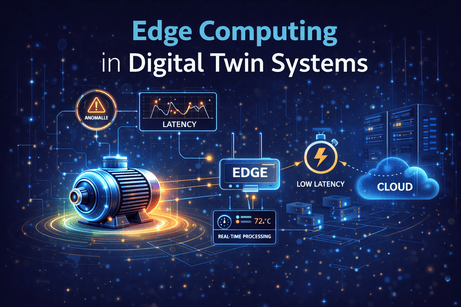
1. Introduction: Why Edge Computing Matters in Digital Twins
Edge computing is a critical component in modern digital twin architectures because it brings computation closer to where data is generated. While cloud computing provides powerful centralized infrastructure, it is not always ideal for scenarios that require ultra-fast responses or operate in environments with limited connectivity.
In digital twin systems, where real-time accuracy and responsiveness are essential, edge computing ensures that data is processed immediately at or near the physical device. Instead of sending all sensor data to the cloud, edge devices perform local analysis, filtering, and decision-making before transmitting only relevant information.
This approach reduces latency, improves efficiency, and enables digital twins to function even in disconnected or bandwidth-constrained environments. Edge computing transforms digital twins into faster, more resilient, and more autonomous systems.
2. What is Edge Computing?
Edge computing refers to the practice of processing data at the edge of the network, near the source of data generation. This typically involves:
- Embedded systems
- IoT gateways
- Industrial controllers
- Local servers
Instead of sending raw data to distant cloud servers, edge devices perform computations locally and send only processed results when necessary.
In a digital twin system, the “edge” is often located directly on or near the physical asset being monitored—such as a machine, sensor hub, or industrial controller.
3. The Role of Edge Computing in Digital Twin Architecture
A complete digital twin system typically includes three layers:
- IoT Layer → collects data from sensors
- Edge Layer → processes data locally
- Cloud Layer → stores and analyzes data globally
Edge computing sits between IoT and the cloud, acting as an intelligent intermediary.
Key Functions of the Edge Layer:
- Pre-processing sensor data
- Filtering noise and irrelevant data
- Detecting anomalies in real time
- Triggering immediate actions
- Reducing data transmission حجم
By handling these tasks locally, edge computing significantly improves the performance of digital twin systems.
4. Reducing Latency: The Core Advantage
Latency refers to the delay between data generation and system response. In traditional cloud-based systems, data must travel from the device to the cloud and back, which introduces delays.
Edge computing eliminates this delay by processing data locally.
Example:
- A sensor detects abnormal vibration
- Edge device analyzes the data instantly
- Machine is stopped immediately
If this process relied on cloud communication, even a small delay could lead to equipment damage or safety risks.
For digital twins, low latency is crucial because the virtual model must stay synchronized with the physical system in real time.
5. Real-Time Decision Making at the Edge
One of the most powerful features of edge computing is its ability to enable real-time decision-making.
In digital twin systems, this means:
- Immediate anomaly detection
- Instant alert generation
- Automatic system adjustments
Example Use Case:
In a manufacturing environment:
- Edge device detects overheating
- It immediately reduces machine load
- Sends alert to central dashboard
This kind of responsiveness is essential in critical systems where delays are unacceptable.
Edge computing allows digital twins to act not just as observers, but as active controllers of physical systems.
6. Data Filtering and Bandwidth Optimization
Digital twin systems generate enormous amounts of data. Sending all this data to the cloud is inefficient and expensive.
Edge computing solves this problem by:
- Filtering unnecessary data
- Aggregating sensor readings
- Sending only meaningful insights
Example:
Instead of sending every temperature reading:
- Edge device sends only anomalies or summaries
- Reduces bandwidth usage
- Lowers cloud storage costs
This makes the system more efficient and scalable.
7. Edge Computing and Reliability
Another major advantage of edge computing is system resilience.
Cloud-dependent systems may fail if:
- Internet connectivity is lost
- Network latency increases
- Cloud services are unavailable
Edge computing ensures that:
- Critical operations continue locally
- Devices remain functional offline
- Digital twin remains partially operational
This is particularly important in remote environments such as:
- Oil rigs
- Mining sites
- Industrial plants
- Smart agriculture systems
Edge computing enables digital twins to operate reliably even in challenging conditions.
8. Integration with AI at the Edge
Edge computing becomes even more powerful when combined with Artificial Intelligence.
Instead of sending data to the cloud for analysis, AI models can run directly on edge devices.
Benefits:
- Faster predictions
- Reduced latency
- Lower cloud dependency
- Real-time anomaly detection
Example:
An edge device runs a lightweight machine learning model that:
- Detects abnormal vibration patterns
- Predicts potential failure
- Triggers preventive action
This creates an intelligent edge, where decisions are made instantly without relying on centralized systems.
9. Edge Computing in a Django Digital Twin System
In a Django-based digital twin project, edge computing integrates with the system as follows:
Architecture Flow:
- Sensors collect data
- Edge device processes data locally
- Only relevant data is sent to Django API
- Django stores and visualizes data
- Cloud services perform deeper analysis
Example Workflow:
- Edge detects anomaly
- Sends alert to Django backend
- Django dashboard displays warning
- Cloud AI model performs deeper analysis
This hybrid approach combines the strengths of edge and cloud computing.
10. Edge vs Cloud: Complementary Technologies
Edge computing does not replace cloud computing—it complements it.
| Feature | Edge Computing | Cloud Computing |
|---|---|---|
| Location | Near device | Centralized |
| Speed | Very fast | Moderate |
| Latency | Low | Higher |
| Processing | Local | Global |
| Storage | Limited | Scalable |
| Use Case | Real-time control | Big data analytics |
A modern digital twin system uses both:
- Edge for speed and immediate response
- Cloud for storage, analytics, and AI training
11. Challenges of Edge Computing
Despite its advantages, edge computing introduces challenges:
Limited Resources
Edge devices have less processing power than cloud servers.
Device Management
Managing many distributed devices can be complex.
Security Risks
Edge devices can be vulnerable to attacks.
Software Updates
Updating edge systems requires careful coordination.
These challenges require robust system design and management strategies.
12. Future of Edge Computing in Digital Twins
The future of edge computing in digital twin systems includes:
- More powerful edge devices
- Integration with 5G networks
- Distributed AI systems
- Autonomous industrial environments
As technology evolves, edge computing will play an even larger role in enabling real-time, intelligent systems.
13. Conclusion
Edge computing is a fundamental component of modern digital twin systems. By processing data closer to the source, it reduces latency, improves efficiency, and enables real-time decision-making.
When combined with IoT, AI, and cloud computing, edge computing creates a powerful ecosystem where digital twins can operate faster, smarter, and more reliably.
It transforms digital twins from centralized systems into distributed, intelligent networks capable of responding instantly to real-world events.



💬 Comments
No comments yet. Be the first to comment!
Login to comment.