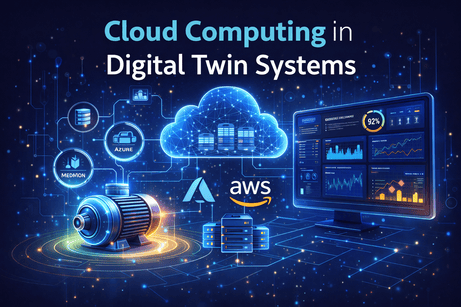
1. Introduction: Why Cloud Computing is Critical for Digital Twins
Cloud computing is the infrastructure layer that enables digital twins to operate at scale. While IoT devices collect real-time data and AI analyzes it, the cloud provides the environment where all this data is stored, processed, and transformed into actionable insights.
A digital twin system generates massive volumes of data continuously. Every sensor reading, every event, every update contributes to a growing stream of information. Managing this data locally would be inefficient, expensive, and difficult to scale. This is where cloud computing becomes essential.
Platforms like Microsoft Azure and Amazon Web Services offer powerful, flexible, and scalable infrastructure that allows digital twin systems to handle real-time data streams, run complex analytics, and serve dashboards to users across the world.
Cloud computing transforms digital twins from small, isolated systems into global, intelligent platforms.
2. Core Role of the Cloud in Digital Twin Architecture
In a digital twin system, the cloud acts as a central hub connecting all components:
- IoT devices send data to the cloud
- Data is stored in cloud databases
- Processing engines analyze incoming streams
- AI models run predictions
- Dashboards display real-time insights
This centralized architecture allows all parts of the system to communicate efficiently and operate in real time.
3. Scalable Data Storage for Massive Telemetry
One of the biggest challenges in digital twin systems is handling large volumes of time-series data. Sensors can generate thousands or even millions of data points per day.
Cloud platforms solve this problem through scalable storage solutions:
a. Object Storage
Used for storing large datasets, logs, and historical records.
b. Time-Series Databases
Optimized for storing sensor data with timestamps.
c. Relational Databases
Used for structured data such as assets, sensors, and alerts.
d. Data Lakes
Store raw, unprocessed data for future analysis.
The key advantage of cloud storage is elasticity. As data grows, storage capacity automatically scales without requiring manual intervention.
4. Real-Time Data Processing and Streaming
Digital twins rely on real-time processing to stay synchronized with the physical world. Cloud platforms provide streaming services that process incoming data instantly.
Key Capabilities:
- Ingest data from thousands of devices simultaneously
- Process data streams in real time
- Trigger alerts when anomalies occur
- Feed data into AI models for predictions
Technologies such as event streams and serverless functions allow developers to build systems that react instantly to changes in the physical environment.
5. Integration with AI and Analytics
Cloud platforms are not just storage systems—they are powerful analytics ecosystems. They provide built-in tools for:
- Machine learning
- Data visualization
- Statistical analysis
- Predictive modeling
For example, platforms like Microsoft Azure Machine Learning and Amazon Web Services SageMaker allow developers to train, deploy, and scale AI models directly in the cloud.
This tight integration enables digital twins to:
- Predict failures
- Optimize performance
- Simulate future scenarios
- Learn from historical data
The cloud becomes the intelligence engine that powers decision-making.
6. High Availability and Global Access
One of the major benefits of cloud computing is high availability. Digital twin systems must be accessible at all times, especially in critical industries like manufacturing, energy, and healthcare.
Cloud providers ensure:
- Redundant data storage across multiple regions
- Automatic failover mechanisms
- Load balancing for high traffic
- Continuous system uptime
This means that digital twin dashboards can be accessed from anywhere in the world, at any time, without interruption.
7. Cost Efficiency and Flexibility
Traditional infrastructure requires large upfront investments in servers, storage, and maintenance. Cloud computing eliminates this barrier by offering a pay-as-you-go model.
Advantages:
- Pay only for what you use
- Scale resources up or down as needed
- No need for hardware maintenance
- Faster deployment of applications
This flexibility is particularly important for digital twin systems, which may start small but grow rapidly as more devices and data are added.
8. Security and Data Protection
Security is a critical concern in digital twin systems because they handle sensitive operational data.
Cloud platforms provide advanced security features:
- Data encryption (at rest and in transit)
- Identity and access management (IAM)
- Network security and firewalls
- Continuous monitoring and threat detection
These features ensure that data remains protected while being processed and stored.
9. Cloud Integration with Django Digital Twin Dashboard
In a Django-based digital twin project, the cloud plays a key role in deployment and scalability.
Typical Architecture:
- Django application hosted on cloud servers
- Database hosted on managed cloud services
- IoT devices send data via APIs
- Background workers process data
- Frontend dashboard displays results
Example Deployment Options:
- Use cloud virtual machines to run Django
- Use managed databases for telemetry storage
- Use cloud storage for logs and backups
- Use serverless functions for data processing
This setup allows your Django application to scale seamlessly as the number of devices and users increases.
10. Cloud + IoT + AI: A Unified Ecosystem
The real power of cloud computing emerges when combined with IoT and AI:
- IoT collects data from the physical world
- Cloud stores and processes the data
- AI analyzes and predicts outcomes
This combination creates a fully integrated digital twin ecosystem capable of real-time monitoring, intelligent analysis, and automated decision-making.
11. Challenges of Cloud Computing in Digital Twins
Despite its advantages, cloud computing introduces some challenges:
Latency
Sending data to the cloud may introduce delays in time-sensitive systems.
Data Transfer Costs
Large volumes of data can increase bandwidth costs.
Vendor Lock-In
Dependence on a specific cloud provider can limit flexibility.
Complexity
Managing cloud infrastructure requires expertise.
To address these challenges, many systems combine cloud computing with edge computing, processing critical data locally while using the cloud for storage and analytics.
12. Future of Cloud Computing in Digital Twins
The future of cloud computing in digital twin systems includes:
- Integration with edge and fog computing
- Real-time global simulations
- AI-driven autonomous systems
- Digital twin ecosystems at city and planetary scale
Cloud platforms will continue to evolve, providing even more powerful tools for building intelligent, scalable systems.
13. Conclusion
Cloud computing is the foundation that enables digital twins to scale, evolve, and operate efficiently. By providing powerful infrastructure for data storage, real-time processing, and AI integration, cloud platforms make it possible to build intelligent systems that mirror and optimize the physical world.
Without the cloud, digital twins would remain limited in scope. With it, they become global, data-driven platforms capable of transforming industries and driving innovation.

💬 Comments
No comments yet. Be the first to comment!
Login to comment.