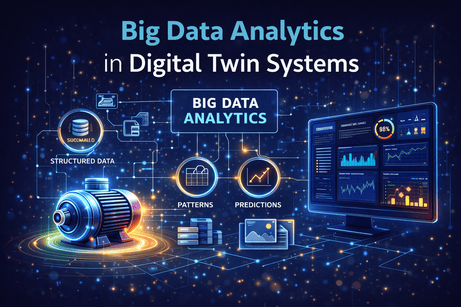
1. Introduction: The Data Explosion Behind Digital Twins
Digital twin systems are fundamentally driven by data. Every sensor reading, system state, event, and interaction contributes to a continuously growing stream of information. This data is not only large in volume but also complex in structure and velocity. Managing and extracting value from this data requires advanced techniques—this is where Big Data Analytics becomes essential.
Big Data Analytics refers to the process of collecting, processing, and analyzing massive volumes of structured and unstructured data to uncover patterns, trends, and insights. In the context of digital twins, it enables systems to move beyond simple monitoring into deep understanding, prediction, and optimization.
Without Big Data Analytics, digital twins would be overwhelmed by data. With it, they become intelligent systems capable of learning from vast datasets and improving continuously.
2. The Nature of Data in Digital Twin Systems
Digital twin systems generate diverse types of data, often categorized into:
a. Structured Data
Highly organized and stored in predefined formats (e.g., databases).
- Sensor readings (temperature, pressure, RPM)
- Asset metadata
- Logs and events
b. Unstructured Data
Data without a fixed format.
- Images (camera feeds)
- Videos (surveillance or inspection)
- Audio signals
- Maintenance reports
c. Semi-Structured Data
Partially organized data (e.g., JSON, XML).
- API responses
- IoT device messages
Handling all these types simultaneously is a major challenge that Big Data Analytics addresses effectively.
3. The Three Vs of Big Data in Digital Twins
Big Data is often defined by three key characteristics:
Volume
Digital twins generate enormous amounts of data continuously.
Velocity
Data arrives in real time or near real time from multiple sources.
Variety
Data comes in different formats and types.
In digital twin systems, these three dimensions are amplified. A single industrial plant can produce millions of data points per day, requiring systems capable of processing and analyzing data at scale.
4. Big Data Architecture in Digital Twin Systems
A typical Big Data architecture for digital twins includes several layers:
a. Data Ingestion
Collects data from IoT devices, sensors, and external systems.
b. Data Storage
Stores data in scalable systems such as data lakes or distributed databases.
c. Data Processing
Processes raw data using batch or real-time analytics.
d. Data Analysis
Applies statistical and machine learning models.
e. Data Visualization
Displays insights through dashboards and reports.
This pipeline transforms raw data into meaningful insights that power the digital twin.
5. Real-Time vs Batch Analytics
Big Data Analytics in digital twins operates in two modes:
Real-Time Analytics
Processes data instantly as it arrives.
- Detect anomalies
- Trigger alerts
- Update dashboards
Batch Analytics
Processes large datasets over time.
- Identify long-term trends
- Train machine learning models
- Perform deep analysis
Both approaches are essential. Real-time analytics ensures responsiveness, while batch analytics provides deeper insights and learning.
6. Pattern Detection and Insight Generation
One of the primary goals of Big Data Analytics is to identify patterns and relationships within large datasets.
Examples:
- Correlation between temperature and machine failure
- Seasonal patterns in energy consumption
- Repeating anomalies in production processes
These patterns are often too complex for manual analysis. Big Data tools use advanced algorithms to detect these relationships automatically.
This allows digital twins to move from data collection to knowledge generation.
7. Predictive and Prescriptive Analytics
Big Data Analytics enables two advanced forms of analysis:
Predictive Analytics
Forecasts future events based on historical data.
- Predict equipment failure
- Estimate maintenance needs
Prescriptive Analytics
Recommends actions based on predictions.
- Optimize system performance
- Suggest operational changes
In digital twin systems, these capabilities allow organizations to make informed decisions and improve efficiency.
8. Integration with AI and Machine Learning
Big Data Analytics and AI are closely connected. Big Data provides the fuel, and AI provides the intelligence.
Large datasets are used to:
- Train machine learning models
- Improve prediction accuracy
- Detect anomalies more effectively
For example, a digital twin can use historical data to train a model that predicts when a machine will fail. As more data is collected, the model becomes more accurate.
This continuous learning process makes digital twins adaptive and self-improving systems.
9. Big Data in a Django Digital Twin Dashboard
In a Django-based system, Big Data Analytics can be implemented through:
a. Data Storage
Using scalable databases for telemetry and logs.
b. Background Processing
Processing large datasets asynchronously.
c. Integration with Big Data Tools
Connecting Django to platforms like Hadoop or Spark.
d. Visualization
Displaying insights using charts and dashboards.
Example Workflow:
- IoT devices send data to Django API
- Data is stored in a database
- Background tasks analyze large datasets
- Results are displayed in dashboards
This architecture allows Django to handle both real-time and large-scale analytics.
10. Data Lakes and Warehouses
Big Data systems often use specialized storage solutions:
Data Lakes
Store raw, unprocessed data in its original format.
Data Warehouses
Store processed and structured data optimized for analysis.
Digital twin systems often use both:
- Data lakes for flexibility
- Data warehouses for performance
This combination allows efficient storage and fast querying of large datasets.
11. Challenges of Big Data in Digital Twins
While powerful, Big Data Analytics introduces challenges:
Data Management
Handling large volumes of data requires efficient storage and organization.
Processing Complexity
Analyzing complex datasets requires advanced tools and expertise.
Data Quality
Poor-quality data can lead to incorrect insights.
Scalability
Systems must scale as data grows.
Addressing these challenges is critical for building effective digital twin systems.
12. Future of Big Data in Digital Twins
The future of Big Data Analytics in digital twin systems includes:
- Real-time global analytics
- Integration with AI and edge computing
- Autonomous decision-making systems
- Advanced simulation and forecasting
As data continues to grow, Big Data Analytics will become even more central to digital twin technology.
13. Conclusion
Big Data Analytics is the engine that transforms massive data streams into actionable insights in digital twin systems. By handling structured and unstructured data at scale, it enables systems to detect patterns, predict outcomes, and optimize performance.
Combined with IoT, AI, cloud, and edge computing, Big Data Analytics allows digital twins to become intelligent, data-driven systems capable of continuous improvement and innovation.



💬 Comments
No comments yet. Be the first to comment!
Login to comment.