1. Introduction: Why AI is Essential for Digital Twins
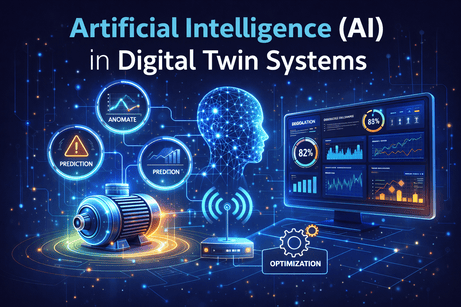
Artificial Intelligence (AI) is the brain of a digital twin system. While IoT provides raw data and connectivity, AI is what gives meaning to that data. Without AI, a digital twin would simply display information—charts, numbers, and logs. With AI, it becomes an intelligent system capable of learning, predicting, and optimizing.
In modern digital twin architectures, AI models continuously analyze incoming data streams from sensors, identify patterns that are invisible to humans, and make decisions based on those insights. This allows organizations to move from reactive operations (fixing problems after they occur) to predictive and proactive strategies (anticipating and preventing issues before they happen).
AI transforms a digital twin from a passive mirror of reality into an active decision-making system.
2. The Role of AI in the Digital Twin Lifecycle
AI operates across the entire lifecycle of a digital twin:
a. Data Interpretation
AI processes massive volumes of sensor data and extracts meaningful insights.
b. Pattern Recognition
It identifies trends and relationships between variables (e.g., temperature vs vibration).
c. Anomaly Detection
AI detects unusual behavior that may indicate a problem.
d. Prediction
It forecasts future states, such as failure risks or performance degradation.
e. Optimization
AI recommends or automatically applies actions to improve system performance.
This continuous cycle transforms raw telemetry into actionable intelligence.
3. From Data to Intelligence: How AI Works
In a digital twin system, AI models rely on machine learning algorithms trained on historical and real-time data. These models learn how a system behaves under normal conditions and compare current data against this learned behavior.
Example Scenario
Consider an industrial motor monitored by a digital twin:
- Temperature normally ranges between 50°C and 80°C
- Vibration remains below a certain threshold
- RPM stays within stable limits
AI models learn these normal patterns. When new data arrives, the system evaluates:
- Is the temperature increasing faster than usual?
- Is vibration fluctuating abnormally?
- Are multiple variables deviating simultaneously?
Instead of checking each value independently, AI understands relationships between variables, making it far more powerful than simple rule-based systems.
4. Machine Learning Models Used in Digital Twins
Several types of AI models are commonly used:
a. Supervised Learning
Used when labeled data is available (e.g., past failures).
- Predicts outcomes like “failure” or “normal operation”
b. Unsupervised Learning
Finds hidden patterns without labeled data.
- Detects anomalies and unusual behaviors
c. Time-Series Forecasting
Analyzes data over time to predict future trends.
- Forecasts temperature, pressure, or energy usage
d. Deep Learning
Uses neural networks for complex systems.
- Handles high-dimensional data and nonlinear relationships
Each of these models plays a role in making the digital twin smarter and more adaptive.
5. AI for Anomaly Detection
One of the most powerful uses of AI in digital twins is anomaly detection. Traditional systems rely on fixed thresholds (e.g., temperature > 90°C = problem). However, real-world systems are more complex.
AI can detect subtle anomalies such as:
- Gradual increase in vibration over time
- Irregular fluctuations in sensor readings
- Unexpected correlations between variables
For example, a motor may still be within acceptable temperature limits, but if vibration and temperature start increasing together in an unusual pattern, AI can detect a potential issue before it becomes critical.
This ability to detect hidden early signals is what makes AI-driven digital twins so valuable.
6. Predictive Maintenance with AI
Predictive maintenance is one of the most impactful applications of AI in digital twins.
Instead of performing maintenance on a fixed schedule, AI predicts when maintenance is actually needed based on the condition of the system.
How it works:
- AI analyzes historical sensor data
- It identifies patterns leading to failures
- It compares current data with those patterns
- It estimates the probability of failure
Example:
- Increasing vibration + rising temperature = bearing wear
- AI predicts failure within the next 10 days
This allows organizations to:
- Avoid unexpected downtime
- Reduce maintenance costs
- Extend equipment lifespan
Predictive maintenance turns maintenance from a cost center into a strategic advantage.
7. AI-Driven Optimization
Beyond prediction, AI can also optimize system performance.
In a digital twin environment, AI continuously evaluates system efficiency and suggests improvements.
Examples:
- Adjust machine speed to reduce energy consumption
- Optimize production processes in a factory
- Balance load across multiple machines
- Improve resource utilization
In advanced systems, AI can even automatically apply changes without human intervention, creating self-optimizing systems.
8. Real-Time Decision Making
AI enables digital twins to make decisions in real time. This is crucial in environments where delays can lead to serious consequences.
For example:
- In manufacturing, AI can stop a machine immediately if a critical anomaly is detected
- In energy systems, AI can adjust power distribution dynamically
- In smart cities, AI can optimize traffic flow in real time
This real-time capability transforms digital twins into autonomous systems.
9. AI Integration in a Django Digital Twin Dashboard
In a Django-based system, AI can be integrated in several ways:
a. Model Inference
Load trained models and use them to evaluate incoming data.
# Example: simple anomaly detection
def detect_anomaly(value, mean, std_dev):
    if abs(value - mean) > 3 * std_dev:
        return True
    return False
b. Predictive Models
Use libraries like scikit-learn or TensorFlow to predict outcomes.
c. Background Tasks
Run AI computations asynchronously using Celery or background workers.
d. API Integration
Send data to external AI services and retrieve predictions.
This allows Django to act as both a data processing layer and an intelligent decision engine.
10. AI + IoT + Digital Twin = Intelligent Systems
The combination of AI, IoT, and digital twins creates a powerful ecosystem:
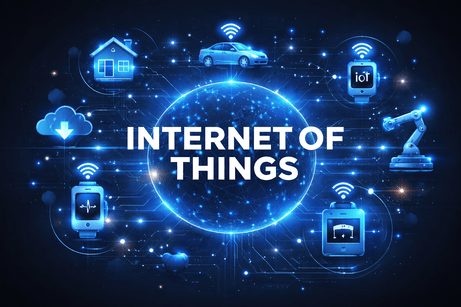
- IoT collects real-time data
- Digital twin models the system
- AI analyzes and predicts
Together, they form a closed intelligent loop:
- Data is collected
- AI analyzes it
- Insights are generated
- Actions are taken
- System improves continuously
This synergy is the foundation of Industry 4.0 and smart systems.
11. Challenges of Using AI in Digital Twins
Despite its power, AI introduces challenges:
Data Quality
AI models are only as good as the data they receive.
Model Accuracy
Poorly trained models can lead to incorrect predictions.
Computational Cost
AI models require significant processing power.
Explainability
Some AI models (like deep learning) are difficult to interpret.
Integration Complexity
Combining AI with IoT and web systems requires careful design.
Addressing these challenges is essential for building reliable digital twin systems.
12. Future of AI in Digital Twins
The future of AI in digital twins is incredibly promising:
- Self-learning systems that improve automatically
- Fully autonomous industrial operations
- Integration with simulation and virtual environments
- AI-driven digital humans (healthcare applications)
Companies like NVIDIA are already developing platforms that combine AI and digital twins at massive scale.
13. Conclusion
Artificial Intelligence is what transforms digital twins from simple data visualization tools into intelligent, predictive, and autonomous systems. By analyzing patterns, detecting anomalies, predicting failures, and optimizing operations, AI enables organizations to make smarter decisions and achieve higher efficiency.
As digital twin technology continues to evolve, AI will remain at its core—driving innovation, improving performance, and shaping the future of intelligent systems.


💬 Comments
No comments yet. Be the first to comment!
Login to comment.