English
Artificial Intelligence
Train a Supervised Machine Learning Model
A course by
Joseph Echrif
This course teaches students to design, train, evaluate, improve, interpret, and deploy supervised machine learning models through practical, reproducible workflows. It covers classification and regression, from problem definition and data preparation to model selection, validation, tuning, interpretation, and basic deployment. Students also learn to prevent data leakage, overfitting, poor metric choices, class imbalance, and unreliable validation.
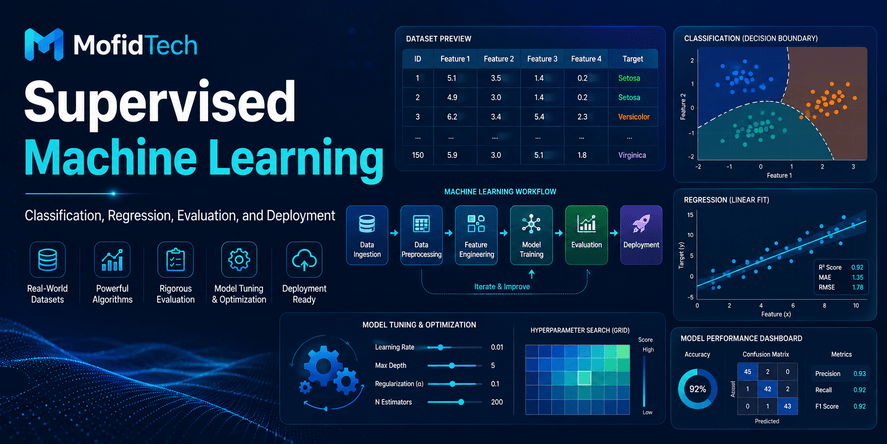
Table of Contents
1
Chapter 1 — Introduction to Machine Learning
2
Chapter 2 — Understanding Supervised Learning
3
Chapter 3 — The Complete Supervised Learning Workflow
4
Chapter 4 — Defining the Machine Learning Problem
5
Chapter 5 — Loading and Inspecting Data
6
Chapter 6 — Exploratory Data Analysis
7
Chapter 7 — Cleaning the Dataset
8
Chapter 8 — Feature and Target Preparation
9
Chapter 9 — Splitting the Dataset Correctly
10
Chapter 10 — Numerical Feature Preprocessing
11
Chapter 11 — Encoding Categorical Features
12
Chapter 12 — Preprocessing Pipelines
13
Chapter 13 — Baseline Models
14
Chapter 14 — Logistic Regression
15
Chapter 15 — K-Nearest Neighbors Classification
16
Chapter 16 — Decision Tree Classification
17
Chapter 17 — Ensemble Classification Models
18
Chapter 18 — Support Vector Machines
19
Chapter 19 — Linear Regression
20
Chapter 20 — Regularized Regression
21
Chapter 21 — Tree-Based Regression
22
Chapter 22 — Confusion Matrix and Basic Metrics
23
Chapter 23 — Probability-Based Classification Evaluation
24
Chapter 24 — Regression Metrics
25
Chapter 25 — Residual Analysis
26
Chapter 26 — Underfitting and Overfitting
27
Chapter 27 — Cross-Validation
28
Chapter 28 — Feature Engineering
29
Chapter 29 — Feature Selection
30
Chapter 30 — Hyperparameter Tuning
31
Chapter 31 — Handling Imbalanced Classification
32
Chapter 32 — Designing a Fair Model Comparison
33
Chapter 33 — Final Test Evaluation
34
Chapter 34 — Global Model Interpretation
35
Chapter 35 — Local Prediction Explanation
36
Chapter 36 — Error Analysis and Robustness
37
Chapter 37 — Fairness and Ethical Considerations
38
Chapter 38 — Model Persistence
39
Chapter 39 — Building a Basic Prediction Application
40
Chapter 40 — Monitoring a Supervised Model