Introduction
AI agents are evolving from systems that generate answers into systems that perform actions.
A conventional chatbot may summarize a document or answer a question. An AI agent may go much further. It can retrieve customer information, update a business record, send a message, create a support ticket, interact with a software repository, query a database, call an external API, delegate work to another agent, or initiate a sensitive workflow.
Once an AI system can act, identity and authorization become fundamental security requirements.
The system must be able to answer several questions reliably:
- Which agent is making the request?
- Who owns and operates that agent?
- Is the agent acting independently or for a user?
- Which user or service authorized the action?
- What resources may the agent access?
- Which operations may it perform?
- Does the action require human approval?
- Can the agent delegate the task to another agent?
- How can its authority be revoked?
- How will investigators determine what happened afterward?
A secure AI agent should never receive broad access simply because it can reason about a task. The language model can propose an action, but a separate security layer must decide whether the action is permitted.
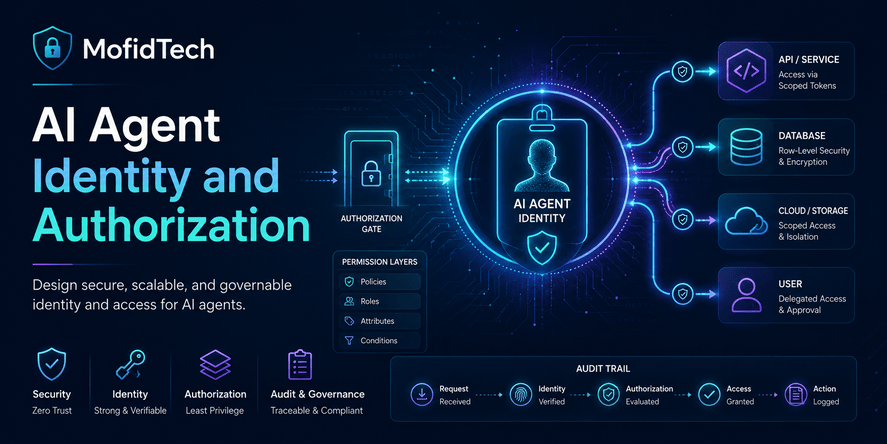
AI agent identity and authorization is the practice of giving each agent a verifiable identity, restricting it to explicitly approved actions and resources, preserving the authority of the user it represents, and recording enough evidence to make every sensitive action accountable.
This subject is becoming an important area of standards and platform development. In February 2026, NIST launched an AI Agent Standards Initiative focused on secure and interoperable agents that can act on behalf of users. NIST’s National Cybersecurity Center of Excellence is also exploring standards-based approaches for identifying agents and authorizing their access and actions.
Microsoft and Google have introduced agent-specific identity capabilities, while OWASP’s 2026 guidance highlights identity and privilege abuse as a major category of agentic security risk. These developments show that agent identity is emerging as a distinct architecture concern rather than merely another use of a shared API key or generic service account.
This guide explains how to design identity and authorization for AI agents without relying on any particular programming language, cloud provider, or agent framework.
Table of Contents
- What is AI agent identity?
- Authentication, authorization, delegation, and attribution
- Why traditional access models are not always enough
- The identities involved in an agent action
- Choosing an agent identity model
- Applying least privilege
- Designing the authorization architecture
- Acting as the agent versus acting for a user
- Managing credentials securely
- Adding human approval boundaries
- Securing tools, APIs, and MCP servers
- Securing multi-agent delegation
- Building an agent identity lifecycle
- Designing auditability and accountability
- Comparing authorization models
- Real-world use cases
- Common mistakes
- Performance and reliability considerations
- Troubleshooting authorization failures
- Production security checklist
- Frequently asked questions
- Conclusion
What Is AI Agent Identity?
An AI agent identity is a unique, verifiable representation of an agent within an identity and access management system.
It allows applications, APIs, tools, databases, and other agents to distinguish one agent from another. It should also connect the agent to relevant governance information, including:
- its owner;
- its purpose;
- its environment;
- its risk classification;
- its allowed tools;
- its approved data scope;
- its credential status;
- its creation date;
- its expiration or review date;
- and its current operational state.
A strong identity answers the question, “Which specific agent is making this request?”
A weak identity merely shows that a request came from somewhere inside an application or cloud environment.
Microsoft describes agent identities as specialized identity accounts that provide unique identification and authentication capabilities for AI agents. Google similarly describes agent identities as identities tied to agent workloads and their lifecycle, with cryptographic credentials that can be used to access resources.
An Agent Identity Is More Than a Name
Giving an agent a display name such as “Sales Assistant” does not create a secure identity.
A secure identity normally requires:
- a unique identifier that cannot be confused with another agent;
- credentials that prove possession of the identity;
- a trusted issuer or identity provider;
- attributes describing ownership and purpose;
- policies defining permitted actions;
- and lifecycle controls for suspension, review, and removal.
The display name helps humans understand the agent. The unique technical identity helps systems make security decisions.
Agent Identity Versus Agent Personality
Identity should not be confused with the agent’s persona, prompt, name, tone, or behavioral instructions.
A system prompt may tell an agent that it is a financial assistant. That statement does not prove that the agent has financial permissions.
Similarly, an agent may claim that it is acting for an administrator. The target system must verify that claim through trusted identity and authorization information rather than accepting text generated by the model.
Prompts influence behavior. Identity systems establish trust.
Agent Class Versus Agent Instance
Many organizations will need to distinguish between an agent design and an individual running agent.
An agent class, template, or blueprint defines common characteristics such as:
- purpose;
- expected tools;
- standard permission boundaries;
- owner type;
- risk level;
- and deployment requirements.
An agent instance is a particular deployed agent created from that design.
For example, an organization may define a customer-support agent blueprint but deploy separate agent identities for different departments, tenants, geographic regions, or customers.
This separation improves governance because administrators can update common rules while still tracking each deployed agent independently.
Authentication, Authorization, Delegation, and Attribution
These terms are closely related, but they answer different security questions.
| Concept | Main Question | Agent Example |
|---|---|---|
| Identification | Who claims to be acting? | The request claims to come from Support Agent 42 |
| Authentication | Can that identity be verified? | The agent presents a trusted credential |
| Authorization | Is this action permitted? | The agent may read a ticket but may not issue a refund |
| Delegation | Whose authority is being used? | The agent is acting for a specific support employee |
| Consent | Has the user approved access? | The user allowed access to selected documents |
| Approval | Must a human confirm this action now? | A manager approves a high-value refund |
| Attribution | Who ultimately caused the action? | The log identifies the agent, user, policy, and tool |
| Accountability | Can responsibility be investigated? | The organization can reconstruct the full decision chain |
What Is AI Agent Authentication?
AI agent authentication is the process of proving that an agent is the identity it claims to be.
Authentication may be based on:
- workload identity;
- managed identity;
- signed credentials;
- short-lived access tokens;
- certificates;
- hardware-backed identity;
- or another cryptographic mechanism.
The important point is that the proof should come from a trusted security mechanism, not from model-generated text.
What Is AI Agent Authorization?
AI agent authorization is the process of determining whether an authenticated agent may perform a particular action on a particular resource under the current conditions.
A robust authorization decision may consider:
- the agent identity;
- the represented user;
- the requested action;
- the target resource;
- the resource owner;
- the tenant;
- the environment;
- the purpose of the task;
- the sensitivity of the data;
- the time of the request;
- the agent’s risk level;
- the delegation chain;
- and whether approval has been granted.
Authentication proves who the agent is. Authorization determines what it may do.
What Is Delegated Authorization?
Delegated authorization allows an agent to act using limited authority granted by a user, service, or organization.
The agent should receive only the authority needed for the requested task. It should not automatically inherit every permission held by the user.
For example, an employee may have permission to view thousands of internal documents. An agent helping that employee prepare one report may require access to only a particular project folder for a limited time.
What Is Attribution?
Attribution connects an action to all relevant actors.
A useful audit record may show that:
- a user requested the task;
- a particular agent accepted it;
- the agent used a specific delegated permission;
- a policy engine approved the operation;
- a human confirmed a high-risk step;
- and a particular tool performed the final change.
Without attribution, an organization may know that “the AI system” performed an action but not which agent, user, permission, or workflow was responsible.
Why Traditional Application Identity Models Are Not Always Enough
Many existing identity technologies can be reused for AI agents. However, simply treating an agent as an ordinary application may overlook important differences.
Agents Can Choose Actions Dynamically
Traditional applications usually follow predefined workflows. A button triggers a known operation, and the application executes logic written by developers.
An AI agent may select tools, determine task order, adapt its plan, interpret unstructured information, and retry operations. This flexibility increases the number of possible action paths.
Authorization must therefore protect the actual tool invocation and resource operation, not merely the initial user request.
Agents Can Combine Harmless Permissions Into Harmful Outcomes
A permission may appear safe when considered individually.
For example, an agent may be allowed to:
- read internal documents;
- access a messaging tool;
- and contact external recipients.
Together, these capabilities may allow confidential data to be sent outside the organization.
Authorization design must consider combinations of permissions, not only individual permissions.
Agents Can Be Influenced by Untrusted Content
An agent may process emails, web pages, files, support tickets, API responses, or messages from other agents. These sources may contain misleading or malicious instructions.
A secure architecture assumes that model reasoning can be manipulated. It therefore prevents the model from directly deciding its own permissions.
OWASP’s agentic security guidance includes risks involving goal hijacking, tool misuse, identity and privilege abuse, insecure inter-agent communication, and rogue behavior. These risks reinforce the need for independent security controls around agent execution.
Agents May Operate Continuously
A human user normally interacts during a visible session. An agent may continue working after the user leaves, respond to events automatically, or execute scheduled tasks.
This creates questions about:
- how long delegated authority remains valid;
- whether the original user still has access;
- whether the task is still relevant;
- and when the agent must request renewed approval.
Agents May Delegate to Other Agents
A primary agent may ask another agent to perform research, access a specialist tool, or complete part of a workflow.
Each delegation can blur accountability and expand the effective permission set. The receiving agent must not automatically obtain all privileges held by the original agent or user.
Agents Can Be Created at Large Scale
Organizations may eventually operate hundreds or thousands of agents. Some may be official, experimental, externally developed, user-created, inactive, or duplicated.
Without a central inventory, agent identities can become a new form of unmanaged non-human identity.
OWASP’s Non-Human Identities Top 10 emphasizes the broader security challenges associated with machine identities throughout the development and operational lifecycle.
The Identities Involved in an Agent Action
A single agent action may involve several distinct identities.
Secure systems should preserve these identities rather than merging them into one generic account.
The Human User
The user initiates, requests, approves, or benefits from the action.
The user identity may determine:
- which organizational data is available;
- what consent has been granted;
- which business role applies;
- and whether the user is allowed to request the task.
The Agent
The agent is the software actor selecting and coordinating operations.
The agent identity determines:
- whether the agent is trusted;
- who owns it;
- which tools it may use;
- which environments it may access;
- and what risk controls apply.
The Agent Owner
The owner is responsible for the agent’s business purpose and operational use.
This may be:
- a department;
- a product team;
- an individual employee;
- a vendor;
- or a service provider.
Ownership should not be left blank. An identity without an accountable owner is difficult to review, renew, investigate, or retire.
The Agent Operator
The operator maintains the agent’s infrastructure, model configuration, tools, monitoring, or deployment.
The owner and operator may be different. A business department may own the agent, while a platform team operates it.
The Authorization Server or Identity Provider
This system authenticates identities and issues credentials or authorization decisions.
It may manage:
- users;
- agents;
- applications;
- groups;
- roles;
- policies;
- and delegated access.
The Policy Decision Point
The policy decision point evaluates whether the requested action should be allowed.
It receives relevant facts and returns a decision such as:
- permit;
- deny;
- permit with conditions;
- or require approval.
The Tool or Resource Server
The target tool performs the actual operation.
Examples include:
- a CRM platform;
- an email service;
- a database;
- a cloud management API;
- a file repository;
- a payment system;
- or an MCP server.
The target should enforce authorization rather than assuming that the agent already checked its own permissions.
The Sub-Agent
A sub-agent receives delegated work from another agent.
It needs its own identity and should receive a limited delegation describing:
- the requested task;
- permitted resources;
- permitted actions;
- expiration;
- and delegation restrictions.
Choosing an Agent Identity Model
There is no single identity model that fits every agent. The appropriate design depends on how the agent operates.
Model 1: The Agent Acts Only as Itself
The agent uses its own identity and its own permissions.
This model is suitable for:
- background maintenance;
- monitoring;
- system-generated reports;
- scheduled data processing;
- or operations owned by a service rather than a specific user.
The agent’s authority remains separate from human accounts.
Advantages:
- clear attribution;
- predictable permissions;
- easier revocation;
- and reduced dependence on user sessions.
Risks:
- permissions may become overly broad;
- users may request actions they themselves are not allowed to perform;
- and the agent may accumulate permanent access.
Model 2: The Agent Acts on Behalf of a User
The agent uses delegated user authority.
This model is suitable when access depends on the user’s identity, such as:
- reading personal email;
- accessing the user’s documents;
- managing the user’s calendar;
- or interacting with user-specific business records.
The target system should be able to identify both the agent and the user.
Google’s agent identity documentation distinguishes between agents acting with their own authority and agents operating on behalf of an end user.
Advantages:
- access follows user boundaries;
- consent can be represented;
- and user-specific data remains separated.
Risks:
- the agent may inherit too much authority;
- user permission changes may not be reflected quickly;
- and attribution may be lost if only the user identity is recorded.
Model 3: The Agent Uses Combined Authority
The agent must satisfy both agent-level and user-level rules.
An operation is allowed only when:
- the user is allowed to request it;
- the agent is approved to perform it;
- the target resource permits it;
- and the current context satisfies policy.
This is often the strongest model for enterprise agents.
A user with access to financial records should not automatically be able to use an unapproved agent to export them. Similarly, an approved financial agent should not access records for a user who lacks permission.
Model 4: The Agent Uses Task-Specific Authority
The agent receives a temporary authorization for one task.
The authorization may define:
- a specific objective;
- permitted resources;
- permitted operations;
- an expiration time;
- a maximum number of actions;
- and whether further delegation is allowed.
This model is useful for sensitive or temporary workflows.
It limits damage if the credential is exposed or the agent deviates from its intended task.
Recommended Default
For most business agents, use combined authority with task-specific restrictions:
- authenticate the agent;
- authenticate the user or service initiating the task;
- verify that both are permitted;
- issue narrowly scoped temporary authority;
- check every sensitive action;
- and preserve both identities in audit records.
How to Apply Least Privilege to AI Agents
Least privilege means giving an identity only the access required to complete its approved purpose.
For AI agents, least privilege should apply across several dimensions.
Limit the Available Tools
An agent should not be able to discover or call every tool available in the organization.
A customer-support agent may require access to:
- support tickets;
- customer profiles;
- approved knowledge sources;
- and a restricted refund workflow.
It probably does not require access to:
- production infrastructure;
- employee payroll;
- software deployment;
- or organization-wide file storage.
Reducing the tool set also reduces the number of harmful action combinations.
Limit Operations Within Each Tool
Access to a tool should not imply permission to use every operation.
Separate capabilities such as:
- read;
- search;
- create;
- update;
- delete;
- publish;
- approve;
- export;
- invite;
- and execute.
An agent that summarizes records may need read access but not modification or deletion rights.
Limit Resources
Permissions should identify the permitted resource scope.
Possible boundaries include:
- one tenant;
- one customer;
- one project;
- one repository;
- one folder;
- one database view;
- one cloud subscription;
- or one geographic region.
Broad tool access with no resource boundary is rarely least privilege.
Limit Data Categories
Not all fields within a resource have the same sensitivity.
An agent may need:
- a customer’s name and order status;
- but not payment details;
- health information;
- identity documents;
- or internal fraud indicators.
Field-level filtering and data minimization can reduce exposure even when the agent is allowed to access a record.
Limit Time
Permanent access should not be the default for temporary work.
Use:
- short-lived credentials;
- temporary grants;
- scheduled expiration;
- just-in-time access;
- and periodic reauthorization.
Shorter authority windows reduce the value of stolen credentials and abandoned sessions.
Limit Purpose
Authorization can consider why the agent is requesting access.
For example, the same agent may be permitted to read customer records for resolving a support case but not for generating an unrelated marketing list.
Purpose restrictions are difficult to enforce using the model’s statement alone. They should be supported by workflow context, task identifiers, resource boundaries, and policy rules.
Limit Delegation
An agent should not automatically be allowed to pass its authority to another agent.
Delegation rules should define:
- whether delegation is permitted;
- which agents may receive work;
- which permissions may be transferred;
- the maximum delegation depth;
- and whether the user must approve the delegation.
Limit the Number and Value of Actions
For high-impact workflows, policies can restrict:
- transaction amount;
- number of records;
- number of recipients;
- frequency;
- total data volume;
- or total financial exposure.
An agent permitted to issue small refunds should not automatically be able to issue thousands of refunds.
Use Deny by Default
When required information is missing, the safest decision is normally to deny the action or request clarification.
The agent should not receive permission simply because:
- the policy is ambiguous;
- the resource was not classified;
- ownership is unclear;
- or the system cannot verify the delegation.
NIST’s zero-trust guidance emphasizes accurate, least-privilege, per-request access decisions rather than implicit trust based on network location or ownership. This approach maps naturally to AI agents that operate across tools and environments.
Designing the Agent Authorization Architecture
A secure agent architecture separates planning from permission enforcement.
Step 1: The User or System Requests a Task
The request should establish:
- who initiated it;
- the intended purpose;
- the target resources;
- and any relevant business context.
An unclear task should not result in broad authority.
Step 2: The Agent Creates a Proposed Plan
The model may determine which tools and actions appear necessary.
This plan is useful for execution, but it is not an authorization decision.
The plan may be incorrect, manipulated, incomplete, or excessively broad.
Step 3: The System Converts the Plan Into Structured Actions
Before execution, the system should identify:
- the requested tool;
- the exact operation;
- the target resource;
- the expected data movement;
- the represented user;
- and the potential impact.
Security policies work better with structured facts than with free-form model explanations.
Step 4: The Policy Layer Evaluates the Request
The authorization layer evaluates the action independently.
Possible results include:
- allow;
- deny;
- require a narrower scope;
- require user confirmation;
- require manager approval;
- or require stronger authentication.
Step 5: The System Issues or Uses Restricted Authority
The agent should receive only the credentials needed for the approved operation.
Avoid exposing general-purpose credentials directly to the model or its conversation context.
Step 6: The Tool Enforces the Decision
The target system should verify:
- the credential;
- the agent identity;
- the user delegation;
- the requested operation;
- and the resource scope.
A tool should not trust an unsigned statement saying that another component already approved the request.
Step 7: The Result Is Recorded and Returned
The audit trail should record the important security context.
The agent then receives only the information necessary for the next approved step.
Keep Policy Enforcement Outside the Model
The model may assist with classification or risk estimation, but it should not be the sole authority for security decisions.
A model can be influenced by:
- prompt injection;
- misleading tool descriptions;
- poisoned memory;
- manipulated documents;
- incorrect reasoning;
- or adversarial agent messages.
Deterministic policy controls should enforce the final boundary.
Acting as the Agent Versus Acting on Behalf of a User
One of the most important design decisions is determining whose authority applies.
When the Agent Should Use Its Own Identity
Use agent-owned authority when:
- the task belongs to a system process;
- the operation is not user-specific;
- the agent has a clearly defined organizational role;
- and permissions can be assigned directly to the agent.
Examples include:
- generating a daily operations report;
- checking application health;
- categorizing new support requests;
- or synchronizing approved data sources.
When the Agent Should Use Delegated User Authority
Use delegated authority when:
- the resource belongs to the user;
- access depends on the user’s role;
- user consent is required;
- or the action must be attributed to a particular person.
Examples include:
- reading a user’s private documents;
- scheduling a meeting;
- replying from a user’s mailbox;
- or updating a record that the user is authorized to manage.
Preserve Both Identities
The target system should not see only the user or only the agent.
Ideally, it should know:
- which agent is calling;
- which user the agent represents;
- which application or organization owns the agent;
- and what delegated scope applies.
This prevents an unapproved agent from using legitimate user permissions.
Never Let Delegation Expand Authority
The delegated permission should be no broader than the authority held by the delegator.
The effective permission should be the intersection of:
- what the user may do;
- what the agent may do;
- what the task allows;
- what the resource permits;
- and what current policy approves.
The result should never be the combined union of every available permission.
Recheck Authority During Long Tasks
A user’s access may change while an agent is working.
The system should reconsider authorization when:
- the task runs for a long period;
- the user’s account is disabled;
- the user changes roles;
- the resource classification changes;
- the agent’s permissions are updated;
- or the action becomes more sensitive than originally expected.
Managing Credentials Securely
Credentials prove identity and enable access. They are therefore high-value targets.
Avoid Shared Credentials
When multiple agents use the same credential:
- actions cannot be attributed accurately;
- one compromise affects every agent;
- permissions cannot be tailored;
- and revocation may interrupt unrelated services.
Each meaningful agent instance or security boundary should have a distinct identity.
Prefer Short-Lived Credentials
Short-lived credentials reduce the period during which stolen authority can be abused.
They also encourage systems to:
- reauthenticate regularly;
- reflect permission changes;
- verify current policy;
- and limit abandoned access.
OAuth security best-practice guidance addresses modern threats and recommends stronger patterns than older, less secure modes of operation. Agent systems using delegated authorization should follow current standards rather than creating proprietary token mechanisms without careful security review.
Use Workload Identity Where Possible
Workload identity allows the runtime environment to prove which workload is running without storing a permanent secret inside the application.
SPIFFE defines identities for workloads, while SPIRE can attest workloads and issue verifiable identity documents. This approach helps reduce dependence on static credentials distributed with application deployments.
Keep Credentials Out of Model Context
Credentials should never be placed in:
- system prompts;
- user prompts;
- agent memory;
- retrieved documents;
- tool descriptions;
- model-visible logs;
- or error messages returned to the model.
The execution environment should apply credentials after the action has been authorized.
The agent may know that a tool is available, but it should not need to see the underlying secret.
Separate Credentials by Environment
Development, testing, staging, and production agents should use different identities and credentials.
A testing agent should not inherit production access merely because both deployments use the same model or agent definition.
Rotate and Revoke Credentials
Credential management should include:
- automatic rotation;
- expiration;
- compromise response;
- emergency revocation;
- and validation that revoked credentials stop working promptly.
Protect Third-Party Credentials
Agents often connect to external services that do not support modern workload identity.
Where static secrets are unavoidable:
- store them in a dedicated secret manager;
- restrict which runtime can retrieve them;
- avoid exposing them to the model;
- monitor their use;
- rotate them regularly;
- and create separate credentials for different agents.
Adding Human Approval Boundaries
Human approval is useful when an action is difficult to reverse, has significant impact, or requires judgment beyond automated policy.
It should not be added indiscriminately.
Actions That Commonly Require Approval
Consider approval for:
- financial transfers;
- high-value refunds;
- production deployments;
- deletion of important data;
- account suspension;
- permission changes;
- external publication;
- legal or contractual communication;
- bulk messaging;
- access to highly sensitive information;
- and actions with safety implications.
Approval Should Be Specific
A user should understand exactly what is being approved.
A useful approval request should explain:
- the proposed action;
- the target resource;
- the affected records;
- the recipient;
- the estimated impact;
- why the agent recommends it;
- and whether it can be reversed.
Avoid vague requests such as “Allow the agent to continue.”
Approval Should Be Bound to the Action
Approval for one operation should not become permanent permission for unrelated future actions.
The approval should be linked to:
- a particular task;
- a particular action;
- a particular scope;
- an expiration;
- and the approved parameters.
Approval Does Not Replace Authorization
A user may approve an operation they are not allowed to perform.
The system must still verify:
- the approver’s identity;
- the approver’s authority;
- the agent’s authority;
- and organizational policy.
Avoid Approval Fatigue
If users must approve every minor read operation, they may stop reviewing requests carefully.
Use risk-based approval:
| Risk Level | Example | Typical Treatment |
|---|---|---|
| Low | Read a public knowledge article | Automatic |
| Moderate | Update a reversible internal draft | Automatic with logging or optional confirmation |
| High | Send an external message or modify important data | Explicit confirmation |
| Critical | Delete production data or transfer funds | Strong authentication and authorized human approval |
Support Rejection and Modification
Approvers should be able to:
- reject the action;
- reduce its scope;
- change the target;
- modify the amount;
- or request additional information.
Human-in-the-loop design is more useful when people can shape the decision rather than merely press “approve.”
Securing Tools, APIs, and MCP Servers
Tools are the execution layer through which agents affect real systems.
Their security should not depend on the model behaving correctly.
Treat Every Tool as a Protected Resource
Each tool should define:
- supported operations;
- required permissions;
- resource boundaries;
- input constraints;
- output restrictions;
- and audit requirements.
Use Operation-Level Authorization
Do not grant a generic permission called “use CRM.”
Separate permissions such as:
- search customers;
- view contact information;
- update support status;
- issue a refund;
- export records;
- and delete an account.
Validate Parameters After Authorization
An agent may be authorized to use an operation but still provide unsafe parameters.
The tool should validate:
- resource identifiers;
- amounts;
- recipients;
- file paths;
- record limits;
- time ranges;
- and data formats.
Minimize Tool Responses
A tool should return only the information required by the task.
For example, a customer search should not return every available profile field when the agent only needs an order status.
This limits accidental exposure through:
- model context;
- logs;
- memory;
- and subsequent tool calls.
Protect Against the Confused-Deputy Problem
A confused deputy occurs when a component with legitimate authority is manipulated into using that authority for an unauthorized purpose.
An agent may become a confused deputy when:
- an untrusted document instructs it to access another system;
- an external user causes it to call an internal API;
- or a sub-agent asks it to perform an operation outside the original task.
The system should preserve the initiating identity and purpose across the entire workflow.
Authorization for MCP Servers
The Model Context Protocol provides a standardized way for agents and applications to interact with tools and contextual resources. Its authorization guidance uses established OAuth-based patterns for protected remote servers.
The official MCP documentation recommends authorization when servers access user-specific data, require consent, need per-user auditing, or expose sensitive operations. Protected MCP servers operate as resource servers and validate access tokens rather than trusting the agent’s request alone.
Do Not Assume Every MCP Server Is Trusted
Before connecting an agent to an MCP server, assess:
- who operates it;
- how it authenticates clients;
- which tools it exposes;
- what data it returns;
- how often it changes;
- whether tool descriptions can be modified;
- whether actions are logged;
- and how credentials are protected.
An external tool server can become part of the agent’s trusted execution path.
Separate Tool Discovery From Tool Authorization
An agent may know that a tool exists without being authorized to call it.
Tool discovery helps planning. Authorization determines actual access.
This distinction allows a system to present available capabilities while maintaining strict runtime enforcement.
Securing Multi-Agent Delegation
Multi-agent systems introduce additional trust boundaries.
Give Every Agent a Distinct Identity
When all agents share one identity, the receiving system cannot determine:
- which agent initiated the action;
- which agent delegated it;
- which agent performed it;
- or where a failure occurred.
Distinct identities support investigation and fine-grained policy.
Pass a Restricted Delegation
A parent agent should not send its full credential to a sub-agent.
Instead, the receiving agent should obtain limited authority describing:
- the assigned task;
- permitted resources;
- permitted operations;
- expiration;
- and whether further delegation is allowed.
Preserve the Delegation Chain
The system should be able to reconstruct:
- who initiated the original task;
- which agent accepted it;
- which agent delegated a subtask;
- which sub-agent performed the operation;
- and which policy authorized the final action.
Restrict Delegation Depth
Unlimited delegation makes authority difficult to track.
A policy may allow:
- no delegation;
- one level of delegation;
- delegation only to approved agents;
- or delegation only for particular low-risk tasks.
Prevent Transitive Trust
Agent A trusting Agent B does not mean that Agent A should trust every agent that Agent B trusts.
Each boundary should authenticate and authorize the immediate request while preserving the original context.
Verify Capabilities, Not Reputation Alone
An agent should not receive authority simply because it belongs to a trusted department or vendor.
The receiving system should verify the specific capability required for the action.
Protect Inter-Agent Messages
Messages between agents may contain:
- task instructions;
- sensitive data;
- delegated authority;
- action results;
- or approval evidence.
Protect their confidentiality and integrity, authenticate the sender, and reject replayed or expired delegations.
OWASP identifies insecure inter-agent communication and identity or privilege abuse among the major risks affecting agentic applications.
Building an Agent Identity Lifecycle
Security must cover the full life of an agent, not only its authentication at runtime.
Phase 1: Request
Before creating an identity, document:
- the business purpose;
- the intended users;
- the owner;
- the operator;
- the required tools;
- the required data;
- the risk classification;
- and the expected lifetime.
Phase 2: Approval
Relevant stakeholders should review:
- whether the agent is necessary;
- whether its proposed scope is reasonable;
- whether an existing agent can perform the function;
- and whether the data and actions require additional controls.
Phase 3: Registration
Register the agent in a central inventory.
The registry should include:
- unique identifier;
- display name;
- owner;
- operator;
- environment;
- model or platform;
- tools;
- permissions;
- creation date;
- review date;
- status;
- and incident contact.
Phase 4: Credential Issuance
Issue credentials through an approved identity system.
Prefer credentials that are:
- workload-bound;
- short-lived;
- automatically rotated;
- and protected from direct model access.
Phase 5: Deployment Validation
Before enabling the agent, verify:
- its identity;
- its permissions;
- its tool boundaries;
- its approval requirements;
- its logging;
- and its revocation procedure.
Phase 6: Continuous Monitoring
Monitor:
- unusual resources;
- unexpected tools;
- authorization denials;
- abnormal action volume;
- unusual delegation;
- access outside expected hours;
- credential failures;
- and deviations from the agent’s registered purpose.
Phase 7: Periodic Review
Review permissions when:
- the agent changes purpose;
- a new tool is added;
- the owner changes;
- the organization restructures;
- the model or framework changes;
- a security incident occurs;
- or the scheduled review date arrives.
Phase 8: Suspension
Administrators should be able to suspend an agent quickly without deleting evidence.
Suspension is useful during:
- incident investigation;
- ownership uncertainty;
- unusual behavior;
- or planned maintenance.
Phase 9: Retirement
Retirement should include:
- revoking credentials;
- removing permissions;
- disabling integrations;
- preserving required audit records;
- transferring or deleting retained data;
- and marking the identity as retired.
A retired identity should not be silently reused for a new agent.
Designing Auditability and Accountability
Agent systems require more than conventional request logs.
The goal is to reconstruct the complete path from human intent to system action.
What Should Be Recorded?
For sensitive operations, consider recording:
- timestamp;
- agent identity;
- agent owner;
- represented user;
- initiating application;
- task identifier;
- delegation chain;
- requested tool;
- requested action;
- target resource;
- authorization decision;
- policy version;
- approval evidence;
- credential identifier;
- action result;
- and correlation identifier.
Record Decisions, Not Hidden Reasoning
Organizations do not need to store unrestricted model reasoning to create accountability.
A better audit record includes structured information such as:
- the action proposed;
- the business reason supplied;
- the relevant policy;
- the decision;
- the approver;
- and the final result.
This is easier to search, protect, and interpret.
Protect the Audit System
An agent should not be able to alter or delete its own security logs.
Use:
- restricted write paths;
- tamper-evident storage;
- retention policies;
- access separation;
- and monitoring for missing records.
Avoid Logging Excessive Sensitive Data
Logs can become a second source of exposure.
Avoid recording complete:
- prompts;
- documents;
- credentials;
- personal data;
- financial records;
- or tool responses
unless they are genuinely required.
Record identifiers, classifications, summaries, hashes, and decision metadata where possible.
Use Correlation Across Agents and Tools
A single task identifier should follow the workflow across:
- the user interface;
- the main agent;
- sub-agents;
- policy services;
- tools;
- APIs;
- and approval systems.
This enables end-to-end investigation.
Define Accountability Before an Incident
For each agent, determine:
- who owns the business outcome;
- who maintains the platform;
- who reviews access;
- who investigates suspicious activity;
- and who can disable the agent.
Accountability cannot be created retroactively from incomplete logs.
Comparing Authorization Models for AI Agents
Most organizations will combine several authorization models.
| Model | How It Works | Strength | Limitation | Suitable Use |
|---|---|---|---|---|
| Role-Based Access Control | Permissions are assigned through roles | Simple and familiar | Roles can become broad | Stable organizational functions |
| Attribute-Based Access Control | Decisions use attributes of users, agents, resources, and context | Fine-grained and flexible | Policies can become complex | Multi-tenant and sensitive systems |
| Policy-Based Access Control | Central policies evaluate each request | Consistent governance | Requires reliable context | Enterprise agent platforms |
| Capability-Based Access | The agent receives a limited capability for an action or resource | Strong task-level restriction | Capability management requires care | Delegation and temporary tasks |
| Relationship-Based Access Control | Access depends on relationships such as owner, member, or manager | Natural for shared resources | Relationship data must be accurate | Collaboration platforms |
| Just-in-Time Access | Permissions are activated temporarily | Reduces standing privilege | Can add operational friction | High-risk administrative actions |
| Risk-Adaptive Access | Controls change based on current risk | Responds to context | Risk scoring may be imperfect | Sensitive and dynamic environments |
Role-Based Access Control
Roles are a reasonable starting point.
Examples include:
- support agent;
- reporting agent;
- deployment agent;
- or compliance-review agent.
However, a role should not become a substitute for resource-level restrictions.
Attribute-Based Access Control
Attribute-based decisions can consider:
- agent purpose;
- owner;
- user department;
- resource sensitivity;
- tenant;
- location;
- time;
- risk level;
- and approval status.
This model is well suited to complex agent workflows.
Capability-Based Authorization
A capability represents explicit authority to perform a limited operation.
For example, an agent may receive authority to:
- update one ticket;
- access one folder;
- or process one approved transaction.
Capabilities are useful for delegation because they can be narrower than the agent’s general identity permissions.
Policy-Based Authorization
A centralized policy layer can create consistent rules across multiple agents and tools.
It also simplifies:
- policy review;
- audit;
- versioning;
- and emergency changes.
Recommended Combination
A practical enterprise design may combine:
- roles for broad agent classification;
- attributes for context;
- capabilities for task-specific delegation;
- just-in-time access for elevated actions;
- and centralized policy enforcement for consistency.
Real-World Use Cases
Customer-Support Agent
A support agent may need to:
- read customer profiles;
- view orders;
- update ticket status;
- and propose refunds.
It should not automatically be able to:
- export the entire customer database;
- change user passwords;
- access employee records;
- or issue unlimited refunds.
A secure model may allow small, policy-compliant refunds automatically while requiring approval for larger or unusual amounts.
Coding Agent
A coding agent may require:
- access to selected repositories;
- permission to create branches;
- permission to propose changes;
- and access to test results.
Production deployment, secret management, permission changes, and destructive repository operations should use separate authority and stronger approval.
The agent should not receive organization-wide repository access because it works on one project.
Data-Analysis Agent
A data agent may need to query approved datasets and generate reports.
Security controls should restrict:
- available tables;
- sensitive columns;
- row-level access;
- export volume;
- and use of personal information.
The agent may receive aggregated data rather than raw records.
Financial Agent
A financial agent may:
- categorize expenses;
- prepare invoices;
- identify anomalies;
- and recommend payments.
Actual transfers should require:
- restricted destination accounts;
- amount limits;
- authorized approval;
- and strong audit records.
IT Operations Agent
An operations agent may monitor services, restart approved components, or open incidents.
Changes to:
- network policies;
- identity systems;
- production databases;
- backups;
- or encryption settings
should use elevated, temporary authority and human approval.
Personal Productivity Agent
A personal agent may access:
- email;
- calendar;
- files;
- and communication tools.
It should use user-specific delegated authority with clear consent and limited scopes.
Sending external messages, sharing files, or deleting events may require confirmation.
Multi-Tenant SaaS Agent
A SaaS agent serving multiple organizations must maintain strict tenant isolation.
The tenant context should be enforced by trusted application and authorization layers, not inferred from conversational text.
A request from one tenant must never cause the agent to retrieve or modify another tenant’s data.
Common AI Agent Identity and Authorization Mistakes
Using One Shared Identity for Every Agent
This prevents accurate attribution and creates excessive impact when the credential is compromised.
Giving the Agent the User’s Full Permissions
An agent usually needs only a subset of the user’s authority for a specific task.
Treating Authentication as Authorization
A valid identity does not imply permission to perform every operation.
Trusting the System Prompt as a Security Boundary
Prompts are behavioral instructions, not enforceable access-control policies.
Checking Permission Only at the Beginning
Long and adaptive workflows require authorization at sensitive execution points.
Allowing the Model to Select Its Own Credentials
Credential selection should be controlled by trusted execution and policy components.
Exposing Secrets to the Model
Anything placed in model context may appear in logs, memory, output, or subsequent tool requests.
Using Permanent Credentials for Temporary Tasks
Standing access increases the impact of compromise and abandonment.
Losing the User Identity During Delegation
The target should know both the agent and the represented user when user authority is involved.
Allowing Unlimited Sub-Agent Delegation
Each delegation expands the attack surface and weakens attribution.
Granting Broad Tool Access
Tool-level permission should be divided by operation, resource, data type, and risk.
Ignoring Agent Ownership
Every production agent should have an accountable business owner and an operational contact.
Failing to Retire Old Identities
Inactive agents can retain unnoticed access long after the original project ends.
Recording Incomplete Audit Logs
Logs that show only the final API call cannot explain the agent, user, approval, and delegation path that caused it.
Performance and Reliability Considerations
Security controls must be reliable enough that teams do not bypass them.
Reduce Authorization Latency Carefully
Per-action authorization adds processing time, but caching decisions indefinitely creates risk.
Cache only when:
- policy permits it;
- the scope is unchanged;
- the decision has a short lifetime;
- and revocation can still take effect promptly.
Avoid Repeated User Prompts
The system should remember valid task-specific approvals for their permitted duration.
Do not repeatedly ask for the same approval, but do not silently broaden it.
Design for Authorization Service Failure
When the authorization service is unavailable, sensitive actions should fail safely.
A system may permit carefully defined low-risk operations during limited outages, but it should not default to broad access.
Keep Policies Understandable
Extremely complicated policies can create:
- inconsistent decisions;
- difficult troubleshooting;
- and accidental privilege.
Use clear ownership, documentation, testing, and policy review.
Prevent Retry Loops
An agent may repeatedly retry a denied action.
The execution layer should:
- return a clear denial reason;
- tell the agent whether narrower access may succeed;
- limit retries;
- and escalate when necessary.
Reflect Permission Changes Quickly
Revocation should take effect within a defined maximum period.
Long-lived sessions and cached permissions should not allow a disabled identity to continue acting indefinitely.
Troubleshooting AI Agent Authorization Problems
The Agent Is Authenticated but Access Is Denied
Possible causes include:
- the agent lacks the required role;
- the represented user lacks access;
- the task scope does not include the resource;
- the credential has expired;
- the environment is incorrect;
- approval is missing;
- or the operation is not permitted for that agent class.
Check the full decision context rather than only the login result.
The Agent Can Access Too Much Data
Review:
- tool scopes;
- resource filters;
- tenant enforcement;
- field-level access;
- inherited roles;
- and shared credentials.
Test what the agent can access directly, not merely what the interface displays.
Actions Cannot Be Attributed to a Specific Agent
This usually indicates:
- shared identity;
- missing agent identifiers;
- lost delegation context;
- or incomplete correlation across tools.
Assign distinct identities and propagate task identifiers through the workflow.
Revoked Access Still Works
Possible causes include:
- long-lived tokens;
- cached decisions;
- sessions not checked again;
- duplicate credentials;
- or permissions granted through another group or role.
Define how quickly revocation must propagate and test that requirement.
A Sub-Agent Receives Excessive Permissions
Check whether the parent agent is forwarding:
- its original credential;
- broad user authority;
- or unrestricted tool access.
Replace this with task-specific delegated authority.
Users Receive Too Many Approval Requests
Review whether:
- low-risk actions can be automated;
- multiple related actions can be presented as one transparent plan;
- approval remains valid for a clearly defined task;
- or policies are creating unnecessary escalation.
The Agent Repeats a Denied Operation
Provide structured denial information that explains:
- which policy blocked the action;
- whether a narrower scope is possible;
- whether approval is required;
- and whether the action should stop permanently.
AI Agent Permission Matrix
Before deploying an agent, document its permissions in a structured matrix.
| Area | Questions to Answer |
|---|---|
| Identity | Does the agent have a unique identity? |
| Owner | Who is accountable for its business use? |
| Operator | Who maintains and monitors it? |
| Purpose | What exact outcome is it approved to achieve? |
| Users | Which users or systems may invoke it? |
| Tools | Which tools may it discover and call? |
| Operations | Which read, create, update, delete, approve, or export actions are allowed? |
| Resources | Which tenants, projects, folders, records, or environments are in scope? |
| Data | Which data categories and fields may it access? |
| Delegation | May it act for a user or delegate to another agent? |
| Credentials | What credential type and lifetime apply? |
| Approval | Which operations require human confirmation? |
| Limits | What amount, volume, frequency, or recipient limits apply? |
| Logging | Which events and decisions must be recorded? |
| Monitoring | Which behaviors should trigger alerts? |
| Review | How often are permissions reviewed? |
| Revocation | Who can disable the identity, and how quickly? |
| Retirement | How are credentials and integrations removed? |
Production Security Checklist
Identity
- Assign a unique identity to every meaningful production agent.
- Record the owner, operator, purpose, and environment.
- Distinguish agent templates from deployed instances.
- Maintain a central inventory.
- Prevent silent identity reuse.
Authentication
- Use trusted, cryptographic authentication.
- Prefer workload identity or managed identity.
- Avoid shared credentials.
- Use short-lived credentials.
- Rotate credentials automatically where possible.
- Keep credentials outside model context.
Authorization
- Deny access by default.
- Check permission at the time of sensitive actions.
- Limit tools, operations, resources, data, time, and volume.
- Combine agent authority with user authority where appropriate.
- Enforce policy outside the language model.
- Apply resource and tenant isolation at the target system.
Delegation
- Preserve the represented user.
- Preserve the full delegation chain.
- Never delegate broader authority than the sender holds.
- Use task-specific authority.
- Restrict delegation depth.
- Authenticate every participating agent.
Human Approval
- Identify irreversible and high-impact operations.
- Show the exact action and impact.
- Bind approval to a specific task.
- Verify the approver’s authority.
- Prevent approval reuse outside its original scope.
- Reduce approval fatigue through risk-based rules.
Tools and APIs
- Treat every tool as a protected resource.
- Authorize at operation level.
- Validate parameters.
- Minimize returned data.
- Restrict external integrations.
- Review MCP servers and other tool providers before trust.
Audit and Monitoring
- Record agent and user identities.
- Record policy decisions and approvals.
- Use correlation identifiers.
- Protect logs against modification.
- Avoid unnecessary sensitive content in logs.
- Alert on unusual tools, resources, volumes, or delegation.
Lifecycle
- Review permissions periodically.
- Suspend suspicious agents quickly.
- Revoke credentials during incidents.
- Remove access when ownership changes.
- Retire inactive identities.
- Preserve required investigation evidence.
Frequently Asked Questions
What is an AI agent identity?
An AI agent identity is a unique, verifiable security identity assigned to an AI agent. It allows systems to authenticate the agent, assign permissions, record ownership, monitor activity, and revoke access independently from other users or applications.
Does every AI agent need a separate identity?
Every production agent that represents a distinct security, ownership, tenant, or operational boundary should normally have a separate identity. Small internal components may share a parent identity when they are truly one workload, but sharing should not prevent required attribution or permission separation.
How is AI agent authentication different from authorization?
Authentication proves which agent is making a request. Authorization determines whether that authenticated agent may perform a particular operation on a particular resource under the current conditions.
Should an AI agent use the permissions of its human user?
An agent should not automatically receive every permission held by the user. It should receive only the subset required for the approved task, and the system should verify that both the user and the agent are allowed to perform the action.
What is delegated authorization for AI agents?
Delegated authorization allows an agent to act with limited authority granted by a user, service, or organization. The delegation should define the permitted task, resources, operations, duration, and whether further delegation is allowed.
Can an API key be used as an AI agent identity?
An API key may identify an application, but static shared keys often provide weak attribution, difficult rotation, broad access, and limited lifecycle control. Workload identities, managed identities, certificates, or short-lived tokens are generally stronger choices for production agents.
What does least privilege mean for an AI agent?
Least privilege means restricting the agent to the minimum tools, operations, resources, data fields, time period, action volume, and delegation rights necessary for its approved purpose.
Should every agent action require human approval?
No. Human approval should focus on high-risk, irreversible, unusual, or externally consequential actions. Excessive confirmation creates fatigue and reduces attention. Low-risk, reversible operations can often be automated under clear policy and monitoring.
How can prompt injection affect authorization?
Prompt injection may influence the agent’s reasoning or cause it to request an unsafe tool action. It should not be able to change the agent’s actual permissions because authorization must be enforced independently by trusted policy and tool layers.
How should agent-to-agent delegation be secured?
Each agent should have a distinct identity. Delegation should use limited task-specific authority, preserve the original user and parent agent, restrict further delegation, expire quickly, and be recorded in the audit trail.
What should an AI agent audit log contain?
A useful log should contain the agent identity, represented user, task identifier, tool, operation, target resource, policy decision, approval evidence, delegation chain, timestamp, and result. It should avoid unnecessary credentials and sensitive content.
How quickly should an agent’s access be revoked?
Revocation should take effect within a defined period appropriate to the agent’s risk. High-impact agents may require near-immediate suspension. Credential lifetimes, session caching, and policy caching must be designed to meet that requirement.
Can a service account be used for an AI agent?
A dedicated service account may be appropriate in some architectures, particularly when the agent acts only as itself. It should not be shared broadly, and it should have clear ownership, narrow permissions, short-lived credentials where possible, monitoring, and a complete lifecycle.
How often should agent permissions be reviewed?
Review frequency should reflect risk. High-impact agents may require frequent automated monitoring and regular formal reviews. Every agent should also be reviewed when its owner, purpose, tools, model, data scope, or deployment environment changes.
What is the safest default when authorization context is missing?
Deny the action or request clarification. Missing ownership, identity, tenant, resource, delegation, or approval information should not result in automatic access.
Conclusion
AI agent security begins with a simple principle: an agent that can act must be identifiable, restricted, observable, and revocable.
A secure architecture does not trust an agent merely because it produced a convincing explanation or received a valid user request. It independently verifies:
- which agent is acting;
- who authorized the task;
- which user is represented;
- which resources are in scope;
- which action is requested;
- whether the action requires approval;
- and whether the resulting activity can be investigated.
The strongest designs give agents unique identities, use short-lived credentials, apply least privilege across tools and data, preserve delegation context, enforce authorization outside the model, and maintain reliable audit trails.
Organizations should also treat agent identity as a lifecycle discipline. Creating an identity is only the beginning. Permissions must be reviewed, behavior monitored, credentials rotated, ownership maintained, incidents investigated, and inactive agents retired.
AI agents can deliver significant productivity and automation benefits, but their autonomy must not become unbounded authority.
The goal is not to prevent agents from acting. It is to ensure that every action occurs within a clear, enforceable, and accountable security boundary.
💬 Comments
No comments yet. Be the first to comment!
Login to comment.