Introduction
AI applications are no longer simple experiments running inside isolated notebooks. Modern AI systems often depend on external models, third-party APIs, vector databases, training datasets, fine-tuning data, cloud services, open-source libraries, prompt templates, evaluation workflows, guardrails, monitoring tools, and human review processes. This creates a new kind of supply chain risk.
A traditional software application already needs dependency visibility. An AI application needs even more transparency because its behavior can depend on data, model versions, inference settings, retrieval sources, safety filters, and changing external services. This is where an AI Bill of Materials becomes important.
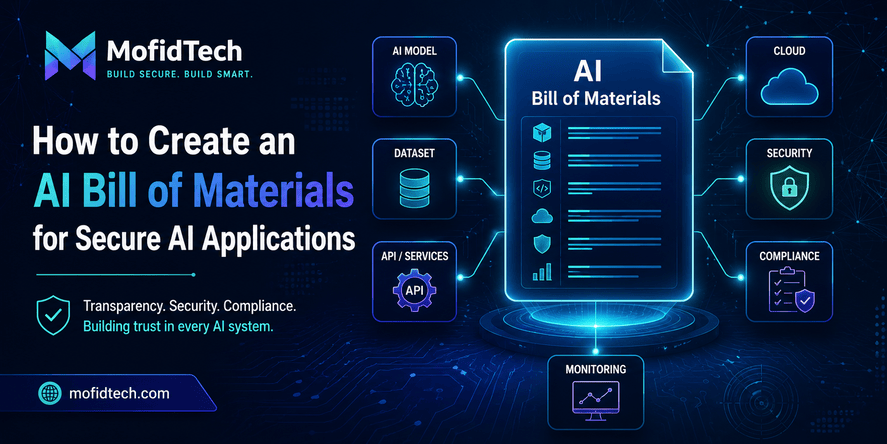
An AI Bill of Materials, often called AIBOM, AI BOM, AI SBOM, or SBOM for AI, is a structured inventory of the components that make an AI system work. OWASP describes an AIBOM as a structured, machine-readable inventory of AI components such as models, datasets, agent tools, guardrails, runtime elements, origin evidence, rights, integrity, and evaluation information.
In 2026, this topic is becoming more important because AI systems are moving into production environments where security, accountability, auditability, and compliance matter. CISA published “Software Bill of Materials for AI - Minimum Elements” on May 12, 2026, showing that AI component transparency is becoming a practical security concern, not only a theoretical governance idea.
This article explains how to create an AI Bill of Materials for secure AI applications without going into code. You will learn what an AIBOM is, how it differs from a traditional SBOM, what information it should contain, how to build one step by step, what mistakes to avoid, and how it helps developers, security teams, and organizations manage AI risk.
Table of Contents
- What Is an AI Bill of Materials?
- Why AI Applications Need an AIBOM
- AIBOM vs SBOM: What Is the Difference?
- What Should an AI Bill of Materials Include?
- How to Create an AI Bill of Materials Step by Step
- Practical AIBOM Example Scenarios
- Security Considerations for AIBOM
- Performance and Operational Considerations
- Common Mistakes When Creating an AIBOM
- Best Practices for Maintaining an AIBOM
- Troubleshooting AIBOM Problems
- AIBOM Checklist for Developers
- FAQ About AI Bill of Materials
- Conclusion
What Is an AI Bill of Materials?
An AI Bill of Materials is a structured inventory of the important components, data sources, models, services, dependencies, ownership details, risks, and security controls used in an AI system.
In simple terms, it answers this question:
What exactly is inside this AI application, where did each component come from, who owns it, what risks does it introduce, and how is it controlled?
A good AIBOM helps teams understand the real composition of an AI application. It is not only a list of software libraries. It also documents the AI-specific parts of the system, including models, datasets, prompts, embeddings, retrieval sources, inference providers, evaluation methods, safety mechanisms, and operational responsibilities.
Simple Definition of AIBOM
An AI Bill of Materials is a formal record that documents the components and risks of an AI system across its lifecycle.
It can include:
| Area | What It Documents |
|---|---|
| Models | Model name, version, provider, purpose, ownership, limitations |
| Data | Training data, fine-tuning data, retrieval data, sensitive data exposure |
| Dependencies | Libraries, frameworks, APIs, external services |
| Runtime | Where and how the model runs |
| Security | Access control, monitoring, abuse prevention, known weaknesses |
| Governance | Owner, reviewer, approval status, update history |
| Evaluation | Test results, quality checks, safety checks, limitations |
The goal is not to create paperwork for the sake of paperwork. The goal is to create visibility.
Without visibility, teams cannot properly secure, maintain, audit, or improve AI systems.
Why the Word “Materials” Matters
The word “materials” comes from the idea of a Bill of Materials in manufacturing and software supply chain security. In manufacturing, a bill of materials lists the parts needed to build a product. In software, an SBOM lists software components and dependencies. In AI, the materials are broader because the behavior of the system depends not only on software, but also on models, data, configuration choices, retrieval sources, and external AI services.
For example, two applications may use the same web framework and the same cloud provider, but they may behave completely differently if they use different language models, different datasets, different prompts, different guardrails, and different retrieval sources. An AIBOM helps capture those differences.
Why AI Applications Need an AIBOM
AI applications need an AIBOM because their risks are often hidden across many layers: software, data, models, APIs, human workflows, infrastructure, and third-party providers.
A normal application can fail because of a vulnerable dependency, a misconfigured server, or a broken authentication flow. An AI application can fail for those same reasons, but it can also fail because of unsafe model behavior, poor data provenance, prompt injection, data leakage, outdated embeddings, hallucinated outputs, biased data, weak evaluation, or uncontrolled third-party model changes.
AI Systems Are Supply Chains
An AI application is rarely built from one component. It usually combines many moving parts:
- A model or several models
- A model provider
- A training or fine-tuning process
- A dataset or knowledge base
- A retrieval layer
- A vector database
- Prompt templates
- Safety instructions
- Guardrails
- Evaluation workflows
- User feedback loops
- External APIs
- Monitoring and logging tools
- Human approval workflows
Each of these parts can introduce risk. If the team does not know what is included, it cannot properly secure the system.
AIBOM Helps With Trust
Trust in AI does not come only from saying that a system is “secure” or “responsible.” Trust comes from evidence.
An AIBOM provides evidence that the team understands what the system uses, where its components come from, what risks exist, and how those risks are managed.
This is useful for:
- Internal security reviews
- Customer trust
- Vendor assessments
- Compliance preparation
- Incident response
- AI governance
- Deployment approval
- Model replacement decisions
- Data protection reviews
AIBOM Helps Teams Move From AI Experimentation to Production
Many AI projects start as experiments. A team tests a model, connects it to a dataset, builds a prototype, and demonstrates a useful feature. The problem appears when that prototype becomes part of a real product.
Production AI requires stronger discipline. Teams need to know:
- Which model is being used
- Whether the model is hosted internally or externally
- What data is sent to the model
- Whether sensitive data is exposed
- Whether the provider can use submitted data for training
- Whether the model output is evaluated
- Whether logs contain confidential information
- Whether the system can be audited later
- Whether someone owns the risk
An AIBOM helps answer these questions before the AI system becomes too complex to manage.
AIBOM vs SBOM: What Is the Difference?
An SBOM focuses mainly on software components. An AIBOM expands that idea to include AI-specific components such as models, datasets, prompts, embeddings, guardrails, inference services, evaluation results, and AI risk controls.
CycloneDX describes AI/ML-BOM capabilities as a way to represent information about models, datasets, dependencies, dataset provenance, training methodologies, and AI framework configuration.
SBOM Focus
A traditional Software Bill of Materials usually answers questions such as:
- What software components are included?
- What open-source libraries are used?
- What versions are installed?
- What licenses apply?
- Are any components vulnerable?
- Who supplied the software?
- How can security teams track dependency risk?
This is still important for AI applications because AI applications are also software applications.
AIBOM Focus
An AI Bill of Materials goes further. It answers questions such as:
- Which AI model is being used?
- Who provides or owns the model?
- What model version is deployed?
- What dataset was used for training, fine-tuning, or retrieval?
- What is the source and license of the data?
- What sensitive data may be processed?
- What prompts or system instructions guide the model?
- What guardrails are used?
- What evaluations were performed?
- What limitations are known?
- What human oversight exists?
- What happens if the model changes?
Comparison Table: SBOM vs AIBOM
| Topic | SBOM | AIBOM |
|---|---|---|
| Main purpose | Software dependency transparency | AI system transparency |
| Main components | Libraries, packages, software modules | Models, datasets, prompts, embeddings, APIs, guardrails |
| Security focus | Vulnerable dependencies, license risks, supply chain risk | Model risk, data risk, AI misuse, prompt injection, leakage, bias, provenance |
| Lifecycle scope | Build, deployment, maintenance | Data collection, training, fine-tuning, deployment, inference, monitoring |
| Key users | Developers, DevOps, security teams | Developers, AI engineers, security teams, data teams, compliance teams |
| Typical output | Software component inventory | AI system component and risk inventory |
| Still needed in AI apps? | Yes | Yes, as an extension for AI-specific risk |
The best approach is not to choose between SBOM and AIBOM. A secure AI application often needs both. The SBOM shows the software supply chain. The AIBOM shows the AI supply chain.
What Should an AI Bill of Materials Include?
An effective AIBOM should include enough information to help a team understand, secure, operate, evaluate, and audit an AI application. It should be detailed, but not so complex that nobody updates it.
1. Application Identity
Start with basic information about the AI application.
Include:
- Application name
- Business purpose
- Main users
- Owner or responsible team
- Production status
- Risk level
- Last review date
- Deployment environment
- Main AI capabilities
This section helps readers understand the context. An AI assistant used for internal document search does not have the same risk level as an AI system used for medical triage, credit decisions, legal analysis, or automated security response.
2. Model Inventory
The model inventory is one of the most important parts of the AIBOM.
Document:
- Model name
- Model provider
- Model version
- Model family or type
- Hosting model: internal, external, managed, or self-hosted
- Purpose of the model
- Input data types
- Output data types
- Known limitations
- License or usage restrictions
- Approval status
- Replacement plan if the model becomes unavailable
For example, a team may use one model for chat responses, another for embeddings, another for classification, and another for moderation. Each model should be documented separately.
3. Dataset Inventory
AI systems depend heavily on data. The AIBOM should clearly document the datasets used by the system.
Include:
- Dataset name
- Dataset source
- Dataset owner
- Dataset purpose
- Data collection method
- Data freshness
- Data sensitivity
- Licensing or contractual restrictions
- Personal data considerations
- Data quality review
- Bias or representativeness concerns
- Retention and deletion rules
Dataset documentation is especially important for systems using retrieval-augmented generation, internal knowledge bases, fine-tuning, customer data, logs, or user feedback.
4. Retrieval and Knowledge Sources
Many AI applications use retrieval systems to provide the model with context. This may include documents, help center articles, product data, legal policies, internal notes, or database-derived content.
Document:
- Knowledge source name
- Source owner
- Update frequency
- Access restrictions
- Data classification
- Retrieval scope
- Review process
- Known gaps
- Data expiration rules
- Whether sensitive information is included
This matters because retrieval sources can change the answer generated by the AI system. If the knowledge base is outdated, incomplete, or unauthorized, the AI output may become unreliable or risky.
5. Prompt and Instruction Inventory
Prompts are part of the AI system design. They influence model behavior and should be documented.
Include:
- Purpose of the system instructions
- Main behavior rules
- Safety instructions
- Refusal rules
- Style and tone requirements
- User role assumptions
- Prompt owner
- Prompt review process
- Prompt change history
- Known weaknesses
You do not need to expose sensitive internal prompts publicly. But internally, teams should know which instructions control the AI system and who is responsible for maintaining them.
6. External AI Services and APIs
Many AI products depend on external providers. The AIBOM should document every external service that affects the AI workflow.
Include:
- Provider name
- Service purpose
- Data shared with the provider
- Region or hosting location if relevant
- Retention policy
- Training usage policy
- Security assurances
- Contractual restrictions
- Availability dependency
- Fallback plan
This is critical because a third-party AI service can affect security, privacy, compliance, reliability, and cost.
7. Dependencies and Software Components
Even though AIBOM goes beyond SBOM, software dependencies still matter.
Document:
- AI frameworks
- Model serving tools
- Vector database technology
- Data processing tools
- Monitoring systems
- Authentication systems
- Logging systems
- Deployment platform
- Security scanning tools
- Critical software libraries
This section helps connect AIBOM with traditional software supply chain security.
8. Security Controls
An AIBOM should include the controls used to reduce AI-related risk.
Include:
- Authentication and authorization controls
- Data access restrictions
- Sensitive data filtering
- Prompt injection protections
- Output validation
- Human review requirements
- Abuse monitoring
- Rate limiting
- Logging and alerting
- Incident response owner
- Model usage restrictions
Security controls should not be described only in general language. The AIBOM should make clear which controls exist, where they apply, and who is responsible for them.
9. Evaluation and Testing Results
AI applications should not be deployed only because they “seem to work.” They should be evaluated.
Document:
- Quality evaluation method
- Safety evaluation method
- Security testing
- Bias or fairness review if relevant
- Hallucination checks
- Regression testing
- Red-team testing if performed
- Human review results
- Known failure cases
- Acceptance criteria
The NIST AI Risk Management Framework organizes AI risk work around functions such as Govern, Map, Measure, and Manage, which reinforces the importance of measuring and managing risk rather than relying on assumptions.
10. Ownership and Governance
An AIBOM is useful only if someone owns it.
Document:
- Product owner
- Technical owner
- Security owner
- Data owner
- Model owner
- Reviewers
- Approval process
- Update frequency
- Escalation path
- Incident contact
AI risk often becomes dangerous when responsibility is unclear. AIBOM helps prevent the “everyone assumed someone else was responsible” problem.
How to Create an AI Bill of Materials Step by Step
Creating an AIBOM does not need to be complicated at the beginning. The best approach is to start with a clear inventory, then improve it over time.
Step 1: Define the AI System Boundary
Start by deciding what system the AIBOM covers.
Ask:
- Is this AIBOM for one AI feature, one application, or one platform?
- Does it include internal tools?
- Does it include external AI providers?
- Does it include data pipelines?
- Does it include monitoring and evaluation?
- Does it include human review workflows?
A clear boundary prevents confusion. For example, if your application has an AI chatbot, an AI search feature, and an AI document summarizer, you may create one AIBOM for the whole application or separate AIBOMs for each feature.
Step 2: Identify All AI Models
List every model used by the system.
Do not document only the main language model. Also include:
- Embedding models
- Classification models
- Moderation models
- Reranking models
- Translation models
- Speech-to-text models
- Text-to-speech models
- Vision models
- Fine-tuned models
- Internally trained models
- Third-party hosted models
Each model should have a purpose. If nobody can explain why a model is included, the team should review whether it is still needed.
Step 3: Document Model Provenance
Model provenance means understanding where the model came from and how it entered the system.
For each model, document:
- Provider
- Source
- Version
- License
- Approval date
- Review status
- Known limitations
- Update policy
- Change notification process
This is important because model changes can affect application behavior. If a provider updates a model silently or deprecates a version, your application may behave differently even if your own code did not change.
Step 4: Document Data Sources
Next, list the data sources that influence AI behavior.
This may include:
- Training data
- Fine-tuning data
- Retrieval documents
- User-uploaded files
- Internal knowledge bases
- Customer support conversations
- Product catalogs
- Policies
- Logs
- Feedback data
For each source, document ownership, sensitivity, freshness, access rules, and quality controls.
Step 5: Identify Data Sensitivity
Not all data has the same risk.
Classify data based on sensitivity:
| Data Type | Risk Level | Example Concern |
|---|---|---|
| Public data | Low | Accuracy and freshness |
| Internal business data | Medium | Unauthorized disclosure |
| Customer data | High | Privacy and contractual obligations |
| Personal data | High | Data protection compliance |
| Secrets or credentials | Critical | Immediate security exposure |
| Legal, medical, or financial data | Critical | High-impact decision risk |
The AIBOM should make it clear whether sensitive data is sent to an external model, stored in logs, included in retrieval, or used for evaluation.
Step 6: Map the AI Workflow
Describe how information moves through the AI system.
A simple workflow description should answer:
- What does the user provide?
- What preprocessing happens?
- What data is retrieved?
- Which model receives the input?
- What output is generated?
- What validation occurs?
- What is logged?
- What is shown to the user?
- When is a human involved?
This does not require code. A plain-language workflow is often more useful for security and compliance reviewers.
Step 7: List Security and Safety Controls
For each major risk, document the control.
For example:
| Risk | Possible Control |
|---|---|
| Prompt injection | Input analysis, retrieval restrictions, instruction hierarchy, output review |
| Sensitive data leakage | Data classification, masking, access control, logging restrictions |
| Hallucinated output | Source attribution, confidence indicators, human review for high-impact use |
| Unauthorized access | Role-based permissions, identity checks, audit logs |
| Unsafe automation | Human approval, restricted actions, transaction limits |
| Vendor dependency | Provider review, fallback plan, version monitoring |
A good AIBOM does not only list risks. It links risks to controls.
Step 8: Add Evaluation Evidence
Document how the system was tested before deployment.
Include:
- Test scenarios
- Expected behavior
- Failure cases
- Human review results
- Safety review
- Security review
- Known limitations
- Open issues
- Approval status
Evaluation evidence helps future teams understand why the system was considered acceptable at the time of release.
Step 9: Assign Ownership
Every important component should have an owner.
Ownership should cover:
- Model ownership
- Dataset ownership
- Security ownership
- Product ownership
- Legal or compliance review
- Operations ownership
- Incident response ownership
If an AI system fails, leaks data, generates unsafe output, or violates policy, the organization must know who investigates and who decides the response.
Step 10: Review and Update Regularly
An AIBOM is not a one-time document.
Update it when:
- A model changes
- A dataset changes
- A provider changes
- A new AI feature is added
- A prompt is significantly modified
- A security control changes
- A new risk is discovered
- An incident occurs
- A compliance requirement changes
- The system moves from prototype to production
A stale AIBOM can create false confidence. It is better to have a simple AIBOM that is regularly updated than a perfect AIBOM that nobody maintains.
Practical AIBOM Example Scenarios
Scenario 1: AI Customer Support Chatbot
An AI customer support chatbot may use a language model, a help center knowledge base, customer account context, moderation filters, and escalation rules.
The AIBOM should document:
- The chat model
- The retrieval sources
- Whether customer data is sent to the model
- How user authentication is handled
- What logs are stored
- How unsafe responses are prevented
- When a human agent takes over
- How help center content is updated
- What happens if the model provider is unavailable
This is important because support chatbots often touch customer data and business policies.
Scenario 2: Internal AI Document Search
An internal AI search system may index company documents and answer employee questions.
The AIBOM should document:
- Document sources
- Access permissions
- Embedding model
- Retrieval system
- Data classification
- Search result filtering
- Logging policy
- Unauthorized access prevention
- Document freshness
- Department ownership
The biggest risk is often not the model itself, but access control. If the retrieval system ignores document permissions, employees may receive answers based on documents they should not be able to view.
Scenario 3: AI Code Review Assistant
An AI code review assistant may analyze source code, summarize changes, identify risks, and suggest improvements.
The AIBOM should document:
- Model provider
- Whether private code is sent to external services
- Repository access rules
- Logging restrictions
- Security review limitations
- Supported languages and frameworks
- Human approval process
- Known false positive and false negative risks
This is especially important because source code can contain intellectual property, credentials, architecture details, and security-sensitive information.
Scenario 4: AI-Powered Content Recommendation System
A content recommendation system may use user behavior data, ranking models, content metadata, and personalization rules.
The AIBOM should document:
- Model purpose
- Data sources
- User profiling logic
- Personal data use
- Evaluation metrics
- Fairness considerations
- Feedback loops
- Monitoring for harmful amplification
- Human review policies
This kind of system may create business value, but it can also introduce bias, privacy concerns, and user trust issues.
Security Considerations for AIBOM
An AIBOM is not just documentation. It is a security asset.
It helps security teams understand what must be protected, monitored, reviewed, and updated.
AI Supply Chain Security
AI supply chain security means protecting the full chain of components that influence AI behavior.
This includes:
- Model sources
- Dataset sources
- Training pipelines
- Fine-tuning workflows
- External providers
- AI frameworks
- Prompt templates
- Retrieval systems
- Vector stores
- Evaluation tools
- Deployment infrastructure
A weakness in any of these areas can affect the final system.
Model Risk
Models can introduce risk through:
- Unknown provenance
- Weak licensing clarity
- Unclear versioning
- Hidden limitations
- Unsafe output behavior
- Poor performance on certain inputs
- Dependency on external providers
- Lack of reproducibility
- Unclear update process
The AIBOM should make these risks visible.
Data Risk
Data risk is often the most serious AI risk.
Common problems include:
- Sensitive data in training data
- Personal data in logs
- Unauthorized documents in retrieval
- Poor data quality
- Outdated knowledge sources
- Unclear dataset licensing
- Unreviewed user feedback
- Data that should have been deleted
- Data collected without proper consent
An AIBOM should document both data sources and data handling rules.
Prompt Injection Risk
Prompt injection happens when a user or external content tries to manipulate the AI system’s instructions.
This is especially dangerous in systems that use retrieval, browsing, tools, plugins, or automated actions.
The AIBOM should document:
- Whether the system uses external content
- Whether retrieved content can contain malicious instructions
- Whether the model can take actions
- Whether human approval is required
- Whether output is validated
- Whether sensitive data can be exposed
Prompt injection cannot be solved only by writing better instructions. It requires architecture, access control, validation, monitoring, and safe design.
Vendor Risk
Many AI systems depend on third-party providers.
The AIBOM should document:
- What data is sent to the vendor
- Whether the vendor stores the data
- Whether the vendor can use the data for training
- What region processes the data
- What happens if the provider changes pricing
- What happens if the provider changes model behavior
- What happens if the provider has downtime
- What contractual and security guarantees exist
This helps teams avoid blind dependency on external AI services.
Performance and Operational Considerations
AIBOM is often discussed as a security and governance tool, but it also helps operations and performance.
Model Performance Visibility
Different models have different latency, cost, quality, and reliability characteristics.
An AIBOM can document:
- Which model handles which task
- Expected response time
- Known performance limits
- Cost sensitivity
- Throughput expectations
- Fallback options
- Monitoring ownership
This helps teams understand operational impact before deployment.
Dataset Freshness
For retrieval-based AI systems, data freshness can be more important than model quality.
If the system retrieves old policies, outdated prices, expired documentation, or obsolete product data, the AI output may be wrong even if the model is strong.
The AIBOM should document:
- How often knowledge sources are updated
- Who owns the update process
- How stale data is detected
- How outdated documents are removed
- Whether the system shows source dates to users
Monitoring and Incident Response
AI systems need monitoring beyond normal uptime checks.
Monitor:
- Failure rates
- Unsafe responses
- User complaints
- Escalation frequency
- Hallucination reports
- Sensitive data exposure
- Unexpected cost increases
- Provider errors
- Retrieval failures
- Abuse patterns
The AIBOM should identify who reviews monitoring results and who responds when something goes wrong.
Common Mistakes When Creating an AIBOM
Mistake 1: Treating AIBOM as Only a Compliance Document
If the AIBOM is created only to satisfy an audit, it will quickly become useless.
A good AIBOM should help developers, security teams, product owners, and operations teams make better decisions.
Mistake 2: Documenting Only the Main Model
Many teams list the main language model and forget the rest of the AI system.
But AI behavior may also depend on:
- Embedding models
- Retrieval systems
- Guardrails
- Moderation tools
- Prompt templates
- External plugins
- User feedback
- Evaluation datasets
A complete AIBOM should include all important AI components.
Mistake 3: Ignoring Data Provenance
If the team does not know where data came from, it cannot properly evaluate quality, legality, bias, or privacy risk.
Data provenance is especially important for fine-tuning, internal knowledge bases, and user-uploaded content.
Mistake 4: Forgetting Access Control
AI systems often expose information through generated answers.
Even if the underlying database or document system has permissions, the AI layer must respect them.
If access control is not documented and tested, users may receive information they should not see.
Mistake 5: Not Updating the AIBOM
An outdated AIBOM can be worse than no AIBOM because it gives teams false confidence.
The AIBOM should be updated whenever models, datasets, prompts, providers, or risk controls change.
Mistake 6: Making the AIBOM Too Complicated
Some teams try to document everything in extreme detail from day one. This can make the process too heavy and discourage updates.
Start with the most important information:
- Models
- Data sources
- External services
- Security controls
- Owners
- Known risks
- Review dates
Then improve over time.
Mistake 7: Ignoring Human Workflow
Many AI systems include human review, escalation, approval, or correction.
The AIBOM should document these workflows because they are part of the risk control system.
Mistake 8: Hiding Known Limitations
AIBOM should not be a marketing document. It should honestly document known limitations.
Examples:
- The model may hallucinate
- The system may struggle with rare cases
- The dataset may be incomplete
- The retrieval source may be outdated
- The system should not be used for final legal, financial, or medical decisions without expert review
Honest limitations improve trust and reduce misuse.
Best Practices for Maintaining an AIBOM
Keep It Close to the Product Lifecycle
The AIBOM should be part of product development, not an afterthought.
Review it during:
- Architecture planning
- Security review
- Data review
- Model selection
- Pre-production approval
- Major releases
- Incident reviews
- Vendor changes
Use Clear Ownership
Every AIBOM should have a responsible owner.
A good ownership model includes:
- Product owner for business purpose
- Technical owner for implementation
- Security owner for risk review
- Data owner for data sources
- Operations owner for monitoring
- Compliance owner if required
Use Risk Levels
Not every AI system needs the same level of documentation.
A low-risk internal writing assistant may need a simpler AIBOM than a system that influences hiring, lending, healthcare, legal decisions, or security automation.
Use risk levels to decide how deep the AIBOM should be.
Connect AIBOM With Existing Security Processes
AIBOM should not replace existing security work.
It should connect with:
- SBOM management
- Threat modeling
- Data protection reviews
- Vendor risk assessments
- Access control reviews
- Logging and monitoring
- Incident response
- Change management
- Compliance documentation
Review Third-Party AI Providers
Before relying on an external AI provider, document:
- Data handling terms
- Retention rules
- Security certifications if available
- Regional processing
- Model update policy
- Availability expectations
- Support process
- Contractual limitations
- Exit plan
Keep the AIBOM Understandable
The AIBOM should be readable by developers, security teams, product owners, and managers.
Avoid making it so technical that only one engineer understands it. The goal is shared visibility.
Troubleshooting AIBOM Problems
Problem: We Do Not Know All the AI Components
Start with discovery.
Ask each team:
- Which models are used?
- Which providers are used?
- Which datasets are used?
- Which documents are indexed?
- Which prompts control behavior?
- Which external services are called?
- Which logs are stored?
- Which users can access the feature?
You may discover shadow AI usage, forgotten prototypes, or undocumented vendor dependencies.
Problem: Nobody Owns the AIBOM
Assign ownership based on the system’s risk and importance.
For small teams, the technical lead may own it. For larger organizations, ownership may be shared between product, security, data, and platform teams.
The important point is that one accountable person or team must coordinate updates.
Problem: The Model Provider Does Not Share Enough Information
Document what is known and what is unknown.
If the provider does not disclose training data, model architecture, retention details, or evaluation results, record that as a limitation or vendor risk.
AIBOM should not pretend that unknowns do not exist.
Problem: The AIBOM Becomes Outdated Quickly
Connect AIBOM updates to release processes.
For example, update it when:
- A model changes
- A data source changes
- A prompt changes
- A vendor changes
- A security control changes
- A new AI capability is deployed
The AIBOM should evolve with the system.
Problem: Teams Think AIBOM Slows Development
Explain that AIBOM reduces future confusion.
It helps teams answer basic questions faster:
- What model are we using?
- What data is exposed?
- Who owns this feature?
- What risks are known?
- What changed since last release?
- What should we review before deployment?
A lightweight AIBOM can save time during incidents, audits, vendor reviews, and debugging.
AIBOM Checklist for Developers
Use this checklist as a practical starting point.
Application Context
- The AI feature has a clear name and purpose.
- The business owner is identified.
- The technical owner is identified.
- The system boundary is defined.
- The production status is documented.
- The risk level is assigned.
- The last review date is recorded.
Model Inventory
- All models are listed.
- Model providers are documented.
- Model versions are recorded.
- Model purposes are explained.
- Model limitations are documented.
- Hosting method is known.
- Licensing or usage restrictions are reviewed.
- Model change process is defined.
Data Inventory
- All data sources are listed.
- Dataset owners are identified.
- Data sensitivity is classified.
- Data freshness is documented.
- Personal data exposure is reviewed.
- Dataset licensing is checked.
- Data retention rules are defined.
- Data deletion process is understood.
Retrieval and Knowledge Sources
- Retrieval sources are documented.
- Access permissions are reviewed.
- Update frequency is defined.
- Source freshness is monitored.
- Sensitive documents are controlled.
- Unauthorized retrieval is prevented.
- Source quality is reviewed.
Prompt and Instruction Management
- System instructions are owned.
- Prompt purpose is documented.
- Safety rules are reviewed.
- Prompt changes are tracked.
- Known prompt weaknesses are documented.
- Human review is required for high-risk behavior.
Security Controls
- Authentication is enforced.
- Authorization is applied correctly.
- Sensitive data leakage controls exist.
- Prompt injection risk is considered.
- Output validation is defined.
- Logging avoids unnecessary sensitive data.
- Abuse monitoring is enabled.
- Incident response owner is identified.
Evaluation
- Quality tests are documented.
- Safety tests are documented.
- Security tests are documented.
- Failure cases are recorded.
- Human review results are captured.
- Acceptance criteria are clear.
- Known limitations are documented.
Operations
- Monitoring owner is assigned.
- Model availability is monitored.
- Cost risk is monitored.
- Provider dependency is reviewed.
- Fallback plan is documented.
- Update schedule is defined.
- AIBOM review process exists.
AIBOM Maturity Model
Teams do not need to become perfect immediately. A simple maturity model can help.
| Level | Description | What It Means |
|---|---|---|
| Level 1: Basic Inventory | The team lists models, datasets, and providers | Better than undocumented AI usage |
| Level 2: Risk-Aware AIBOM | The team adds risks, owners, and security controls | Useful for security review |
| Level 3: Lifecycle AIBOM | The AIBOM is updated with releases and changes | Useful for production governance |
| Level 4: Integrated AIBOM | The AIBOM connects with SBOM, monitoring, vendor review, and incident response | Strong operational value |
| Level 5: Continuous Assurance | The AIBOM supports automated checks, ongoing evaluation, and audit readiness | Mature AI governance |
Most teams should aim first for Level 2 or Level 3. That is enough to create real value without overwhelming the development process.
How AIBOM Supports AI Governance
AI governance is the process of making sure AI systems are developed, deployed, and operated responsibly.
An AIBOM supports governance because it creates a shared source of truth.
It helps answer:
- What AI systems do we have?
- Which ones are high-risk?
- Who owns each system?
- What data do they use?
- Which providers do they depend on?
- What risks are known?
- What controls are in place?
- When were they last reviewed?
Without an AIBOM, governance teams may rely on meetings, assumptions, and scattered documents. With an AIBOM, they can review structured information.
AIBOM and Risk Management
Risk management requires visibility. You cannot manage what you cannot see.
An AIBOM helps teams map AI risk across:
- Data risk
- Model risk
- Security risk
- Privacy risk
- Vendor risk
- Operational risk
- Compliance risk
- Reputational risk
This aligns naturally with AI risk management frameworks that emphasize governance, mapping, measurement, and management of AI risks.
AIBOM for Small Teams and Startups
Small teams may think AIBOM is only for large companies. That is a mistake.
A startup building an AI product can benefit from a lightweight AIBOM because it helps with:
- Investor due diligence
- Customer security questionnaires
- Enterprise sales
- Vendor review
- Incident response
- Team onboarding
- Product reliability
- Future compliance preparation
A small team does not need a complex governance platform. It can begin with a simple structured document that lists models, datasets, external providers, data risks, owners, and review dates.
The most important rule is consistency. A simple AIBOM that is maintained is more valuable than a sophisticated template that nobody updates.
AIBOM for Enterprise Teams
Enterprise teams usually need more structure.
For larger organizations, AIBOM should connect with:
- Asset inventory
- Vendor management
- Security architecture review
- Data classification
- Privacy impact assessment
- Model risk management
- Compliance workflows
- Incident response
- Audit documentation
- Change management
- Monitoring and observability
Enterprise teams should also define AIBOM requirements for internal teams and external vendors. If a vendor provides an AI product, the organization should ask what models, datasets, security controls, evaluation processes, and data handling practices are involved.
FAQ About AI Bill of Materials
1. What is an AI Bill of Materials?
An AI Bill of Materials is a structured inventory of the models, datasets, dependencies, services, prompts, guardrails, risks, owners, and controls used in an AI application. It helps teams understand what is inside the AI system and how to manage its security, reliability, and governance.
2. Is an AIBOM the same as an SBOM?
No. An SBOM focuses mainly on software components and dependencies. An AIBOM expands the idea to include AI-specific components such as models, datasets, prompts, embeddings, retrieval systems, evaluation results, and AI safety controls.
3. Why do AI applications need an AIBOM?
AI applications need an AIBOM because their behavior depends on many components beyond traditional software. Models, datasets, prompts, external providers, and retrieval sources can all introduce security, privacy, reliability, and compliance risks.
4. What should an AIBOM include?
An AIBOM should include application context, model inventory, dataset inventory, external providers, dependencies, prompts, retrieval sources, security controls, evaluation results, known limitations, owners, and update history.
5. Who should create an AIBOM?
An AIBOM should be created by the team responsible for the AI system. Developers, AI engineers, data owners, security teams, product owners, and compliance reviewers may all contribute to it.
6. How often should an AIBOM be updated?
An AIBOM should be updated whenever a model, dataset, provider, prompt, security control, deployment environment, or major AI workflow changes. It should also be reviewed periodically for production systems.
7. Does AIBOM help with AI security?
Yes. AIBOM improves AI security by making risks visible. It helps teams identify model risks, data exposure, vendor dependencies, prompt injection concerns, access control gaps, logging issues, and missing evaluation controls.
8. Can small teams use an AIBOM?
Yes. Small teams can start with a lightweight AIBOM that documents models, datasets, providers, data sensitivity, owners, and known risks. It does not need to be complex at the beginning.
9. Does AIBOM replace security testing?
No. AIBOM does not replace security testing, threat modeling, access control review, or monitoring. It supports those processes by providing a clear inventory of what needs to be reviewed and protected.
10. Is AIBOM useful for AI governance?
Yes. AIBOM is useful for AI governance because it creates a shared source of truth about AI systems, their components, owners, risks, controls, and review status.
11. What is model provenance?
Model provenance means knowing where a model came from, who created or provided it, what version is used, what license or restrictions apply, and how it entered the system. It helps teams evaluate trust and risk.
12. What is dataset provenance?
Dataset provenance means knowing where data came from, how it was collected, who owns it, how it can be used, whether it contains sensitive information, and whether it is suitable for the AI system.
Conclusion
An AI Bill of Materials is becoming an essential practice for teams building secure, reliable, and trustworthy AI applications.
As AI systems become more complex, teams need more than a list of software dependencies. They need visibility into models, datasets, prompts, retrieval sources, external providers, security controls, evaluation results, ownership, and known risks.
AIBOM helps developers and organizations answer practical questions:
- What AI components are inside the system?
- Where did the models and data come from?
- What sensitive data is processed?
- Which providers are involved?
- What risks are known?
- What controls are in place?
- Who owns each part?
- What changed over time?
The best way to start is simple. Create a basic inventory of models, data sources, providers, risks, owners, and controls. Then connect it gradually to security review, AI governance, monitoring, vendor management, and incident response.
For modern AI applications, transparency is not optional. It is part of secure engineering. A well-maintained AI Bill of Materials gives teams the visibility they need to build AI systems that are safer, easier to manage, and more trustworthy.

💬 Comments
No comments yet. Be the first to comment!
Login to comment.