Introduction
AI applications are no longer only experimental chat interfaces. They are becoming real production systems used inside SaaS products, internal business tools, customer support platforms, search engines, coding assistants, analytics dashboards, and agentic workflows. Once an AI feature moves into production, the main question changes. It is no longer only “Can the model answer?” but “Can this AI system be controlled, secured, monitored, optimized, and trusted?”
That is where the AI gateway becomes important.
An AI gateway is a control layer between your application and the AI models it uses. Instead of every part of your system calling AI providers directly, requests pass through a central gateway that can apply policies, observe behavior, route traffic, manage costs, protect sensitive data, and improve reliability.
This matters because production AI introduces problems that normal application architecture does not fully solve. AI requests can be expensive. Model behavior can be unpredictable. Prompts may contain sensitive information. Outputs may be unsafe or inaccurate. Users may abuse AI features. Different model providers may have different pricing, latency, limits, and reliability. AI agents may call tools, access data, or trigger workflows. Without a gateway, these risks are spread across the application and become difficult to control.
Cloudflare describes its AI Gateway as a way to monitor usage, costs, and errors while reducing risk and expense through caching, rate limiting, retries, and model fallbacks. Kong also positions AI gateway functionality around the full AI connectivity path, including token usage tracking, billing, and cost control across models and prompt types. These examples show a larger architectural trend: AI applications need an operational layer, not only a model integration.
This article explains what an AI gateway is, how it differs from a traditional API gateway, why it matters in production, which features it should provide, what mistakes to avoid, and how developers can design a practical AI gateway strategy without overengineering the system.
Table of Contents
- What Is an AI Gateway?
- Why Production AI Applications Need an AI Gateway
- AI Gateway vs API Gateway
- Core Responsibilities of an AI Gateway
- AI Gateway Architecture Explained
- When Does a Project Need an AI Gateway?
- AI Gateway Use Cases
- Security Benefits of an AI Gateway
- Cost Control Strategies for AI Applications
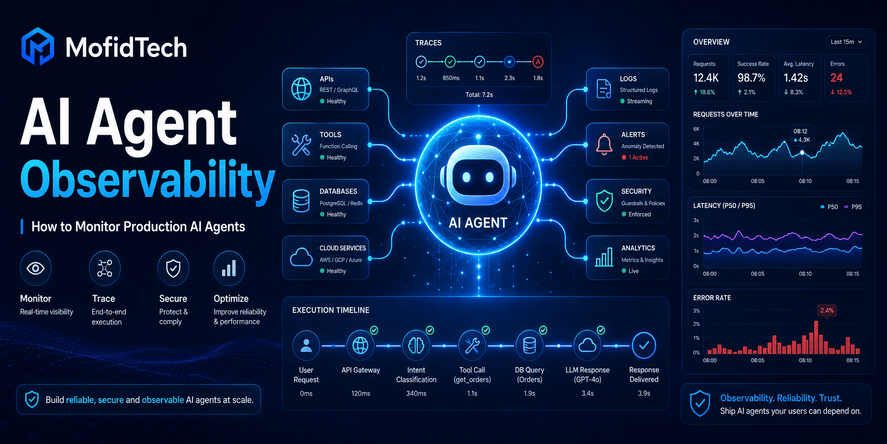
- Observability for AI Applications
- Reliability and Fallback Design
- AI Gateway Design Principles
- Common Mistakes to Avoid
- AI Gateway Checklist for Developers
- Troubleshooting AI Gateway Problems
- Comparison Tables
- FAQ
- Conclusion
What Is an AI Gateway?
An AI gateway is a centralized layer that manages traffic between your application and AI model providers. It receives AI requests from your application, applies rules, collects observability data, controls access, manages cost, and then forwards the request to the right model or provider.
In simple terms, an AI gateway gives your team one controlled entry point for AI usage.
Without an AI gateway, each feature in your application may call an AI provider directly. That can work for early prototypes, but it becomes risky as the application grows. You may lose visibility into how much each feature costs, which users generate the most requests, which prompts fail, which providers are slow, or whether sensitive data is being sent to models unnecessarily.
With an AI gateway, the application does not treat AI calls as scattered external requests. It treats AI usage as a managed platform capability.
Simple Definition for Developers
An AI gateway is a middleware layer for AI traffic.
It can answer questions such as:
- Which model should handle this request?
- Is this user allowed to use this AI feature?
- Has this team exceeded its AI budget?
- Does this prompt contain sensitive data?
- Is this request suspicious or abusive?
- Should the response be cached?
- Should the request be retried?
- Should the gateway use a fallback model if the primary model fails?
- How much did this request cost?
- How long did the model take to respond?
- Which prompt version produced this result?
This makes the AI gateway a practical control point for security, reliability, cost, and governance.
Why the Term “Gateway” Matters
The word gateway is important because it means AI traffic should not be uncontrolled.
A gateway is a boundary. It is the place where you inspect, route, allow, deny, transform, measure, and protect traffic. In traditional web systems, gateways are used to manage API requests. In AI systems, the same idea becomes even more important because AI requests carry prompts, context, user data, generated outputs, model choices, token usage, and sometimes tool execution.
AI systems are not just normal APIs with a smarter response. They involve probabilistic outputs, large context windows, variable cost, data exposure risks, and new attack surfaces such as prompt injection.
OWASP lists prompt injection as a major LLM application risk, explaining that crafted inputs can manipulate model behavior and lead to unauthorized access, data breaches, or compromised decision-making. An AI gateway does not magically solve all AI security problems, but it gives teams a central place to apply defenses and collect evidence.
Why Production AI Applications Need an AI Gateway
Production AI applications need an AI gateway because AI usage creates operational problems that are difficult to manage when every feature connects directly to model providers.
A prototype can often survive with a simple model integration. A production system cannot.
In production, teams need to answer practical questions:
- Who is using AI features?
- Which feature is responsible for the highest cost?
- Which users are sending abnormal request volumes?
- Which model gives the best balance of cost, speed, and quality?
- Which prompts fail most often?
- Which outputs require human review?
- Which model provider should be used when another is unavailable?
- Which requests should be blocked because they contain sensitive information?
- Which AI interactions must be logged for audit or debugging?
An AI gateway helps centralize these decisions.
AI Cost Can Grow Quickly
AI usage is often priced differently from normal infrastructure. A simple web page request may have a predictable cost. An AI request can vary depending on input size, output size, model choice, context length, retries, and user behavior.
If a team sends every task to the most expensive model, costs may increase without improving product quality. If a user repeatedly sends long prompts, the cost may be much higher than expected. If an application retries failed AI requests without control, costs may multiply.
An AI gateway can help by tracking usage, applying quotas, routing simple tasks to cheaper models, caching repeated responses, and enforcing budget rules.
Cloudflare’s AI Gateway documentation notes that rate limiting can prevent expensive bills and suspicious activity. Its caching documentation also explains that cached AI responses can reduce latency, reduce paid provider requests, and increase throughput for repeated requests.
AI Security Needs Central Control
AI applications often process user messages, documents, customer records, internal knowledge, source code, support tickets, business data, or retrieved context from databases. This creates serious security and privacy concerns.
An AI gateway can help enforce rules such as:
- Do not send certain data types to external models.
- Block prompts that appear malicious.
- Restrict AI features by user role.
- Log high-risk requests.
- Require approval for sensitive actions.
- Separate tenant data in multi-tenant applications.
- Prevent unauthorized access to tools or internal systems.
- Apply output filters before returning responses to users.
The gateway should not be the only security layer, but it can become a critical enforcement point.
AI Reliability Needs Fallback Planning
AI providers can be slow, unavailable, rate-limited, or inconsistent. Even when the provider is available, one model may be unsuitable for a particular task. Production systems should not fail completely because one model endpoint is overloaded or because one provider returns an error.
An AI gateway can support:
- Provider fallback
- Model fallback
- Retry rules
- Timeout policies
- Request prioritization
- Degraded-mode behavior
- Task-based routing
For example, a customer support chatbot may use a high-quality model for complex customer questions, but a smaller or cheaper model for classification, summarization, or routing. If the primary model is unavailable, the gateway can redirect certain requests to another model while preserving a consistent application interface.
AI Governance Becomes Necessary as Teams Grow
In small teams, one developer may know exactly where AI is used. In larger teams, AI features can appear across multiple products, dashboards, internal tools, and background workflows. Without governance, it becomes unclear which model is used where, which prompts are approved, and which teams are responsible for cost.
An AI gateway creates a shared control layer where teams can standardize usage, enforce policies, review logs, and manage access.
AI Gateway vs API Gateway
An AI gateway and an API gateway are related, but they are not the same thing.
An API gateway manages general API traffic. It often handles routing, authentication, rate limiting, request transformation, and service protection. An AI gateway focuses specifically on AI model traffic and adds AI-specific capabilities such as model routing, prompt logging, token tracking, cost attribution, guardrails, semantic caching, model fallback, and AI-specific observability.
Quick Comparison
| Area | API Gateway | AI Gateway |
|---|---|---|
| Main purpose | Manage API traffic | Manage AI model traffic |
| Common traffic | REST, GraphQL, microservices, backend APIs | Prompts, model requests, completions, embeddings, agent requests |
| Cost model | Usually infrastructure-based | Often token-based, request-based, or model-based |
| Observability | Latency, status codes, throughput, errors | Latency, cost, tokens, prompt versions, model quality, safety events |
| Security focus | Authentication, authorization, rate limits, API protection | Prompt safety, data leakage, model abuse, tool access, sensitive data exposure |
| Routing logic | Route to services | Route to models, providers, model tiers, or fallback paths |
| Caching | Response caching for predictable APIs | AI response caching where safe and useful |
| Governance | API consumers and service policies | Teams, users, models, prompts, providers, budgets, AI policies |
When You Need Both
Many production systems need both an API gateway and an AI gateway.
The API gateway can protect your application’s public and internal APIs. The AI gateway can manage the AI-specific path between your application and model providers. In some architectures, the AI gateway may be integrated into a broader gateway platform. In others, it may be a dedicated service focused only on AI workloads.
The important idea is separation of concerns. General API management and AI traffic governance overlap, but AI introduces additional risks and metrics that normal API gateways do not fully cover.
Core Responsibilities of an AI Gateway
A good AI gateway should do more than forward prompts to a model. It should help the team control the full lifecycle of AI requests.
Request Routing
Request routing decides where an AI request should go.
Routing can be based on:
- Task type
- User role
- Model cost
- Expected response quality
- Latency requirements
- Provider availability
- Region or data residency requirements
- Risk level
- Feature importance
For example, a summarization task may not require the same model as a legal document analysis task. A simple classification task may be routed to a smaller model, while a complex reasoning task may be routed to a more capable model.
Good routing reduces cost and improves reliability.
Model Abstraction
Model abstraction means the application does not need to know every provider-specific detail.
Instead of tightly coupling your application to one provider or one model name, the gateway can expose internal model categories such as:
- Fast model
- Low-cost model
- High-quality model
- Reasoning model
- Embedding model
- Moderation model
- Fallback model
This allows teams to change providers or model choices without rewriting every application feature.
Kong’s AI Gateway documentation describes tracking token usage across models and prompt types for billing and cost control, which reflects this larger idea of managing AI connectivity as a platform concern rather than as scattered direct calls.
Rate Limiting
Rate limiting controls how many AI requests can be made within a defined period.
This is important because AI systems are vulnerable to both accidental overuse and intentional abuse. A user may unknowingly trigger many expensive requests. A malicious actor may attempt automated abuse. A buggy application feature may create a loop of repeated AI calls.
Rate limits can be applied by:
- User
- Team
- Organization
- Application feature
- Model
- Provider
- Subscription plan
- Risk level
Rate limiting protects both cost and system availability.
Quotas and Budgets
Quotas define allowed usage. Budgets define allowed spending.
An AI gateway should help teams set limits such as:
- Maximum daily requests per user
- Maximum monthly cost per team
- Maximum usage per application feature
- Maximum output size for certain tasks
- Maximum number of premium model calls
- Separate limits for development, testing, and production
This prevents one feature, user, or team from consuming all AI resources.
Caching
Caching stores and reuses previous responses when the same or equivalent request appears again.
Caching is useful for repeated, stable, non-personalized requests. It is less suitable for sensitive, highly dynamic, personalized, or context-heavy requests.
Good AI caching can reduce cost, improve response time, and reduce provider load. However, caching must be designed carefully to avoid serving the wrong response to the wrong user or exposing private data.
Logging and Audit Trails
AI logs are essential for debugging, compliance, safety, and quality improvement.
An AI gateway can log:
- Request metadata
- User or team identity
- Model provider
- Model version or category
- Prompt template identifier
- Token usage
- Cost estimate
- Latency
- Errors
- Safety checks
- Fallback events
- Cache hits
- Output review status
Logs should be designed with privacy in mind. Sensitive prompt content should not be stored unnecessarily. When logs are needed, they should be protected, minimized, and retained only as long as necessary.
Guardrails and Policy Enforcement
Guardrails are rules that help control what enters and leaves the AI system.
Input guardrails may check for:
- Sensitive data
- Prompt injection attempts
- Abuse patterns
- Unsupported requests
- Dangerous instructions
- Excessive context size
Output guardrails may check for:
- Unsafe content
- Hallucinated policy claims
- Sensitive information
- Disallowed advice
- Untrusted actions
- Low-confidence responses
OpenAI’s safety best practices emphasize moderation, adversarial testing, and human oversight for responsible AI deployment. An AI gateway can help operationalize these practices by placing moderation, review, and policy checks into the request path.
Fallbacks and Retries
A fallback is an alternative path when the preferred model or provider fails.
Fallbacks may be triggered by:
- Provider outage
- Rate limit from provider
- Timeout
- High latency
- Repeated errors
- Model unavailability
- Safety failure
- Cost threshold
Retries should be limited and controlled. Unlimited retries can increase cost and worsen outages. A gateway should define when to retry, how often to retry, and when to stop.
Usage Analytics
Usage analytics help teams understand how AI is used across the product.
Useful analytics include:
- Cost by model
- Cost by user
- Cost by organization
- Cost by feature
- Requests by model
- Failure rate by provider
- Average latency by task
- Cache hit rate
- Fallback frequency
- Safety event frequency
- Top expensive workflows
Without analytics, teams often discover AI cost and reliability problems too late.
AI Gateway Architecture Explained
An AI gateway architecture usually contains five main layers: application, gateway, model provider, observability, and governance.
1. Application Layer
The application layer includes your web app, mobile app, backend services, internal tools, background workers, or AI agents.
This layer should not directly manage all AI policies. Its main responsibility is to send AI requests with enough context for the gateway to make good decisions.
For example, the application may identify:
- The user
- The organization
- The feature
- The task type
- The sensitivity level
- The expected response style
- The required model capability
The gateway then uses this information to apply the correct rules.
2. AI Gateway Layer
The gateway layer is the control center.
It handles:
- Authentication
- Authorization
- Request validation
- Routing
- Rate limiting
- Budget control
- Logging
- Guardrails
- Caching
- Retry behavior
- Fallback behavior
- Provider abstraction
- Policy enforcement
The gateway should be treated as critical infrastructure. If it is poorly designed, it can become a single point of failure. If it is well designed, it becomes one of the most valuable parts of the AI platform.
3. Model Provider Layer
The provider layer includes external and internal AI models.
This may include:
- Commercial LLM providers
- Cloud AI platforms
- Open-weight models hosted internally
- Embedding models
- Speech models
- Image models
- Moderation models
- Specialized domain models
A gateway should make it easier to use multiple providers without forcing every application feature to understand provider-specific details.
4. Observability Layer
The observability layer collects and analyzes AI system behavior.
It should help answer:
- Is the AI feature working?
- Is it too expensive?
- Is it too slow?
- Is the quality acceptable?
- Are users abusing it?
- Are safety policies being triggered?
- Are fallbacks happening too often?
- Are certain prompts failing repeatedly?
AI observability is not only about uptime. It is about the behavior and business impact of model usage.
5. Governance Layer
The governance layer defines who can use AI, how they can use it, and under what rules.
Governance includes:
- Access policies
- Data handling rules
- Approved model lists
- Prompt review processes
- Cost ownership
- Team budgets
- Audit requirements
- Human review rules
- Compliance requirements
The AI gateway enforces many of these rules in practice.
When Does a Project Need an AI Gateway?
A project needs an AI gateway when AI usage becomes important enough that uncontrolled model calls create risk.
Not every small experiment needs a dedicated gateway. A personal prototype or small internal proof of concept may not require a full gateway architecture. But once AI features affect users, costs, sensitive data, or business workflows, a gateway becomes valuable.
You Probably Need an AI Gateway If:
- Your application uses more than one AI model or provider.
- You have multiple AI features in the same product.
- You need to track AI cost by user, team, or customer.
- You process sensitive or private data.
- You need rate limits or quotas.
- You need fallback models or provider redundancy.
- You have internal AI tools used by employees.
- You are building AI agents that can call tools.
- You need audit logs for AI decisions.
- You need to separate development and production AI usage.
- You want consistent safety rules across all AI features.
You May Not Need a Full AI Gateway Yet If:
- The project is a small prototype.
- There is only one developer and one simple AI feature.
- No sensitive data is involved.
- AI usage is low and not business-critical.
- Cost is predictable and manually monitored.
- There is no need for multi-model routing.
Even then, it is wise to design the application so that an AI gateway can be added later without rewriting everything.
Real-World AI Gateway Use Cases
AI gateways are useful in many practical scenarios.
SaaS Applications with AI Features
A SaaS platform may offer AI writing, summarization, search, classification, customer support, and analytics. Different customers may have different usage limits based on subscription plans.
An AI gateway can enforce plan-based quotas, route tasks to appropriate models, track usage per customer, and prevent one tenant from affecting others.
Internal AI Assistants
Companies increasingly build internal assistants for HR, IT support, documentation search, knowledge management, and operations.
These assistants may access sensitive company information. An AI gateway can enforce employee access rules, prevent sensitive data leakage, log high-risk requests, and separate departments or permission levels.
AI Customer Support Systems
Customer support AI systems often handle personal information, account details, complaints, refunds, and service policies.
An AI gateway can help decide which questions can be answered automatically, which require human escalation, and which should be blocked or reviewed.
AI Search and RAG Applications
Retrieval-augmented generation systems use external content to ground AI responses. This improves usefulness, but it also creates new risks. Retrieved documents may contain outdated information, sensitive data, malicious instructions, or content from the wrong tenant.
An AI gateway can help monitor which data sources are used, apply access rules, detect risky prompts, and log retrieval behavior.
AI Coding Assistants
AI coding tools may process source code, architecture descriptions, database schemas, or internal documentation.
An AI gateway can help prevent secret leakage, restrict access to sensitive repositories, track model usage by team, and enforce approved model providers.
Agentic AI Workflows
AI agents can do more than answer. They may call tools, search documents, update records, schedule tasks, generate reports, or interact with external systems.
This makes governance much more important. A gateway can restrict which tools an agent can access, log actions, enforce approval steps, and block high-risk requests.
Google’s AI search guidance also notes the rise of agentic experiences, where AI agents can interact with websites and perform tasks on behalf of users. As agentic systems become more common, controlled gateways will become more important.
Security Benefits of an AI Gateway
An AI gateway improves AI security by giving teams a central point to enforce rules, observe risky behavior, and reduce uncontrolled data exposure.
It should not be treated as a complete security solution by itself. Instead, it should be part of a broader AI security architecture.
Prompt Injection Control
Prompt injection happens when a user or external content attempts to manipulate the model’s behavior.
This can include attempts to:
- Override system instructions
- Reveal confidential data
- Ignore safety rules
- Misuse tools
- Change the intended task
- Extract hidden prompts
- Manipulate retrieved context
OWASP identifies prompt injection as the first category in its LLM application risk list. A gateway can help reduce the risk by detecting suspicious patterns, separating trusted instructions from untrusted content, limiting tool access, and logging attempted attacks.
However, no gateway can guarantee complete protection from prompt injection. The right approach is layered defense.
Sensitive Data Protection
AI requests may include names, emails, customer messages, financial records, medical information, source code, credentials, internal policies, or business documents.
A gateway can help by:
- Detecting sensitive data before it leaves the system
- Masking or removing unnecessary data
- Restricting which models can process sensitive content
- Enforcing tenant boundaries
- Logging sensitive-data policy violations
- Blocking requests that violate company rules
The best design is data minimization: send only what the model needs to complete the task.
Access Control
Not every user should have access to every AI feature.
An AI gateway can enforce access based on:
- User role
- Organization
- Subscription plan
- Team
- Environment
- Feature flag
- Risk level
- Approval status
For example, a free user may access a limited AI assistant, while a paid business user may have higher quotas. An internal employee may use summarization but not sensitive document analysis unless they have the correct permission.
Tool Access Control for AI Agents
AI agents are powerful because they can interact with tools. They are risky for the same reason.
A gateway can restrict:
- Which tools an agent can call
- Which user actions require confirmation
- Which data sources are available
- Which actions are read-only
- Which actions are blocked in production
- Which actions require human approval
This is essential for preventing excessive agency, unauthorized actions, and unintended side effects.
Output Review and Filtering
AI outputs can contain errors, unsafe advice, private information, or unsupported claims.
A gateway can apply output policies before the response reaches the user. For high-risk use cases, the gateway may route the response to human review or display a safer fallback message.
Output validation is especially important when AI output is used downstream by other systems. OWASP warns that insecure output handling can lead to downstream security exploits when LLM outputs are not properly validated.
Cost Control Strategies for AI Applications
An AI gateway can become one of the most effective cost-control tools in a production AI system.
Track Cost by Feature
Do not only track total AI spending. Track cost by feature.
For example:
- Search assistant
- Support chatbot
- Document summarizer
- Code assistant
- Internal knowledge assistant
- Customer analytics assistant
- Background classification job
This helps teams identify which features create value and which features consume resources without enough benefit.
Route Simple Tasks to Cheaper Models
Not every task needs the most capable model.
A gateway can route simple tasks to cheaper or faster models, such as:
- Classification
- Labeling
- Short summarization
- Sentiment detection
- Language detection
- Simple rewriting
- Template-based responses
More complex tasks can be reserved for advanced models.
This model-tiering strategy can reduce cost without reducing user experience.
Apply Usage Limits
Usage limits prevent accidental or abusive spending.
Useful limits include:
- Per-user daily limits
- Per-team monthly limits
- Per-customer plan limits
- Per-feature limits
- Premium model limits
- Development environment limits
- Trial account limits
Limits should be transparent where possible. Users and teams should understand when they are approaching their quota.
Use Caching Carefully
Caching can reduce repeated AI calls, especially for stable and public information.
Good candidates for caching include:
- Repeated documentation questions
- Public product explanations
- Common help center answers
- Static educational content
- Frequently repeated classification tasks
Bad candidates include:
- Personal user data
- Private customer data
- Highly dynamic content
- Sensitive business information
- Responses that depend on fresh context
- Tenant-specific answers unless isolation is guaranteed
Caching should always respect privacy and context boundaries.
Monitor Long Prompts and Large Outputs
AI cost often grows with input and output size.
A gateway should help identify:
- Features that send too much context
- Users who paste very large documents
- Prompts with unnecessary history
- Responses that are longer than needed
- RAG systems that retrieve too many documents
- Agents that keep adding context across steps
Cost optimization often begins by reducing unnecessary context.
Separate Development, Testing, and Production
Development and testing can accidentally generate large AI bills.
A gateway can enforce separate limits for:
- Local development
- Staging
- Production
- Automated testing
- Internal demos
- Customer-facing features
This prevents experimental usage from affecting production budgets.
Observability for AI Applications
AI observability means monitoring not only whether the system is running, but whether the AI behavior is useful, safe, cost-effective, and reliable.
Traditional application monitoring usually focuses on uptime, latency, errors, and resource usage. AI observability adds model-specific concerns.
What Should Developers Monitor?
Developers should monitor:
- Request volume
- Input size
- Output size
- Token usage
- Cost per request
- Cost per user
- Cost per feature
- Model latency
- Provider latency
- Error rates
- Rate limit events
- Cache hit rate
- Fallback rate
- Prompt version performance
- Safety filter triggers
- User satisfaction signals
- Human escalation rate
- Repeated failure patterns
These metrics help teams understand whether AI features are working in real usage.
Why Normal Logs Are Not Enough
Normal logs may tell you that a request succeeded. They may not tell you whether the answer was useful, too expensive, unsafe, or generated by the wrong model.
AI logs need more context.
A successful model response can still be a product failure if it is inaccurate, slow, expensive, unsafe, or irrelevant. The gateway should help connect technical behavior with product outcomes.
Prompt Version Tracking
Prompt changes can affect quality, safety, cost, and latency.
Teams should track which prompt version was used for each AI request. This makes it easier to compare behavior before and after changes.
Prompt version tracking is especially important when multiple developers work on the same AI feature.
Quality Feedback Loops
An AI gateway can support quality improvement by connecting responses with feedback signals.
Feedback may include:
- User thumbs-up or thumbs-down
- Human review notes
- Escalation events
- Correction events
- Repeated user rephrasing
- Abandoned conversations
- Support ticket reopen rates
This helps teams improve prompts, routing, retrieval, and model selection.
Reliability and Fallback Design
Reliability is one of the main reasons to use an AI gateway.
Why AI Reliability Is Different
AI reliability includes normal infrastructure reliability, but also model behavior reliability.
A model may be available but produce low-quality output. A provider may respond quickly but fail on certain tasks. A request may succeed technically but violate a product policy.
An AI gateway should help detect and manage different failure types.
Common AI Failure Types
| Failure Type | Example | Gateway Response |
|---|---|---|
| Provider outage | Primary provider unavailable | Use fallback provider |
| Rate limit | Provider rejects too many requests | Queue, throttle, or route elsewhere |
| Timeout | Model takes too long | Retry carefully or switch model |
| High cost | Request exceeds budget | Block, shorten, or downgrade model |
| Unsafe input | Prompt contains risky content | Block or require review |
| Unsafe output | Response violates policy | Filter, regenerate, or escalate |
| Low confidence | Output appears unreliable | Ask for clarification or human review |
| Tool risk | Agent wants to perform sensitive action | Require confirmation |
Fallback Models
Fallback models should be selected carefully.
A fallback should not only be available. It should be appropriate for the task. A weaker fallback may be acceptable for simple summarization but not for a high-risk domain decision.
Teams should define fallback behavior by task type.
Graceful Degradation
When AI features fail, the whole application should not always fail.
Graceful degradation may include:
- Showing a non-AI search result
- Asking the user to retry later
- Offering a simpler response
- Escalating to a human
- Returning a cached safe answer
- Using a less advanced model
- Disabling only the affected AI feature
A gateway makes these decisions easier to centralize.
AI Gateway Design Principles
A good AI gateway strategy should be practical, secure, observable, and adaptable.
Start with Visibility Before Automation
The first goal should be visibility.
Before adding complex routing or advanced policies, make sure you can answer:
- Who is using AI?
- Which features use AI?
- Which models are used?
- What does it cost?
- Where do errors happen?
- What data is being sent?
- Which requests are high risk?
Visibility creates the foundation for better decisions.
Design for Least Privilege
Least privilege means users, services, and agents should only have access to what they need.
Apply least privilege to:
- Model access
- Tool access
- Data access
- Prompt templates
- Provider credentials
- Logs
- Administrative settings
This is especially important for AI agents that can use tools or retrieve internal data.
Do Not Send Unnecessary Data
Data minimization is one of the most important AI security principles.
Before sending context to a model, ask:
- Is this data necessary?
- Can it be summarized first?
- Can sensitive fields be removed?
- Can the answer be generated without private data?
- Is the selected model approved for this data type?
- Should this request stay inside a private environment?
The gateway can help enforce these checks.
Separate Policies by Risk Level
Not every AI task has the same risk.
Low-risk examples:
- Public FAQ summarization
- Writing style suggestions
- Public documentation search
- Basic classification
Higher-risk examples:
- Legal document analysis
- Financial recommendations
- Medical content
- Source code review
- Customer account actions
- Agentic workflows with tool access
- Internal confidential document search
A gateway should allow stricter controls for higher-risk tasks.
Keep Human Review Where Needed
Human review remains important for high-impact AI decisions.
Use human review when:
- The output affects rights, payments, access, or safety.
- The AI system handles sensitive personal data.
- The AI agent wants to perform irreversible actions.
- The response may create legal, financial, or reputational risk.
- The model confidence is low.
- The user reports a problem.
An AI gateway can help route risky cases to review.
Avoid Vendor Lock-In Where Possible
An AI gateway can reduce dependence on one model provider.
This does not mean you must use many providers from the beginning. It means your architecture should avoid unnecessary coupling.
A gateway can help by abstracting model categories, centralizing provider credentials, and allowing controlled migration when model quality, pricing, or availability changes.
Common Mistakes to Avoid
Mistake 1: Calling AI Providers Directly from Every Feature
This is common in prototypes but risky in production.
Direct calls make it harder to control cost, enforce policies, rotate credentials, change providers, and monitor behavior. As AI usage grows, direct integration becomes technical debt.
Mistake 2: Sending Every Request to the Most Powerful Model
The best model is not always the best choice.
For many tasks, a smaller or cheaper model may be good enough. The gateway should help match model capability to task complexity.
Mistake 3: Ignoring AI Cost Until the Invoice Arrives
AI cost should be monitored continuously.
A gateway should provide visibility before cost becomes a problem. Waiting for a monthly invoice is not a strategy.
Mistake 4: Logging Too Much Sensitive Data
Logs are useful, but they can become a data exposure risk.
Teams should avoid storing sensitive prompts and responses unless there is a clear reason. Logs should be minimized, protected, and retained according to policy.
Mistake 5: Treating Prompt Injection as a Prompting Problem Only
Prompt injection is not solved only by better wording.
It requires layered defense: input handling, access control, tool restrictions, retrieval filtering, output validation, monitoring, and human review for high-risk cases.
Mistake 6: Adding AI Agents Before Adding Controls
AI agents can create value, but they also increase risk.
Before deploying agents, teams should define:
- What tools the agent can use
- What actions require confirmation
- What data the agent can access
- What should be logged
- What should be blocked
- What happens when the agent is uncertain
A gateway is especially useful for agentic systems.
Mistake 7: Using One Policy for Every AI Feature
Different AI features have different risk levels.
A public chatbot, internal assistant, coding assistant, and document analysis tool should not necessarily follow the same rules.
Mistake 8: Forgetting the User Experience
Security and cost controls should not create a confusing user experience.
When a request is blocked, limited, or delayed, the user should receive a clear explanation. When a fallback is used, the response should still be useful. When human review is required, the flow should be understandable.
AI Gateway Checklist for Developers
Security Checklist
- Define which data types can be sent to AI models.
- Apply role-based access to AI features.
- Separate user-provided input from trusted system instructions.
- Detect and log suspicious prompt patterns.
- Restrict AI agent tool access.
- Apply output checks for high-risk use cases.
- Protect model provider credentials.
- Minimize sensitive data in logs.
- Define retention rules for AI logs.
- Require human review for sensitive actions.
Cost Control Checklist
- Track cost by user, team, feature, and model.
- Set daily and monthly usage limits.
- Use cheaper models for simple tasks.
- Reserve premium models for complex tasks.
- Cache safe repeated responses.
- Limit excessive input and output size.
- Separate development and production budgets.
- Monitor retries and fallback costs.
- Alert teams before budget exhaustion.
- Review expensive workflows regularly.
Observability Checklist
- Monitor request volume.
- Monitor model latency.
- Monitor provider errors.
- Track token or usage consumption.
- Track cache hit rate.
- Track fallback frequency.
- Track safety events.
- Track prompt versions.
- Track user feedback.
- Review failed and high-cost requests.
Reliability Checklist
- Define timeout policies.
- Define retry limits.
- Prepare fallback models.
- Prepare provider fallback.
- Design degraded-mode behavior.
- Avoid unlimited retries.
- Prioritize critical requests.
- Monitor provider performance.
- Test failure scenarios.
- Document incident response steps.
Governance Checklist
- Maintain approved model lists.
- Define which teams can use which models.
- Assign AI cost ownership.
- Review prompt changes.
- Define audit requirements.
- Create rules for sensitive data.
- Document AI feature ownership.
- Separate experimental and production usage.
- Review policies regularly.
- Train developers on AI risks.
Troubleshooting AI Gateway Problems
Problem: AI Costs Are Increasing Too Quickly
Start by identifying cost by feature, not only total cost.
Check whether:
- One feature sends unusually long prompts.
- A model is too expensive for the task.
- Users are triggering repeated requests.
- Retries are multiplying cost.
- Responses are longer than necessary.
- Development usage is mixed with production usage.
- Caching is missing for repeated safe requests.
The solution may involve model routing, quotas, shorter context, caching, and better usage dashboards.
Problem: Users Are Hitting Rate Limits Too Often
Rate limits may be too strict, or the application may be making unnecessary requests.
Check whether:
- Requests are repeated due to frontend behavior.
- Background jobs are creating bursts.
- Users do not understand their quota.
- The same task is being called multiple times.
- Fixed-window limits create sudden blocks.
- Sliding-window limits would create smoother behavior.
Rate limits should protect the system without breaking normal usage.
Problem: The AI Feature Is Too Slow
Latency can come from the model, provider, network, context size, retries, or post-processing.
Check whether:
- The selected model is too slow for the task.
- The prompt includes too much context.
- The output is longer than needed.
- The provider is experiencing delays.
- The gateway is adding unnecessary processing.
- Fallbacks are being triggered too often.
- Caching could help repeated requests.
The best solution may be routing simpler tasks to faster models and reducing unnecessary context.
Problem: The AI Gives Inconsistent Answers
Inconsistent answers may come from prompt design, model choice, temperature settings, retrieved context, or unclear product rules.
A gateway can help by tracking prompt versions, model versions, retrieved sources, and feedback signals. This makes it easier to compare behavior across changes.
Problem: Sensitive Data Appears in AI Logs
This is a serious issue.
Review:
- What prompt and response content is logged
- Who can access logs
- How long logs are retained
- Whether sensitive fields can be removed
- Whether metadata-only logging is enough
- Whether high-risk requests need special handling
Logs should support debugging without becoming a privacy risk.
Problem: Fallbacks Produce Lower Quality Responses
Fallbacks should be designed by task type.
A fallback model that works for summarization may not work for reasoning. A fallback provider may not support the same context size. A fallback response may need a different user message or reduced functionality.
Test fallback behavior before production incidents happen.
AI Gateway Feature Comparison Table
| Feature | Why It Matters | Production Benefit |
|---|---|---|
| Model routing | Sends requests to the right model | Better cost-quality balance |
| Rate limiting | Controls request volume | Prevents abuse and unexpected bills |
| Budget control | Limits spending | Protects teams from cost overruns |
| Caching | Reuses safe repeated responses | Reduces latency and cost |
| Logging | Records AI activity | Helps debugging and audits |
| Guardrails | Applies safety policies | Reduces risky inputs and outputs |
| Fallbacks | Handles provider or model failure | Improves reliability |
| Token tracking | Measures usage | Supports cost attribution |
| Access control | Restricts AI features | Improves security and governance |
| Prompt version tracking | Connects behavior to prompt changes | Improves quality management |
AI Gateway vs Direct Model Integration
| Question | Direct Model Integration | AI Gateway Approach |
|---|---|---|
| Is it fast to prototype? | Yes | Sometimes slightly slower |
| Is it easy to govern? | No | Yes |
| Is cost visible by feature? | Usually no | Yes |
| Can policies be centralized? | Difficult | Yes |
| Can providers be changed easily? | Often difficult | Easier |
| Can sensitive data rules be enforced centrally? | Difficult | Yes |
| Does it support fallback design? | Usually manual | Centralized |
| Is it suitable for production scaling? | Limited | Stronger |
Practical Decision Framework
Use this framework to decide how advanced your AI gateway needs to be.
Stage 1: Prototype
At this stage, the goal is learning.
Recommended controls:
- Basic usage logging
- Simple environment separation
- Manual cost monitoring
- No sensitive production data
- Clear limits on who can test the feature
Stage 2: Internal Pilot
At this stage, real users begin testing.
Recommended controls:
- User-level tracking
- Basic rate limits
- Prompt version tracking
- Sensitive data review
- Error monitoring
- Feedback collection
- Limited model access
Stage 3: Production Launch
At this stage, the feature affects real customers or business workflows.
Recommended controls:
- Centralized AI gateway
- Cost attribution by feature and customer
- Rate limits and quotas
- Approved model routing
- Input and output guardrails
- Fallback rules
- Audit logs
- Incident response plan
- Human review for high-risk cases
Stage 4: Multi-Team AI Platform
At this stage, many teams use AI across the organization.
Recommended controls:
- Team budgets
- Model governance
- Provider abstraction
- Advanced observability
- Central prompt registry
- Policy-as-platform approach
- Security review workflow
- Compliance reporting
- Cross-team usage dashboards
- AI platform ownership
Best Practices for AI Gateway Design
Build Around Real Product Needs
Do not design an AI gateway only because it is trendy. Start from real questions:
- What AI features exist?
- What risks do they create?
- What data do they process?
- What costs are expected?
- What needs to be monitored?
- What failure behavior is acceptable?
- Who owns the AI platform?
The gateway should solve real operational problems.
Keep the First Version Simple
A first gateway does not need every advanced feature.
Start with:
- Centralized routing
- Basic logs
- Cost tracking
- Rate limits
- Provider abstraction
- Simple fallback rules
- Basic security policies
Then improve as usage grows.
Design Clear Ownership
Someone must own the gateway.
Ownership may belong to:
- Platform engineering
- DevOps
- AI engineering
- Security engineering
- Backend engineering
- A dedicated AI platform team
Without ownership, policies become outdated and logs are ignored.
Review AI Policies Regularly
AI models, provider features, security threats, and product needs change quickly.
Review:
- Approved models
- Cost limits
- Sensitive data rules
- Prompt injection defenses
- Logging policies
- Human review requirements
- Agent tool permissions
- Fallback behavior
Policy review should be a recurring engineering process.
Document the AI Request Lifecycle
Every team should understand what happens when an AI request is made.
The documentation should explain:
- Where the request starts
- What metadata is included
- What the gateway checks
- How the model is selected
- What is logged
- What happens on failure
- What happens on policy violation
- How cost is attributed
- How incidents are investigated
Good documentation reduces confusion and improves adoption.
Security Considerations
AI gateway security should be designed from the beginning.
Protect Gateway Credentials
The gateway often holds credentials for model providers. These credentials must be protected carefully.
Use strong access control, secret management, rotation policies, and environment separation.
Avoid Overexposing Logs
AI logs may contain sensitive information. Limit who can access them.
Use metadata logging when possible. Store full prompt and response content only when truly necessary and legally acceptable.
Separate Tenants
For multi-tenant applications, tenant isolation is critical.
The gateway must prevent one customer’s prompts, logs, cached responses, or retrieved context from being exposed to another customer.
Validate Outputs Before Downstream Use
Do not automatically trust model output.
If AI output is used to trigger workflows, update records, generate decisions, or call tools, validate it before use.
Control Agent Actions
AI agents should not have unrestricted tool access.
Use approval flows, permission boundaries, read-only defaults, and detailed audit logs.
Performance Considerations
An AI gateway should improve control without becoming a bottleneck.
Watch Gateway Latency
The gateway adds processing. That processing should be useful and efficient.
Measure how much latency comes from:
- Authentication
- Policy checks
- logging
- Guardrails
- Model routing
- Provider response time
- Retry behavior
- Output filtering
Use Caching Where Safe
Caching can greatly improve performance for repeated safe requests. However, cache design must respect user identity, tenant boundaries, freshness, and privacy.
Avoid Excessive Guardrail Chains
Too many checks can slow down the response.
Use stronger checks for higher-risk tasks and lighter checks for low-risk tasks.
Keep Routing Rules Understandable
Complex routing can become difficult to debug.
Document why each task uses a specific model or provider.
FAQ
What is an AI gateway?
An AI gateway is a control layer between an application and AI model providers. It manages AI requests, applies policies, monitors usage, controls cost, routes traffic, handles fallbacks, and helps protect production AI systems.
Is an AI gateway the same as an API gateway?
No. An API gateway manages general API traffic, while an AI gateway manages AI-specific traffic such as prompts, model requests, token usage, AI costs, guardrails, model routing, and AI observability. Some platforms may combine both ideas, but the responsibilities are different.
Why do production AI applications need an AI gateway?
Production AI applications need an AI gateway because AI usage can become expensive, risky, unpredictable, and difficult to monitor. A gateway gives teams a central place to control security, reliability, cost, routing, and governance.
Can an AI gateway reduce AI costs?
Yes. An AI gateway can reduce AI costs by tracking usage, applying rate limits, setting budgets, caching repeated safe responses, routing simple tasks to cheaper models, and preventing uncontrolled retries or abuse.
Does an AI gateway prevent prompt injection?
An AI gateway can help reduce prompt injection risk, but it cannot guarantee complete prevention. It can detect suspicious inputs, separate trusted and untrusted content, restrict tool access, apply policy checks, and log attacks. Prompt injection requires layered defense.
Do small projects need an AI gateway?
Small prototypes may not need a full AI gateway. However, any project that uses sensitive data, multiple AI features, paid model usage, customer-facing AI, or AI agents should consider adding gateway-like controls early.
What should developers monitor in AI applications?
Developers should monitor request volume, cost, token usage, latency, error rates, model selection, fallback events, cache hit rate, prompt versions, safety events, and user feedback.
How is AI observability different from normal observability?
Normal observability focuses on system health such as latency, errors, and uptime. AI observability also tracks model behavior, prompt performance, output quality, safety events, cost, token usage, and user satisfaction.
Can an AI gateway work with multiple model providers?
Yes. One of the main benefits of an AI gateway is the ability to route requests across multiple models or providers while giving the application a consistent control layer.
Is an AI gateway useful for AI agents?
Yes. AI agents need strong control because they may access tools, retrieve data, or perform actions. An AI gateway can restrict tool access, log actions, enforce approval rules, and block risky behavior.
What is the biggest mistake teams make with AI gateways?
The biggest mistake is waiting too long. Teams often add AI controls only after cost, security, or reliability problems appear. It is better to design a simple control layer early and improve it as AI usage grows.
Should an AI gateway store all prompts and responses?
Not always. Full prompt and response logging can help debugging, but it can also create privacy and security risks. Teams should log only what they need, protect logs carefully, and define clear retention rules.
Conclusion
An AI gateway is becoming a key part of production AI architecture. It gives teams a central way to manage AI traffic, control costs, improve security, monitor model behavior, handle failures, and govern usage across applications.
For small experiments, direct model integration may be enough. But for real production systems, especially those involving sensitive data, multiple models, customer-facing features, or AI agents, a gateway provides the structure needed to scale responsibly.
The most important benefit is control. An AI gateway helps developers move from “we connected an AI model” to “we operate an AI system.” That shift is essential for building AI applications that are reliable, secure, cost-aware, and ready for long-term use.
As AI becomes part of more web applications, SaaS platforms, internal tools, and agentic workflows, teams that design proper gateway architecture early will be better prepared to manage risk, reduce cost, improve user experience, and adapt to new models and providers.
💬 Comments
No comments yet. Be the first to comment!
Login to comment.