Introduction
Memory-safety vulnerabilities are among the most persistent problems in systems software. They appear when software reads, writes, frees, or interprets memory in ways that violate the program’s intended boundaries or lifetime rules. The consequences range from crashes and data corruption to privilege escalation and remote code execution. For teams maintaining large C or C++ systems, the challenge is not simply understanding the problem. The harder question is how to reduce the risk without throwing away years of tested code, hardware integration, domain knowledge, performance tuning, and product-specific behavior.
That question matters more in 2026 because memory safety is increasingly treated as a secure-by-design requirement rather than an optional hardening improvement. The NSA and CISA have jointly encouraged the adoption of memory-safe languages, and CISA has promoted memory-safe roadmaps for software manufacturers. At the same time, major engineering organizations have shown that adoption does not have to mean a complete rewrite. Google’s Android team, for example, has described a gradual strategy for introducing Rust into existing native and firmware code, with priority given to new code and high-risk components. Recent Android Automotive work continues that direction by using Rust as the primary language for new native components in a software-defined vehicle environment.
The practical lesson is important: a memory-safety program is a modernization strategy, not a language contest. Rust may be the right answer for some components. A managed language may be better for others. In safety-critical environments, Ada or SPARK may be appropriate. In mature native modules that cannot yet move, stronger isolation, hardening, fuzzing, runtime protection, static analysis, and reduced privileges can materially lower risk while the architecture evolves.
This guide explains how to make those decisions. It focuses on concepts, architecture, risk prioritization, workflows, testing, migration governance, and practical recommendations. It deliberately avoids code and copy-paste commands so that the article remains useful to technical leaders, developers, students, security teams, and engineers working across different toolchains and operating systems.
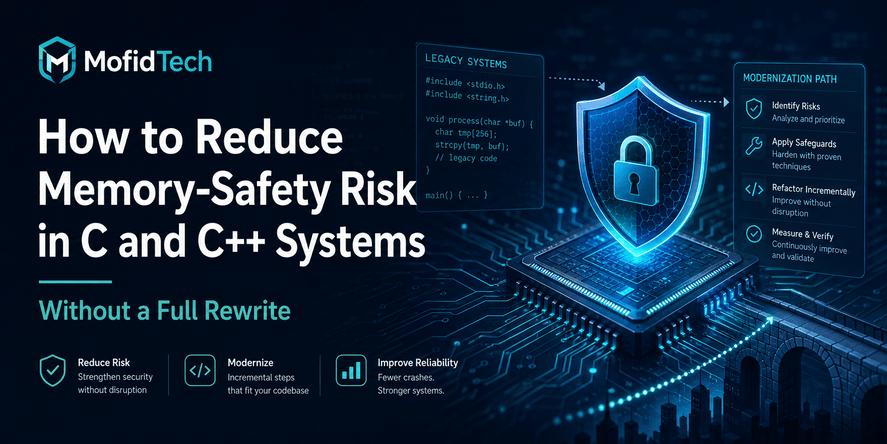
Direct answer: You do not need to rewrite an entire C or C++ system to improve memory safety. The most practical approach is usually to stop creating new high-risk native code, identify the most exposed and privileged components, move those components incrementally to memory-safe implementations, isolate the remaining unsafe code, and use strong testing and runtime mitigations during the transition.
Table of Contents
1. Why memory safety is a strategic engineering issue in 2026
2. What memory safety actually means
3. Why C and C++ remain important despite the risk
4. Why a full rewrite is usually the wrong first move
5. How to identify the highest-risk parts of a codebase
6. How to choose a memory-safe modernization path
7. A phased migration strategy for legacy systems
8. How to harden code that cannot move yet
9. Testing, fuzzing, verification, and performance validation
10. Architecture and interoperability during migration
11. Embedded systems, IoT, firmware, and safety-critical software
12. Cloud, backend, and native-extension considerations
13. Using AI coding tools during memory-safety modernization
14. Building the organizational and economic case
15. Common mistakes and troubleshooting logic
16. Best-practice checklist
17. A practical 90-day migration roadmap
18. Frequently asked questions
19. Conclusion
20. Internal linking and MofidTech tool opportunity
1. Why Memory Safety Is a Strategic Engineering Issue in 2026
Memory safety used to be discussed mainly in security research, operating-system development, browser engineering, and low-level programming communities. That has changed. The issue now affects product strategy, procurement, compliance discussions, embedded development, cloud platforms, automotive systems, and long-term software maintenance.
The reason is structural. C and C++ give developers precise control over memory, object lifetimes, representation, and hardware interaction. Those capabilities make the languages valuable for operating systems, device drivers, media processing, games, databases, networking stacks, real-time software, embedded devices, and performance-sensitive libraries. The same flexibility also means that many safety properties depend on programmer discipline, review quality, testing coverage, compiler behavior, runtime mitigations, and the correctness of every dependency that participates in a memory operation.
Secure-by-design thinking changes the objective. Instead of asking how many memory bugs can be detected before release, the stronger question is how much of the system can be designed so that entire bug classes are difficult or impossible to create in ordinary development. This is why memory-safe languages have become strategically important: they move part of the safety burden from individual developers into language rules, type systems, ownership models, managed runtimes, or verified subsets.
The policy environment reinforces that shift. NSA and CISA guidance published in 2025 explicitly highlighted memory-safe languages as a way to improve software security. CISA’s memory-safe roadmap guidance frames migration as a long-term management and engineering program. This matters for organizations selling software to security-conscious customers because buyers increasingly ask not only whether a vendor scans for vulnerabilities, but whether the architecture reduces the probability that certain vulnerability classes are introduced in the first place.
The engineering environment is changing as well. Google reported in late 2025 that memory-safety vulnerabilities had fallen below 20 percent of Android vulnerabilities in its data and attributed substantial gains to a strategy centered on memory-safe development for new native code. The same report described lower vulnerability density for Rust code and also reported delivery benefits such as fewer rollbacks and shorter review time. These figures are specific to Google’s environment and should not be generalized automatically, but they demonstrate that memory safety can affect reliability and development process, not only exploit prevention.
For MofidTech readers, the key implication is that memory safety is no longer a narrow “Rust versus C++” debate. It is a systems-engineering question: where should unsafe native code remain, where should it be isolated, where should new development move, and how should teams manage the transition without breaking products?
2. What Memory Safety Actually Means
Memory safety means that a program accesses memory only in valid ways: within authorized boundaries, during valid lifetimes, with compatible types and initialization states, and under concurrency rules that do not create undefined behavior. Different languages and platforms enforce different subsets of these properties, so “memory safe” should not be treated as a magical binary label. It is better understood as a set of guarantees that sharply reduce common vulnerability classes when developers remain within the language’s safe model.
2.1 Spatial memory safety
Spatial memory safety concerns where a program reads or writes. A spatial error occurs when software accesses memory outside the bounds of the object or buffer it is supposed to use. Buffer overflows and out-of-bounds reads are common examples. These defects are dangerous because adjacent memory may contain control data, credentials, pointers, secrets, or unrelated objects.
Bounds checking, safer container abstractions, validated indexing, and memory-safe type systems reduce this risk. Hardware features and runtime protections can also make exploitation harder, but they do not necessarily remove the underlying programming error.
2.2 Temporal memory safety
Temporal memory safety concerns when memory can be used. Use-after-free errors, double frees, stale references, and lifetime mistakes occur when software keeps using memory after its valid ownership or allocation period has ended. These defects are often harder to reason about than simple bounds errors because the faulty access may happen far away in time and code location from the original lifecycle mistake.
Ownership and lifetime systems are particularly powerful here because they make resource validity part of the program model. Garbage-collected languages address many lifetime problems differently by delaying reclamation until objects are no longer reachable. Each approach has tradeoffs in latency, predictability, performance, binary size, and runtime requirements.
2.3 Initialization, type, and concurrency safety
Memory safety also intersects with uninitialized values, invalid type reinterpretation, data races, integer calculations that influence allocation sizes, and synchronization mistakes. A program can avoid a classic buffer overflow yet still reach unsafe behavior through incorrect size arithmetic or an invalid assumption about concurrent ownership.
This is why migration should not be reduced to “replace pointers.” The deeper goal is to reduce the number of states in which the program can represent an invalid memory relationship.
| Risk class | Typical failure | Why it matters | Modernization goal |
| Spatial | Out-of-bounds read or write | Can corrupt data or expose adjacent memory | Make bounds explicit and enforceable |
| Temporal | Use-after-free or double free | Can enable crashes or control-flow abuse | Make ownership and lifetimes enforceable |
| Initialization | Using data before a valid value exists | Can leak data or cause unpredictable behavior | Require valid initialization before use |
| Type safety | Interpreting memory as an incompatible object | Can break invariants and produce undefined behavior | Use stronger type boundaries and validated conversions |
| Concurrency | Unsynchronized shared mutable state | Can create race-driven corruption | Constrain mutation and synchronize ownership |
| Size arithmetic | Overflow or truncation in length calculations | Can under-allocate or bypass validation | Use checked arithmetic and explicit size contracts |
3. Why C and C++ Remain Important Despite the Risk
A serious memory-safety strategy should begin by acknowledging why native code exists. Organizations rarely maintain millions of lines of C or C++ because they have ignored modern languages. They maintain them because the code represents years of product behavior, tested algorithms, hardware interfaces, platform support, performance work, certification evidence, supplier integrations, and domain-specific knowledge.
C remains a foundational language for firmware, microcontrollers, kernels, drivers, networking, and portable libraries. C++ remains central in browsers, game engines, trading systems, databases, robotics, simulation, automotive software, computer vision, media pipelines, and large desktop applications. Replacing these systems is not merely a syntax translation exercise. It can change build systems, debugging workflows, binary interfaces, memory layout, real-time behavior, exception models, dependency management, certification processes, and staffing needs.
The correct strategic question is therefore not “Is C++ bad?” It is “Where does the control offered by C or C++ still create more value than risk, and where can the system move to safer abstractions without sacrificing required behavior?”
This framing prevents two common mistakes. The first is denial: assuming that existing testing and experienced developers make memory risk negligible. The second is ideology: assuming that every native component should be rewritten regardless of cost, maturity, or operational importance. Both positions ignore system context.
4. Why a Full Rewrite Is Usually the Wrong First Move
Full rewrites are attractive because they promise a clean architecture, modern language, simplified dependencies, and removal of accumulated technical debt. In reality, a mature software system contains behavior that is only partially documented. Production quirks, compatibility rules, timing assumptions, data-format edge cases, and integration contracts may exist only in code and tests. A rewrite can remove known memory risks while simultaneously reintroducing years of functional bugs.
There are cases where a rewrite is justified: the old architecture is no longer maintainable, the product is being replaced anyway, the component is small and well specified, certification or procurement requirements force a new implementation, or the existing module is so exposed and dangerous that containment is insufficient. But these conditions should be demonstrated rather than assumed.
Recent industry discussion increasingly emphasizes incremental migration. Google’s firmware guidance describes introducing Rust gradually into existing codebases, focusing on new and high-risk functionality. A 2026 JetBrains discussion of real-world Rust rewrites likewise argues that incremental expansion is usually more practical than replacing everything at once. CISA advisory material has also recognized phased transitions and interim hardening for code that cannot immediately move.
Incremental migration has a powerful security property: it lets an organization reduce the rate at which new unsafe code is created before it has solved the entire legacy problem. If all new high-risk functionality is implemented behind safer interfaces, the unsafe footprint can shrink over time rather than continuing to grow while a multi-year rewrite proceeds.
Decision rule: Treat a full rewrite as one migration option, not the default strategy. Prefer the smallest architectural change that produces a meaningful reduction in memory-safety exposure while preserving product behavior and operational confidence.
5. How to Identify the Highest-Risk Parts of a Codebase
The best migration order is rarely the same as the codebase directory order. Risk is concentrated. A small parser exposed to attacker-controlled data can be more important than a much larger internal computation module. A privileged daemon may deserve attention before a user-space utility. Firmware that receives wireless input may be a higher priority than offline numerical code.
A useful inventory therefore maps components to security context, not just language and line count.
5.1 Build a native-code inventory
Start by identifying where C, C++, assembly, unsafe language features, foreign-function interfaces, native extensions, and memory-unsafe third-party libraries exist. Include generated code and vendor components. The purpose is not to produce a perfect bill of materials on day one. The purpose is to make the unsafe computing base visible enough to prioritize decisions.
For each component, record its role, owners, product lifetime, supported platforms, build system, test maturity, dependencies, privilege level, data sources, external interfaces, and whether it can be isolated behind a stable boundary.
5.2 Score exposure, privilege, and consequence
| Factor | Lower-risk signal | Higher-risk signal |
| Input exposure | Trusted internal data | Internet, radio, file upload, media, protocol, or untrusted device input |
| Privilege | Restricted user process | Kernel, root, administrator, firmware, hypervisor, or high-value service identity |
| Reachability | Rare offline path | Always-on network or IPC path |
| Data sensitivity | Public or low-value data | Secrets, credentials, personal data, cryptographic material |
| Failure consequence | Recoverable local failure | Remote compromise, safety impact, fleet outage, persistent device compromise |
| Change frequency | Stable and rarely modified | Rapidly evolving or frequently extended |
| Product lifetime | Near retirement | Many years of expected maintenance |
| Test maturity | High coverage and mature fuzzing | Weak coverage and difficult-to-reproduce defects |
The highest-priority components typically combine exposure, privilege, and long future lifetime. A network-facing image decoder running with elevated privileges is an obvious candidate. A small native library used by many applications may also be important because its blast radius is large even if each call appears simple.
Do not rank only by historical bug count. A component with few reported bugs may simply receive less testing, less attacker attention, or less telemetry. Architecture and consequence provide a more durable risk signal.
5.3 Identify security boundaries that can become migration boundaries
Migration becomes easier when the architecture already has clear process, service, library, protocol, or device boundaries. Those boundaries can become seams where a memory-safe implementation replaces unsafe behavior without forcing simultaneous changes across the entire application.
Good migration seams have narrow interfaces, explicit data formats, limited shared mutable state, and testable contracts. Poor seams expose internal pointers, rely on implicit ownership, share complex global state, or require both sides to know the same memory layout. Improving the seam may be more valuable than immediately rewriting the implementation behind it.
6. How to Choose a Memory-Safe Modernization Path
There is no universal “best memory-safe language.” The correct choice depends on performance constraints, runtime requirements, hardware access, ecosystem maturity, interoperability, team experience, certification needs, platform support, and operational tooling. The goal is to choose a language and architecture that the organization can maintain safely for the full product lifecycle.
6.1 Rust for systems-level replacement
Rust is a strong candidate when teams need native performance, deterministic resource management, low-level hardware access, and strong compile-time memory-safety guarantees. Its ownership and borrowing model prevents many spatial and temporal errors in ordinary safe code, while still providing controlled escape hatches for operations the compiler cannot verify.
Rust is particularly attractive for parsers, protocol handlers, security-sensitive services, device-facing components, firmware modules, command-line infrastructure, and new systems code that would otherwise be written in C or C++. Current platform adoption in Android, Linux-related work, cloud infrastructure, and automotive environments makes the ecosystem increasingly relevant to production teams.
Rust is not a guarantee that a product has no memory-safety risk. Unsafe Rust, native dependencies, foreign-function boundaries, logic errors, build configuration, and platform vulnerabilities still matter. The benefit is that the default programming model dramatically narrows where memory invariants must be manually trusted.
6.2 Managed languages for services and control-plane components
Many native components exist for historical reasons rather than strict performance requirements. Backend services, orchestration tools, configuration systems, administrative interfaces, business logic, and data-processing services may be excellent candidates for languages with managed runtimes or strong runtime safety.
Java, C#, Go, Swift, Kotlin, and other languages can reduce memory-management risk while offering mature ecosystems. The tradeoff is that garbage collection, runtime behavior, startup characteristics, binary size, deployment model, or platform availability may not suit every embedded or real-time environment. The migration decision should be driven by system requirements, not by a desire to standardize on a single language everywhere.
6.3 Ada, SPARK, and high-assurance environments
Safety-critical and high-assurance systems may prioritize analyzability, verification, certification, and strong contracts over mainstream ecosystem size. Ada and SPARK can be appropriate in aerospace, defense, industrial control, and other environments where correctness evidence is a product requirement.
The important lesson is broader than any one language: memory-safety modernization should align with the assurance model of the system. A consumer web backend and an aircraft control component should not use identical decision criteria.
6.4 Safer C/C++ subsets, hardware protection, and constrained legacy paths
Some organizations cannot move critical code immediately because of platform constraints, toolchain certification, third-party SDK requirements, or specialized hardware. In those cases, reducing the unsafe subset of the language, using stronger library abstractions, enabling platform hardening, applying memory tagging where available, and tightening review rules can reduce exposure.
These measures are valuable, but CISA secure-by-design material has emphasized that mitigations for legacy memory-unsafe code should not be confused with eliminating the root class of vulnerability. Treat hardening as defense in depth and as a bridge to safer architecture, not as proof that the migration problem has disappeared.
| Option | Best fit | Main advantage | Main caution |
| Rust | Native systems, firmware, parsers, performance-sensitive components | Strong compile-time memory and concurrency safety with systems control | Learning curve, interoperability design, unsafe/native dependencies |
| Managed language | Services, tools, control planes, business logic | Simpler memory model and mature application ecosystems | Runtime, latency, footprint, or platform constraints |
| Ada / SPARK | High-assurance and safety-critical systems | Strong correctness and verification-oriented development | Specialized skills and ecosystem requirements |
| Hardened C/C++ | Legacy code that cannot move yet | Lower transition cost and immediate risk reduction | Does not remove the underlying class of memory-unsafety risk |
| Process isolation | Dangerous components with stable interfaces | Reduces blast radius even before rewrite | Adds IPC, operational, latency, and failure-mode complexity |
7. A Phased Migration Strategy for Legacy Systems
A successful program reduces risk continuously. It should not require waiting years for a final replacement release. The following phases create measurable progress while allowing teams to learn from smaller changes.
7.1 Phase 1 — Stop adding avoidable unsafe exposure
The fastest way to make a legacy problem worse is to continue writing new high-risk native code while planning a future migration. Establish an architectural policy for new components. If a new module processes untrusted input, handles cryptographic material, runs with high privilege, or is expected to live for many years, require an explicit justification before implementing it in a memory-unsafe language.
This policy does not forbid C or C++. It changes the default decision. Teams must demonstrate why native unsafe control is necessary rather than assuming it.
7.2 Phase 2 — Move new functionality to safer components
Greenfield functionality is usually the easiest place to adopt a memory-safe language because there is no behavioral parity requirement with a large legacy implementation. New parsers, new protocol support, new management services, new firmware modules, and new hardware abstraction layers can establish language expertise without immediately touching the most fragile legacy code.
This approach also changes the codebase trajectory. Even if the old system remains large, the proportion of new unsafe code can begin to fall immediately.
7.3 Phase 3 — Target exposed and privileged components
Once the team has production experience, prioritize components where a memory error would have the highest consequence. Common candidates include file and media parsers, network protocol handlers, authentication helpers, decompression libraries, device communication layers, browser or document processing modules, and services that run with elevated privileges.
Do not choose only the easiest component. The migration should demonstrate risk reduction, not merely language adoption. A slightly more difficult boundary may produce much more security value.
7.4 Phase 4 — Shrink the trusted unsafe computing base
As components move, make the remaining unsafe area smaller and more explicit. Encapsulate native dependencies behind narrow interfaces. Reduce shared-memory contracts. Move validation into memory-safe code before data reaches unsafe logic. Limit unsafe operations to small modules that can receive specialized review.
This is one of the most important architectural outcomes. Even if a product remains multilingual for its entire life, a small, well-defined unsafe core is easier to test, reason about, fuzz, monitor, and eventually replace than a codebase where unsafe assumptions are distributed everywhere.
7.5 Phase 5 — Retire, replace, or freeze low-value legacy code
Not every legacy component deserves a rewrite. Some should be retired. Others can be frozen behind a stable interface, restricted to trusted input, or moved into a sandbox. Migration planning should include product simplification so that engineering effort is not spent modernizing features that no longer create value.
This is where security modernization and technical-debt reduction reinforce each other. Removing unnecessary code reduces both attack surface and maintenance cost.
8. How to Harden Code That Cannot Move Yet
Legacy hardening remains essential because migration takes time. The objective is to reduce exploitability, improve detection, and limit the blast radius of defects while safer replacements are introduced.
8.1 Use layered compiler and runtime protections
Modern toolchains and operating systems provide protections that make common exploitation techniques more difficult. These include stack protections, non-executable memory, address randomization, control-flow defenses, fortified library behavior, and other platform-specific mitigations. Where hardware supports memory tagging or capability-oriented memory protection, those mechanisms can add valuable enforcement.
Treat deployment hardening as a baseline. It should be standardized in build and release policy rather than applied only after a vulnerability is found.
8.2 Make dynamic testing part of normal engineering
Memory errors often hide in edge cases that normal functional tests do not exercise. Dynamic analysis, sanitization, fuzzing, stress testing, and fault injection can uncover invalid accesses, lifetime errors, race conditions, and parser weaknesses before they reach production.
Fuzzing is especially valuable for components that process structured untrusted input. A good fuzzing program is continuous: it preserves crashing inputs as regression cases, tracks coverage, updates input dictionaries or models when formats evolve, and assigns ownership for triage.
8.3 Apply static analysis with context
Static analysis can identify dangerous memory operations, suspicious ownership patterns, unchecked return values, size calculations, and API misuse without executing the program. Its value depends on integration and triage quality. A tool that produces thousands of unactionable warnings can train developers to ignore the signal.
Prioritize findings by reachability, input control, privilege, and exploit consequence. Use recurring defect patterns to guide architectural changes and coding standards rather than treating each warning as an isolated ticket.
8.4 Isolate dangerous components
Process isolation, sandboxing, least privilege, capability restrictions, syscall reduction, file-system boundaries, network restrictions, and explicit IPC can limit what a compromised native component can do. This approach is particularly useful when a parser or codec must remain in C/C++ but can run in a restricted process with a narrow input-output contract.
Isolation is not free. It introduces operational complexity, serialization costs, new failure modes, and debugging challenges. The security gain should be balanced against performance and maintainability, but for high-risk components the reduction in blast radius can be substantial.
8.5 Reduce dependency risk
A memory-safe top-level module can still depend on unsafe native libraries. Inventory transitive dependencies, watch vulnerability disclosures, evaluate maintenance health, and prefer libraries that have clear security ownership. Where a memory-safe replacement exists for a high-risk native dependency, replacing the dependency may offer better return on investment than rewriting application code around it.
9. Testing, Fuzzing, Verification, and Performance Validation
Migration changes both security properties and behavior. A component is not successful merely because it compiles in a memory-safe language. It must preserve required functionality, performance, latency, resource usage, error behavior, and interoperability.
9.1 Establish behavioral equivalence before replacement
Document what the legacy component actually does, including edge cases. Build regression suites around externally observable behavior. For parsers and protocols, include malformed, boundary, ambiguous, and adversarial inputs. For firmware, include timing, power-state, recovery, and hardware interaction scenarios.
Where the legacy behavior is itself unsafe or incorrect, decide explicitly whether the new component should preserve compatibility or intentionally break it. Silent behavioral drift is more dangerous than a documented compatibility change.
9.2 Use differential testing during overlap
When practical, run the old and new implementations against the same representative inputs and compare outputs, errors, timing, and side effects. Differential testing is powerful because the old implementation becomes an executable description of expected behavior, while discrepancies reveal hidden assumptions that documentation may have missed.
The old implementation should not be treated as automatically correct. Differences require investigation, not blind convergence.
9.3 Keep fuzzing after migration
Memory-safe languages remove many memory corruption paths, but they do not eliminate logic vulnerabilities, denial-of-service conditions, parser inconsistencies, integer mistakes, unsafe escape hatches, or vulnerabilities in native dependencies. Continue fuzzing after migration. The security goal shifts from “find memory corruption” to “find any input that violates the component’s intended contract.”
9.4 Validate operational performance, not only microbenchmarks
A rewrite may be faster in a synthetic benchmark and slower in the real product because of allocation patterns, IPC overhead, runtime startup, cache behavior, binary size, logging, or interoperability boundaries. Measure production-relevant workload characteristics: tail latency, CPU consumption, memory footprint, power usage, real-time deadlines, throughput, startup time, and failure recovery.
Performance regressions should be understood in context. A modest cost may be acceptable if it removes a critical attack path. Conversely, a security migration that breaks real-time deadlines in an embedded controller is not viable. The decision should be explicit and evidence-based.
9.5 Apply formal methods where consequence justifies the cost
Memory safety is only one dimension of correctness. Cryptographic implementations, safety controllers, parsers for critical protocols, and high-assurance components may benefit from formal specification, model checking, proof-oriented development, or stronger static verification. Microsoft Research’s 2026 work on verified Rust cryptography illustrates the direction: memory-safe implementation can be combined with proofs that the code correctly implements higher-level algorithmic specifications.
Most application teams do not need formal verification everywhere. The useful principle is to spend the strongest assurance techniques where failure consequence is highest.
10. Architecture and Interoperability During Migration
Interoperability is the center of an incremental strategy. The safer component must communicate with legacy code without recreating the same unsafe assumptions at the boundary.
10.1 Design narrow, explicit boundaries
Prefer interfaces based on explicit values, immutable data, validated buffers, handles, messages, or well-defined serialization formats. Avoid exposing ownership of internal pointers or requiring one side to understand the other side’s object layout. A good boundary makes lifetime, error handling, and responsibility obvious.
The boundary should also be versionable. If the migration requires many coordinated changes across unrelated modules every time the interface evolves, the architecture is too tightly coupled.
10.2 Validate data before it enters unsafe code
Whenever possible, put parsing, length validation, normalization, and structural checks on the safer side of the boundary. The remaining unsafe component should receive data in a form that reduces ambiguity and limits the number of attacker-controlled states it must handle.
This does not mean trusting validation blindly. The unsafe component should still protect its own invariants. Defense in depth is especially important when different teams or languages evolve independently.
10.3 Minimize shared mutable state
Shared mutable state is difficult across language boundaries because ownership rules, thread models, and error semantics may differ. Prefer message passing, clear ownership transfer, or isolated services. If shared memory is essential for performance, define strict ownership and synchronization contracts and treat that interface as security-sensitive code requiring dedicated review.
10.4 Treat unsafe escape hatches as a security boundary
Memory-safe languages often provide mechanisms for operations that cannot be proven safe automatically. Those mechanisms are necessary for operating systems, device access, foreign-function calls, and specialized performance work. They should be small, documented, reviewed, tested, and measured.
A useful organizational metric is not merely “percentage of code in Rust” or “percentage migrated.” A more meaningful metric is the size and reachability of code where memory invariants are manually trusted.
11. Embedded Systems, IoT, Firmware, and Safety-Critical Software
Embedded systems are one of the most important memory-safety migration domains because they combine long product lifetimes, hardware constraints, remote input, limited patchability, and high consequences when devices are compromised. They also present some of the hardest adoption constraints: small memory budgets, specialized architectures, proprietary vendor SDKs, real-time requirements, certification obligations, and direct register or peripheral access.
11.1 Prioritize externally reachable firmware paths
Wireless stacks, network protocol handlers, update mechanisms, file parsers, USB interfaces, Bluetooth logic, and device-management services are natural priorities because they process data from outside the trust boundary. Moving or isolating these components can reduce attack surface even when hardware drivers remain in C.
11.2 Separate hardware access from policy and parsing
Many embedded architectures mix register-level access, protocol parsing, business rules, and state machines in the same native module. That makes migration unnecessarily difficult. A more maintainable design isolates hardware-specific operations behind a small interface while moving parsing, state management, and policy into safer components where practical.
This decomposition also improves testability because logic can be exercised independently from physical hardware.
11.3 Account for real-time and resource constraints
Memory safety is not useful if the system misses deadlines or exceeds memory budgets. Evaluate stack usage, allocation behavior, interrupt constraints, binary size, power consumption, and worst-case execution characteristics. In hard real-time systems, deterministic behavior may matter more than average throughput.
The evaluation should compare architectures, not stereotypes. A carefully designed memory-safe component can be efficient, while an unsafe component may depend on expensive runtime mitigations. Measure the actual product workload.
11.4 Use the 2026 automotive shift as a practical signal
Android Automotive’s August 2026 secure-by-design discussion is notable because software-defined vehicles combine distributed trust, native frameworks, constrained environments, and long-lived safety expectations. Its use of Rust as a primary language for new components shows that memory-safe systems development is moving into real product architectures rather than remaining a research recommendation.
For smaller IoT teams, the lesson is not to copy a large platform architecture. It is to adopt the same prioritization logic: new exposed code should default toward memory-safe implementation, while legacy device-specific code is isolated and reduced over time.
12. Cloud, Backend, and Native-Extension Considerations
Web and cloud teams may assume that memory safety is irrelevant because application logic is written in Python, Java, JavaScript, C#, Go, or another higher-level language. In practice, these applications often depend on native libraries for cryptography, compression, image processing, machine learning, databases, networking, serialization, and operating-system integration.
The attack surface therefore crosses language boundaries. A memory-safe application can still be exposed through an unsafe image decoder, database driver, runtime component, or native extension. Security architecture should map those dependencies and understand which ones process untrusted data.
12.1 Reduce unnecessary native extensions
Native extensions should earn their complexity. If a pure memory-safe implementation provides acceptable performance and maintenance, replacing an unsafe extension can reduce deployment friction and security risk simultaneously. If native code is necessary, keep the interface narrow and ensure the dependency is actively maintained.
12.2 Isolate parsers and conversion services
File conversion, media processing, document extraction, archive handling, and other parser-heavy workloads are good candidates for isolation. Even when the underlying native library cannot be replaced, running the risky operation in a restricted worker can prevent a parsing bug from becoming full application compromise.
12.3 Treat containers as isolation layers, not memory-safety guarantees
Containers can limit blast radius through namespaces, permissions, seccomp-style restrictions, and resource limits, but they do not make unsafe code memory safe. A compromised process may still access secrets, service credentials, mounted data, or network destinations allowed to the container. Use container isolation as one layer in the architecture while reducing memory-unsafe exposure at the component level.
13. Using AI Coding Tools During Memory-Safety Modernization
AI coding assistants and agents can accelerate inventory work, documentation, test generation, interface exploration, and mechanical refactoring. They can also create false confidence. A generated translation that looks idiomatic may still preserve hidden logic errors, weaken error handling, introduce inefficient ownership patterns, or wrap unsafe operations without understanding the required invariants.
Memory-safety migration is therefore a strong example of where AI should augment engineering judgment rather than replace it.
13.1 Good uses of AI assistance
- Summarizing module responsibilities and identifying likely ownership boundaries for human review.
- Generating candidate tests from documented requirements and existing behavior.
- Explaining unfamiliar legacy code paths to speed up onboarding.
- Suggesting interface decompositions that reduce pointer sharing or global state.
- Mapping dependencies and identifying native libraries used by higher-level applications.
- Drafting migration documentation, risk registers, and review checklists.
- Comparing alternative designs before implementation begins.
13.2 High-risk uses of AI assistance
- Automatically rewriting security-critical native modules without a behavioral specification.
- Accepting generated unsafe-language interop because it compiles.
- Removing checks because the model assumes they are redundant.
- Changing concurrency or lifetime behavior without stress testing.
- Treating generated tests as evidence that all legacy behavior is understood.
- Allowing an autonomous coding agent to modify build hardening or security settings without review.
The governance rule should be simple: the more privileged, exposed, or safety-critical the component, the stronger the human review and verification requirements. AI can reduce effort, but it does not change the consequence of a bad migration.
14. Building the Organizational and Economic Case
Memory-safety migration competes with features, performance work, platform upgrades, customer requests, and other security investments. A successful roadmap therefore needs a business case that translates technical risk into lifecycle impact.
14.1 Count the cost of unsafe code beyond CVEs
The cost of memory-unsafe code includes vulnerability response, emergency patching, crash investigation, fuzzing infrastructure, specialized reviewers, backports, customer advisories, exploit mitigations, incident management, certification rework, and reputational impact. It also includes opportunity cost when senior engineers spend time on recurring defect classes instead of product improvements.
A migration proposal becomes more credible when it compares total lifecycle cost rather than only rewrite cost.
14.2 Use leading and lagging metrics
| Metric type | Example measure | Why it helps |
| Leading | Share of new exposed native components implemented in memory-safe languages | Shows whether future risk creation is slowing |
| Leading | Number of high-risk unsafe interfaces with explicit ownership contracts | Measures architectural containment |
| Leading | Fuzzing coverage for exposed native parsers | Measures preventive testing maturity |
| Leading | Size of manually trusted unsafe/interop code | Tracks the trusted unsafe computing base |
| Lagging | Memory-safety defects found before release | Shows defect discovery trend |
| Lagging | Production crashes or vulnerabilities linked to memory errors | Shows operational impact |
| Lagging | Time spent on emergency native-code security fixes | Connects risk to engineering cost |
Avoid vanity metrics. “We migrated 40 percent of the code” may be meaningless if the remaining 60 percent contains every exposed and privileged component. Risk-weighted progress is more useful than raw line counts.
14.3 Plan for skills and ownership
Language adoption fails when organizations train a few enthusiasts but leave production ownership ambiguous. Define who reviews memory-safe code, who reviews unsafe interop, who maintains build tooling, who owns language upgrades, and how incidents are handled. Pair experienced native engineers with engineers who understand the target language so that product knowledge and language expertise move together.
Training should focus on architecture and safety models, not just syntax. Developers need to understand ownership, lifetimes, error handling, concurrency, dependency trust, foreign-function boundaries, and performance tradeoffs.
15. Common Mistakes and Troubleshooting Logic
15.1 Mistake: choosing the migration target before mapping risk
A team may decide “we are moving to Rust” and then search for code to rewrite. Reverse the order. Identify the highest-value risk reduction first, then select the language and architecture that best satisfy that component’s constraints.
15.2 Mistake: rewriting a stable internal module while leaving exposed parsers untouched
Easy migrations are useful for learning, but the roadmap must eventually address security consequence. Track whether migrated components actually reduce exposure, privilege, or blast radius.
15.3 Mistake: creating a huge unsafe interoperability layer
A memory-safe implementation can lose much of its benefit if the boundary contains extensive pointer manipulation, shared ownership, or unchecked conversions. If interop becomes large, redesign the interface. The safest migration seam is usually a simpler architecture seam.
15.4 Mistake: assuming memory-safe means vulnerability-free
Memory-safe languages still permit authentication mistakes, injection, broken access control, cryptographic misuse, denial of service, insecure configuration, supply-chain compromise, and logic vulnerabilities. Security testing remains necessary. Memory safety removes or reduces an important class of defects; it does not replace application security.
15.5 Mistake: measuring only performance averages
Systems software often fails at the tail: worst-case latency, peak memory usage, cold start, interrupt pressure, or pathological input. Use workload-specific performance criteria and define acceptable security-performance tradeoffs before migration.
15.6 Mistake: treating hardening as permanent architecture
Legacy mitigations can buy time and reduce exploitability, but they should not become an excuse to keep expanding high-risk unsafe code. Record which controls are transitional and what event will trigger replacement.
15.7 Troubleshooting decision framework
| Question | If yes | If no |
| Does the component process untrusted input? | Raise migration priority; consider safe parsing or isolation | Evaluate privilege and consequence next |
| Does it run with high privilege or device-level authority? | Prioritize containment or replacement | Consider lower-risk phased migration |
| Is there a stable interface boundary? | Replace behind the boundary incrementally | First refactor the boundary and ownership model |
| Can requirements be tested independently of implementation? | Use differential and regression testing | Invest in characterization tests before rewrite |
| Is a memory-safe ecosystem mature for the target platform? | Prototype production-relevant workloads | Use hardening/isolation while evaluating alternatives |
| Would a rewrite threaten delivery or certification? | Prefer staged component replacement | A larger replacement may be feasible |
16. Best-Practice Checklist
- Maintain an inventory of memory-unsafe components and native dependencies.
- Prioritize by exposure, privilege, consequence, and product lifetime rather than by line count.
- Default new exposed systems components to a memory-safe implementation unless constraints justify otherwise.
- Use greenfield modules to build language and tooling experience before attacking the hardest legacy component.
- Choose migration seams with narrow, explicit, testable interfaces.
- Move validation and parsing to safer boundaries where practical.
- Minimize shared mutable state across language boundaries.
- Keep unsafe escape hatches and native interop small, documented, and specially reviewed.
- Use compiler, runtime, operating-system, and hardware hardening on legacy native code.
- Continuously fuzz components that parse untrusted or complex input.
- Preserve crashing inputs as regression tests and assign triage ownership.
- Use static analysis as an engineering feedback system, not merely a compliance report.
- Isolate dangerous legacy components with least privilege and restricted access.
- Track high-risk third-party native libraries and evaluate memory-safe replacements.
- Characterize legacy behavior before replacement so hidden compatibility rules are discovered.
- Use differential testing when old and new implementations can run against the same inputs.
- Measure tail latency, resource use, power, and failure recovery in production-relevant workloads.
- Use stronger verification for cryptographic, safety-critical, and highly privileged components.
- Train teams on ownership, interop, concurrency, and safety models—not only target-language syntax.
- Measure risk-weighted reduction in the trusted unsafe computing base.
- Document which legacy hardening controls are temporary bridges and when they will be reevaluated.
- Do not allow AI-generated migration changes to bypass normal security review and testing.
- Retire unnecessary legacy code instead of automatically rewriting it.
- Review the roadmap at least quarterly as threats, platforms, and product priorities change.
17. A Practical 90-Day Migration Roadmap
A 90-day plan should not promise to “solve memory safety.” Its purpose is to create visibility, establish policy, prove one useful migration pattern, and define a multi-quarter roadmap based on evidence.
Days 1–30: Inventory and risk map
- Identify native-code components, unsafe language use, native extensions, and critical third-party libraries.
- Score components by untrusted input exposure, privilege, blast radius, data sensitivity, and product lifetime.
- Select two or three high-value candidate components and one lower-risk learning component.
- Document current compiler/runtime hardening, fuzzing, static analysis, and sandboxing coverage.
- Define an engineering policy for new high-risk native code and exception approval.
Days 31–60: Prototype and characterize
- Create behavioral characterization tests for the selected component.
- Evaluate target language ecosystem, platform support, dependencies, observability, and deployment impact.
- Design a narrow interoperability boundary with explicit ownership and error behavior.
- Prototype the replacement or isolation pattern using production-relevant inputs and workloads.
- Measure performance, resource use, operational complexity, and review burden.
Days 61–90: Pilot production path and roadmap
- Harden the remaining legacy component and ensure rollback is possible during the pilot.
- Run differential, regression, fuzz, and stress testing against the new path.
- Deploy to a controlled environment with clear telemetry and incident ownership.
- Document lessons about tooling, training, interfaces, testing, and performance.
- Publish a prioritized roadmap for the next two to four quarters, including risk-weighted metrics and ownership.
Success criterion after 90 days: The organization should know where its highest memory-safety risk lives, have a policy that prevents unnecessary new exposure, possess at least one validated incremental migration pattern, and have a funded roadmap tied to measurable risk reduction.
18. Migration Strategy Comparison
| Strategy | Security gain | Delivery risk | Best use |
| Full rewrite | Potentially high if well executed | High | Small/well-specified components or products already undergoing replacement |
| Incremental component migration | High over time | Low to medium | Most large legacy systems with usable architectural seams |
| New-code-only memory-safe policy | Compounding future gain | Low | Immediate first step for long-lived products |
| Sandbox/isolate legacy code | Medium to high blast-radius reduction | Medium | Exposed parsers or components that cannot yet be rewritten |
| Harden existing C/C++ | Medium short-term reduction | Low | Transitional protection and constrained platforms |
| Retire functionality | Very high for removed attack surface | Low to medium | Low-value or obsolete legacy features |
19. Frequently Asked Questions
What is a memory-safety migration roadmap?
A memory-safety migration roadmap is a risk-based plan for reducing software that depends on manually enforced memory correctness. It identifies exposed and privileged native components, chooses safer replacement or isolation strategies, strengthens legacy defenses, and tracks the shrinking trusted unsafe computing base over time.
Do we need to rewrite all C and C++ code in Rust?
No. Large systems often benefit more from incremental migration. New and high-risk components can move first, while stable legacy code is hardened, isolated, or retired. A full rewrite is justified only when architecture, product strategy, risk, and testing evidence support it.
Is Rust the only memory-safe option?
No. Rust is well suited to many systems-level workloads, but managed languages such as Java, C#, Go, Kotlin, or Swift may be better for services and control-plane logic. Ada or SPARK may suit high-assurance environments. The correct choice depends on platform, assurance, performance, ecosystem, and lifecycle requirements.
Can C++ be made completely memory safe?
C++ can be substantially hardened through safer abstractions, restricted language subsets, static analysis, sanitizers, compiler protections, runtime mitigations, and careful review. Those measures reduce risk but do not generally provide the same default guarantees as languages designed around memory safety. Treat them as defense in depth and as part of a broader roadmap.
Which components should be migrated first?
Prioritize components that combine untrusted input, high privilege, large blast radius, sensitive data, frequent change, and long remaining product life. Network parsers, media decoders, device communication modules, update logic, and privileged services are common high-value targets.
Does using a memory-safe language eliminate security vulnerabilities?
No. It reduces important classes of memory errors but does not prevent logic flaws, broken access control, insecure authentication, injection, supply-chain attacks, cryptographic misuse, denial of service, unsafe dependencies, or configuration mistakes. Application and infrastructure security controls remain necessary.
How can embedded systems adopt memory-safe languages with limited resources?
Start with new externally reachable modules, parsers, protocol handlers, and state logic rather than low-level hardware drivers that are difficult to replace. Evaluate binary size, memory use, real-time behavior, toolchain support, and hardware access using production-relevant workloads. Incremental adoption is often more realistic than replacing all firmware.
What should we do with legacy C code that cannot be migrated?
Harden it, isolate it, reduce its privileges, fuzz it, apply static and dynamic analysis, minimize the data it receives, and place it behind a narrow validated interface. Document the residual risk and define when the component will be reevaluated for replacement or retirement.
How should we measure progress?
Use risk-weighted metrics. Track the share of new high-risk code written in memory-safe languages, the size of unsafe interoperability layers, fuzzing coverage, exposed native dependencies, and the number of high-risk components isolated or replaced. Combine these leading indicators with production memory-safety defects and incident response effort.
Can AI coding agents safely translate C or C++ to Rust?
They can assist with translation, documentation, test generation, and refactoring, but security-critical migration still requires human review, characterization tests, fuzzing, performance validation, and careful inspection of unsafe boundaries. Compilation is not proof of behavioral or security equivalence.
How long does memory-safety migration take?
It depends on codebase size, architecture, hardware constraints, certification, test maturity, staffing, and product lifetime. The better objective is not a single completion date but continuous risk reduction: stop adding avoidable unsafe exposure immediately, migrate high-risk components in stages, and measure the unsafe computing base over time.
What is the biggest mistake in a memory-safety program?
The biggest mistake is treating language adoption as the goal. The goal is measurable reduction in exploitable memory risk. A team can migrate large amounts of low-risk code while leaving the most dangerous interfaces untouched, or write memory-safe code around a huge unsafe dependency. Risk, architecture, and consequence must drive priorities.
20. Conclusion
Memory safety is becoming a core part of secure software design, but the path forward does not require organizations to discard every line of C or C++. The practical objective is to reduce the amount of security-critical behavior that depends on manually maintained memory invariants.
Start with visibility. Map the native code, the unsafe dependencies, the exposed interfaces, and the privileged components. Then change the codebase trajectory by making memory-safe development the default for new high-risk functionality. Use incremental replacement at stable architectural boundaries, move validation toward safer components, minimize unsafe interoperability, and isolate legacy code that cannot yet move.
At the same time, strengthen the remaining C and C++ with modern hardening, fuzzing, static and dynamic analysis, least privilege, and operational controls. Continue testing after migration because memory safety does not eliminate logic or supply-chain vulnerabilities. Measure risk-weighted progress rather than celebrating raw percentages of rewritten code.
The most effective roadmap is the one that reduces real exposure every quarter while preserving product reliability. That is more valuable than a dramatic rewrite plan that takes years to deliver security benefits. For most mature systems, memory safety is best approached as disciplined architecture modernization: safer new code, smaller unsafe boundaries, stronger containment, better verification, and deliberate retirement of legacy risk.






💬 Comments
No comments yet. Be the first to comment!
Login to comment.